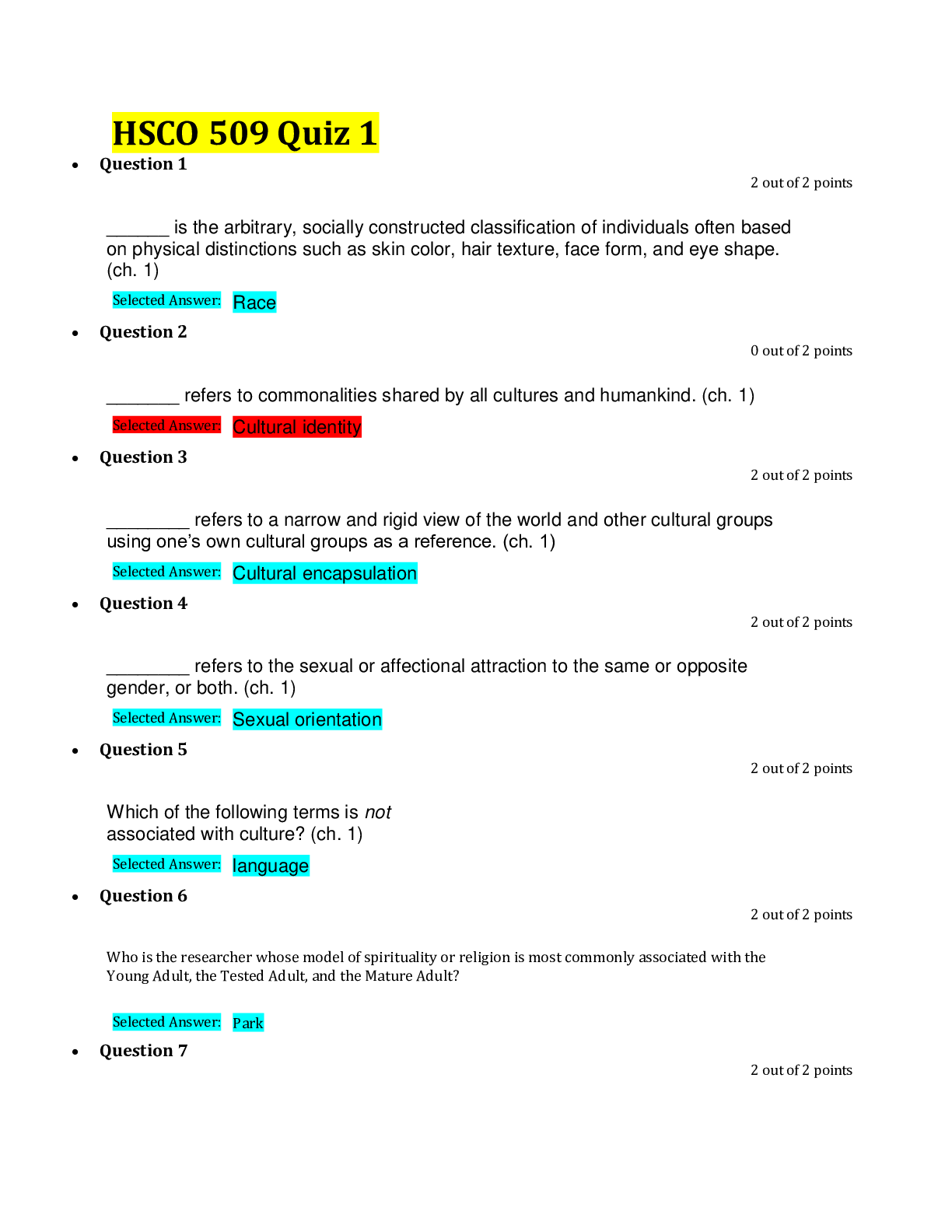
HSCO 509 Quiz 2
• Question 1
Sexism is defined as the oppression of individuals based on ________. (ch. 5)
• Question 2
All of the following were considerations called for by, among others,
...
HSCO 509 Quiz 2
• Question 1
Sexism is defined as the oppression of individuals based on ________. (ch. 5)
• Question 2
All of the following were considerations called for by, among others, the American Psychological Association when counseling females except ________. (ch. 5)
• Question 3
All of the following are part of the Three-Tier Model of Social Advocacy except (ch. 3)
• Question 4
Each of the following contributes to empowering clients at an individual except ________ (ch. 4)
• Question 5
The American Psychological Association uses the term ________ to define the prejudicial and discriminatory oppression of LGBTQI individuals. (ch. 6)
• Question 6
_______ includes overt acts of oppression. (ch. 3)
• Question 7
_________ counseling refers to counseling that recognizes the impact of oppression, privilege, and discrimination on the mental health of individuals. (ch. 3)
• Question 8
_______ is behaviors and attitudes that clients identify as beneficial in coping with stressful situations and adversity. (ch. 3)
• Question 9
The term affectional orientation allows the LGB or questioning client to identify themselves beyond their sexual behavior (ch. 6).
• Question 10
Levant and others described a complex, learned socialization pattern whereby some men may exhibit a relational style characterized by suppressing or denying their __________ (ch. 5)
• Question 11
The myth of meritocracy is the notion that all individuals, regardless of racial makeup, can succeed if they “work hard.” (ch. 4)
• Question 12
_______ is a term that has been used to describe people whose gender identities and expressions do not fit into societal norms of sex assignment (male, female) and the gender binary (man, woman). (ch. 5)
• Question 13
Transgenerational focus involves coming to understand a male client’s resistance to counseling by examining his relationships with his immediate family and with his siblings in particular. (ch. 5).
• Question 14
________ racism involves social forces, institutions, and ideologies that generate and reinforce inequalities among racial or ethnic groups. (ch. 4)
• Question 15
_______ racism or cultural racism refers to members of marginalized groups believing and accepting negative social messages about their own racial and ethnic groups. (ch. 4)
• Question 16
___________ describes the social practice of boys becoming men by not getting too close to other boys due to learned restrictive emotionality and by avoiding all feminine behavior and attitudes. (ch. 5)
• Question 17
Lee (2007) and others have suggested that establishing a social justice compass in counseling should be considered the _________ source. (ch. 3)
• Question 18
The authors equate the Defense of Marriage Act and other anti-gay marriage laws passed by states with institutional heterosexism. (ch. 6)
• Question 19
________ is a defining cultural characteristic in that individuals and groups perceive and understand each other through this socially constructed prism that will be transmitted to succeeding generations. (ch. 4)
• Question 20
The American Institute of Bisexuality identified seven variables involved in sexual orientation. Which of the following was not one of those variables? (ch. 6)
• Question 21
All of the following contribute to counselor racism except _______ (ch. 4)
• Question 22
The ACA (2014) Code of Ethics states that counselors have an ethical responsibility to continually educate themselves and to become culturally competent practitioners. (ch. 5)
• Question 23
Male privilege refers to unearned rights and societal benefits afforded to men solely based on their physical appearance. (ch. 5)
• Question 24
_________ includes acts of depriving an individual or groups an object, label, experience, or living condition and hinders physical and psychological well-being. (ch. 3)
• Question 25
Success, power, and competition (SPC) describes the degree to which men are socialized to focus on personal achievement, obtaining authority, or comparing themselves to others. (ch. 5)
[Show More]