THIS IS A TRADITIONAL & OPTIONAL ASSIGNMENT… IT MUST BE PRINTED AND COMPLETED IN INK!
Name:
Class Period:
Due Date: / /
Guided Reading & Analysis: The American Revolution and Confederation, 17
...
THIS IS A TRADITIONAL & OPTIONAL ASSIGNMENT… IT MUST BE PRINTED AND COMPLETED IN INK!
Name:
Class Period:
Due Date: / /
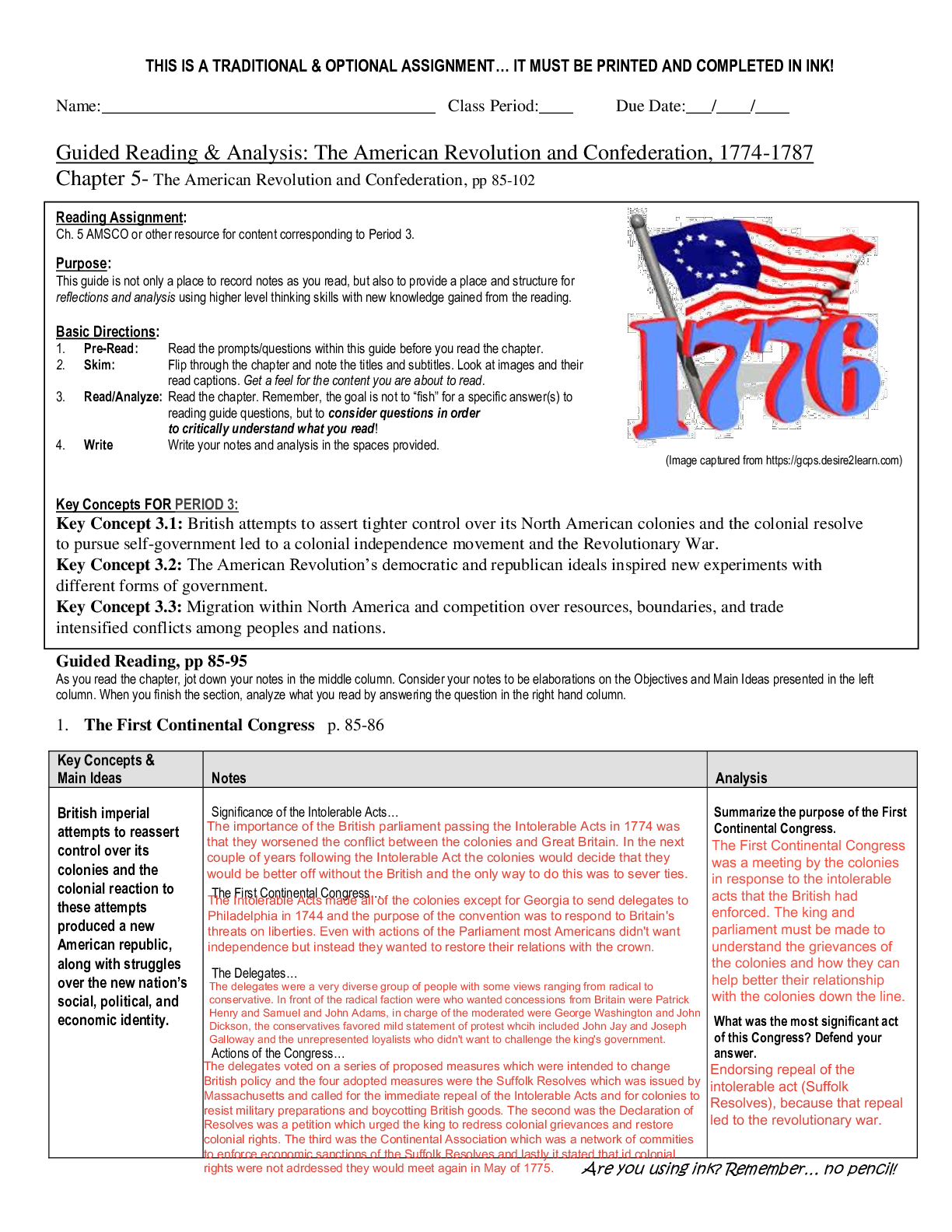
Guided Reading & Analysis: The American Revolution and Confederation, 1774-1787 Chapter 5- The American Revolution and Confederation, pp 85-102
Reading Assignment:
Ch. 5 AMSCO or other resource for content corresponding to Period 3.
Purpose:
This guide is not only a place to record notes as you read, but also to provide a place and structure for
reflections and analysis using higher level thinking skills with new knowledge gained from the reading.
Basic Directions:
1. Pre-Read: Read the prompts/questions within this guide before you read the chapter.
2. Skim: Flip through the chapter and note the titles and subtitles. Look at images and their read captions. Get a feel for the content you are about to read.
3. Read/Analyze: Read the chapter. Remember, the goal is not to “fish” for a specific answer(s) to reading guide questions, but to consider questions in order
to critically understand what you read!
4. Write Write your notes and analysis in the spaces provided.
(Image captured from https://gcps.desire2learn.com)
Key Concepts FOR PERIOD 3:
Key Concept 3.1: British attempts to assert tighter control over its North American colonies and the colonial resolve to pursue self-government led to a colonial independence movement and the Revolutionary War.
Key Concept 3.2: The American Revolution’s democratic and republican ideals inspired new experiments with different forms of government.
Key Concept 3.3: Migration within North America and competition over resources, boundaries, and trade intensified conflicts among peoples and nations.
Guided Reading, pp 85-95
As you read the chapter, jot down your notes in the middle column. Consider your notes to be elaborations on the Objectives and Main Ideas presented in the left column. When you finish the section, analyze what you read by answering the question in the right hand column.
1. The First Continental Congress p. 85-86
Key Concepts &
Main Ideas
Notes
Analysis
British imperial attempts to reassert control over its colonies and the colonial reaction to these attempts produced a new American republic, along with struggles over the new nation’s social, political, and economic identity.
Significance of the Intolerable Acts…
The First Continental Congress…
The Delegates…
Actions of the Congress…
Summarize the purpose of the First Continental Congress.
What was the most significant act of this Congress? Defend your answer.
Are you using ink? Remember… no pencil!
2. Fighting Begins, pp 86-87
Key Concepts &
Main Ideas
Notes
Analysis
During and after the imperial
Fighting Begins…
What was the chief reason for colonial discontent just prior to the first shots?
struggles of the
mid-18th
century, new
pressures began
to unite the British colonies against
perceived and Lexington and Concord…
Explain how the fighting between British troops and colonists illustrated the cultural conflict that had evolved.
real constraints
on their
economic
activities and
political rights,
sparking a
colonial
Bunker Hill…
independence
movement and
war with
Britain.
3. The Second Continental Congress, pp 87-88
Key Concepts &
Main Ideas Notes Analysis
The resulting independence movement was
fueled by established
Second Continental Congress…
What was the most significant accomplishment of the Second Continental Congress? Defend your answer.
colonial elites, as
well as by grassroots
movements that Military Actions…
included newly
mobilized laborers,
artisans, and women, and rested on
arguments over the
Peace Efforts…
rights of British subjects, the rights of the individual, and
the ideas of the What was the most powerful argument by Thomas Paine for independence? Explain your reasoning.
Enlightenment.
The colonists’ belief in the superiority of
Thomas Paine’s Argument for Independence…
republican self-
government based
on the natural rights
of the people found
its clearest American The Declaration of Independence…
expression in
Thomas Paine’s
Common Sense and
in the Declaration of
Independence.
4. The Revolutionary War, pp 88-91
Key Concepts &
Main Ideas
Notes
Analysis
Despite
The Revolutionary War…
Explain how the American Revolution
considerable was essentially a Civil War.
loyalist
opposition, as
well as Great
Britain’s Patriots….
apparently
overwhelming
military and
financial
advantages, the What was a common motivation for African Americans and American Indians
patriot cause fighting in the Revolution?
succeeded
because of the African Americans….
colonists’ greater
familiarity with Why is the Battle of Saratoga the turning
the land, their point of the war?
resilient military and political leadership, their
ideological Loyalists…. Tories…
List 4 important reasons why the British lost the war.
commitment, and
their support
1.
from European
allies. 2.
American Indians…
3.
4.
Initial American Losses and Hardships…
List 4 important provisions of the Treaty
of Paris, 1783.
1.
Alliance with France…
2.
3.
4.
Victory…
5. Organization of New Governments pp 91-93
Key Concepts & Main
Ideas
Notes
Analysis
During the 18th century, new ideas about politics and society led to debates about religion and governance, and ultimately inspired experiments with new governmental structures.
Organization of New Governments…
State Governments…
List of Rights… Separation of Powers… Voting…
Office Holding…
The Articles of Confederation…
Ratification…
Structure of Government… Powers… Accomplishments…
Problems with the Articles…
Explain how the following Colonial Era events influenced the creation of new state constitutions:
House of Burgesses:
Roger Williams Founds Rhode Island:
John Locke and other Enlightenment thinkers theorize on the relationship between man and government:
The First Great Awakening:
What was the most significant accomplishment of the AOC? Explain your reasoning.
What was the most significant weakness of the AOC? Explain your reasoning.
Many new state
constitutions and the
national Articles of
Confederation,
reflecting republican
fears of both
centralized power and
excessive popular
influence, placed
power in the hands of
the legislative branch
and maintained
property
qualifications for
voting and citizenship.
The policies of the
United States that
encouraged western
migration and the
orderly incorporation
of new territories into
the nation both
extended republican
institutions and
intensified conflicts
among American
Indians and
Europeans in the
trans-Appalachian
West.
6. Social Change, pp 93-94
Key Concepts &
Main Ideas
Notes
Analysis
Social Change…
Explain how close the new nation came to ending slavery.
Explain how close the new nation came to gender equality.
Which one came closer, racial or gender equality?
While the new
governments
continued to limit
rights to some
groups, ideas
promoting self-
government and Abolition of Church and State…
personal liberty
reverberated around
the world.
The constitutional framers postponed a Women…
solution to the
problems of slavery
and the slave trade,
setting the stage for
recurring conflicts
over these issues in
later years.
New voices for Slavery…
national identity
challenged
tendencies to cling to
regional identities,
contributing to the
emergence of
distinctly American
cultural
expressions.
7. Historical Perspectives, p. 95
Opposing Viewpoints on the “Radical” nature of the Revolution-NOTES
Analysis-Context
Crane Brinton…
Differences between American Revolution and the French and Russian Revolutions…
Divergent interpretations of the Sons of Liberty…
Similarities of Revolution to the post WWII rebellions in Africa and Asia…
Similarities between Revolution and the post WWII rebellions in Cuba and Vietnam…
American Revolution Local Context:
Broad Context:
Other Context:
(if you cannot complete this analysis, see the contextualization activity in the Writing section of your
notebook for instruction.)
Section 2: HIPP+
Historical Context:
Intended Audience:
Author’s Purpose:
Author’s Point of View:
+Other Context (Similar in Kind, In a Different Time)
Historical Context for map
(map image captured from mapssite.blogspot.com)
Significant changes in North America following the Treaty of Paris 1783:
Reading Guide written by Rebecca Richardson, Allen High School
Sources include but are not limited to: 2015 edition of AMSCO’s United States History Preparing for the Advanced Placement Examination, College Board Advanced Placement United States History Framework 2012 and 2015 versions, writing strategies developed by Mr. John P. Irish, Carroll High School, 12th edition of American Pageant, and other sources as cited in document and collected/adapted over 20 years of teaching and collaborating..
[Show More]