Quiz wk 6 TCO 7) Radicals use the term “political economy” instead of _____ to describe their critique of capitalism and the inequitable distribution of wealth among nations.
Correct!
Marxism
laissez-fai
...
Quiz wk 6 TCO 7) Radicals use the term “political economy” instead of _____ to describe their critique of capitalism and the inequitable distribution of wealth among nations.
Correct!
Marxism
laissez-faire
public choice
Keynesian
Chapter 16, page 261
Question 2
3 / 3 pts
(TCO 7) Early 20th-century European governments subscribed to _____ doctrines, generally keeping their hands away from the economy.
Correct!
classic liberal
inflationary
neoclassical
Smithian
Chapter 16, page 262
Question 3
3 / 3 pts
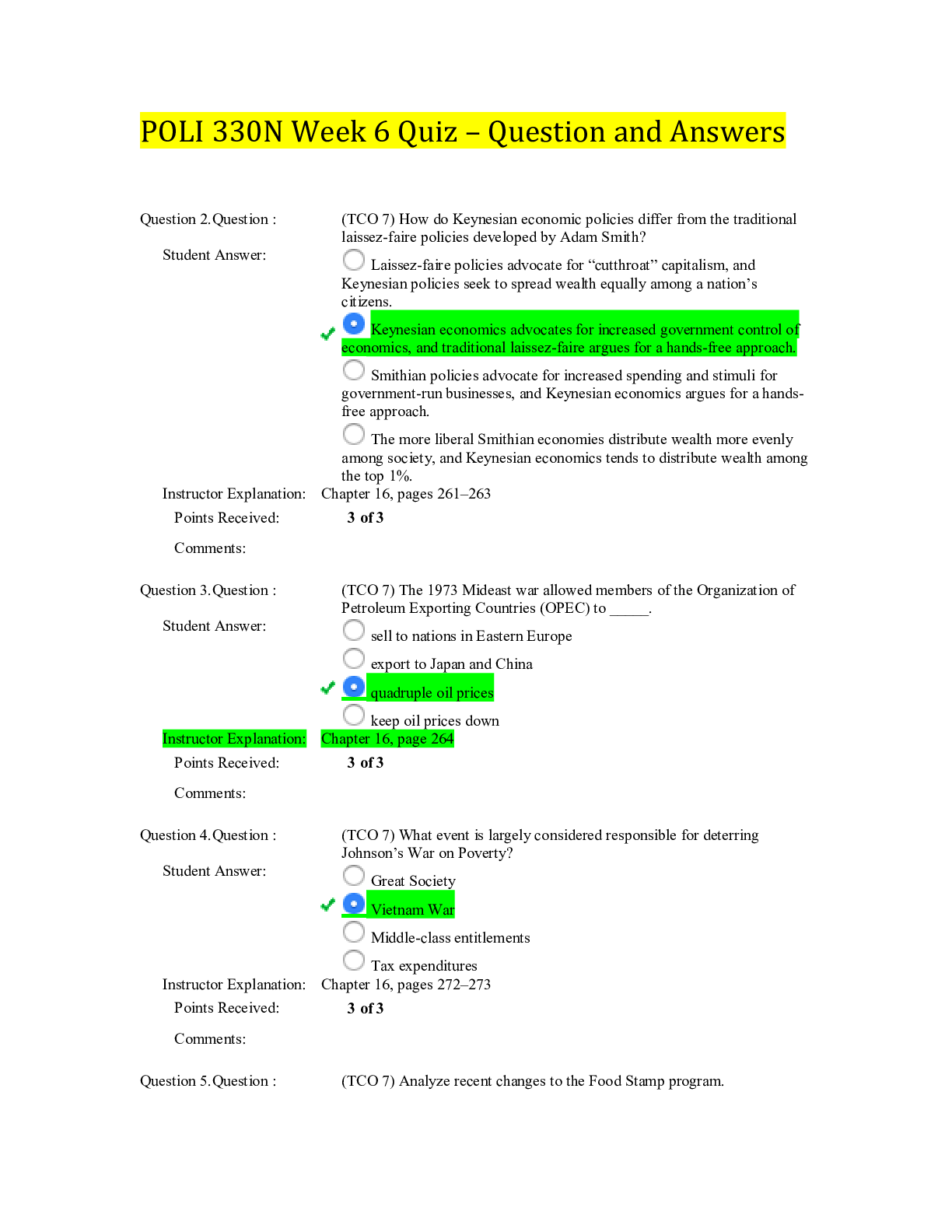
(TCO 7) The 1973 Mideast war allowed members of the Organization of Petroleum Exporting Countries (OPEC) to _____.
sell to nations in Eastern Europe
export to Japan and China
Correct!
quadruple oil prices
keep oil prices down
Chapter 16, page 264
Question 4
3 / 3 pts
(TCO 7) What event is largely considered responsible for deterring Johnson’s War on Poverty?
Great Society
Correct!
Vietnam War
Middle-class entitlements
Tax expenditures
Chapter 16, pages 272–273
Question 5
3 / 3 pts
(TCO 7) Analyze recent changes to the Food Stamp program.
The distribution of cash grants allows the program to be easily misused.
Correct!
The updated debit card system makes the program more difficult to misuse.
Many recipients sell Food Stamps for 50 cents on the dollar in order to purchase drugs and alcohol.
The program allocates surplus government dairy to the poor, ameliorating milk and cheese inflation.
Type: MC
Chapter 16, page 274
Question 6
3 / 3 pts
(TCO 7) Which of the following is an increasing financial concern of the Medicare program?
Correct!
The proportion of older people in American society is increasing steadily.
Every American citizen obtains Medicare on reaching age 65, regardless of class.
Economic inequality renders Medicare more necessary for some than for others.
Wealthy Americans are taking advantage of the Medicare system.
Chapter 16, page 274
Question 7
3 / 3 pts
(TCO 7) According to political scientist Ira Sharkansky, “All modern states are welfare states, and all welfare states are _____.”
democratic
compassionate
bureaucratic
Correct!
incoherent
Chapter 16, page 276
Question 8
3 / 3 pts
(TCO 7) How might Americans’ reluctance toward entitlement programs benefit them in the long run?
Citizens will pay lower taxes, stimulating the economy via “trickle-down” economics.
Correct!
Entitlement programs are complex and inefficient; our government will save time and money by proceeding with caution.
Americans can justify raising the debt ceiling through entitlement programs, so long as they are wary of the choices they make.
Government subsidies to businesses, rather than spending on welfare programs, will help the United States generate revenue and reduce overall spending.
Chapter 16, pages 275–276
Question 9
3 / 3 pts
(TCO 7) Most liberals feel that the poverty line is _____.
reasonable
disproportionate
too high
Correct!
too low
Chapter 16, pages 269–270
Question 10
3 / 3 pts
(TCO 7) Many conservative economists argue that some banks are _____, because they would topple the rest of the economy with them.
inherently successful
Correct!
too big to fail
destined for profit
practically invincible
Chapter 16, pages 275–276
[Show More]