United States University NURSING MSN 570 Study Guide CHAPTER
1 Cellular Biology
CHAPTER 1 Cellular Biology
B) Cellular Permeability:
Is the ability of the cell to allow passage of some
substances through the membr
...
United States University NURSING MSN 570 Study Guide CHAPTER
1 Cellular Biology
CHAPTER 1 Cellular Biology
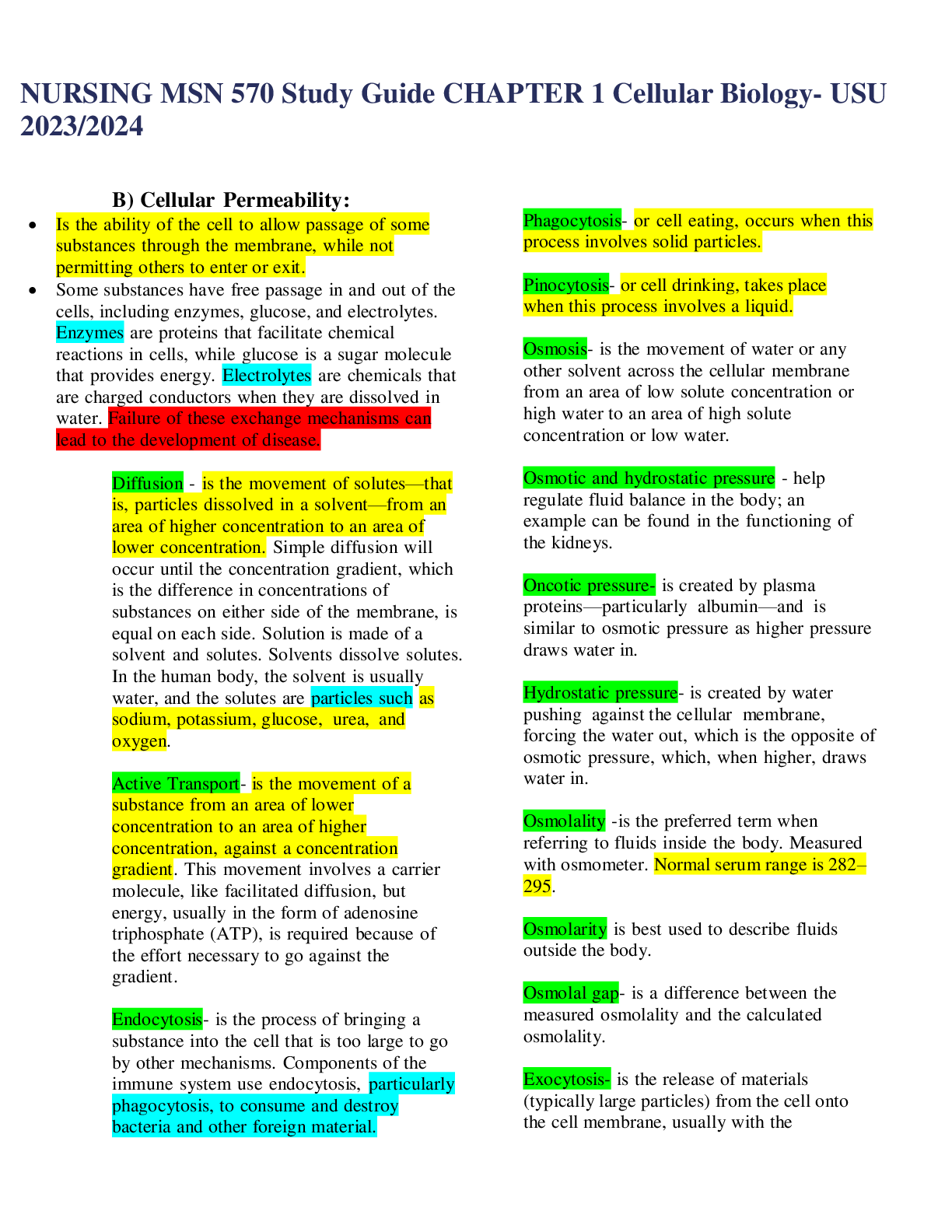
B) Cellular Permeability:
Is the ability of the cell to allow passage of some
substances through the membrane, while not
permitting others to enter or exit.
Some substances have free passage in and out of the
cells, including enzymes, glucose, and electrolytes.
Enzymes are proteins that facilitate chemical
reactions in cells, while glucose is a sugar molecule
that provides energy. Electrolytes are chemicals that
are charged conductors when they are dissolved in
water. Failure of these exchange mechanisms can
lead to the development of disease.
Diffusion - is the movement of solutes—that
is, particles dissolved in a solvent—from an
area of higher concentration to an area of
lower concentration. Simple diffusion will
occur until the concentration gradient, which
is the difference in concentrations of
substances on either side of the membrane, is
equal on each side. Solution is made of a
solvent and solutes. Solvents dissolve solutes.
In the human body, the solvent is usually
water, and the solutes are particles such as
sodium, potassium, glucose, urea, and
oxygen.
Active Transport- is the movement of a
substance from an area of lower
concentration to an area of higher
concentration, against a concentration
gradient. This movement involves a carrier
molecule, like facilitated diffusion, but
energy, usually in the form of adenosine
triphosphate (ATP), is required because of
the effort necessary to go against the
gradient.
Endocytosis- is the process of bringing a
substance into the cell that is too large to go
by other mechanisms. Components of the
immune system use endocytosis, particularly
phagocytosis, to consume and destroy
bacteria and other foreign material.
Phagocytosis- or cell eating, occurs when this
process involves solid particles.
Pinocytosis- or cell drinking, takes place
when this process involves a liquid.
Osmosis- is the movement of water or any
other solvent across the cellular membrane
from an area of low solute concentration or
high water to an area of high solute
concentration or low water.
Osmotic and hydrostatic pressure - help
regulate fluid balance in the body; an
example can be found in the functioning of
the kidneys.
Oncotic pressure- is created by plasma
proteins—particularly albumin—and is
similar to osmotic pressure as higher pressure
draws water in.
Hydrostatic pressure- is created by water
pushing against the cellular membrane,
forcing the water out, which is the opposite of
osmotic pressure, which, when higher, draws
water in.
Osmolality -is the preferred term when
referring to fluids inside the body. Measured
with osmometer. Normal serum range is 282–
295.
Osmolarity is best used to describe fluids
outside the body.
Osmolal gap- is a difference between the
measured osmolality and the calculated
osmolality.
Exocytosis- is the release of materials
(typically large particles) from the cell onto
the cell membrane, usually with the
[Show More]