Chamberlain College of Nursing Program Outcome #5
I did my practicum in a Family Practice and was able to incorporate the material that I have learned throughout my 7 weeks of this course. The older adult population i
...
Chamberlain College of Nursing Program Outcome #5
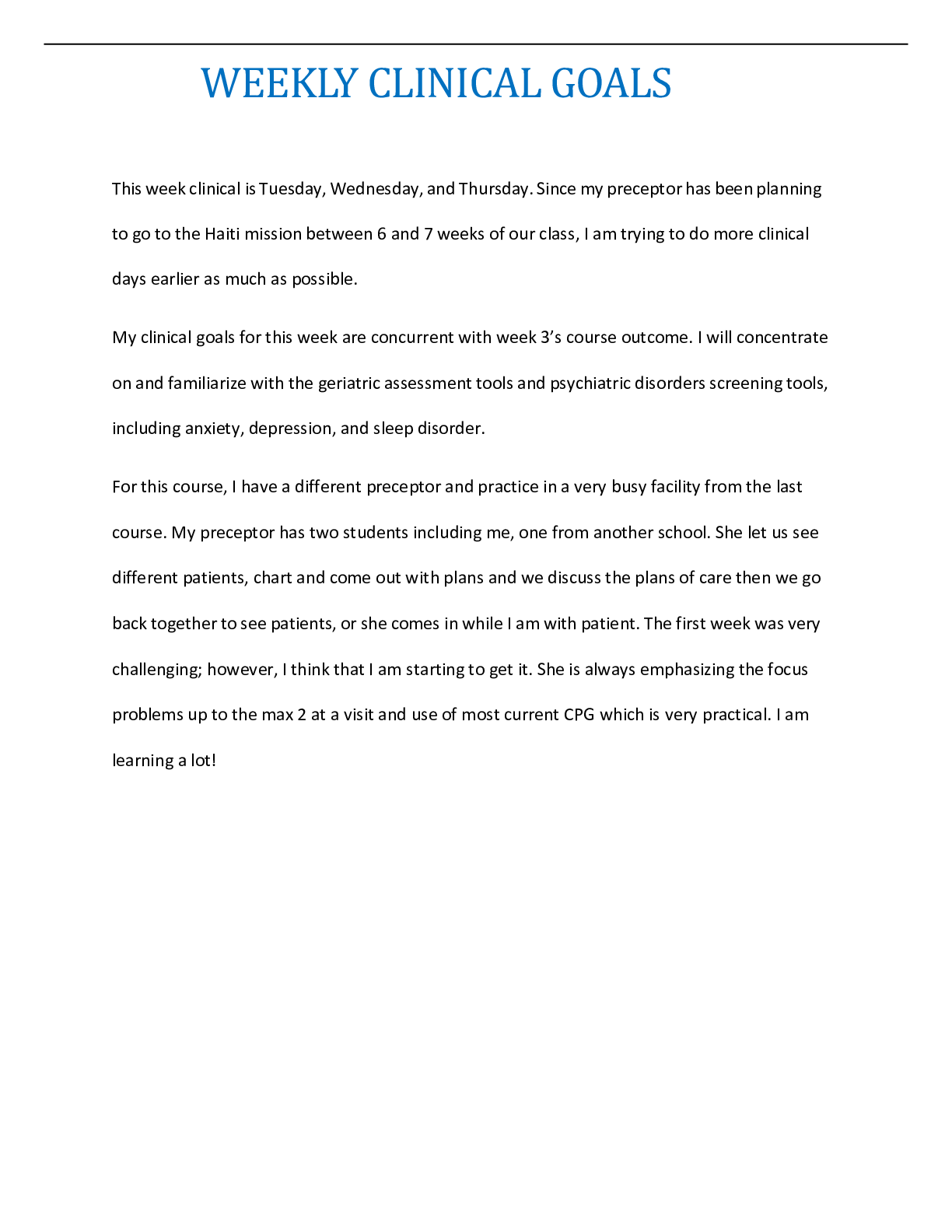
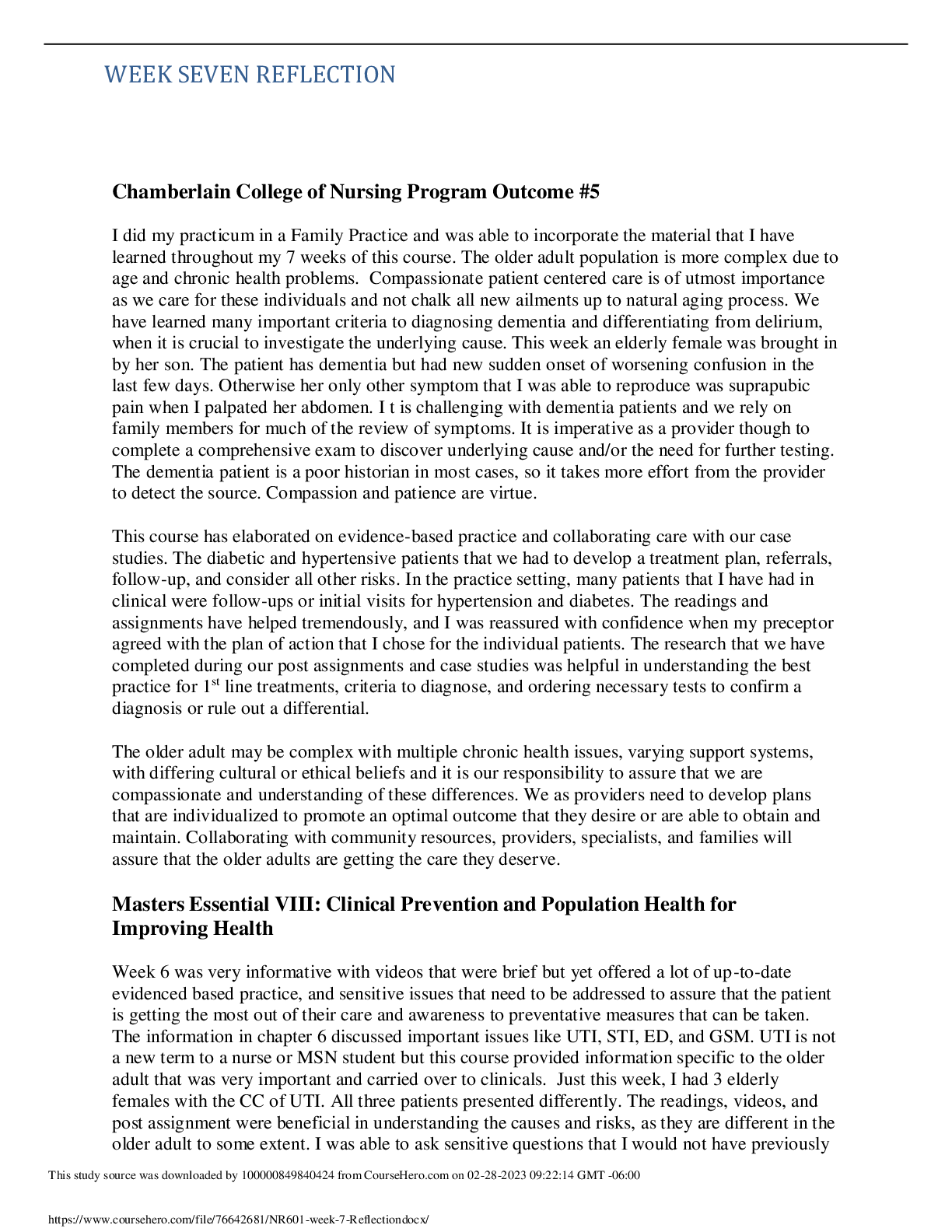
I did my practicum in a Family Practice and was able to incorporate the material that I have learned throughout my 7 weeks of this course. The older adult population is more complex due to age and chronic health problems. Compassionate patient centered care is of utmost importance as we care for these individuals and not chalk all new ailments up to natural aging process. We have learned many important criteria to diagnosing dementia and differentiating from delirium, when it is crucial to investigate the underlying cause. This week an elderly female was brought in by her son. The patient has dementia but had new sudden onset of worsening confusion in the last few days. Otherwise her only other symptom that I was able to reproduce was suprapubic pain when I palpated her abdomen. I t is challenging with dementia patients and we rely on family members for much of the review of symptoms. It is imperative as a provider though to complete a comprehensive exam to discover underlying cause and/or the need for further testing. The dementia patient is a poor historian in most cases, so it takes more effort from the provider to detect the source. Compassion and patience are virtue.
This course has elaborated on evidence-based practice and collaborating care with our case studies. The diabetic and hypertensive patients that we had to develop a treatment plan, referrals, follow-up, and consider all other risks. In the practice setting, many patients that I have had in clinical were follow-ups or initial visits for hypertension and diabetes. The readings and assignments have helped tremendously, and I was reassured with confidence when my preceptor agreed with the plan of action that I chose for the individual patients. The research that we have completed during our post assignments and case studies was helpful in understanding the best practice for 1st line treatments, criteria to diagnose, and ordering necessary tests to confirm a diagnosis or rule out a differential.
The older adult may be complex with multiple chronic health issues, varying support systems, with differing cultural or ethical beliefs and it is our responsibility to assure that we are compassionate and understanding of these differences. We as providers need to develop plans that are individualized to promote an optimal outcome that they desire or are able to obtain and maintain. Collaborating with community resources, providers, specialists, and families will assure that the older adults are getting the care they deserve.
Masters Essential VIII: Clinical Prevention and Population Health for Improving Health
Week 6 was very informative with videos that were brief but yet offered a lot of up-to-date evidenced based practice, and sensitive issues that need to be addressed to assure that the patient is getting the most out of their care and awareness to preventative measures that can be taken.
The information in chapter 6 discussed important issues like UTI, STI, ED, and GSM. UTI is not a new term to a nurse or MSN student but this course provided information specific to the older adult that was very important and carried over to clinicals. Just this week, I had 3 elderly females with the CC of UTI. All three patients presented differently. The readings, videos, and post assignment were beneficial in understanding the causes and risks, as they are different in the older adult to some extent. I was able to ask sensitive questions that I would not have previously
asked, such as sexual activity, bladder prolapse, and incontinent episodes. It is important to remember that we can not assume that an individual is or is not sexually active or that these issues are not significant as they age. Individuals may vary in the level of importance but as a provider we are obligated to review this within the systems and provide the patient the opportunity to voice concerns or ask questions. Dr. Shapiro emphasized that at least ask and provide them the opportunity to address concerns that otherwise may be ignored. The course material taught us the risk factors of ED and importance of addressing this question in order to have highest quality of life and optimal health outcomes. Once these questions are addressed it also provides an opportunity to educate, discuss preventative measures, and treatment options.
Communication with patients and families are a primary part of what we do. Last week I had a pediatric Hispanic child in for a well check. The mother was deaf and signed. We used a MARTI system to communicate with the mother to ensure that everything was understood, communicated, addressed, and provide quality care. Advancements in technology and education decrease the barriers of communication, cultural beliefs/norms, and differences in ethnicities that would otherwise hinder optimal care. This example of a communication barrier that the mother might otherwise not seek medical care for herself or children because of such barriers. Another example using evidence-based practice and how we are educated to properly research tools to make the best decision for our individual patients is the African American male that was seen in the office last week for hypertension. ACEI or a beta blocker would be 1st line pharmacological choice for HTN, but we have learned that in this situation a CCB is shown to produce better effects and commonly need to add a thiazide diuretic to achieve a target BP< 130/80 (Whelton et al., 2018).
NONPF: #8 Ethics Competencies
1. Integrates ethical principles in decision making.
2. Evaluates the ethical consequences of decisions.
3. Applies ethically sound solutions to complex issues related to individuals, populations and systems of care.
References
Whelton, P. K., Carey, R. M., Aronow, W. S., Casey, D. E., Collins, K. J., Himmelfarb, C. D., DePalma, S. M., Gidding, S., Jamerson, K. A., Jones, D. W., MacLaughlin, E. J., Muntner, P., Ovbiagele, B., Smith, S. C., Spencer, C. C., Stafford, R. S., Taler, S. J., Thomas, R. J., Williams,
K. A., Williamson, J. D., & Wright, J. T. (2018). 2017ACC/AHA/AAPA/ABC/ACPM/AGS/ APhA/ASH/ASPC/NMA/PCNA guideline for the prevention, detection, evaluation, and management of high blood pressure in adults. Journal of American College of Cariology, 71(19), e127-e248.
[Show More]


 GRADE A SOLUTION.png)