Edexcel A Level Business – Managing Business Activities Theme 2
Document Content and Description Below
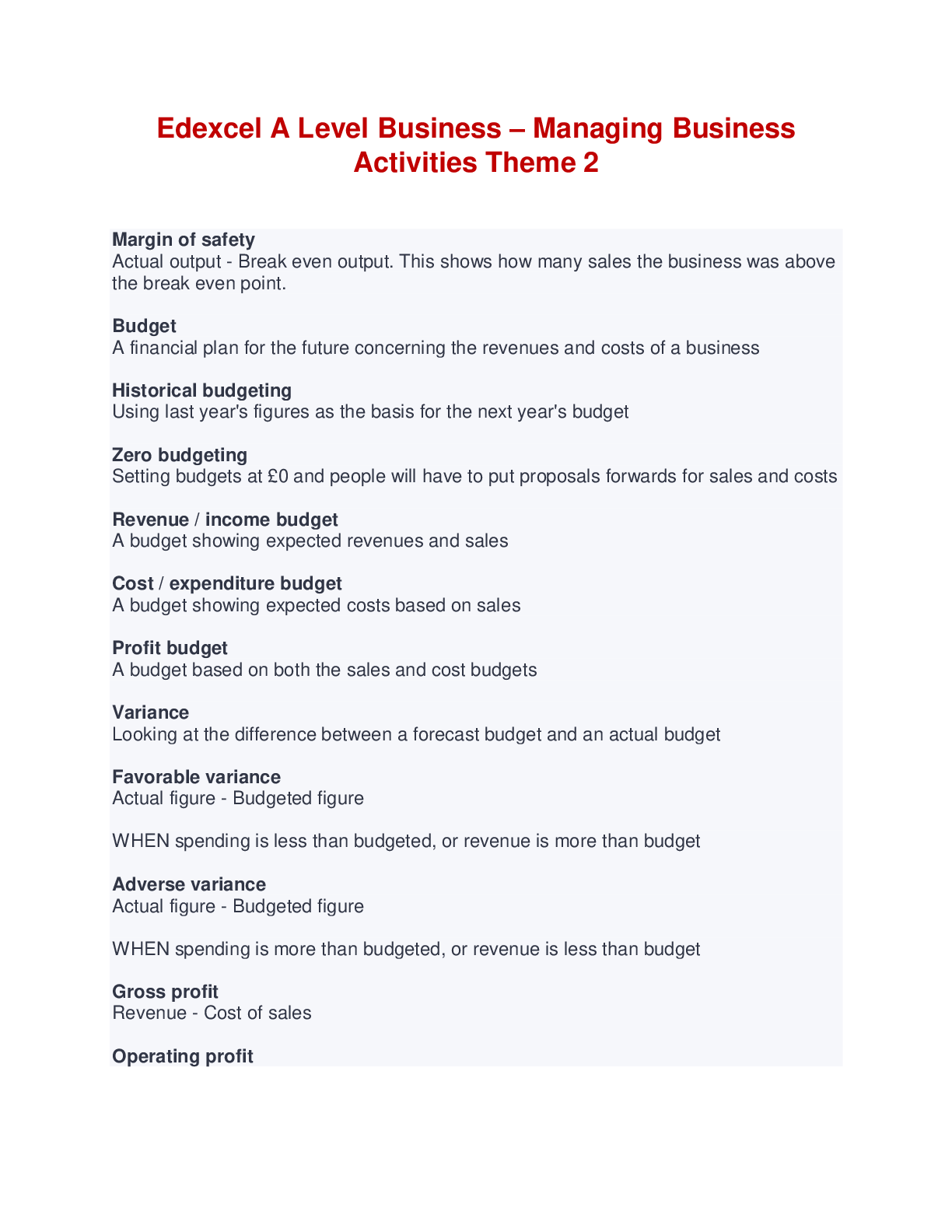
Edexcel A Level Business – Managing Business Activities Theme 2 Margin of safety Actual output - Break even output. This shows how many sales the business was above the break even point. Budget A financial plan for the
...
[Show More]
Last updated: 3 years ago
Preview 1 out of 12 pages
Instant download
Buy this Document to get the Full Access Instantly
Provided by Students Who Aced it
We Verify Document Content to Gurantee Accuracy
Reviews( 0 )
Document information
Connected school, study & course
About the document
Uploaded On
Mar 07, 2023
Number of pages
12
Written in
All

Additional information
This document has been written for:
Uploaded
Mar 07, 2023
Downloads
0
Views
132
Document Keyword Tags
Recommended For You
Get more on EXAM »

$7
24 Pages
Pearson Edexcel International Advanced Level Business Internat...

$6
24 Pages
Pearson Edexcel Level 3 GCE Business Advanced Subsidiary PAPER...

$6
24 Pages
Pearson Edexcel Level 3 GCE [Business Advanced Subsidiary PAPE...
.png)
$10
24 Pages
Pearson Edexcel Level 3 GCE 8BS0/02 2022 Business Advanced Sub...
$8
67 Pages
Pearson Edexcel AS Level 3 GCE (8BS0/02) Business Advanced Sub...
$7
17 Pages
Pearson Edexcel International Advanced Subsidiary In Business...
$19
983 Pages
Solution Manual for Canadian Income Taxation 20232024 26th Edi...
$25
211 Pages
Solution Manual for Canadian Income Taxation (2022-2023) 25th...
$22
374 Pages
Concepts in Strategic Management and Business Policy Globaliza...

$32
2186 Pages
Business Law 17th Edition Langvardt Test Bank.Answers and chea...
$29
78 Pages
Solutions Manual for Business Research Methods, 5th Edition By...
$18
334 Pages
Test Bank for Business Analytics 3rd Edition Evans | All Chapt...
More related documents below