NYSTCE Multi-Subject CST ELA,Exam
preview. 1005 Mastery, Easy Revision.
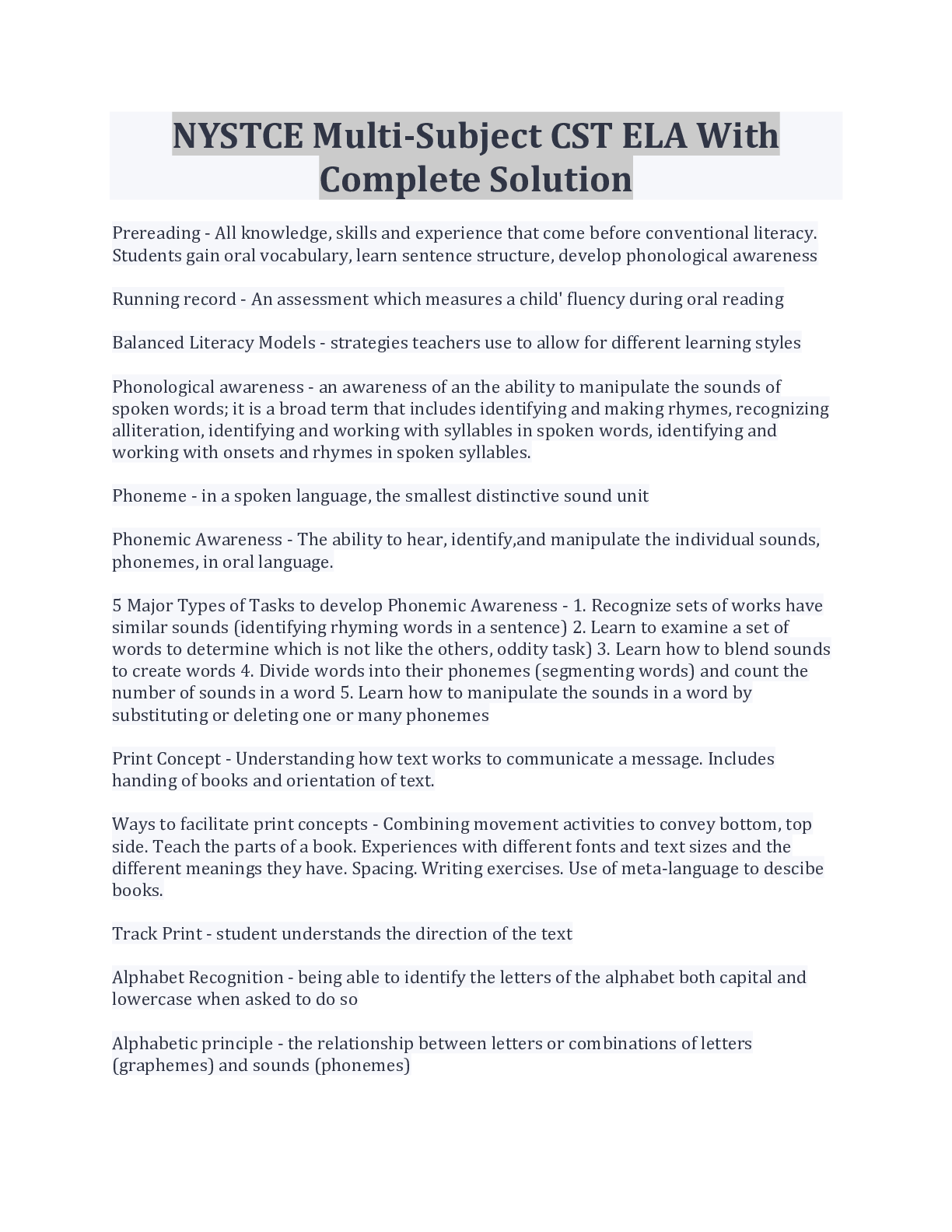
Prereading - ✔✔-All knowledge, skills and experience that come before conventional literacy. Students
gain oral vocabulary, learn sentence stru
...
NYSTCE Multi-Subject CST ELA,Exam
preview. 1005 Mastery, Easy Revision.
Prereading - ✔✔-All knowledge, skills and experience that come before conventional literacy. Students
gain oral vocabulary, learn sentence structure, develop phonological awareness
Running record - ✔✔-An assessment which measures a child' fluency during oral reading
Balanced Literacy Models - ✔✔-strategies teachers use to allow for different learning styles
Phonological awareness - ✔✔-an awareness of an the ability to manipulate the sounds of spoken words;
it is a broad term that includes identifying and making rhymes, recognizing alliteration, identifying and
working with syllables in spoken words, identifying and working with onsets and rhymes in spoken
syllables.
Phoneme - ✔✔-in a spoken language, the smallest distinctive sound unit
Phonemic Awareness - ✔✔-The ability to hear, identify,and manipulate the individual sounds,
phonemes, in oral language.
5 Major Types of Tasks to develop Phonemic Awareness - ✔✔-1. Recognize sets of works have similar
sounds (identifying rhyming words in a sentence) 2. Learn to examine a set of words to determine which
is not like the others, oddity task) 3. Learn how to blend sounds to create words 4. Divide words into
their phonemes (segmenting words) and count the number of sounds in a word 5. Learn how to
manipulate the sounds in a word by substituting or deleting one or many phonemes
Print Concept - ✔✔-Understanding how text works to communicate a message. Includes handing of
books and orientation of text.
Ways to facilitate print concepts - ✔✔-Combining movement activities to convey bottom, top side.
Teach the parts of a book. Experiences with different fonts and text sizes and the different meanings
they have. Spacing. Writing exercises. Use of meta-language to descibe books.
Track Print - ✔✔-student understands the direction of the text
Alphabet Recognition - ✔✔-being able to identify the letters of the alphabet both capital and lowercase
when asked to do so
Alphabetic principle - ✔✔-the relationship between letters or combinations of letters (graphemes) and
sounds (phonemes)
Letter-sound correspondence - ✔✔-refers to the identification of sounds associated with individual
letters and letter combination.
Short Vowel sounds - ✔✔-every vowel has two sounds, the vocal cords are more relaxed when
producing the short vowel sound because of this the sounds are often referred to as lax. They can be
heard at the beginning of these words: apple, Ed, igloo, octopus, and umbrella.
Digraph - ✔✔-n. A union of two characters representing a single sound.
Diphthong - ✔✔-n. The sound produced by combining two vowels in to a single syllable or running
together the sounds.
CVC - ✔✔-consonant-vowel-consonant pattern which produces a short vowel sound or a closed syllable.
Consonant Clusters - ✔✔-- also called blends
- Consonants that occur side by side within the same
syllable.
-No intervening vowel sound
Phonics - ✔✔-teaching reading by training beginners to associate letters with their sound values
Phonograms - ✔✔-Often called word families, these end in high frequency rimes that vary only in the
beginning consonant sound to make a word. For example, back, sack, black and track.
Onset - ✔✔-the part of a syllable (or the one-syllable word) that comes before the vowel (e.g., str in
string)
Rime - ✔✔-The vowel and the ending consonants after the onset
Semantic Cues - ✔✔-Use of knowledge about the subject of the text and words associated with that
subject to identify an unknown word within a text: meaning cues from each sentence and the evolving
whole.
Children use their prior knowledge, sense of the story, and pictures to support their predicting and
confirming the meaning of the text.
Syntactic Cues - ✔✔-hints that rely on language structure or rules (sometimes called grammatical cues)
Grammatical information in a text that readers process to construct meaning.
Content clues - ✔✔-surrounding words that help you figure out the meaning of unfamiliar words
Syllabication - ✔✔-the ability to conceptualize and separate words into their basic pronunciation
components.
word structure - ✔✔-The way in which the parts of a word are arranged together-used to determine a
word's meaning
syllabication rules - ✔✔-rules for forming/dividing words into syllables
syllabication rules - ✔✔-. To find the number of syllables:Count the number of vowels (a, e, i, o, u and
sometimes y) Subtract any silent vowels (vowel, consonant, -e) Subtract one vowel from every
diphthong.(when two vowels go walking the first one does the talking)Divide between two double
consonants. Never split between digraphs.Usually divide before a single middle consonant.Divide before
the consonant before -le syllable.Divide off any compound words, prefixes, suffixes and root which have
vowel sounds.
ALL syllables have a vowel
compound words - ✔✔-Two or more words combined to create a new word.
prefix - ✔✔-a syllable or word that comes before a root word to change its meaning
Suffix - ✔✔-a group of letters placed at the end of a word to change its meaning
Inflectional suffixes - ✔✔-Indicate possession, gender, number in nouns, tense, voice, person & number
& mood in verbs, and comparison in adjectives; do not change the part of speech of the base. (-ed, -ing)
Sight-word recognition - ✔✔-1. a word that is immediately recognized as a whole and does not require
word analysis for identification. 2. a word taught as a whole. Note: Words that are phonically irregular or
are important to learn before students have the skills to decode them are often taught as sight words.
Dolch List - ✔✔-A list of frequently used words compiled by Edward William Dolch, PhD, a major
proponent of the "whole-word" method of beginning reading instruction. Goes up to 3rd grade
Reading Fluency - ✔✔-ability to decode words quickly and accurately in order to read text with
appropriate word stress, pitch, and intonation pattern (prosody)..
This skill requires automacity of word recognition and reading with prosody to facilitate comprehension.
Vocabulary - ✔✔-a language user's knowledge of words. Important in Prereading activities. Use graphic
organizers and word webs to introduce and review
domain-Specific vocabulary words - ✔✔-Teacher discusses these when reading nonfiction in order to
develop content clues
Visual Clues - ✔✔-helps students construct meaning from unfamiliar text
Context clues - ✔✔-Clues in surrounding text that help the reader determine the meaning of an
unknown word.
Picture walk - ✔✔-A visual clues strategy. Before reading a picture book, teacher invites students to look
at the pictures and try to form an idea about the story. After text is read, discuss the predictions and
how they compared to the actual text
Cloze exercise - ✔✔-A context clues strategy. An activity in which students replace words that have been
deleted from a text.
Prior Knowledge - ✔✔-learner's preexisting attitudes, experiences, and knowledge:
Schema - ✔✔-an internal representation of the world. Needs to be activated before learning something
new. K-W-L charts are examples. Field trips and hands-on experiences help to increase prior knowledge.
Think-aloud - ✔✔-A modeling activity in which the teacher verbalizes the teacher's thoughts while
reading; used to model ways in which skilled readers make predictions, use visualization, related prior
knowledge, and monitor and self-correct their comprehensions.
Literal comprehension - ✔✔-refers to the understanding of information that is explicitly stated in a
written passage. (main idea, sequence of events, knowledge of vocabulary, details and cause-effect
patterns)
Identifying the sequence of events - ✔✔-When a student can recognize the order that actions or ideas
occurred in a text and then recall them in chronological order. Words such as now, before, first,
following and since are important.
Story walk - ✔✔-teacher walks through story, pointing out order of events as they happened
Story map - ✔✔-A graphic organizer of major events and ideas from a story to help guide students'
thinking and heighten their awareness of the structure of stories. The teacher can model this process by
filling out a chart on an overhead while reading. Or students can complete a chart individually or in
groups after a story is read, illustrating or noting characters, setting, compare/contrast,
problem/solution, climax, conflict, and so forth.
identifying the main idea - ✔✔-Finding the topic or subject of a text (what the text is mostly about)
Look at the details that the author uses to clarify his or her topic
Topic Sentence - ✔✔-states the main idea of the text; what the paper will be about. In nonfiction, it is
often stated directly in the text. To find the central idea in a story requires higher-level thinking skills
Details - ✔✔-pieces of information that support or tell more about the main idea. Uses words like who,
what, where, when , how and why to identify main ideas. News articles are good for practicing.
cause-and-effect - ✔✔-determining the reason something happens as well as the result of that cause;
the cause happens first and the event happens after; events in a plot are often connected by cause and
effect. Teachers can elicit information from students by asking questions such as "what made the
character do what he did?"
Inferential Comprehension Skills - ✔✔-skills that assist students to make connections to new info in
texts by drawing conclusions, determining relationships, conceptualizing implied ideas. Reading in
between the lines. Making inferences requires several reading behaviors: recognizing a pronoun's
antecedent, learning unknown words from context clues, identifying bias, etc...
concluding - ✔✔-Drawing together the main ideas of something and restating them in a succinct way.
generalizing - ✔✔-about a characters beliefs, motivations and relationships. , Draw or state a general
conclusion from a number or items or instances, making a statement about what several people or
things have in common, finding and extending patterns.
Inferences - ✔✔-conclusions that a reader draws based on clues in the story and his/her own knowledge
Ways to model making inferences - ✔✔-think-alouds, referents, asking questions that are often "Think
and Search". Write down a sequence of events from the story line and ask students to script the missing
pieces using what they know about characters, setting and other related clues. Students can read their
own sentences and look for referents, context clues and details of events
referents - ✔✔-the objects, events, ideas, or relationships referred to by the words
Fact - ✔✔-Something that can be proven
Opinion - ✔✔-something that is believed to be true. When used to support an argument, position is
weakened. Also revelatory of writer's bias and perspective.
Faulty reasoning - ✔✔-an argument based on stereotypes, generalizations, loaded words or opinions.
Loaded word - ✔✔-Word used to evoke very strong positive or negative attitudes toward a person,
group, or idea by using connotation
stereotypes - ✔✔-generalized beliefs about what members of an identifiable group are like that operate
as schemas when perceiving members of those groups
Bias - ✔✔-a partiality that prevents objective consideration of an issue or situation
How to uncover writer's bias - ✔✔-By asking questions about sources writer uses, use of fact or opinions
to support claim, what was left out, how they address contrary evidence or opinions. Prevents students
being easily manipulated or controlled by what they read
Schema theory - ✔✔-Students make meaning by using their previous experiences to understand new
ones. For students to comprehend and interpret their readings, teachers must help students activate
prior knowledge to help them make sense of the new information. Helps retention and comprehension
K-W-L - ✔✔-KWL ("Know", "Want to Know", "Learned") charts encourage students to use prior
knowledge and personal curiosity while researching a subject or a topic. This strategy is especially useful
in reading classes, but is also useful in plenty of other subjects, like science and social studies.
Anticipation Guides - ✔✔-comprehension strategy that is used before reading to activate students' prior
knowledge and build curiosity about a new topic. They help students make connections between new
information and prior knowledge. Used to motivate reluctant readers by stimulating their information
word sorts - ✔✔-A word-study activity in which words on cards are grouped according to designated
categories, as by spelling or vowel patterns, or meanings, etc. Helps students make sense of new
vocabulary
closed word sort - ✔✔-The teacher defines the process for categorizing the words. This requires
students to engage in critical thinking as they examine sight vocabulary, corresponding concepts, or
word structure.
open word sort - ✔✔-Students determine how to categorize the words, thereby becoming involved in
an active manipulation of words.
double-entry journal - ✔✔-A note taking strategy to improve comprehension. This is a double entry
record in which a student takes notes and adds reflections while reading any text. A two column format
is used. Typically, the left column is used to record specific statements from a test that are important to
the reader in understanding the text. The right column is used to record responses and reactions to
those statements
personal connections - ✔✔-How and why we enjoy and appreciate what we read. Help you use your
prior knowledge to understand characters, draw conclusions, make generalizations, inferences and
understand cause and effect relationships.
T-S - ✔✔-Text-Self. Part of a code students use to highlight passages they personally relate to
code - ✔✔-notes made on the reading that highlight passages that "speak" to them personally
GRTA - ✔✔-Guided reading-thinking activities that offer support by engaging students in the reading
and improving comprehension of narrative text. They teach how to make predictions, focus their
reading on confirming or disproving, adjustments in thinking. A cycle. A form of scaffolding that will be
removed once the process is internalized
SQ3R - ✔✔-a study method incorporating five steps: survey, question, read, rehearse, review
survey - ✔✔-a brief first look at the text to look for clues to its organization. Bold and italic words, titles
and subtitles are noted and used to organize students notes as they read
Question - ✔✔-Students turn titles found during survey into 5wh questions
Read - ✔✔-As students read, they use the text to answer their questions
Review - ✔✔-Students review their notes until they are familiar with the information
Recite - ✔✔-When students can recall the information they have learned from what they have read
Cornel Notes Method - ✔✔-Left side is for recording main idea, Right side is for details about the main
ideas, bottom = summary
Discuss - ✔✔-After reading, students should be encouraged to to discuss the reading. Three ways a
teacher can help include literature circles, Socratic seminars and fishbowls
Literature Circles - ✔✔-small groups who read and discuss same materials together (facilitator,
connector, summarizer, vocabulary master, illustrator) Teachers provide role sheets but do not direct
discussion
Paideia Seminars - ✔✔-Works best with older students. Conversations about text rick in ideas meant to
improve abstract thinking and problem-solving skills. Collaborative work using many different skills.
Works with open ended questions
Think-aloud benefits - ✔✔-Students who understand their own reading behavior are more likely to
recognize when they do not understand what they are reading and to adjust using various reading
comprehension strategies. Can be done with partner who takes notes, can be done alone with sheet
filled out after, can be used by teacher to assess students reading habits.
Say Something - ✔✔-A during reading activity that helps students monitor their reading comprehension.
In small groups students take turns reading and commenting on text. Shared observations help students
get meaning from tex
[Show More]