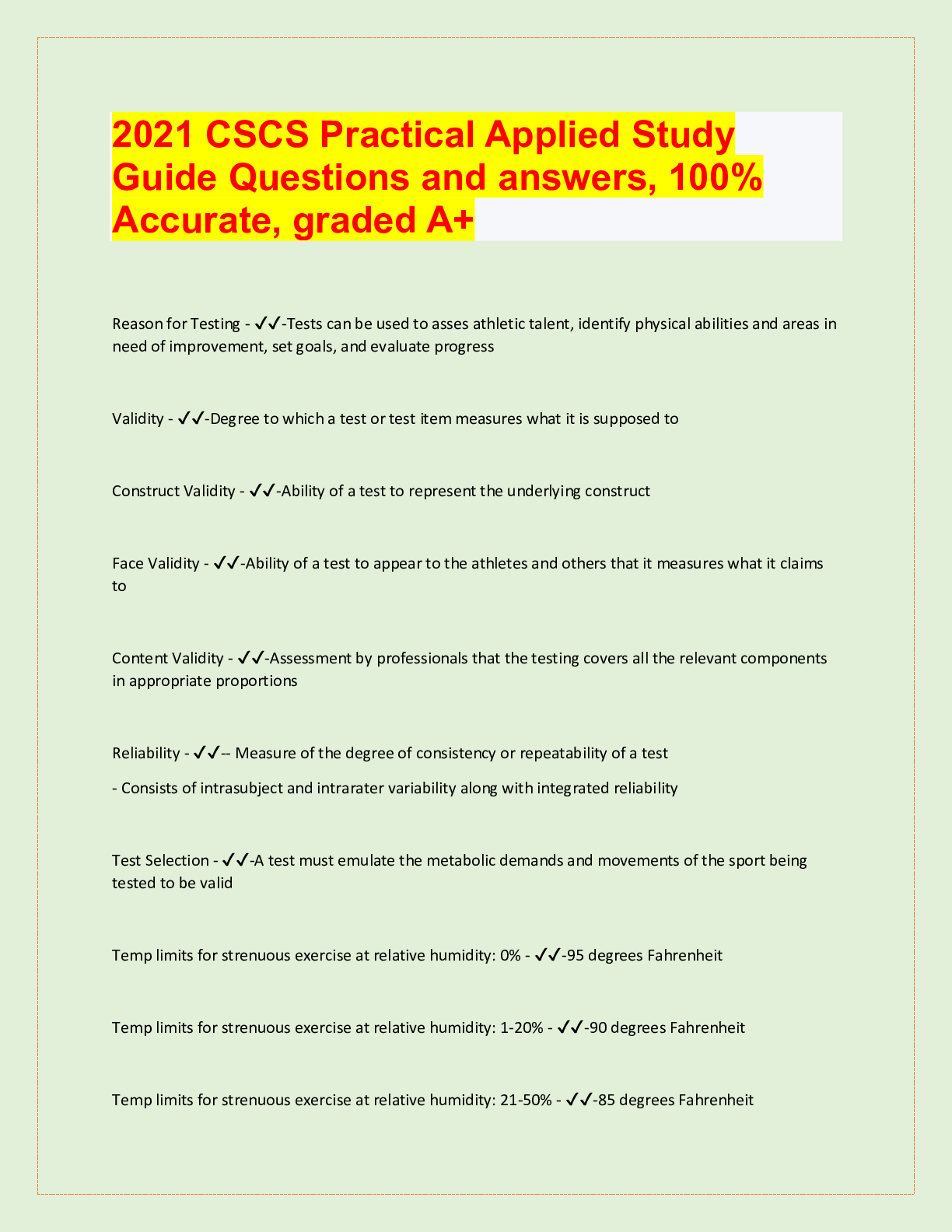
2021 CSCS Practical Applied Study
Guide Questions and answers, 100%
Accurate, graded A+
Reason for Testing - ✔✔-Tests can be used to asses athletic talent, identify physical abilities and areas in
need of improvem
...
2021 CSCS Practical Applied Study
Guide Questions and answers, 100%
Accurate, graded A+
Reason for Testing - ✔✔-Tests can be used to asses athletic talent, identify physical abilities and areas in
need of improvement, set goals, and evaluate progress
Validity - ✔✔-Degree to which a test or test item measures what it is supposed to
Construct Validity - ✔✔-Ability of a test to represent the underlying construct
Face Validity - ✔✔-Ability of a test to appear to the athletes and others that it measures what it claims
to
Content Validity - ✔✔-Assessment by professionals that the testing covers all the relevant components
in appropriate proportions
Reliability - ✔✔-- Measure of the degree of consistency or repeatability of a test
- Consists of intrasubject and intrarater variability along with integrated reliability
Test Selection - ✔✔-A test must emulate the metabolic demands and movements of the sport being
tested to be valid
Temp limits for strenuous exercise at relative humidity: 0% - ✔✔-95 degrees Fahrenheit
Temp limits for strenuous exercise at relative humidity: 1-20% - ✔✔-90 degrees Fahrenheit
Temp limits for strenuous exercise at relative humidity: 21-50% - ✔✔-85 degrees Fahrenheit
Temp limits for strenuous exercise at relative humidity: 51-90% - ✔✔-80 degrees Fahrenheit
Temp limits for strenuous exercise at relative humidity: 91-100% - ✔✔-75 degrees Fahrenheit
Rest time between test trials far from max - ✔✔-At least 2 minutes
Rest time between test trials close to max - ✔✔-At least 3 minutes
Rest time between tests for a Test battery - ✔✔-At least 5 minutes
Logical Testing Sequence - ✔✔-1. Nonfatiguing
2. Agility
3. Max power and strength
4. Sprint
5. Local muscular endurance
6. Fatiguing anaerobic capacity
7. Aerobic capacity
General and Specific warm-ups before a test - ✔✔-Have the capability of increasing a test's reliability
Policies - ✔✔-A facility's rules and regulations
Procedures - ✔✔-Describes how policies are met or carried out
Litigation - ✔✔-Process of taking legal action
Mission Statement - ✔✔-Organization's statement of purpose
Program Goals - ✔✔-The desired end products of a strength and conditioning program
Program Objectives - ✔✔-Specific means of attaining program goals
Risk Management - ✔✔-Employment of strategies to decrease and control the risk of injury from
athletic participation and therefore the risk of liability exposure
Medical Clearance - ✔✔-The first step before an athlete is allowed to access a strength and conditioning
facility
Jr. High Professional to Participant Ratio - ✔✔-1:10
High School Professional to Participant Ratio - ✔✔-1:15
Collegiate Professional to Participant Ratio - ✔✔-1:20
Emergency Planning and Response for Life-threatening situations - ✔✔-1: Call 911
2: Do not move victim
3: If victim is conscious, ask permission to administer first aid
4: Administer CPR or AED if necessary
5: Stay with victim until help arrives
6: Activate the emergency communication plan to notify appropriate parties
7: Document incident on injury report
Emergency Planning and Response for Environmental situations - ✔✔-1: Activate the appropriate alarm
and get everyone directed to a predetermined safe location
2: Call 911 for medical help if necessary
3: Account for all parties and notify rescue personnel
4: Activate the emergency communication plan to notify appropriate parties
5: Document incident on injury report
Emergency Planning and Response for non-life-threatening situations - ✔✔-1: Provide first aid
2: Call 911 for medical help if necessary
3: Activate the emergency communication plan to notify appropriate parties
4: Document incident on injury report
Predesign Phase - ✔✔-The first step in building a new facility
Consists of Needs Analysis, Master Plan, and Feasibility Study
Needs Analysis - ✔✔-Process in which the designers and oppress collaborate and determine the needs
of the athletic program
Feasibility Study - ✔✔-Analyzes strengths, weaknesses, opportunities, and threats (SWOT analysis)
Goal is to ensure that the financial investment will yield a viable and sustainable return
Master Plan - ✔✔-General plan for all phases of the new facility
Design Phase - ✔✔-Second step in the process of building a new facility
Consists of finalizing committee and creating blueprint
Construction Phase - ✔✔-Time frame from the beginning to end of construction fo the new facility
Longest phase of the process
Preoperation Phase - ✔✔-Final steps before facility can open, includes finishing the interior decor and
hiring staff
First Steps of Remodeling Existing Facility - ✔✔-Form committee, feasibility study, and needs analysis
Second Steps of Remodeling Existing Facility - ✔✔-Create operational plan, remodel/upgrade, and
finalize design and decorations
Third Steps of Remodeling Existing Facility - ✔✔-Arrange equipment, create employee duties and
schedule, and hire/keep staff
Recommended Minimum Space per Athlete - ✔✔-100 sq. ft. per participant
Minimum Floor Load-bearing Capacity - ✔✔-Load-bearing capacity of at least 100lbs/sq. ft.
Ramp or Lift required - ✔✔-When there is a change in height of at least 1/2inch
Ramp length to height requirement - ✔✔-For every 1inch in height need 12inch in length
Ceiling height recommendation - ✔✔-At least 12 to 14 feet tall
Most common flooring - ✔✔-Rubber flooring and anti-fungal carpet
Indoor Turf - ✔✔-Flooring that is useful for plyometrics, agility, conditioning, ground-based movements,
and sled pushes
Lumen recommendation for Facility lighting - ✔✔-50 to 100 lumens
Basic Temperature Range for Facility - ✔✔-68 degrees F to 78 degrees F
Optimal Temperature Range for Facility - ✔✔-72 degrees F to 78 degrees F
Relative Humidity for Facility - ✔✔-Should not exceed 60%
Air Exchange Ratio for Facility - ✔✔-Air Exchanged 8 to 12 times per hour
Fan recommendation for Facility - ✔✔-2 to 4 fans for every 1200sq. ft.
Recommendation for sounds made by facility - ✔✔-Should not exceed 90 decibels
Mirror Guidelines for Facility - ✔✔-6 inches from equipment
20 inches from floor
Tall Machines - ✔✔-Should be bolted to floor or a column to prevent from tipping
Minimum Distance of 36 inches - ✔✔-Between Dumbbells/Barbells and other Dumbbells/Barbells
Between weight trees and racks
Space around racks
Space Recommended for Warm-up/Stretching Area - ✔✔-49sq. ft. of space
Circuit training machine/area recommendations - ✔✔-24 to 36 inches between machines
4 to 7 ft wide walkways
Recommended space between Racks and Platforms - ✔✔-3 to 4 feet of space betweeb
Bikes and Stair Steppers Space Requirements - ✔✔-24sq. ft.
Skiers Space Requirements - ✔✔-6sq. ft.
Rowers Space Requirements - ✔✔-40sq. ft.
Treadmills Space Requirements - ✔✔-45sq. ft.
Nonfunctional Equipment - ✔✔-Should be labeled with "Out of Order" sign
Equipment that will take a while to fix - ✔✔-Should be removed from the floor and placed in storage
Team Physician - ✔✔-Provides medical care to an organization, school, or team
Team Physician Specific Responsibilities - ✔✔-Pre-participation Examination
On-field emergency care
Evaluation and Diagnosis
Athletic Trainer - ✔✔-Responsible for the day-to-day physical health of the athlete
Athletic Trainer Specific Responsibilities - ✔✔-Management and Rehab of injuries
Prevention of injuries through prescription of sport specific exercises and taping/bracing
Physical Therapist - ✔✔-May help develop specific treatment strategies or manage long-term
rehabilitation
Strength and Conditioning Professional - ✔✔-Typically focuses on strength, power and performance
enhancement
Specialized Members of Sports Medicine Team - ✔✔-Exercise Physiologist
Nutritionist
Counselor
Principles of Rehabilitation and Reconditioning - ✔✔--Healing tissues must not be overstressed.
-The athlete must fulfill specific criteria to progress from one phase to another
-The rehabilitation program must be based on current clinical and scientific research.
-The program must be adaptable to each individual and his or her specific requirements and goals.
-Rehabilitation is a team-oriented process
Indication - ✔✔-Form of treatment required by the rehabilitating athlete
Contraindication - ✔✔-Activity prohibited due to injury
Macrotrauma - ✔✔-A specific, sudden episode of overload injury to a given tissue
Contusion or Fracture - ✔✔-Trauma to a bone
Joint Trauma - ✔✔-Leads to joint laxity or instability
Dislocation - ✔✔-Complete displacement of joint surfaces
Subluxation - ✔✔-Partial displacement of joint surfaces
Ligament Trauma - ✔✔-Sprain
Sprain 1st Degree - ✔✔-Partial tear with no change in joint instability
Sprain 2nd Degree - ✔✔-Partial tear with minor instability
Sprain 3rd Degree - ✔✔-Complete tear with full instability
Musculotendinous Trauma - ✔✔-Contusion or Strain of the muscle
Contusion - ✔✔-Direct trauma
Pooling of blood or fluid in tissues surrounding muscle
Strain - ✔✔-Indirect trauma
Tears of individual muscle fibers
Strain 1st Degree - ✔✔-Partial tear with strong painful muscle activity
Strain 2nd Degree - ✔✔-Partial tear with weak painful muscle activity
Strain 3rd Degree - ✔✔-Complete tear with very weak painless muscle activity
Microtrauma - ✔✔-overuse injury; results from repeated, abnormal stress applied to a tissue by
continuous training or training with too little recovery time
Inflammatory Response Phase (IRP) - ✔✔-Pain, Swelling, and Redness
Typically lasts less than one week
IRP ——> FRP - ✔✔-Decreased collagen synthesis
Increased number of inflammatory cells
Fibroblastic Repair Phase (FRP) - ✔✔-Collagen fiber production
Typically lasts up to two months
FRP ——> MRP - ✔✔-Decreased collagen fiber organization
Decreased number of inflammatory cells
Maturation-Remodeling Phase (MRP) - ✔✔-Proper collagen fiber alignment
Increased tissue strength
Can last months to years
Edema - ✔✔-Inhibits contractile tissues
Can significantly limit function
Type III Collagen Fibers - ✔✔-Produced during FR
[Show More]