ACSM Certified Exercise Physiologist,
Questions with accurate answers, 100%
ACCURATE.
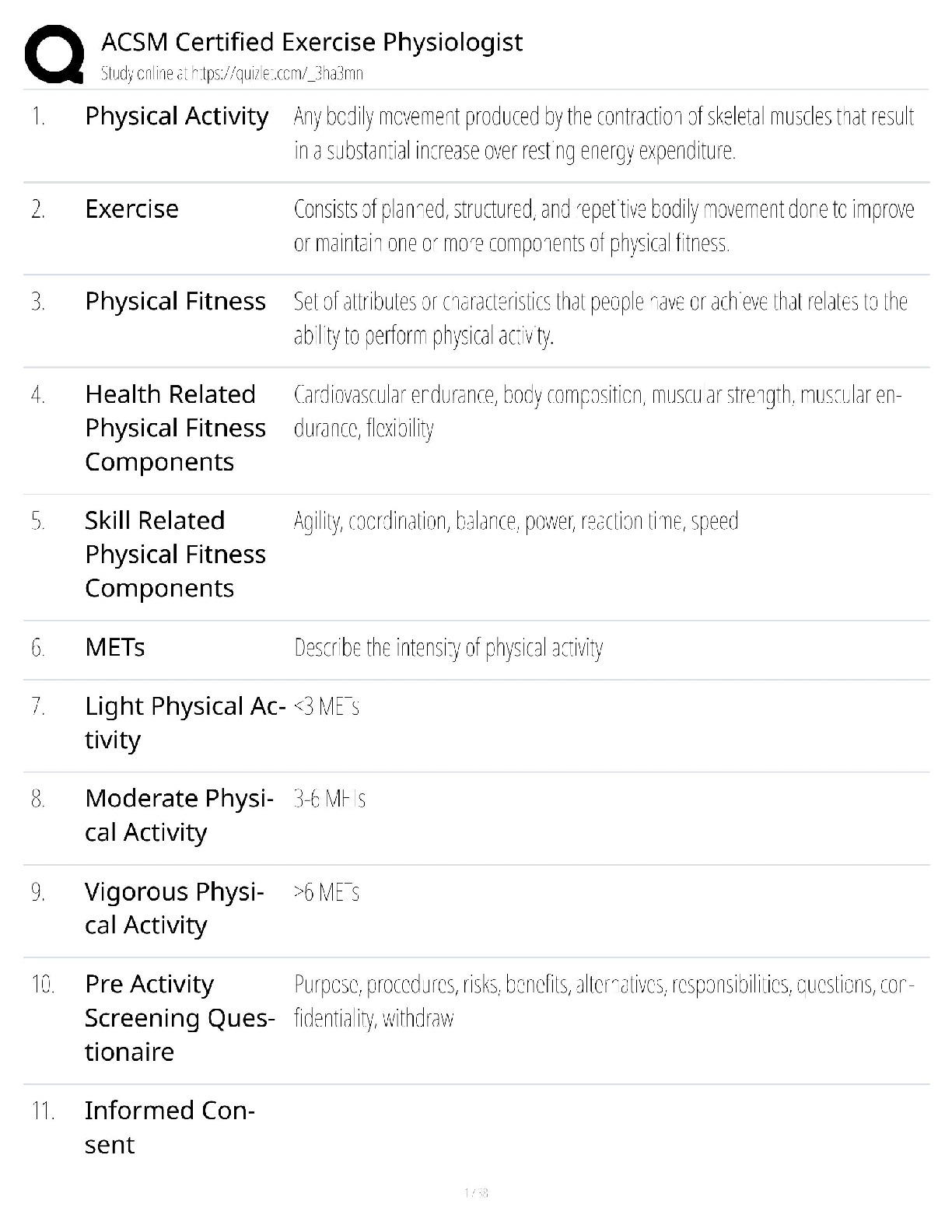
Pre-activity screening procedures and tools that provide accurate information about the individual's
health/medical history, cu
...
ACSM Certified Exercise Physiologist,
Questions with accurate answers, 100%
ACCURATE.
Pre-activity screening procedures and tools that provide accurate information about the individual's
health/medical history, current medical conditions, risk factors, signs/symptoms of disease, current
physical activity habits, and medications - ✔✔-1. Self-guided methods such as the Physical Activity
Readiness Questionnaire (PAR-Q) or the modified AHA/ACSM Health/Fitness Facility Preparticipation
Screening Questionnaire.
2. CVD risk factor assessment and classification by qualified health/fitness, clinical exercise, or health
care professionals
3. Medical evaluation including a physical examination and stress test by a qualified health care
provider.
The key components included in informed consent and health/medical history - ✔✔-Informed Consent:
1. Purpose and explanation of the test
2. Attendant risks and discomforts
3. Responsibilities of the participant
4. Benefits to be expected
5. Inquiries
6. Use of medical records
7. Freedom of consent
Health/Medical History:
1. Medical diagnosis
2. Previous physical examination findings
3. History of symptoms
4. Recent illness, hospitalization, new medical diagnosis, or surgical procedures.
5. Orthopedic problems
6. Medication use and drug allergies
7. Other habits including caffeine, alcohol, tobacco use, or recreational drug use
8. Exercise history
9. Work history
10. Family history of cardiac, pulmonary, or metabolic disease, stroke, or sudden death
The limitations of informed consent and health/medical history - ✔✔-1. Breach of contract claims
2. Failure to obtain adequate informed consent
3. Negligence in procedural explanation
4. Doesn't provide legal immunity
5. Improper test administration
6. Personnel qualifications
7. Poor safety procedures
8. Informed consent process can be used as defense
Risk factor thresholds for ACSM risk stratification including genetic and lifestyle factors related to the
development of CVD. - ✔✔-Age: Men >_ 45 years old. Women >_ 55 years old
Family History: Myocardial infarction, coronary revascularization, or sudden death before 55 years old in
father or other first degree male relative or before 65 years old in mother or other first degree female
relative.
Cigarette smoking: Current cigarette smoker or those who quit within the previous 6 months or
exposure to environmental tobacco smoke
Sedentary lifestyle: Not participating in at least 30 min of moderate intensity physical activity (40%-60%
VO2R) on at least 3 days of the week for at least 3 months.
Obesity: Body mass index >_ 30 kg/m2 or waist girth >102 cm (40 in) for men and >88 cm (35 in) for
women
Hypertension: Systolic blood pressure >_ 140 mmHg and/or diastolic blood pressure >_ 90 mmHg,
confirmed by measurements of at least 2 separate occasions, or on anti-hypertensive medication.
Dyslipidemia: low-density lipoprotein (LDL) cholesterol >_ 130 mg/dL or high density lipoprotein (HDL)
cholesterol < 40 mg/dL or on lipid-lowering medication. If total serum cholesterol is all that is available,
use >_ 200 mgd/L
Prediabetes: Impaired fasting glucose = fasting plasma glucose >_ 100 mg/dL and <_ 125 mg/dL or
impaired glucose tolerance (IGT) = 2 hours values in oral glucose tolerance test >_ 140 mg/dL and <_ 199
mg/dL confirmed by measurements on at least 2 separate occasions.
Negative risk factors: High density lipoprotein (HDL): >_ 60 mg/dL
The major signs or symptoms suggestive of cardiovascular, pulmonary and metabolic disease. - ✔✔-1.
Pain, discomfort in the chest, neck, jaw, arms, or other areas that may result from ischemia.
2. Shortness of breath at rest or with mild exertion. Dyspnea.
3. Dizziness or syncope
4. Orthopnea or paroxysmal nocturnal dyspnea
5. Ankle edema
6. Palpitations or tachycardia
7. Intermittent claudication
8. Known heart murmur
9. Unusual fatigue or shortness of breath with usual activities
Cardiovascular risk factors or conditions that may require consultation with medical personnel prior to
exercise testing or training - ✔✔-Individuals at moderate risk with 2 or more CVD risk factors
Inappropriate changes in resting heart rate and/or blood pressure
New onset discomfort in chest, neck, shoulder, or arm
Changes in the pattern of discomfort during rest or exercise
Fainting
Dizzy spells
Claudication
The pulmonary risk factors or conditions that may require consultation with medical personnel prior to
exercise testing or training - ✔✔-Asthma
Exercise induced asthma/bronchospasm
Extreme breathlessness at rest or during exercise
Chronic Bronchitis
Emphysema
The metabolic risk factors or conditions that may require consultation with medical personnel prior to
exercise testing or training - ✔✔-Obesity
Metabolic syndrome
Diabetes or glucose intolerance
Hypoglycemia
The musculoskeletal risk factors or conditions that may require consultation with medical personnel
prior to exercise testing or training - ✔✔-Acute or chronic pain
Osteoarthritis
Rheumatoid arthritis
Osteoporosis
Inflammation/pain
Low back pain
ACSM risk stratification categories and their implications for medical clearance before administration of
an exercise test or participation in an exercise program - ✔✔-Low Risk: Asymptomatic, <2 risk factors
No medical exam required before exercise
No exercise test required before exercise
No supervision of exercise test if done
Moderate Risk: Asymptomatic, >_ 2 risk factors
Medical exam before vigorous exercise but not moderate exercise
No exercise test required before exercise
No medical supervision of exercise test if done
High Risk: Symptomatic, or known cardiovascular, pulmonary, renal, or metabolic disease.
Medical exam required before exercise
Exercise test required before exercise
Medical supervision of exercise test if done.
Risk factors that may be favorably modified by physical activity habits - ✔✔-- Improvement in
cardiovascular and respiratory function
- Reduction in cardiovascular disease risk factors
- Decreased morbidity and mortality
- Decreased anxiety/depression
- Improved cognitive function
- Enhanced physical function and independent living in older individuals
- Enhanced feeling of well being
- Enhanced performance of work, recreational, and sport activities.
- Reduced risk of falls and injuries from falls in older individuals
- Prevention or mitigation of functional limitations in older adults
- Effective therapy for many chronic diseases in older adults
Total Cholesterol - ✔✔-Sum of all forms of cholesterol in the blood. Healthy TC typically below 200
mg/dL. Borderline high 200-239. High >_ 240 mg/dL
High Density Lipoprotein Cholesterol (HDL-C) - ✔✔-"Good" cholesterol. Low <40. High >_60. Low HDL is
strongly and inversely associated with CVD risk. Raising HDL cholesterol reduces CVD risk.
Low Density Lipoprotein Cholesterol (LDL-C) - ✔✔-"Bad" cholesterol. Optimal <100, near optimal/above
optimal 100-129, borderline high 130-159, high 160-189, very high >_ 190. Elevated LDL cholesterol is a
powerful risk factor for CVD.
Triglycerides - ✔✔-Normal <150, borderline high 150-199, high 200-499, very high >_ 500. Elevated
triglycerides increase CVD risk.
Impaired fasting glucose - ✔✔-Prediabetes, elevated blood glucose in response to dietary carbohydrates
in a fasted state. 100-125 mg/dL fasting at least 8 hours.
Impaired glucose tolerance - ✔✔-2 hour values in oral glucose tolerance test. 140-199 mg/dL during an
oral glucose tolerance test.
Hypertension - ✔✔-Resting systolic blood pressure (SBP) >_ 140 mmHg and diastolic blood pressure
(DBP) >_ 90 mmHg, taking anti-hypertension medication, or being told by a physician or other health
care professional on at least 2 occasions that an individual has high Bp. Increased risk of CVD, stroke,
heart failure, peripheral artery disease, and chronic kidney disease. Risk of CVD doubles for each
incremental increase in SBP or 20 mmHg of DBP of 10 mmHg.
Atherosclerosis - ✔✔-Process where fatty streaks develop causing the artery wall to thicken while
reducing luminal diameter. Progressive and dangerous arterial build up of fat and fibrous plaques.
Myocardial Infarction - ✔✔-Complete obstruction of blood flow to the cardiac myocardial tissue. Heart
attack and results in tissue death or narcosis.
Dyspnea - ✔✔-Shortness of breath
Tachycardia - ✔✔-Rapid beating or fluttering of the heart
Claudication - ✔✔-Pain and/or cramping in the lower leg due to inadequate blood flow to the muscles
Syncope - ✔✔-Fainting and dizziness during exercise may indicate poor blood flow to the brain because
of inadequate cardiac output from a number of cardiac disorders
Ischemia - ✔✔-Shortage of oxygenated blood flow to the heart myocardium
Recommended plasma cholesterol levels for adults based on National Cholesterol Education
Program/ATP guidelines - ✔✔-LDL Cholesterol: Optimal <100
Near optimal/above optimal 100-129
Borderline High 130-159
High 160-189
Very high >_ 190
HDL Cholesterol: Low <40
High >_ 60
Total Cholesterol: Desirable <200
Borderline high 200-23
[Show More]


.png)

.png)