ACSM Domain 2: Exercise Programming
and Implementation. Questions and
answers, 100% Accurate, rated A+
What is the underlying principle behind Specificity of Training?
*Principles of Resistance Training Programs -
...
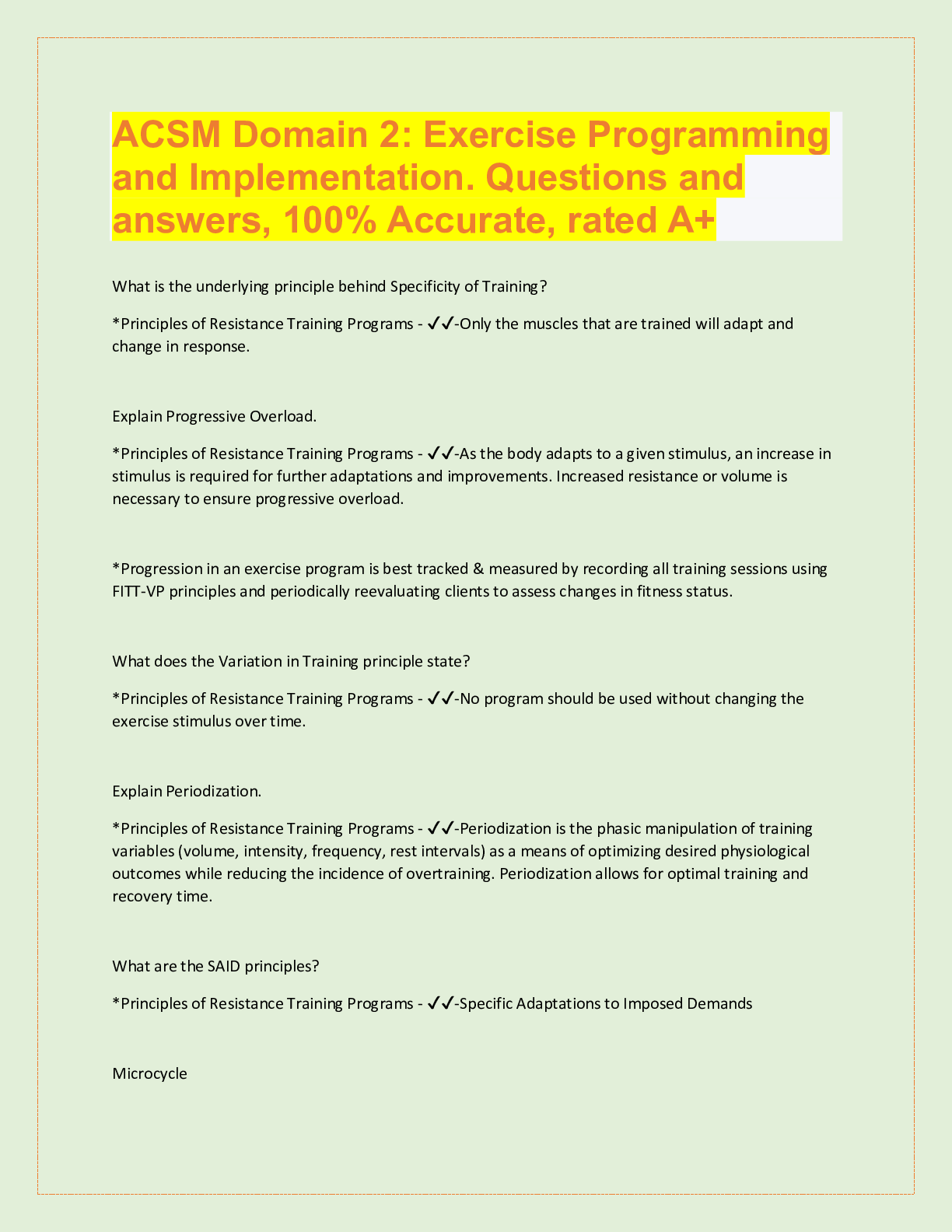
ACSM Domain 2: Exercise Programming
and Implementation. Questions and
answers, 100% Accurate, rated A+
What is the underlying principle behind Specificity of Training?
*Principles of Resistance Training Programs - ✔✔-Only the muscles that are trained will adapt and
change in response.
Explain Progressive Overload.
*Principles of Resistance Training Programs - ✔✔-As the body adapts to a given stimulus, an increase in
stimulus is required for further adaptations and improvements. Increased resistance or volume is
necessary to ensure progressive overload.
*Progression in an exercise program is best tracked & measured by recording all training sessions using
FITT-VP principles and periodically reevaluating clients to assess changes in fitness status.
What does the Variation in Training principle state?
*Principles of Resistance Training Programs - ✔✔-No program should be used without changing the
exercise stimulus over time.
Explain Periodization.
*Principles of Resistance Training Programs - ✔✔-Periodization is the phasic manipulation of training
variables (volume, intensity, frequency, rest intervals) as a means of optimizing desired physiological
outcomes while reducing the incidence of overtraining. Periodization allows for optimal training and
recovery time.
What are the SAID principles?
*Principles of Resistance Training Programs - ✔✔-Specific Adaptations to Imposed Demands
Microcycle
*Term Definitions - ✔✔-The smallest raining cycle time frame in a periodization program. This cycle
usually lasts from 1-4 weeks in length and focuses on one workout variable in that phase.
Mesocycle
*Term Definitions - ✔✔-This is the middle cycle time frame in a Periodization training program.
Combining Mesocycles usually results in the larger Macrocycle, of which there are 4-6 in a year.
Macrocycle
*Term Definitions - ✔✔-A Macrocycle is the largest training-cycle time frame of a Periodization
program. This cycle consists of the combined Mircro and Mesocycles. One calendar year is an example
of a Macrocycle.
Multi-joint exercise
*Term Definitions - ✔✔-An exercise that involves two or more muscle groups and joints (e.g., deadlifts,
bench press, and squats)
Single-joint exercise
*Term Definitions - ✔✔-Isolated muscle group exercises that involve one joint movement (e.g., bicep
curls, knee extensions, and leg curls)
Unilateral
*Term Definitions - ✔✔-Exercises or movements that involve one limb (e.g., one-arm bicep curl)
Bilateral
*Term Definitions - ✔✔-Exercises or movements that involve both limbs (e.g., bench press)
Push exercises
*Term Definitions - ✔✔-Exercises involving the push muscle groups (e.g., bench press, squats, and
abduction)
Pull exercises
*Term Definitions - ✔✔-Exercises involving the pull muscle groups (e.g., pull ups, dead lifts, and
adduction)
What is High Intensity Interval Training (HIIT)?
*Interval, Continuous & Circuit Training Programs - ✔✔-Alternating brief periods of high intensity
activity followed by less intense recovery periods. This type of training produces greater benefits in a
shorter amount of "training" time. Benefits include increased speed, endurance, recovery time,
cardiovascular health, insulin sensitivity, fat burning, and increased metabolism. Interval training should
not be performed on consecutive days to prevent the risk of overtraining. Typically, performing HIIT on
2-3 non-consecutive daystar week is sufficient.
What is Continuous Training?
*Interval, Continuous & Circuit Training Programs - ✔✔-Involves activity without rest intervals. This type
of training can be performed at low, moderate, or high intensities. Continuous training improves aerobic
fitness, endurance, and aids in weight loss. This type of training is more time consuming than interval or
circuit training and does little to improve anaerobic fitness.
What is Circuit Training?
*Interval, Continuous & Circuit Training Programs - ✔✔-Involves performing several continuous
exercises in a short period of time. This type of training Induces metabolic and cardiovascular response
that could improve aerobic capacity. It also targets strength building and muscular endurance.
Super Setting
*Advanced Resistance Training Programs - ✔✔-Consecutive performing of two exercises either for the
same or different muscle groups.
Olympic Lifting
*Advanced Resistance Training Programs - ✔✔-Total body resistance exercises that recruit most major
muscle groups. Olympic lifts are the most complex exercises to perform but are also considered the
most effective for increasing total-body power. The clean and jerk, snatch, and overhead squat are
examples of olympic lifts.
Plyometric Training
*Advanced Resistance Training Programs - ✔✔-Explosive exercises that target power development.
These exercises begin with a quick stretch of the muscle fibers (eccentric phase) followed by a fast
shortening of the same muscle fibers (concentric phase). Some examples are jump lunges, box jumps,
and sprints.
Linear Periodization
*Advanced Resistance Training Programs - ✔✔-Steady linear increase of intensity of a program. A
traditional linear increase program includes the following four phases:
1. Hypertrophy Phase (high volume, short rest periods)
2. Strength and Power phase (reduced volume but increased resistance and rest periods)
3. Peak Phase (low volume but high resistance and longer res
[Show More]