APES Final Review Vocabulary, All
Definitions, 100% examinable. Rated A+
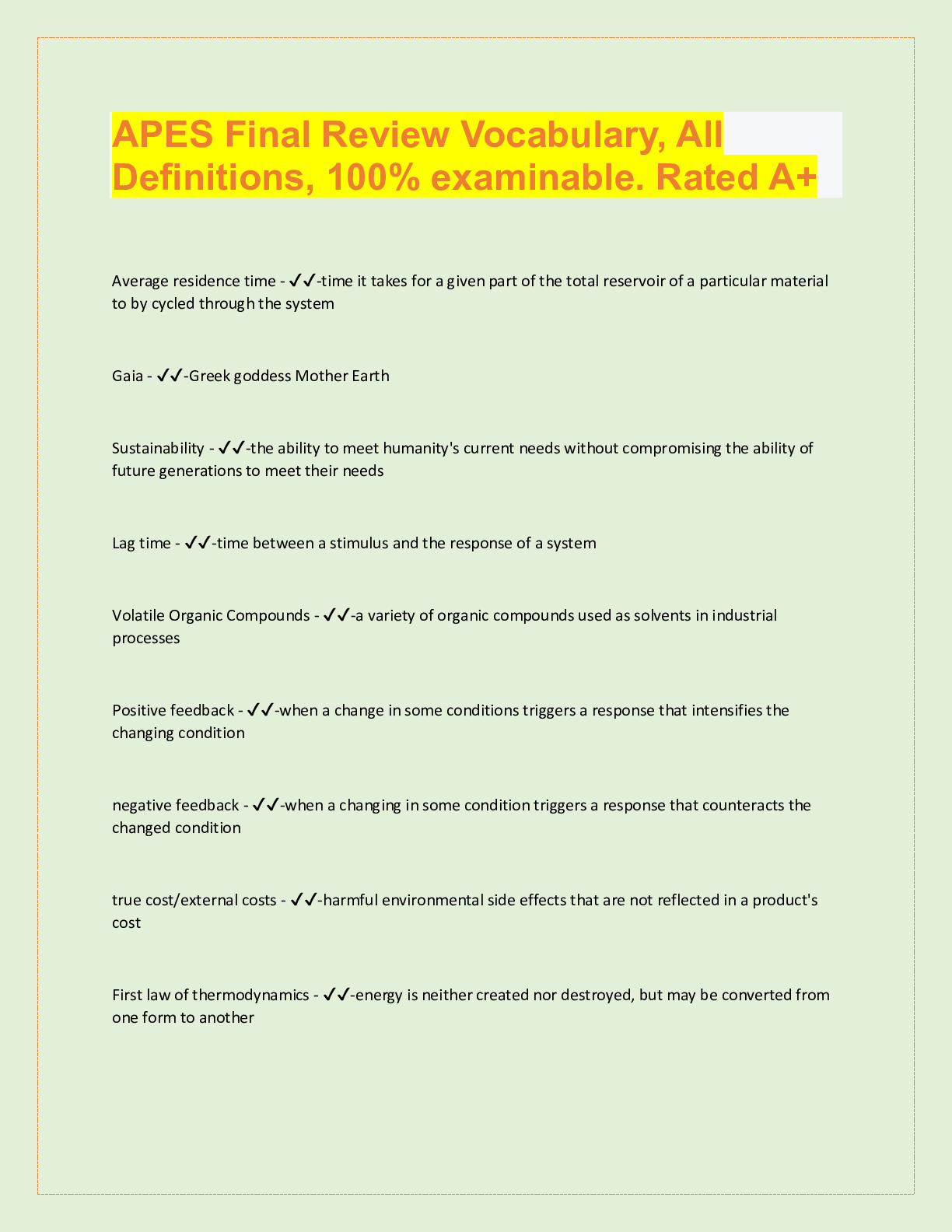
Average residence time - ✔✔-time it takes for a given part of the total reservoir of a particular material
to by cycled through the system
Ga
...
APES Final Review Vocabulary, All
Definitions, 100% examinable. Rated A+
Average residence time - ✔✔-time it takes for a given part of the total reservoir of a particular material
to by cycled through the system
Gaia - ✔✔-Greek goddess Mother Earth
Sustainability - ✔✔-the ability to meet humanity's current needs without compromising the ability of
future generations to meet their needs
Lag time - ✔✔-time between a stimulus and the response of a system
Volatile Organic Compounds - ✔✔-a variety of organic compounds used as solvents in industrial
processes
Positive feedback - ✔✔-when a change in some conditions triggers a response that intensifies the
changing condition
negative feedback - ✔✔-when a changing in some condition triggers a response that counteracts the
changed condition
true cost/external costs - ✔✔-harmful environmental side effects that are not reflected in a product's
cost
First law of thermodynamics - ✔✔-energy is neither created nor destroyed, but may be converted from
one form to another
second law of thermodynamics - ✔✔-when energy is changed from one form to another, some useful
energy is always degraded into lower quality energy
Ionizing radiation - ✔✔-radiation with enough energy to free electrons from atoms forming ions, may
cause cancer
High Quality Energy - ✔✔-organized & concentrated, can perform useful work
Low Quality Energy - ✔✔-disorganized, dispersed
Natural radioactive decay - ✔✔-unstable radioisotopes decay releasing gamma rays, alpha & beta
particles
half-life - ✔✔-the time it takes for half the mass of a radioisotope to decay. A radioactive isotope must
be stored for approximately 10 half-lives until it decays to a safe level
nuclear fission - ✔✔-nuclei of isotopes split apart when struck by neutrons
nuclear fusion - ✔✔-2 isotopes of light elements forced together at high temperatures till they fuse to
form a heavier nucleus. Happens in Sun, very difficult to accomplish on Earth, prohibitively expensive
10 half lives - ✔✔-estimate of how long a radioactive isotope must be stored until it decays to a safe
level
ore - ✔✔-a rock that contains a large enough concentration of a mineral making it profitable to mine
mineral reserve - ✔✔-identified deposits currently profitable to extract
surface mining - ✔✔-cheaper, can remove more minerals, less hazardous to workers
organic fertilizer - ✔✔-slow acting long lasting because the organic remains need time to decompose
silviculture - ✔✔-professional growing of trees
shelterwood-cutting - ✔✔-cutting dead and less desirable trees first and after cutting more mature trees
seed-tree cutting - ✔✔-removes all but a few seed trees to promote regeneration
selective cutting - ✔✔-individual trees are marked and cut
humus - ✔✔-organic, dark material remaining after decomposition by microorganisms
leaching - ✔✔-removal of dissolved materials from soil by water moving downwards through soil
illuviation - ✔✔-deposit of leached material in lower soil layers (B)
Conservation - ✔✔-allows use of resources in a responsible manner
Preservation - ✔✔-setting aside areas & protecting them from human activities
loam - ✔✔-perfect agricultural soil with equal portions of sand, silt, clay
soil conservation methods - ✔✔-conservation tillage, crop rotation, contour plowing, organic fertilizers
soil salinization - ✔✔-in arid regions, water evaporates leaving salts behind (ex. Fertile crescent,
southwestern US)
water logging - ✔✔-water completely saturates soil, starves plant roots of oxygen, rots roots
Hydrologic cycle components - ✔✔-evaporation, transpiration, runoff, condensation, precipitation, and
infiltration
watershed - ✔✔-all of the land that drains into a body of water
aquifer - ✔✔-underground layers of porous rock allow water to move slowly
cone of depression - ✔✔-lowering of the water table around a pumping well
salt water intrusion - ✔✔-near the coast, overpumping of groundwater causes saltwater to move into
aquifer
adaptive radiation - ✔✔-occurs when a species enters a new habitat that has unoccupied niches and
evolves into a group of new species, each adapted to one of these niches
alpha particle - ✔✔-one of the major types of nuclear radiation, consisting of two protons and two
neutrons
beta particle - ✔✔-one of three kinds of nuclear radiation; electrons that are emitted when one of the
protons or neutrons in the nucleus of an isotope spontaneously changes
gamma rays - ✔✔-one of three kinds of nuclear radiation; type of EM radiation emitted from the isotope
similar to X gays but more energetic and penetrating
ENSO - ✔✔-El Nino Southern Oscillation, trade winds weaken & warm, surface water moves toward
South America. Diminished fisheries off S. America, drought in W. Pacific, increased precipitation in
southwestern N. America, fewer Atlantic hurricanes
During an El Nino Year - ✔✔-trade winds weaken & warm water sloshed back to S. America
During non El Nino year - ✔✔-Easterly trade winds and ocean currents pool warm water in the western
Pacific, allowing upwelling of nutrient rich water off the West coast of S. America
effects of el nino - ✔✔-upwelling decreases disrupting food chains, N. US has mild winters, SW US has
increased rainfall, lass Atlantic hurricanes
La Nina - ✔✔-"Normal" year, easterly trade winds and ocean currents pool warm water in the W. Pacific,
allowing upwelling of nutrient rich water off West coast of S. America
nitrogen fixation - ✔✔-because atmospheric N cannot be used directly by plants, it must be first
converted to ammonia by bacteria
ammonification - ✔✔-decomposers convert organic waste into ammonia
nitrification - ✔✔-ammonia is converted to nitrate ions
assimilation - ✔✔-inorganic N is converted into organic molecules such as DNA/amino acids & proteins
denitrification - ✔✔-bacteria convert ammonia back into N
phosphorus - ✔✔-does not exist as a gas; released by weathering of phosphate rocks, it is a major
limiting factor for plant growth. Phosphorus cycle is slow, and not atmospheric
excess phosphorus - ✔✔-added to aquatic ecosystems by runoff of animal wastes, fertilizer, sewage
discharge
photosynthesis - ✔✔-plants convert CO2 into complex carbs (glucose)
aerobic respiration - ✔✔-oxygen consuming producers, consumers & decomposers break down complex
organic compounds and convert C back into CO2
largest reservoirs of Carbon - ✔✔-carbonate rocks first, oceans second
biotic - ✔✔-the living components of an ecosystem
abiotic - ✔✔-the nonliving components of an ecosystem
producer/autotroph - ✔✔-organisms that make their own food--- photosynthetic life
fecal coliform - ✔✔-indicator of sewage contamination
chlorine - ✔✔-good= disinfection of water, bad= forms trihalomethanes
obligate symbiont - ✔✔-relationship between two organisms in which neither by themselves can exist
without the other
rangeland - ✔✔-provides food for grazing and browsing animals w/o plowing and planting
pasture - ✔✔-plowed, planted, and harvested to provide forage for animals
igneous rock - ✔✔-formed from solidification of magma
metamorphic rock - ✔✔-formed by heat & pressure
sedimentary rock - ✔✔-formed by weathering & erosion
OAEBCR - ✔✔-soil horizon layers
contour plowing - ✔✔-land is plowed perpendicular to the slopes and as horizontally as possible
no-till agriculture - ✔✔-involves not plowing the land, using herbicides and integrated pest management
to keep down weeds, and allowing some weeds to grow
eutrophication - ✔✔-a body of water develops a high concentration of nutrients, causes increase in
algae, organisms below deprived of light, large die off, decompose, DO lowers
oligotrophic - ✔✔-referring to bodies of water having low concentration of chemical elements required
for life
photodissociation - ✔✔-solar radiation brea
[Show More]