NETA CPT Exam: Chapters 1-5, top
Exam questions & Answers, 100%
Accurate.
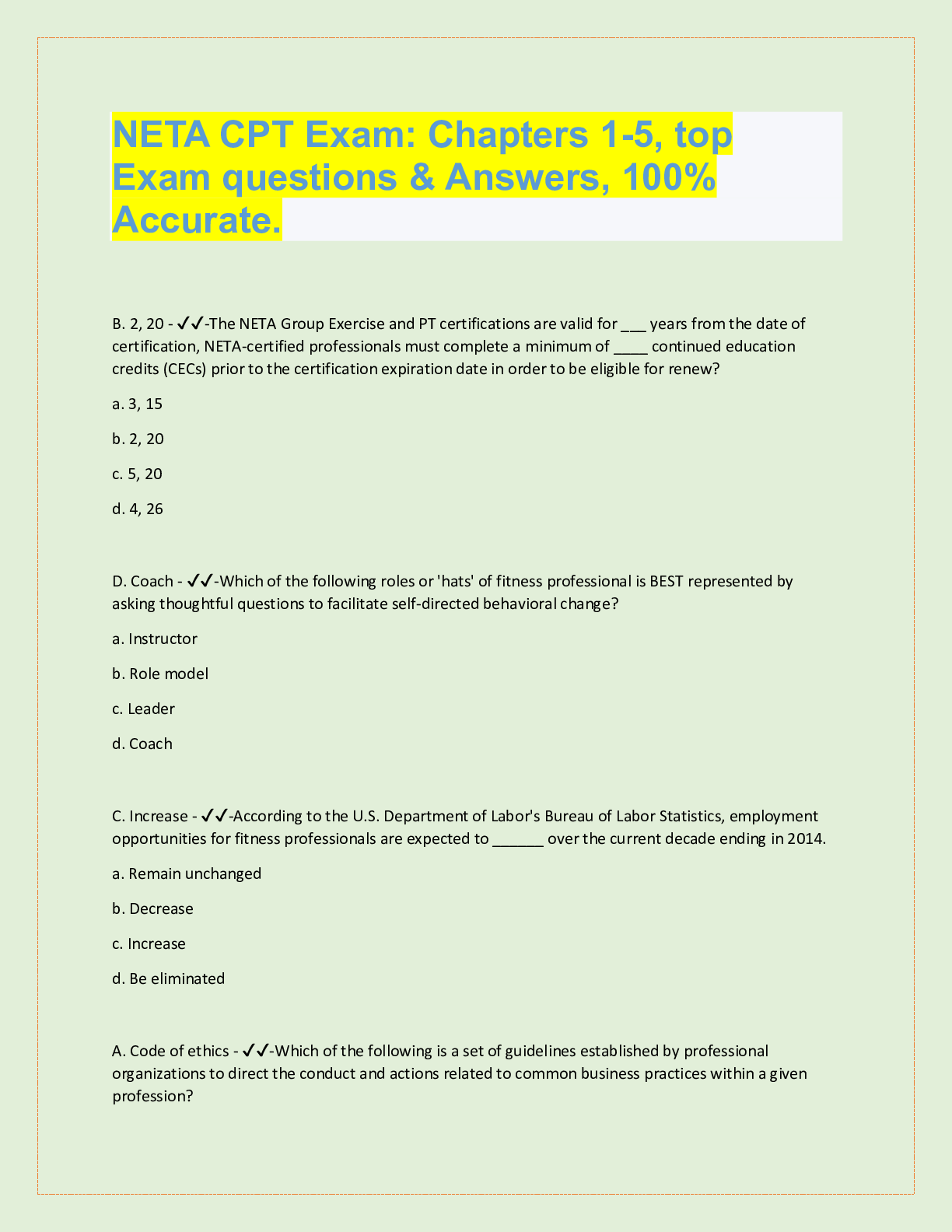
B. 2, 20 - ✔✔-The NETA Group Exercise and PT certifications are valid for ___ years from the date of
certification, NETA-certified professi
...
NETA CPT Exam: Chapters 1-5, top
Exam questions & Answers, 100%
Accurate.
B. 2, 20 - ✔✔-The NETA Group Exercise and PT certifications are valid for ___ years from the date of
certification, NETA-certified professionals must complete a minimum of ____ continued education
credits (CECs) prior to the certification expiration date in order to be eligible for renew?
a. 3, 15
b. 2, 20
c. 5, 20
d. 4, 26
D. Coach - ✔✔-Which of the following roles or 'hats' of fitness professional is BEST represented by
asking thoughtful questions to facilitate self-directed behavioral change?
a. Instructor
b. Role model
c. Leader
d. Coach
C. Increase - ✔✔-According to the U.S. Department of Labor's Bureau of Labor Statistics, employment
opportunities for fitness professionals are expected to ______ over the current decade ending in 2014.
a. Remain unchanged
b. Decrease
c. Increase
d. Be eliminated
A. Code of ethics - ✔✔-Which of the following is a set of guidelines established by professional
organizations to direct the conduct and actions related to common business practices within a given
profession?
a. Code of ethics
b. Accreditation
c. Certification
d. Articles of Order
B. Certification - ✔✔-Successfully obtaining a/an _________ indicated that an individual has passed a
written assessment, demonstrating a minimum level of knowledge and competency to safely perform
the basic duties of a personal trainer or group exercise instructor.
a. Accreditation
b. Certification
c. Job
d. Certificate of completion
B. Arms crossed over chest - ✔✔-Which of the following may indicate a defensive position suggesting
that an individual is not interested in communicating or interacting?
A. Hand placed over mouth
B. Arms crossed over chest
C. Leaning backwards
D. Arms held to the sides of the body with palms open
B. The body position and facial expressions of the speaker - ✔✔-Which of the following nonverbal
aspects is likely to have the MOST significant impact on the meaning of a message?
A. The selection and use of words being communicated
B. The body position and facial expressions of the speaker
C. The projection and volume of the speaker's voice
D. The education and experience of the speaker
B. Preparation - ✔✔-A member indicates that he has been active on an inconsistent basis for the past
five weeks and would like to begin a structured exercise program to improve his cardiorespiratory
fitness and to lose some weight. Based on this info, you conclude that he is in which stage of the trans
theoretical model?
A. Precontemplation
B. Preparation
C. Contemplation
D. Maintenance
C. Contemplation - ✔✔-A friend indicates that she would like to begin an exercise program, but at the
same time enjoys spending her free time in sedentary activities. She recognizes the benefits of being
active, but also perceives an equal number of disadvantages and sacrifices she would have to make in
order to become active. Based on this info, what stage of behavioral change is she in?
A. Precontemplation
B. Preparation
C. Contemplation
D. Maintenance
D. "I will complete a minimum of two full-body resistance training sessions each week." - ✔✔-Which of
the following goal statements is an example of a SMART action-oriented goal?
A. "I will lose 10 pounds over the next 10 weeks through increased exercise and decreased caloric
intake."
B. "I will increase my maximal O2 consumption by 5mL/kg/min over the next 3 months."
C. "I will reduce my abdominal fat by doing more core exercises."
D. "I will complete a minimum of two full-body resistance training sessions each week."
C. Feelings of satisfaction and accomplishment after running a marathon. - ✔✔-Which of the following is
an example of an intrinsic source of motivation?
A. Giving a class participant a T-shirt for perfect attendance in a series of classes.
B. Earning a partial reimbursement of membership dues for visiting the club a minimum number of
times each month.
C. Feelings of satisfaction and accomplishment after running a marathon.
D. Receiving compliments from others regarding your recent weight loss.
B. Health Belief Model - ✔✔-You have just started working with a 52-year-old male client. When asked
what prompted him to begin an exercise program, your client indicates that a close friend of his had
recently suffered a heart attack. The client is overweight and has high blood pressure. He is worried that
he may be at risk for a heart attack if her does not start exercising regularly. Which of the following trans
theoretical models of behavior change best explain this scenario?
A. Self-Determination Theory
B. Health Belief Model
C. Transtheoretical Model
D. Social-Cognitive Theory
A. Sharing success stories of other clients who have achieved fitness goals similar to the client's - ✔✔-
What is most likely to increase a client's self-efficacy related to exercise?
A. Sharing success stories of other clients who have achieved fitness goals similar to the client's
B. Educating the client in regards to the risks of a sedentary lifestyle
C. Highlighting the health benefits of regular exercise
D. Setting aggressive long-term goals using the SMART approach to goal-setting
TTM Stages of Change: Precontemplation - ✔✔-The individual is not thinking about adopting physical
activity and has no intention of beginning in the foreseeable future (i.e. next 6 mo)
Doesn't perceive any problems with their present lifestyle, consider the disadvantages to outweigh the
advantages of behavior change.
"I won't" or "I can't"
TTM Stages of Change: Contemplation - ✔✔-Individual has intentions to make behavior change in the
next 6 months.
Growing awareness of the advantages but is off-set by perceived disadvantages and barriers.
"I may"
TTM Stages of Change: Preparation - ✔✔-Intentions of behavior change or beginning behavior change
within the next month.
Preparing for behavior change.
"I will"
TTM Stages of Change: Action - ✔✔-Performing behavior change.
"I am"
(TTM) Stages of Change: Maintenance - ✔✔-Sustained behavior change for 6 consecutive months.
"I still am"
C. Evoking - ✔✔-Which of the following processes of motivational interviewing is characterized by
discovering the client's motivation for change and eliciting change talk?
A. Engaging
B. Focusing
C. Evoking
D. Planning
B. Simultaneity - ✔✔-The principle of appreciative inquiry that suggests positive questions and positive
reflections directly results in positive conversations and interactions known as the _______ Principle.
A. Constructionist
B. Simultaneity
C. Positivity
D. Anticipatory
D. Dream - ✔✔-In what stage of the 5-D model of appreciative inquiry is a coach most likely to ask the
question, "Looking into the future, what would your ideal state of health look like?"
A. Define
B. Discover
C. Design
D. Dream
A. "How do you feel about your current level of physical activity?" - ✔✔-Which of the following
questions is a coach most likely to ask during the "R" stage of the GROW model?
A. "How do you feel about your current level of PA?"
B. "What would you tell a friend who is struggling to achieve similar goals?"
C. "On a scale of 0 to 10, how confident are you that you will complete the task next week?"
D. "What alternatives are you considering?"
The 'Spirit' of MI - ✔✔-Partnership
Acceptance
Compassion
Evocation
Guiding Principle of MI - ✔✔-Express empathy
Develop discrepancy
Roll with resistance
Support self-efficacy
The Key Processes of MI - ✔✔-Engaging
Focusing
Evoking
Planning
Core Skills of MI - ✔✔-OARS:
Open-ended questions
Affirmations
Reflective listening
Summarizing
Appreciative Inquiry (AI) - ✔✔-Coaching mindset and an approach the focuses on exploring and
amplifying an individual's strengths in order to motivate behavior change.
5-D Model of AI - ✔✔-Define
Discovery
Dream
Design
Destiny
5-D Model of AI: Define - ✔✔-Identify desired outc
[Show More]






, 1e by Cristiane Surbeck, Jeff Kuo.png)




, 1e by Fariborz Tayyari.png)



.png)









