PMP Study Guide Questions and
answers, 100% Accurate, rated A+
A Guide to the Project Management Body of Knowledge (PMBOK) - ✔✔-A PMI publication that defines
widely accepted project management practices. The CAPM a
...
PMP Study Guide Questions and
answers, 100% Accurate, rated A+
A Guide to the Project Management Body of Knowledge (PMBOK) - ✔✔-A PMI publication that defines
widely accepted project management practices. The CAPM and the PMP exam are based on this book.
Application Areas - ✔✔-The areas of expertise, industry, or function where a project is centered.
Examples of application areas include architecture, IT, health care, or manufacturing.
Certified Associate in Project Management (CAPM) - ✔✔-A person who has slightly less project
management experience than a PMP, but who has qualified for and then passed the CAPM examination.
Cultural and social environment - ✔✔-Defines how a project affects people and how those people may
affect the project. Cultural and social environments include the economic, educational, ethical, religious,
demographic, and ethnic composition of the people affected by the project.
Deliverable - ✔✔-A product, service, or result created by the project. Projects can have multiple
deliverables.
General Management skills - ✔✔-These include the application of accounting, procurement, sales and
marketing, contracting, manufacturing, logistics, strategic planning, human resource management,
standards and regulations, and information technology.
Internal and political environment - ✔✔-The consideration of the local and international laws,
languages, communication challenges, time zone differences, and other non-collocated issues that
affect a projects ability to progress.
Interpersonal skills - ✔✔-The ability to interact, lead, motivate, and manage people.
Iron Triangle of Project Management - ✔✔-A triangle with the characteristics of time, cost, and scope.
Time, cost, and scope each constitute one side of the triangle; if any side of the Iron Triangle is not in
balance with the other sides, the project will suffer. The Iron Triangle of Project Management is also
known as the Triple Constraints of Project Management, as all projects are constrained by time, cost and
scope.
Physical environment - ✔✔-The physical structure and surroundings that affect a project's work.
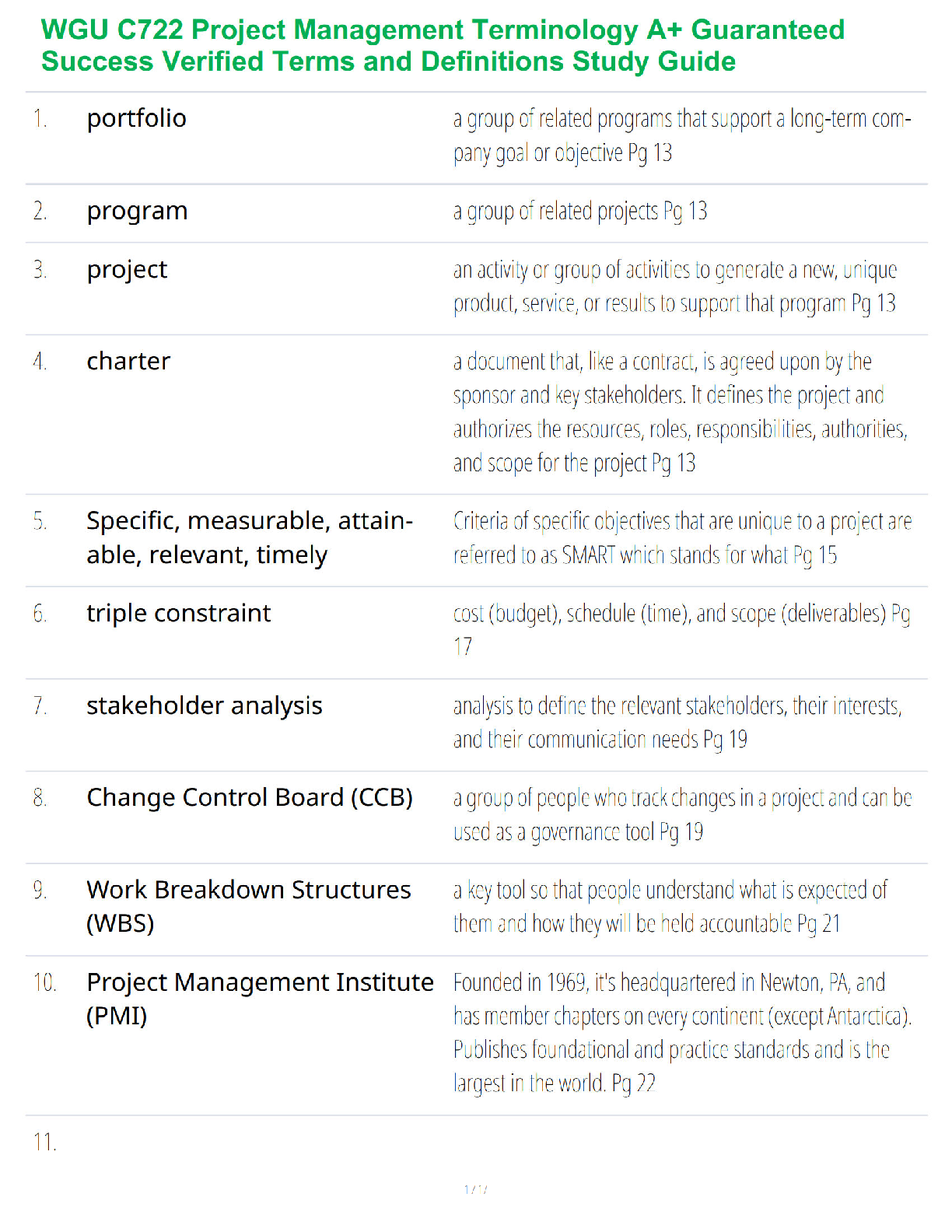
Program - ✔✔-A collection of related projects working in unison toward a common deliverable.
Progressive Elaboration - ✔✔-The process of gathering project details in steady, uniform steps. This
process uses deductive reasoning, logic, and a series of information-gathering techniques to identify
details about a project product, or solution.
Project - ✔✔-A short-term endeavor to create a unique product, service, or result. The end result of a
project is also called a deliverable.
Project Environment - ✔✔-The location and culture of the environment where the project work will
reside. The project environment includes the social, economic, and environmental variables the project
must work with or around.
Project Management Institute (PMI) - ✔✔-An organization of project management professionals from
around the world, supporting and promoting the careers, values, and concerns of project managers.
Project management office (PMO) - ✔✔-A central office that oversees all projects within an organization
of within a functional department. A PMO supports the project manager through software, training,
templates, policies, communication, dispute resolution, and other services.
Project Management Professional (PMP) - ✔✔-A person who has proven project management
experience and has qualified for and then passed the PMP examination.
Project portfolio management - ✔✔-The management and selection of projects that support an
organizations vision and mission. It is the balance of project priority, risk, reward, and return on
investment. This is a senior management process.
Subprojects - ✔✔-A smaller project managed within a larger, parent project. Subprojects are often
contracted work whose deliverable allows the larger project to progress.
Triple Constraints of Project Management - ✔✔-Also known as the Iron Triangle. This theory posits that
time, cost, and scope are three constraints that every project has.
Balanced matrix structure - ✔✔-An organization where organizational resources are pooled into one
project team, but the functional mangers and the project managers share the project power.
Composite structure - ✔✔-An Organization that creates a blend of the functional, matrix, and
projectized structures.
Customer/user - ✔✔-The person(s) who will pay for and use the project's deliverables.
Deliverable - ✔✔-A verifiable, measurable product or service created by a phase and/or a project.
Functional structure - ✔✔-An organization that is divided into functions, and each employee has one
clear functional manager. Each department acts independently of the other departments. A project
manger in this structure has little to no power and may be called a project coordinator.
Influences - ✔✔-Persons who can positively or negatively influence a projects ongoing activities and/or
project's likeihood or success.
Kill point - ✔✔-The review of a phase to determine if it accomplished its requirements. A kill point
signals an opportunity to kill the project if it should not continue.
Negative stakeholder - ✔✔-A stakeholder who doe not want a project to succeed. He or she may try to
negatively influence the project and help it fail.
Performing organization - ✔✔-The organization whose employees or members are most directly
involved in the project work.
Phase - ✔✔-The logical division of a project based on the work or deliverable completed within that
phase. Common examples include the phases within construction, software development, or
manufacturing.
Phase exit - ✔✔-The review of a phase to determine if it accomplished its requirement.
Phase gate - ✔✔-The review of a phase to determine if it accomplished its requirements.
Phase-end review - ✔✔-The review of a phase to determine if it accomplished its requirements. A
phase-end review is also called a phase exit, a phase gate, and a kill point.
Positive stakeholder - ✔✔-A stakeholder who wants a project to exist and succeed. He or she may try to
positively influence the project and help it s
[Show More]