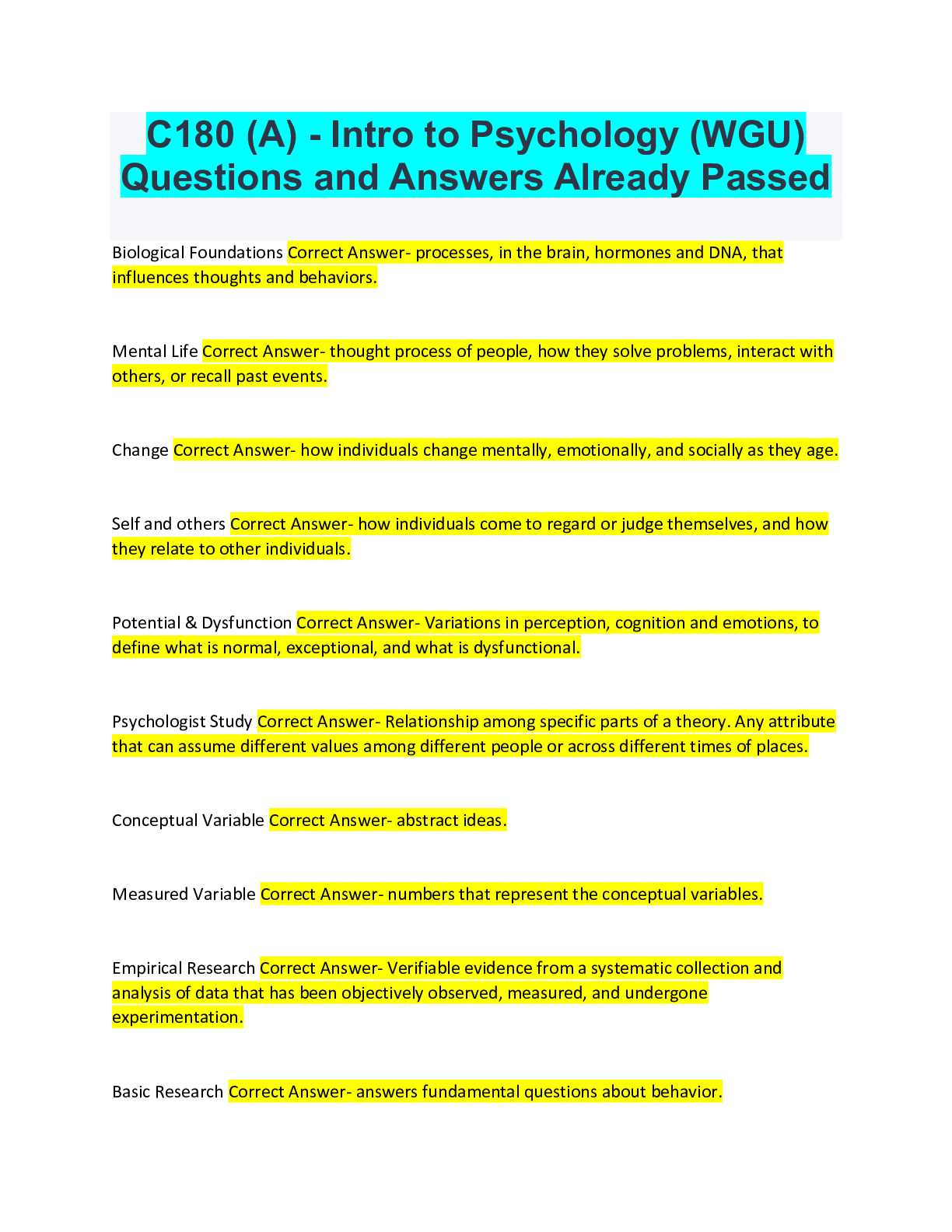
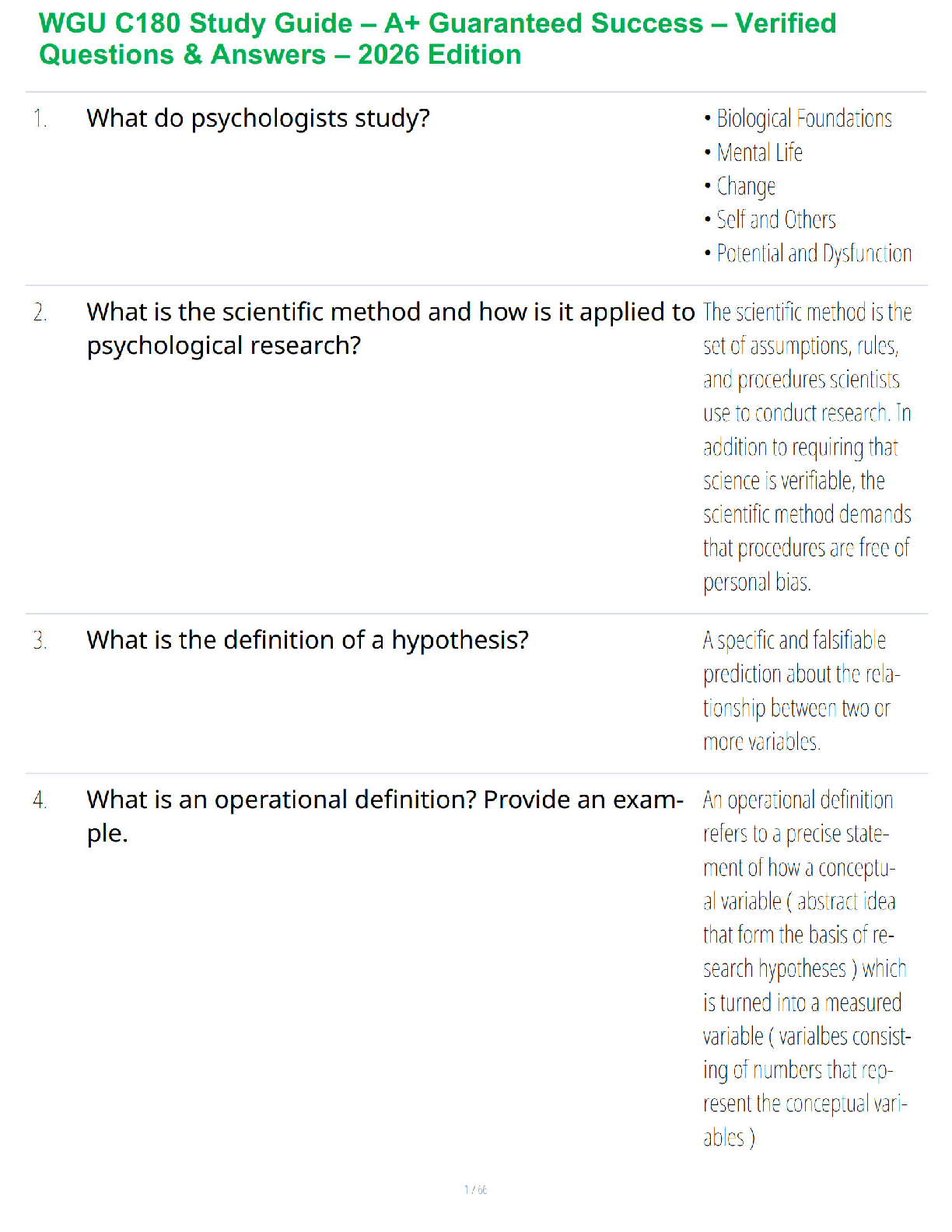
C180 WGU Version 4 Summary, Exam
Preview Questions and answers, Graded
A+
Psychology - ✔✔is the science of the mind and behavior.
The history of psychology includes - ✔✔philosophy, physiology, and behavioral compon
...
C180 WGU Version 4 Summary, Exam
Preview Questions and answers, Graded
A+
Psychology - ✔✔is the science of the mind and behavior.
The history of psychology includes - ✔✔philosophy, physiology, and behavioral components.
Psychologists use various levels of analysis including - ✔✔the levels of brain, person, and group.
The level of the brain involves - ✔✔both the brain and its structure.
The level of the person encompasses - ✔✔mental contents and processes.
The level of the group incorporates - ✔✔social and cultural interactions.
Functionalism is interested in - ✔✔why something is important, while structuralism focuses on what is
important.
Structuralists use the method of - ✔✔introspection.
Psychodynamic psychology exerts a great influence - ✔✔of unconscious cognition on people's moods
and behaviors.
Freud mapped out these unconscious - ✔✔structures against his stages of psychosexual development.
Humanistic psychology advocated - ✔✔complete respect and positive regard for clients.
The focus of humanist psychologists is - ✔✔for people to get well, applying what is right with them to
their goals instead of focusing on their problems.
The cognitive revolution brought - ✔✔about the framework that thought influences mood and behavior.
Cognitive neuroscience seeks - ✔✔to know brain functioning.
Evolutionists step back into human roots to understand - ✔✔the connections between inherited
adaptive traits and modern behavior.
Psychology is - ✔✔an expanding discipline with multiple areas of interest.
Clinical, counseling - ✔✔and school psychologists are, the most prevalent areas of employment for
psychologists.
The neuron - ✔✔is the key building block of the brain.
The cell body - ✔✔receives inputs from the dendrites (or sometimes, directly from axons of other
neurons) and sends its output via the axon (which is connected to the dendrites of other neurons or, in
some cases, their cell bodies).
When a neuron fires as a result of receiving input - ✔✔chemical reactions work their way down the axon
and neurotransmitter substances are released at the terminal buttons.
The largest part of the brain is the cerebral cortex - ✔✔a folded mass of gray matter that is divided
lengthwise into two hemispheres and laterally into four lobes.
The occipital lobe - ✔✔processes vision
The temporal lobe - ✔✔processes sound interprets language and stores memories.
The parietal lobe - ✔✔controls spatial awareness and the sense of touch. Across the central sulcus the
frontal lobe provides motor control as well as many processes related to reason attention executive
control and emotion.
The two hemispheres - ✔✔span all four lobes but are specialized.
The left hemisphere is - ✔✔more effective at speech and reasoning
The right hemisphere is - ✔✔more effective at spatial perception and processing nonverbal cues.
Below the cortex lie inner brain structures, including the thalamus the "switching center" of the brain;
the hypothalamus, which controls many automatic bodily functions; the limbic system, which plays an
important role in emotions as well as memory; the cerebellum, which manages balance and
coordination; and the brainstem, which relays information from the spinal cord. - ✔✔
The thalamus - ✔✔the switching center of the brain
The hypothalamus - ✔✔which controls many automatic bodily functions
The limbic system - ✔✔which plays an important role in emotions as well as memory
The cerebellum - ✔✔which manages balance and coordination
The brainstem - ✔✔which relays information from the spinal cord
Researchers use= descriptive, correlational, and experimental methods to explore questions in
psychology. - ✔✔
The scientific method for research is - ✔✔a systematic set of six steps that helps researchers and
scientists answer questions in the field of psychology and many other fields. The steps are Observe and
question. Research. Formulate a hypothesis. Test your hypothesis. Analyze and conclude. Share the
results.
To ensure that psychological research is conducted in a fair and ethical manner - ✔✔the American
Psychological Association provides guidelines in areas such as beneficence and nonmaleficence, fidelity
and responsibility, integrity, justice, and respect for people's rights and dignity. Institutional Boards of
Review (IRBs) also maintain strict oversight.
Classical conditioning involves - ✔✔the pairing of an initially neutral stimulus (such as a tone, which
then becomes the conditioned stimulus) with an unconditioned stimulus (such as food).
The unconditioned stimulus reflexively elicits - ✔✔an unconditioned response (such as salivation), and,
with repeated unconditioned stimulus (conditioned stimulus pairings), the conditioned stimulus will
elicit the response evoked by the unconditioned stimulus as a conditioned response (such as salivation).
Pavlov discovered classical conditioning while - ✔✔conducting studies of dogs' salivation.
Extinction is achieved - ✔✔by repeatedly presenting the conditioned stimulus without the
unconditioned stimulus.
With stimulus generalization - ✔✔a similar but nonidentical stimulus elicits the conditioned response.
Classical conditioning is used - ✔✔in advertising and to treat phobias.
Classical conditioning is also a - ✔✔mechanism underlying food or taste aversions and some placebo
responses.
Operant conditioning is a process involving - ✔✔a person or animal that is operating and engaged in the
world.
Reinforcements increase - ✔✔behaviors or
[Show More]