C961 - Ethics in Technology, Exam
Section Coverage, rated A+
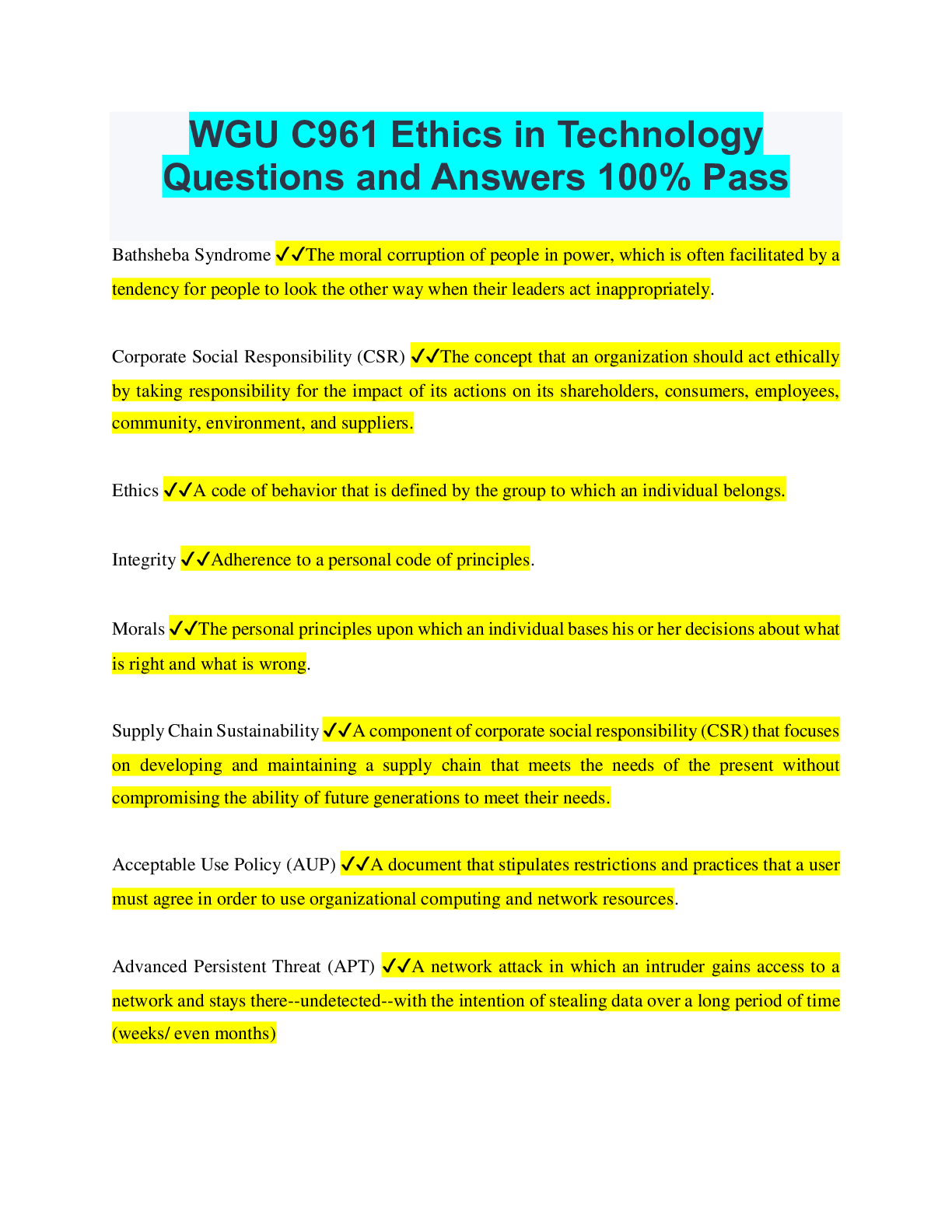
Bathsheba syndrome
The moral corruption of people in power, which is often facilitated by a tendency for people to look the
other way when their leaders
...
C961 - Ethics in Technology, Exam
Section Coverage, rated A+
Bathsheba syndrome
The moral corruption of people in power, which is often facilitated by a tendency for people to look the
other way when their leaders act inappropriately.
code of ethics
A statement that highlights an organization's key ethical issues and identifies the overarching values and
principles that are important to the organization and its decision-making.
corporate compliance officer
OR
corporate ethics officer
A senior-level manager who provides an organization with vision and leadership in the area of business
conduct.
corporate social responsibility (CSR)
The concept that an organization should act ethically by taking responsibility for the impact of its actions
on its shareholders, consumers, employees, community, environment, and suppliers.
ethics
A code of behavior that is defined by the group to which an individual belongs.
integrity
Adherence to a personal code of principles.
law
A system of rules that govern what we can and cannot do.
morals
The personal principles upon which an individual bases his or her decisions about what is right and what
is wrong.
problem statement
A clear, concise description of the issue that needs to be addressed.
social audit
A process whereby an organization reviews how well it is meeting its ethical and social responsibility
goals and communicates its new goals for the upcoming year.
software piracy
A form of copyright infringement that involves making copies of software or enabling others to access
software to which they are not entitled.
supply chain sustainability
A component of corporate social responsibility (CSR) that focuses on developing and maintaining a
supply chain that meets the needs of the present without compromising the ability of future
generations to meet their needs.
stakeholder
Someone who stands to gain or lose, depending on how a particular situation is resolved.
vice
A habit of unacceptable behavior.
virtue
A habit that inclines people to do what is acceptable.
advanced persistent threat (APT)
A network attack in which an intruder gains access to a network and stays there - undetected - with the
intention of stealing data over a long period of time (weeks or even months).
antivirus software
Software that scans for a specific sequence of bytes, known as a virus signature, that indicates the
presence of a specific virus.
blended threat
A sophisticated threat that combines the features of a virus, worm, Trojan horse, and other malicious
code into a single payload.
botnet
A large group of computers, which are controlled from one or more remote locations by hackers,
without the knowledge or consent of their owners.
bring your own device (BYOD)
A business policy that permits - and in some cases, encourages - employees to use their own mobile
devices (smartphones, tablets, or laptops) to access company resources and applications, including
email, corporate databases, the corporate intranet, and the internet.
business continuity plan
A risk-based strategy that includes an occupant emergency evacuation plan, a continuity of operations
plan, and an incident management plan with an active governance process to minimize the potential
impact of any security incident and to ensure business continuity in the event of a cyberattack or some
form of disaster.
CAPTCHA (Completely Automated Public Turing Test to Tell Computers and Humans Apart)
Software that generates and grades tests that humans can pass and all but the most sophisticated
computer programs cannot.
CIA security triad
Refers to confidentiality, integrity, and availability.
computer forensics
A discipline that combines elements of law and computer science to identify, collect, examine, and
preserve data from computer systems, networks, and storage devices in a manner that preserves the
integrity of the data gathered so that it is admissible as evidence in a court of law.
Controlling the Assault of Non-Solicited Pornography and Marketing (CAN-SPAM) Act
A law that specifies that it is legal to spam, provided the messages meet a few basic requirements:
spammers cannot disguise their identity by using a false return address, the email must include a label
specifying that it is an ad or a solicitation, and the email must include a way for recipients to indicate
that they do not want future mass mailings.
cost per thousand impressions (CPM)
One of the two common methods of charging for paid media in which ads are billed at a flat rate per
1,000 impressions, which is a measure of the number of times an ad is displayed whether it was actually
clicked on or not.
cost per click (CPC)
One of the two common methods of charging for paid media in which ads are paid for only when
someone actually clicks on them.
cyberabuse
Any form of mistreatment or lack of care, both physical and mental, using an electronic communications
device that causes harm and distress to others.
cyberespionage
The deployment of malware that secretly steals data in the computer systems of organizations, such as
government agencies, military contractors, political organizations, and manufacturing firms.
cyberharassment
A form of cyberabuse in which the abusive behavior, which involves the use of an electronic
communications device, is degrading, humiliating, hurtful, insulting, intimidating, malicious, or
otherwise offensive to an individual or group of individuals, causing substantial emotional distress.
cyberstalking
Threatening behavior or unwanted advances directed at an adult using the internet or other forms of
online and electronic communications; the adult version of cyberbullying.
cyberterrorism
[Show More]