WGU C235 - Flashcards from Text + PA +
Study Guide + Final Prep Assessment
Questions and answers, graded A+
verified.
Aligns human capital with organizational objectives and strategies:
a. Company mission statemen
...
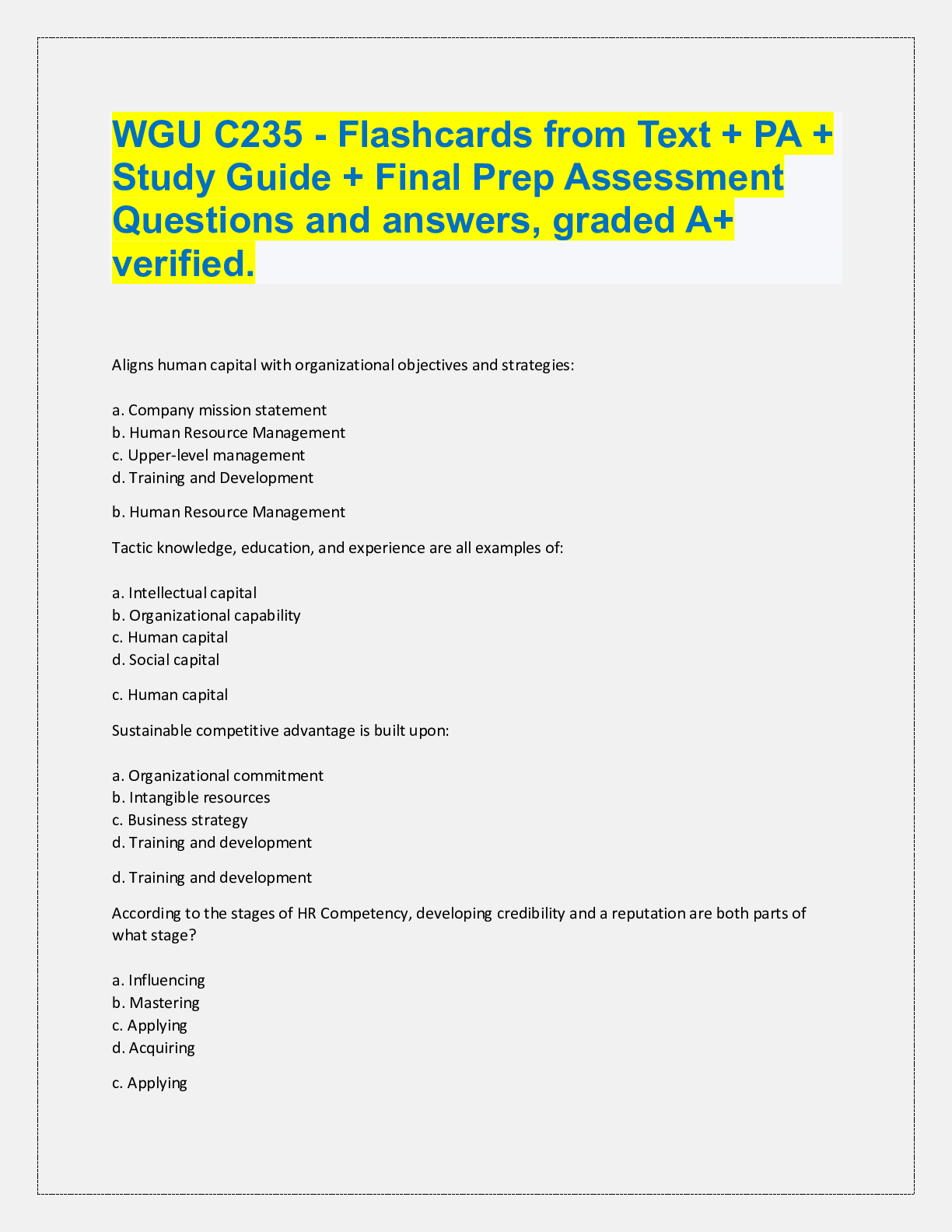
WGU C235 - Flashcards from Text + PA +
Study Guide + Final Prep Assessment
Questions and answers, graded A+
verified.
Aligns human capital with organizational objectives and strategies:
a. Company mission statement
b. Human Resource Management
c. Upper-level management
d. Training and Development
b. Human Resource Management
Tactic knowledge, education, and experience are all examples of:
a. Intellectual capital
b. Organizational capability
c. Human capital
d. Social capital
c. Human capital
Sustainable competitive advantage is built upon:
a. Organizational commitment
b. Intangible resources
c. Business strategy
d. Training and development
d. Training and development
According to the stages of HR Competency, developing credibility and a reputation are both parts of
what stage?
a. Influencing
b. Mastering
c. Applying
d. Acquiring
c. Applying
Which of the following is the responsibility of line management and not the human resources
department?
a. Coordinates career planning and employee development efforts
b. Prepares knowledge and skill training materials
c. Provides feedback on the effectiveness of formal training efforts
d. Provides input and expertise for individual and organizational development efforts
c. Provides feedback on the effectiveness of formal training efforts
The goal of needs assessment is to:
I: Determine whether a training need exists
II: Who it is that needs the training
III: Where in the organization the need exists
IV: Exactly what kind of training is needed
a. I, III, and IV
b. I, II, and IV
c. I, II, and III
d. I, II, III, and IV
a. I, III, and IV
What are the three levels of needs assessment?
a. Behavior, organizational, and analysis
b. Analysis, implementation, and feedback
c. Organizational, task, and person
d. Task, behavior, and feedback
c. Organizational, task, and person
A learning objective should be a/an ________ objective.
a. Performance
b. Behavior
c. Obtainable
d. Skill
b. Behavior
What can be the most powerful kind of feedback for learning?
a. Positive
b. Reflection
c. Observation
d. Negative
c. Observation
Concrete experience, reflective observation, abstract conceptualization, and active experimentation are
all examples of:
a. Learning approaches
b. Learner characteristics
c. Learning styles
d. Learner categories
a. Learning approaches
In order to be ready for training, trainees need high self-efficacy. In other words, trainees need:
a. The motivation and determination to make the training beneficial
b. Personal ambitions and goals
c. To feel they are of worth to the company
d. To believe they are capable of learning the material
d. To believe they are capable of learning the material
Training and development methods can be divided into three categories:
a. Simulation, behavior, and information presentation
b. Information presentation, skills, and technical
c. Behavior, skills, and technical
d. Information presentation, simulation, and on-the-job
d. Information presentation, simulation, and on-the-job
Sensitivity training is an example of:
a. Information presentation training
b. Simulation training
c. On-the-job training
d. All of the above
b. Simulation training
What is currently the most common approach to training?
a. E-learning
b. External learning
c. Classroom learning
d. Blended learning
c. Classroom learning
A variation of e-learning:
a. Self study
b. Case studies
c. Blended learning
d. Virtual classroom learning
c. Blended learning
During which step of the on-the-job training process do you make sure trainees know each point of the
training?
a. Perform follow-up
b. Prepare the learners
c. Present the information
d. Have trainee practice
c. Present the information
Is able to relate practical experiences, and conduct problem solving exercises:
a. Communication expert
b. Consultant
c. Training expert
d. Subject matter expert
d. Subject matter expert
Learning in training that does not affect performance on the job is called:
a. Negative transfer
b. Wasted training
c. Zero transfer
d. Unsuccessful training
c. Zero transfer
What are the two types of positive transfer?
a. Future and current
b. Near and far
c. Established and successful
d. Actual and perceived
b. Near and far
Traits, ability, and motivation are all considered:
a. Training design
b. Trainee characteristics
c. Work environment
d. Trainer characteristics
b. Trainee characteristics
The opportunity for practice consists of all the following dimensions EXCEPT:
a. Task type
b. Activity level
c. Job relevance
d. Breadth
c. Job relevance
Which of the following is NOT a level of criteria in training evaluation?
a. Behavior
b. Learning
c. Application
d. Reaction
d. Application
Which experimental design includes single-group pretest-posttest?
a. Pre-experimental design
b. Quasi-experimental design
c. Experimental design
d. All of the above
a. Pre-experimental design
Reactions and learning measures are called _______ evaluations.
a. Analysis
b. Internal
c. Behavior
d. Synthesis
b. Internal
What is a training evaluation with a quasi-experimental design?
a. Post-test only control group with random assignment
b. Time series
c. Single group pretest-post-test
d. Pretest-post-test control group with random assignment to group
b. Time series
Which of the following is considered career planning?
a. Design and implement orientation and on-boarding programs
b. Communicate development preferences to manager
c. Match organizational needs with individual capabilities
d. Identify future organizational staffing needs
b. Communicate development preferences to manager
Which of the following is NOT a model of career development?
a. Young career
b. Late career
c. Occupational preparation
d. Organizational entry
a. Young career
What is the third phase of the Adult Renewal Cycle?
a. Stuck in the doldrums
b. Cocooning
c. Go for it
d. Getting ready for the next chapter
b. Cocooning
Evaluations can be aimed at the following:
I: Product
II: Process
III: Customer
IV: Person
a. I and II
b. II and III
c. I, II, and IV
d. I, II, and III
c. I, II, and IV
___________ is/are involved in planning and budgeting for the organization, whereas ___________
establish/establishes the direction.
a. Management; leadership
b. Employees; upper-management
c. Trainees; trainers
d. Management; trainers
a. Management; leadership
Which of the following is a trait of a transformational leader?
a. Management by exception
b. Contingent reward
c. Charisma
d. All of the above
c. Charisma
Which of the following is NOT a discipline necessary to become a learning organization?
a. Inspired leadership
b. Team learning
c. Mental models
d. Shared vision
a. Inspired leadership
What is a con for using explicit and implicit coercion to overcome resistance to change?
a. Time-consuming
b. Might leave people angry
c. Not cost effective
d. People feel manipulated
b. Might leave people angry
Many adults (1 in 5) lack:
a. Diversity training
b. Cross-cultural training
c. Technology training
d. Basic skills training
d. Basic skills training
Leniency Error
Tendency to rate everyone too generously
Central Tendency
Tendency to rate everyone in a lump as average
Regarding Ranking methods
Ranking ratees against others in the same department or classification
Straight method
Regarding Ranking methods
The supervisor identifies the top and bottom performers
Names are removed and the process is repeated till all employees have been ranked
Alternation
Regarding Ranking methods
Subordinates are compared to all other subordinates on each
dimension of performance
Paired Comparison
Regarding Ranking methods
The rater is forced to divide candidates into percentages, top 10%, bottom 20%, and so on
Forced Distribution
Regarding Ranking methods
An absolute standard system
Behaviorally Anchored Rating Scales (BARS)
Regarding Ranking methods
Several dimensions of job performance are drawn from a job analysis and anchored at each point with
statements of behavior reflecting the level of performance
Behaviorally Anchored Rating Scales (BARS)
Regarding Ranking methods
Receiving feedback from all those affected by the work includes co-workers, suppliers, customers,
bosses and peers
360 Degree Review
Regarding Evaluation Targets
Is the following statement person, process, or product?
Trait rating
Person
Regarding Evaluation Targets
Is the following statement person, process, or product?
The easiest target for discrimination lawsuits
Person
Regarding Evaluation Targets
Is the following statement person, process, or product?
Observes and evaluates specific behaviors rather than general traits
Process
Regarding Evaluation Targets
Is the following statement person, process, or product?
Focused on behaviors rather than outcomes or results
Process
Regarding Evaluation Targets
Is the following statement person, process, or product?
Focuses only on outcomes or results
Product
Regarding Evaluation Targets
Is the following statement person, process, or product?
Measurable - How many? How long? Etc...
Product
Standards or Goals?
An expectation that must be met over and over again
Standard
Standards or Goals?
Model or example (zero defects, attendance...)
Standard
Standards or Goals?
Something to be achieved by a single employee or group effort
Goal
Standards or Goals?
Based on a certain time frame
Goal
Standards or Goals?
Non-repetitive situatio
[Show More]


.png)
.png)
.png)