AP World History - ALL UNITS. Verified,
rated A+
Units 1-5: 600 BCE through present {Includes all "Important Terms", all
"People, Places, and Events" terms, and other bolded vocabulary throughout
the chapters} *All
...
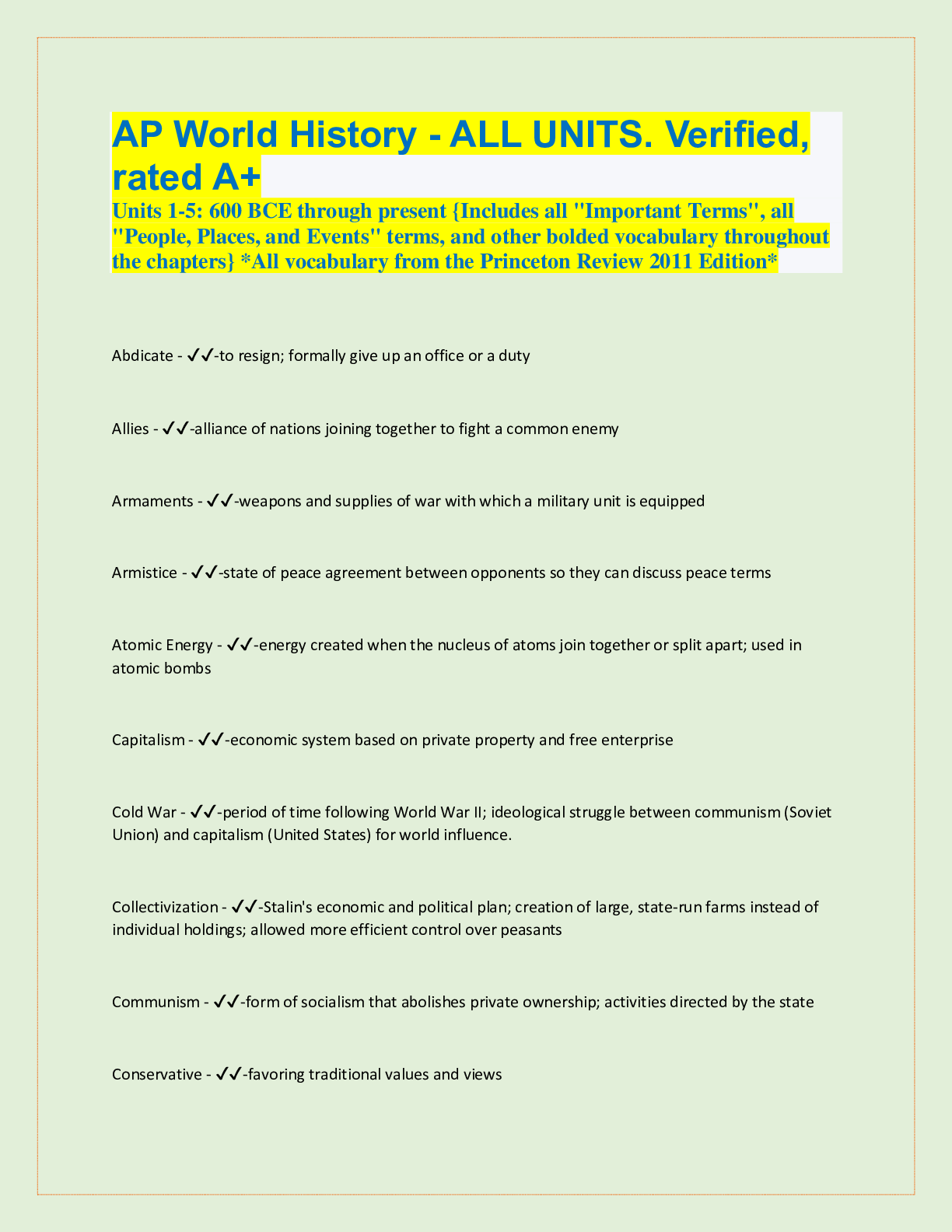
AP World History - ALL UNITS. Verified,
rated A+
Units 1-5: 600 BCE through present {Includes all "Important Terms", all
"People, Places, and Events" terms, and other bolded vocabulary throughout
the chapters} *All vocabulary from the Princeton Review 2011 Edition*
Abdicate - ✔✔-to resign; formally give up an office or a duty
Allies - ✔✔-alliance of nations joining together to fight a common enemy
Armaments - ✔✔-weapons and supplies of war with which a military unit is equipped
Armistice - ✔✔-state of peace agreement between opponents so they can discuss peace terms
Atomic Energy - ✔✔-energy created when the nucleus of atoms join together or split apart; used in
atomic bombs
Capitalism - ✔✔-economic system based on private property and free enterprise
Cold War - ✔✔-period of time following World War II; ideological struggle between communism (Soviet
Union) and capitalism (United States) for world influence.
Collectivization - ✔✔-Stalin's economic and political plan; creation of large, state-run farms instead of
individual holdings; allowed more efficient control over peasants
Communism - ✔✔-form of socialism that abolishes private ownership; activities directed by the state
Conservative - ✔✔-favoring traditional values and views
Containment - ✔✔-U.S. foreign policy adopted by President Harry Truman in the late 1940s; goal of
stopping spread of communism by creating alliances and helping weak countries to resist Soviet
advances
Decolonization - ✔✔-to free a colony to become self-governing or independent.
Deposed - ✔✔-removed from office or power
Democratization - ✔✔-creating a government elected by the people
Doctrine - ✔✔-belief or system of beliefs accepted as authoritative by some group or school
Egalitarian - ✔✔-a person who believes in the equality of all people
Ethnic Cleansing - ✔✔-the expulsion, imprisonment, or killing of ethnic minorities by a dominant
majority group
Exodus - ✔✔-journey by a large group to escape a hostile environment
Fascism - ✔✔-strong, centralized government with strict social and economic control; usually headed by
a dictator. First found in Italy by Mussolini.
First World - ✔✔-largely democratic and free-market states of the US and Western Europe
Front Line - ✔✔-line along which opposing armies face each other
Globalization - ✔✔-trend toward increased cultural and economic connectedness between people,
businesses, and organizations throughout the world.
Global Warming - ✔✔-increase in the average temperature of the earth's atmosphere causing climate
changes
Guerilla - ✔✔-member of a loosely organized fighting force that makes surprise attacks on enemy troops
Intervention - ✔✔-deliberate act of a nation or a group of nations to introduce its military forces into
the course of an existing conflict. "The World's Policeman"
Isolationism - ✔✔-national policy of avoiding involvement in world affairs
Jihad - ✔✔-holy war undertaken as a sacred duty by Muslims
Legislature - ✔✔-persons who make, amend or repeal laws
Liberal - ✔✔-Someone who favors federal government action to bring about social and economic reform
Militarism - ✔✔-policy of building up strong armed forces to prepare for war
Nationalism - ✔✔-pride in or devotion to one's country
Nationalize - ✔✔-to take over ownership by a national government
Nation-State - ✔✔-independent nation of people having a common culture and identity
Natural Resources - ✔✔-materials and energy in nature that are essential or useful to humans
National Socialist Party - ✔✔-Nazi party led by Adolf Hitler in Germany; picked up political support
during the economic chaos of the Great Depression; advocated authoritarian state under a single leader,
aggressive foreign policy to reverse humiliation of the Treaty of Versailles; took power in Germany in
1933.
Nuclear Weapons - ✔✔-deriving destructive energy from the release of atomic energy
Radical - ✔✔-opinions and actions that are far beyond the norm
Recession - ✔✔-economic slowdown of the economy; results in rising unemployment, increased
business failures, declining economic growth and higher personal bankruptcies.
Reform - ✔✔-make changes for improvement in order to remove abuse and injustices
Reparations - ✔✔-payments for war damage such as demanded of Germany in Treaty of Versailles after
WWI
Revolution - ✔✔-the overthrow of a government by those who are governed
Rivalry - ✔✔-competing against each other for something
Secular - ✔✔-worldly; not pertaining to church matters or religion
Sectarian - ✔✔-limited to the beliefs of a small group such as a religious sect; narrow in scope
Terrorism - ✔✔-calculated use of violence against civilians in order to attain political, religious or
ideological goals
Third World - ✔✔-Collective name for underdeveloped/developing countries of Asia and Africa and Latin
America
Totalitarian - ✔✔-single party and leader who suppress all opposition and control all aspects of people's
lives
Westernization - ✔✔-Adoption of western ideas, technology, and culture.
Apartheid - ✔✔-policy of racial segregation and oppression in the Republic of South Africa 1948-1994
Asian Tigers - ✔✔-Collective name for South Korea, Taiwan, Hong Kong, and Singapore-nations that
became economic powers in the 1970s and 1980s.
Aswan Dam - ✔✔-Dam across Nile River completed in 1970; Created Lake Nasser; increased Egypt's
farmland by 50%
Kemel Mustafa Ataturk - ✔✔-"Father of the Turks"; helped to create Republic of Turkey and wanted to
modernize [westernize] Turkey as well as separate religion and government
Ayatollah Khomeini - ✔✔-Shiite religious leader of Iran; overthrew Shah of Iran in 1979 Islamic
Revolution; ordered the invasion of the US Embassy
Balfour Declaration - ✔✔-British document that promised land in Palestine as homeland for Jews in
exchange for Jews help in WWI
Berlin Airlift - ✔✔-airlift in 1948 that supplied food and fuel to citizens of west Berlin when the Russians
closed off land access to Berlin
Bolshevik Party - ✔✔-Founded by Vladimir Lenin, this party later became known as the Communist Party
Fidel Castro - ✔✔-led revolution and took control of Cuba in 1959; established a Marxist socialist state
(communist)
Chiang Kai Shek - ✔✔-Leader of the nationalist government in China from 1925 until WWII; focused on
defeating the communists in China during the Long March
Winston Churchill - ✔✔-prime minister of Britain during world war II; coined term "iron curtain";
powerful speechmaker; rallied Allied morale
Cuban Missile Crisis - ✔✔-1962 confrontation bewteen US and the Soviet Union over Soviet missiles in
Cuba
Cultural Revolution - ✔✔-Campaign in China by Mao Zedong to purge the Communist Party of his
opponents and instill revolutionary values in the younger generation
Deng Xioaping - ✔✔-leader after Mao Zadong; led a group of practical minded reformers, ended cultural
revolution; shift towards family traditions, clothing changed, names not patriotic
Eastern Bloc - ✔✔-Soviet allies in eastern Europe; Bulgaria, Poland, East Germany, Czechoslovakia,
Romania, Hungary.
European Economic Community - ✔✔-EEC; Organization established in Western Europe by the Treaty of
Rome in 1958; also known as the common market.
European Union - ✔✔-international organization of Western European countries to promote free trade
among members
Fourteen Points - ✔✔-list of Wilson's terms for resolving WWI and future wars
Mahatma Gandhi - ✔✔-led nonviolent resistance to win India's freedom from British colonial rule;
believed in resisting injustice despite a threat of jail or enduring violent attacks.
Marcus Garvey - ✔✔-1920's African American leader; founded Universal Negro Improvement
Association and advocated mass migration of African Americans back to Africa.
Great Leap Forward - ✔✔-Mao's five-year failed plan; aimed to speed up economic development while
developing a socialist society; resulted in mass starvation between 1958 and 1960.
Adolph Hitler - ✔✔-German fascist leader of Nazi Party 1933-1945. rose to power by promoting racist
and national views; Mein Kampf
Ho Chi Minh - ✔✔-Communist leader of North Vietnam; he and his Viet Minh/Viet Cong allies fought
French and American forces to a standstill in Vietnam, 1946-1973.
Holocaust - ✔✔-mass slaughter of Jews and other civilians, carried out by the Nazi government of
Germany before and during World War II.
Saddam Hussein - ✔✔-President of Iraq from 1979 to 2003; Waged war on Iran in 1980-1988. In 1990 he
ordered an invasion of Kuwait but was defeated by United States and its allies in the Gulf War (1991).
Defeated by US led invasion in 2003.
IAEA - ✔✔-International Atomic Energy Agency; responsible for monitoring global nuclear activities
Intifada - ✔✔-uprising by Palestinian Arabs (in both the Gaza Strip and the West Bank) against Israel in
the late 1980s and again in 2000
Iran-Iraq War - ✔✔-1980-1988: Hussein vs. Khomeini; Iraq attacks Iran; over 1 mil. killed and war ends in
a stalemate; USA backs Iraq; secret deal with Iran
Iron Curtain - ✔✔-Term by Churchill to describe the East-West divide in postwar Europe between
communist and democratic nations
Israel - ✔✔-Jewish republic in southwestern Asia at eastern end of Mediterranean; formerly part of
palestine
Korean War - ✔✔-1950-1953; conflict between Communist North Korea and Non-Communist South
Korea. The United Nations (led by US) helped South Korea.
League of Nations - ✔✔-organization of nations formed after World War I to promote cooperation and
peace.
Vladimir Lenin - ✔✔-Russian founder of the Bolsheviks (later communist party); leader of the Russian
Revolution and first head of the USSR (1870-1924)
Mao Zedong - ✔✔-Leader of the Chinese Communist Party; led the Communists on the Long March
(1934-1935); rebuilt the Communist Party and Red Army during the Japanese occupation of China (1937-
1945).
Marshall Plan - ✔✔-United States program of economic aid for the reconstruction of Europe (1948-
1952)
NAFTA - ✔✔-North American Free Trade Agreement; allows open trade with US, Mexico, and Canada
NATO - ✔✔-North Atlantic Treaty Organization; an alliance made to defend one another if they were
attacked by any other country; US, England, France, Canada, Western European countries
OPEC - ✔✔-Organization of Petroleum Exporting Countries; founded in 1960 of nations that export large
amounts of petroleum; formed to establish oil-exporting policies and set prices.
Shah of Iran - ✔✔-Muhammad Reza Pahlovi, Leader of Iran with goals to nationalize their oil and
improve economy; pro-western; sparked Iranian Revolution; overthrown by Khomeini
Palestine - ✔✔-region at eastern end of the Mediterranean Sea that became the ancient home of the
jews; former name of the area that today includes israel
Rape of Nanjing - ✔✔-Japanese attack on Chinese capital from 1937-1938 when Japanese slaughtered
thousands of civilians and raped thousands of women in order to gain control of China
Six Days War - ✔✔-1967 clash between Israel and the Arab world; Israel was victorious
Josef Stalin - ✔✔-dictator of the USSR; Successor to Lenin; 5 years plans, collective farms, purges,
totalitarian rule, command economy
Sun Yat Sen - ✔✔-Overthrew old regime in China in 1911 and tried to replace it with democratic, liberal
and moderate socialist principles.
Third Reich - ✔✔-Third empire/republic of Germany; began by Hitler in 1933 and ended with his defeat
in 1945
Treaty of Versailles - ✔✔-treaty imposed on Germany by the Allied powers in 1920 after WWI; Germany
ordered to pay fines to the Allies to repay the costs of the war; lead to a severe depression in Germany.
Trench Warfare - ✔✔-fighting from ditches protected by barbed wire, as in WWI
Leon Trotsky - ✔✔-Russian revolutionary (communist); helped Lenin gain his power and win the civil war
by leading the Red army
Truman Doctrine - ✔✔-President Truman's policy of providing economic and military aid to any country
threatened by communism.
USSR - ✔✔-Union of Soviet Socialist Republics or soviet union; formed in 1922 by the communists;
dissolved in 1991
United Nations - ✔✔-organization founded after World War II to promote international peace and
cooperation.
Vietnam War - ✔✔-long war between North and South Vietnam; goal to prevent communisum in South
Vietnam; US usuccessfully assisted South Vietnam
War on Terror - ✔✔-After 9/11, President George W. Bush declared a worldwide "war on terrorism"
aimed at defeating terrorist groups, destroying terrorist training camps, and bringing terrorists to
justice.
Warsaw Pact - ✔✔-1955 treaty binding the Soviet Union and countries of eastern Europe in an alliance
against the North Atlantic Treaty Organization (NATO).
Woodrow Wilson - ✔✔-American President during WWI; developed 14 point plan; key figure in League
of Nations
WTO - ✔✔-World Trade Organization; international body established in 1995 to foster and bring order
to international trade.
World War I - ✔✔-"Great War" from 1914 to 1918 between the allies (Russia, France, British Empire,
Italy, United States, Japan, Rumania, Serbia, Belgium, Greece, Portugal, Montenegro) and the central
powers (Germany, Austria-Hungary, Turkey, Bulgaria)
World War II - ✔✔-War fought from 1939 to 1945 between the Allies and the Axis, involving most
countries in the world. The United States joined the Allies in 1941, helping them to victory.
Young Turks Party - ✔✔-Turkish revolutionary nationalist reform party; Committee of Union and
Progress (CUP); leaders led rebellion against the Ottoman sultan; effectively ruled the Ottoman Empire
from 1908 until shortly before World War I.
Abolish - ✔✔-do away with (e.g. slavery)
Assembly Line - ✔✔-Production method that breaks down a complex job into a series of smaller tasks
(Industrial Revolution)
Capital - ✔✔-wealth in the form of money or property owned by a person or business and human
resources of economic value
Cartel - ✔✔-a consortium of independent organizations formed to limit competition by controlling the
production and distribution of a product or service
Communism - ✔✔-a theory or system of social organization based on the holding of all property in
common, actual ownership being ascribed to the community as a whole or to the state.
Constitution - ✔✔-law determining the fundamental political principles of a government; the act of
forming something
Corporation - ✔✔-a group of people who are joined into one legal or commercial body
Doctrine - ✔✔-a belief (or system of beliefs) accepted as authoritative by some group or school
Domestic - ✔✔-of concern to or concerning the internal affairs of a nation; involving the home or family
Emancipation - ✔✔-freeing someone from the control of another (e.g. Emancipation Proclamation)
Enclosure - ✔✔-taking money small farms and making them into bigger ones in England during the
1700's
Enlightenment - ✔✔-a movement in the 18th century that advocated the use of reason in the
reappraisal of accepted ideas and social institutions; education that results in understanding and the
spread of knowledge
Estates-General - ✔✔-France's traditional national assembly with representatives of the three estates,
or classes, in French society: the clergy, nobility, and commoners. The calling of the Estates General in
1789 led to the French Revolution.
Factory - ✔✔-a plant consisting of buildings with facilities for manufacturing
Free Market - ✔✔-an economic system in which prices and wages are determined by unrestricted
competition between businesses, without government regulation or fear of monopolies.
Free Trade - ✔✔-international trade free of government interference; the removal of trade barriers so
that goods can flow freely between countries
Immigration - ✔✔-migration into a place (especially migration to a country of which you are not a native
in order to settle there)
Imperialism - ✔✔-A policy in which a strong nation seeks to dominate other countries politically,
socially, and economically.
Indemnity - ✔✔-legal exemption from liability for damages
Industrial Revolution - ✔✔-the change from an agricultural to an industrial society and from home
manufacturing to factory production, especially the one that took place in England from about 1750 to
about 1850.
Laissez-faire - ✔✔-a policy based on the idea that government should play as small a role as possible in
the economy
Labor Union - ✔✔-Organization of workers for the purpose of increased lobbying power for benefits and
wages; created to defend the interests of the members
Leisure - ✔✔-freedom provided by the cessation of activities; time free from work or duties
Marxism - ✔✔-the economic and political theories of Karl Marx and Friedrich Engels that hold that
human actions and institutions are economically determined and that class struggle is needed to create
historical change and that capitalism will ultimately be replaced
Nationalism - ✔✔-the doctrine that your national culture and interests are superior to any other
Natural Resources - ✔✔-materials found in nature that are used by living things
Rural - ✔✔-living in or characteristic of farming or country life
Social Class - ✔✔-a group of pe
[Show More]


, 5e Robert Strayer, Eric Nelson.png)
, 5e Robert Strayer, Eric Nelson.png)




, 4e Nancy Hewitt, Steven Lawson.png)
.png)
.png)
.png)