CPHQ Exam Flashcards (2022), Top Exam Questions with accurate answers, 100% Accurate, rated A+
Document Content and Description Below
CPHQ Exam Flashcards (2022), Top
Exam Questions with accurate answers,
100% Accurate, rated A+
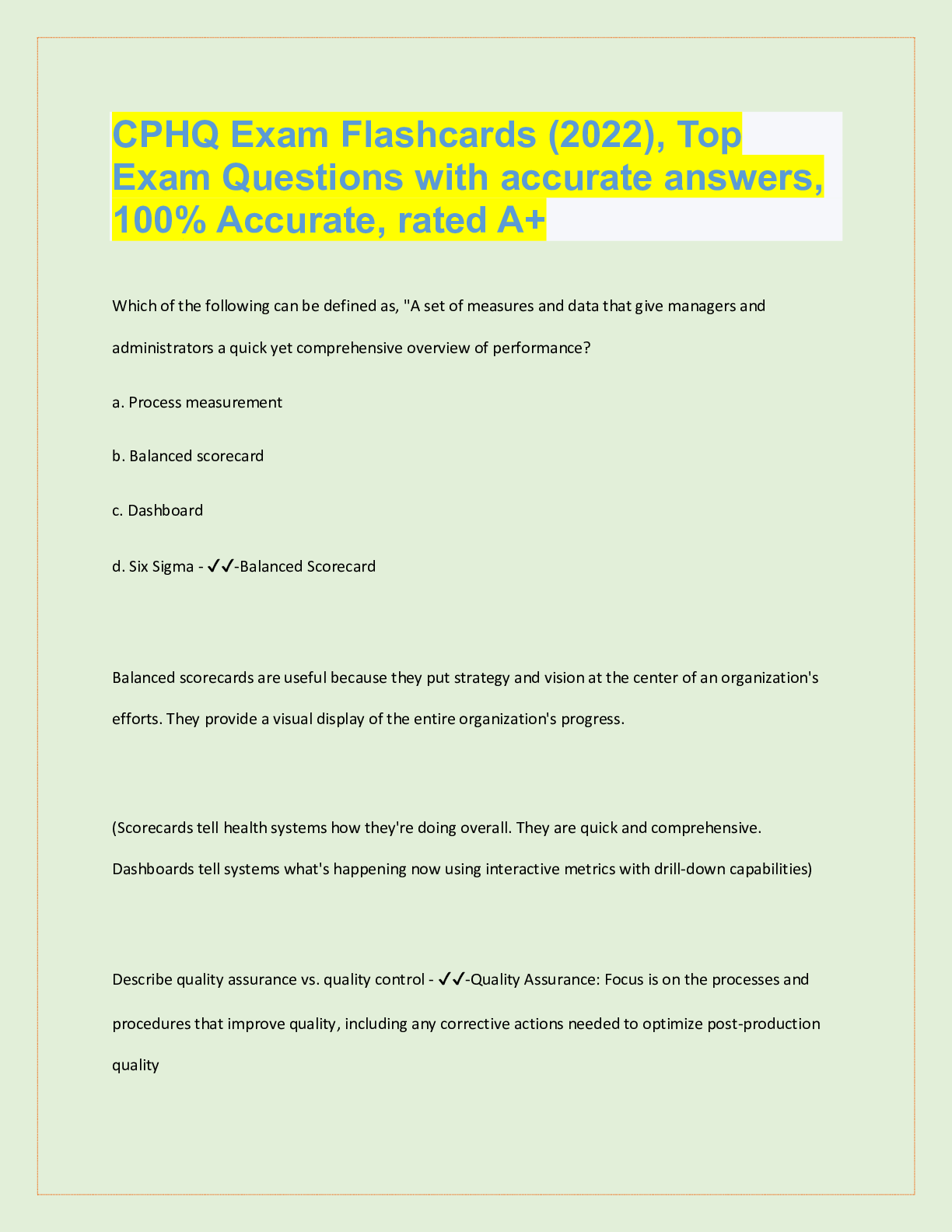
Which of the following can be defined as, "A set of measures and data that give managers and
admin
...
istrators a quick yet comprehensive overview of performance?
a. Process measurement
b. Balanced scorecard
c. Dashboard
d. Six Sigma - ✔✔-Balanced Scorecard
Balanced scorecards are useful because they put strategy and vision at the center of an organization's
efforts. They provide a visual display of the entire organization's progress.
(Scorecards tell health systems how they're doing overall. They are quick and comprehensive.
Dashboards tell systems what's happening now using interactive metrics with drill-down capabilities)
Describe quality assurance vs. quality control - ✔✔-Quality Assurance: Focus is on the processes and
procedures that improve quality, including any corrective actions needed to optimize post-production
quality
Quality Control: Focus on the product to find defects that occur after development
A patient care team is in disagreement over new admissions procedures. What decision-making model
should management use?
a. Decision criteria
b. Consensus
c. Tenure influence - ✔✔-Decision criteria
(This model explores all options equally and gives unorthodox or unpopular options a fair chance)
How does the World Health Organization Surgical Safety Checklist lead to tight coupling in the operating
room?
a. It establishes universality for patients
b. It compartmentalizes the procedures
c. It establishes a clear OR hierarchy
d. It closely aligns the various individuals involved in the process - ✔✔-It closely aligns the various
individuals involved in the process
Define risk management - ✔✔-Taking steps to avoid and control risks within an environment to
accomplish a desired outcome
Describe internal vs. external customers - ✔✔-Internal customers work within the organizational
structure. External customers rely on and/or utilize the healthcare organization and product (patients,
family members, medical equipment suppliers)
Within the last 4 days, three post-surgical patients have died of pneumonia-related complications at a
large hospital. None of the patients presented as symptomatic for pneumonia at the time of surgery.
What evaluation tool should be used to help identify and resolve this issue?
a. Epidemiological theory
b. Performance management measures
c. Statistical analysis
d. Improvement measures - ✔✔-Epidemiological Theory, which is used to identify the source and cause
of an issue or anomaly
(The other tools are used to quantify data or examine processes that can contribute to improvement)
When Hospital A's neonatal infection rates rise unexpectedly, the quality council establishes a new set
of performance measures. They base their measures on internal standards, customer survey data, and
employee survey data. What important element are the members disregarding? - ✔✔-External
standards, such as national goals and requirements
(External data provides a context for the internal data and distinguishes where and how the facility falls
compared to national standards)
What challenges often occur with the use of aggregated data? - ✔✔-Context is lost and solutions are not
identified
What elements should be part of an employee performance improvement plan? What elements should
NOT be part of a performance improvement plan? - ✔✔-1) A clear statement of the problems to be
addressed
2) Specific action steps to be taken as part of the plan
3) A desired outcome or goal behavior and a timeline
(It does NOT include any research into the cause of an employee's challenges)
Recent HCAHPS data for Hospital A indicate that doctors are not providing adequate explanations to
patients. In improving the patient safety culture with regards to this issue, what two elements must be
addressed?
a. Patient perceptions and clinical quality
b. Patient perceptions and physician education
c. Physician education and time constraints
d. Quality standards and time constraints - ✔✔-Patient perceptions and clinical quality
(Patient perception includes the mode of communication, the depth of information, and
understandability of the context. Clinical quality includes the doctor's understanding of communication
techniques, health literacy, etc.)
Which of the following are the primary reasons for developing drug formularies?
a. Manage pharmacy costs, promote patient safety
b. Reduce medication errors, educate physicians
c. Encourage the appropriate use of medications, educate physicians
d. Decrease food and drug interactions, promote patient safety - ✔✔-A drug formulary is an approved
list of medications, clinical indications, and doses that helps manage pharmacy costs and patient safety
Management using quality improvement principles should emphasize the importance of:
a. Staff orientation
b. Customers' expectations
c. Quarterly statistical reports
d. Team selection - ✔✔-The basis of quality improvement is knowing what the customer needs and
wants (b) The rest are only one component of quality improvement.
Quality improvement teams are beneficial because they
a. Promote competition and pride among members
b. Maximize expertise and perspectives
c. Authorize solutions to problems - ✔✔-A diverse team, including members with different experience
and backgrounds, provides a broader knowledge base and outcomes
Which of the following is an essential component in a performance improvement report?
a. Governing body approval
b. Data analysis and display
c. Individual performance review
d. Team composition and attendance - ✔✔-Data and analysis display
What is the primary goal of risk management? - ✔✔-To identify and manage risks to promote patient
safety
The relationship between patient satisfaction and hours per patient day on a medical unit was found to
be (r=0.60, p < 0.05). What is the correlation between these two values?
a. 0.05
b. 0.36
c. 0.55
d. 0.60 - ✔✔-The correlation coefficient (r) is an index that ranges from -1 to 1 and reflects the extent of
a linear relationship between two data sets. The correlation coefficient is 0.60.
For a quality improvement team to deal effectively with conflict, it is important to appoint which of the
following to its membership?
a. Risk manager
b. HR representative
c. Facilitatior
d. Senior leader - ✔✔-A facilitator is an unbiased party that may help groups deal with conflict (c)
Which of the following best describes an organizational vision statement?
a. It is used as a marketing strategy
b. It defines the structure of the institution
c. It describes the organization's strategic plan
d. It reflects the organization's aspirations - ✔✔-An organization's vision statement reflects its
aspirations and goals for the future
(Not to be confused with the mission statement, which describes the organization's purpose or reason
for existence)
The most effective way for a healthcare quality professional to communicate quality improvement
activities to the medical staff is by:
a. Evaluating physician participation on quality teams
b. Inviting medical staff to an in-service on quality tools
c. Providing outcome data at medical staff meetings
d. Developing professional relationships - ✔✔-Providing outcome data at medical staff meetings
(Outcome data communicates objective feedback to medical staff)
Quality improvement team progress is best evaluated by which of the following?
a. Team leader
b. Senior leadership
c. PDCA/PDSA process
d. Nominal group technique - ✔✔-PDCA/PDSA process
(The Plan, Do, Check, Act process is a comprehensive methodology used to conduct performance
improvement activities, including the analysis of progress)
A team has identified a process for improvement, selected examples of best practice performers, visited
those sites, gathered all necessary data, and compiled the results. The most effective next step for the
team is to
a. Identify the next process to benchmark
b. Implement change at the team's site
c. Compare results to historical data
d. Make the results public for others to use for benchmarking - ✔✔-Implementation (b) is the next step
in the performance improvement cycle
Which of the following is essential to an effective quality council?
a. Involvement of leadership
b. Consultation of the legal advisor
c. Participation of the strategic planning committee
d. Direction from the organization's quality team - ✔✔-Leadership involvement (a) promotes an
effective quality council through resource and support allocation to achieve objectives
Organizational leaders can best demonstrate commitment to a new quality improvement initiative by
a. Reviewing the quality improvement plan
b. Offering solutions to identified problems
c. Allocating resources for the process - ✔✔-Allocating resources
(Potential solutions are best offered by the participants in the process (front line staff))
List the steps of an FMEA - ✔✔-1) Define topic and process to be studied
2) Build interdisciplinary team with content and process experts
3) Develop flow diagram of process and sub-processes
4) List all possible failure modes for each sub-process and determine the severity of each effect
5) Identify an action plan for each failure mode that will be corrected
6) Identify the measures that will be used to analyze and test the redesigned process. Identify the
person responsible for completing each action
When is an FMEA performed? - ✔✔-The FMEA process is a proactive, systematic method of identifying
and preventing incidents before they occur.
Used for new systems/processes, redesign of systems/processes in early stages, and existing
systems/processes
Based on identified issues, a healthcare quality professional examines 100% of one physician's
admissions and only 20% of all other physicians' admissions. This is best described as a
a. Focused review
b. Prospective review
c. Retrospective review
d. Concurrent review - ✔✔-Focused review
(A prospective review is performed prior to care, and a concurrent review is performed at the onset and
during care. This case is a retrospective review, but "focused review" is more accurate.)
Which of the following are essential functions of an infection control program?
a. Risk management and surveillance
b. Prevention and education
c. Surveillance and prevention
d. Patient safety and risk management - ✔✔-Surveillance and prevention (c)
What are the responsibilities of an organization's governing body (board of directors)? What is it NOT
responsible for? - ✔✔-The governing body is responsible for setting policy, financial and strategic
direction, quality of care, and setting goals and objectives
It is NOT responsible for implementing strategies and collecting measurements of quality indicators
In an organization, who assumes full responsibility for the quality of care provided in an organization? -
✔✔-The governing body
An RCA revealed a patient in an acute psychiatric unit committed suicide by hanging himself with his
shoelaces. To prevent this from occurring again, the most appropriate action is to institute:
a. A buddy system for the patients
b. A 24-hour video monitoring system
c. A policy allowing only non-laced shoes
d. Patient checks every 15 minutes - ✔✔-A policy allowing only non-laced shoes
(This policy eliminates the object that was used to commit suicide and creates a safer environment)
Patient satisfaction scores for a community hospital demonstrate multiple areas for improvement
including a need to improve attractiveness of the facility, responsiveness to patient needs, and physician
and nursing communication. Based on these results, which of the following should the healthcare
quality professional also expect to find?
a. Administration prioritizing and leading units to achieve organizational goals
b. Unit managers who openly discuss patient satisfaction scores
c. Units operating independently with little communication between units
d. Employee satisfaction scores in the 80th percentile compared to other peer organizations - ✔✔-Units
operating independently with little communication between units (c)
(Responsiveness to patient needs requires effective communication between multiple units as well as
staff)
A team approach to problem solving is most useful when
a. The organization's goals are unclear
b. Diverse areas of expertise are required
c. Communication challenges exist
d. There are ample resources within the organization - ✔✔-Diverse areas of expertise are required (b)
(The make-up of a team that varies in perspective and experience provides a variety of skill sets that will
help solve problems)
A performance improvement training program has been conducted. The healthcare quality professional
has determined that improvement has not occurred. What is the most likely cause for the lack of
improvement? - ✔✔-System challenges within the organization. There must be a culture that fosters
safety as a priority for everyone within the organization
A facility has identified a trend of increased falls for patients aged 60 to 85 years. An effective fall
prevention program should include
a. A fall protocol, restraint criteria, and a family sitter program.
b. Restraint criteria, staff education, and a sedation protocol.
c. A patient assessment process, a family sitter program, and a sedation protocol.
d. A patient assessment process, a fall protocol, and staff education. - ✔✔-A patient assessment
process, a fall protocol, and staff education (d)
(According to the CMS Conditions of Participation for hospitals and long-term care, patients or residents
have the right to be free of restraints of any form (physical or drug) that are not medically necessary)
A Quality Council has chartered a performance improvement team to reduce medication errors. The
team has been meeting for several months and progress has been very slow. Which of the following is
the most important factor for the Quality Council to assess with the team leader?
a. Composition of the team
b. Number of medication errors since the team was chartered
c. Team members' ability to interpret graphs
d. Frequency of team meetings - ✔✔-The composition of the team (a) is the most important factor and
is often the main cause of team failure. Having the right team in place is essential.
A number of specialty and primary care clinicians have participated in several meetings to develop
clinical practice guidelines for the management of diabetes. The team leader has moved the team
through the actual guideline development, and is now concentrating on the "evaluation of quality-of�care" phase. Which of the following sequences of steps should the team consider in developing the
evaluation phase?
a. Identify medical review criteria, identify sampling methods to be used, define objectives of the
performance review, pilot test
b. Develop data collection form, identify populations covered by the guideline, identify the data sources,
conduct the review
c. Define objectives of the performance review, identify populations covered by the guideline, develop
data collection form, pilot test
d. Consider costs of the review, identify clinicians and sites of care, define objectives of the performance
review, develop data collection form - ✔✔-Objectives (c) must be defined first, before anything else can
be done
Evaluating medication administration to reduce medical errors is an example of
a. Quality managemen
[Show More]
Last updated: 2 years ago
Preview 1 out of 78 pages
.png)
 answers.png)

.png)