EPPP Practice Exam Questions &
Answers, 100% Accurate, Graded A+
J. Berry acculturation, integration - ✔✔-J. Barry conceptualizes acculturation as many models existing on
a continuum, with the minority culture and t
...
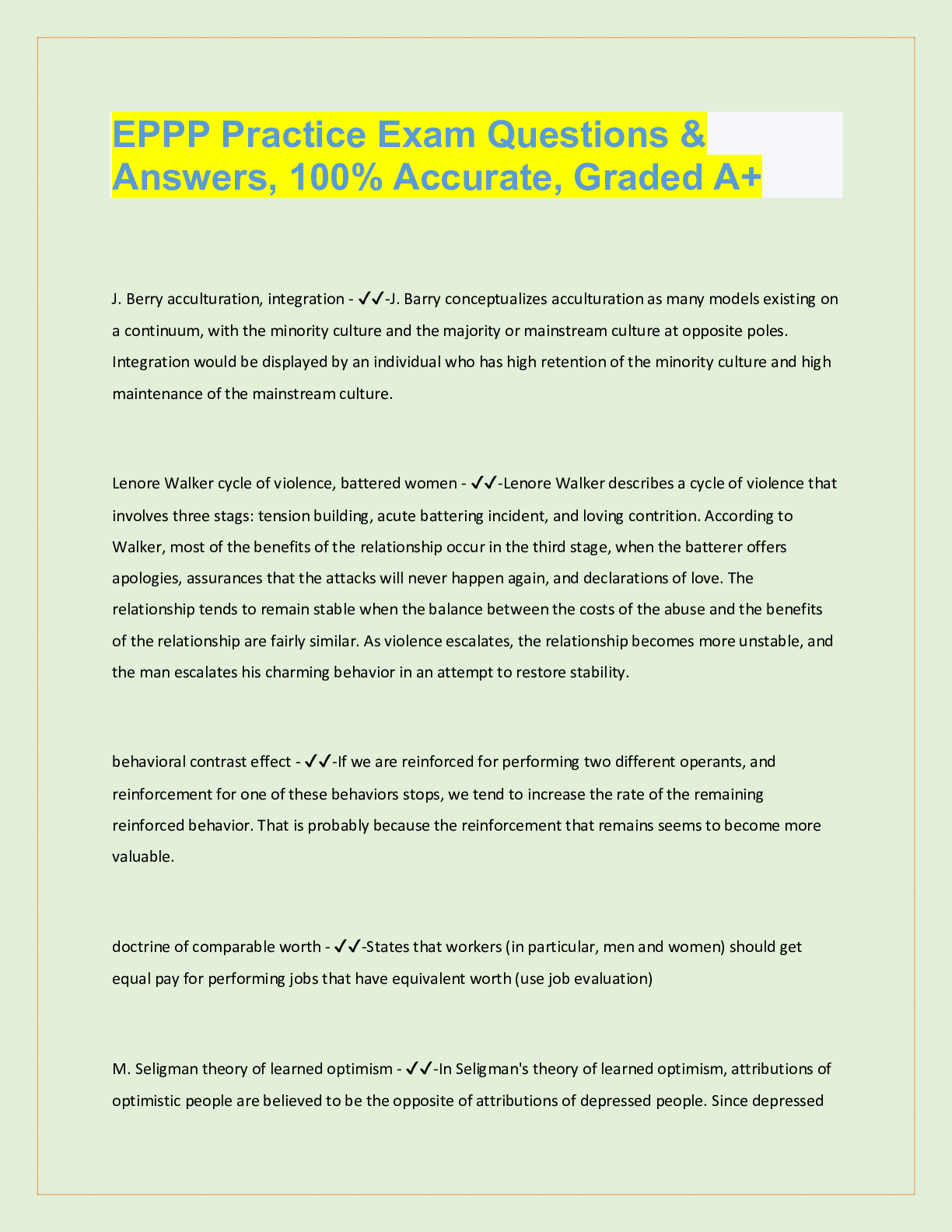
EPPP Practice Exam Questions &
Answers, 100% Accurate, Graded A+
J. Berry acculturation, integration - ✔✔-J. Barry conceptualizes acculturation as many models existing on
a continuum, with the minority culture and the majority or mainstream culture at opposite poles.
Integration would be displayed by an individual who has high retention of the minority culture and high
maintenance of the mainstream culture.
Lenore Walker cycle of violence, battered women - ✔✔-Lenore Walker describes a cycle of violence that
involves three stags: tension building, acute battering incident, and loving contrition. According to
Walker, most of the benefits of the relationship occur in the third stage, when the batterer offers
apologies, assurances that the attacks will never happen again, and declarations of love. The
relationship tends to remain stable when the balance between the costs of the abuse and the benefits
of the relationship are fairly similar. As violence escalates, the relationship becomes more unstable, and
the man escalates his charming behavior in an attempt to restore stability.
behavioral contrast effect - ✔✔-If we are reinforced for performing two different operants, and
reinforcement for one of these behaviors stops, we tend to increase the rate of the remaining
reinforced behavior. That is probably because the reinforcement that remains seems to become more
valuable.
doctrine of comparable worth - ✔✔-States that workers (in particular, men and women) should get
equal pay for performing jobs that have equivalent worth (use job evaluation)
M. Seligman theory of learned optimism - ✔✔-In Seligman's theory of learned optimism, attributions of
optimistic people are believed to be the opposite of attributions of depressed people. Since depressed
people make internal, stable, and global attributions to negative events, optimistic people would tend to
make external, unstable, and specific attributions in response to negative events. Therefore, we can
readily eliminate "B" ("I didn't study enough") since that's an internal attribution. Choice "C" ("the
teacher is always a tough grader") is a stable attribution. That leaves Choices "A" ("I was unlucky") and
Choice "D" ("the test was hard this time") - which are both external and unstable attributions. Of the
two, however, Choice "D" is better since being unlucky would imply that success is a matter of luck.
Course of Antisocial Personality Disorder - ✔✔-The symptoms of Antisocial Personality Disorder (APD),
particularly criminal behaviors, often become less evident as an individual grows older (DSM-TR-IV, p.
704). APD has a chronic course and while some symptoms like criminal behaviors may decrease, other
symptoms such as difficulties with interpersonal relationships may persist. (See: Paris, J. (2004).
Personality disorders over time: Implications for therapy, American Journal of Psychotherapy, 58(4),
420-429.)
Group polarization - ✔✔-A group's decisions tend to be more extreme (in one direction or the other)
than those that would be made by individuals in the group acting alone. This phenomenon is referred to
as group polarization. One explanation for group polarization is that group members are more willing to
support extreme decisions because, as group members, they won't have to take as much personal
responsibility for their decisions as they would if they were acting alone.
Solomon's four group design - ✔✔-a true experimental design used to evaluate the effects of pretesting,
since some groups are pretested and others are not.
MANOVA - ✔✔-A MANOVA (multivariate analysis of variance) is used to analyze the effects of one or
more independent variables on two or more dependent variables that are each measured on an interval
or ratio scale.
factorial ANOVA - ✔✔-A factorial ANOVA (a.) is used to analyze data when a factorial design, which
includes two or more independent variables, is used and the dependent variable is measured on an
interval or ratio scale.
Factorial designs also allow for the assessment of both main effects (the effects of each independent
variable considered individually) and interaction effects (the effects of each variable at the different
levels of the other variable). The study described in this question has two "significant main effects" for
the independent variables: type of reading program and past level of reading comprehension. And a
"significant interaction effect" means that the effects of the different reading programs varied
significantly for students at different reading levels. For example, "Reading Program A" may have been
highly effective for above average students, moderately effective for average students, yet ineffective
for below average students. On the other hand, "Reading Program B" may have been only effective for
below average students, while "Reading Program C" may not have been effective for any students.
One-Way ANOVA - ✔✔-A one-way ANOVA (c.) is used when a study has one independent variable and
more than two independent groups.
Split-Plot (mixed) ANOVA - ✔✔-The split-plot (mixed) ANOVA (d.) is the appropriate technique when at
least one independent variable is a between-groups variable and another independent variable is a
within-subjects variable.
experiment wise error rate - ✔✔-alpha (chance of Type I error) for all analyses done on a data set
capitation - ✔✔-A common method of reimbursement used primarily by health maintenance
organizations in which the provider or medical facility is paid a fixed, per capita amount for each
individual enrolled in the plan, regardless of how many or few services the patient uses.
time-series quasi-experimental design - ✔✔--Used when only ONE group is available to study over a
longer period of time
-Useful for determining trends over time
-Data are collected multiple times before the introduction of the treatment ot establish a baseline point
of reference on outcomes.
-The experimental treatment is introduced and data are collected multiple times afterward to determine
a change from baseline.
-The broad range and number of data-collection points helps rule out alternative explanations, such as
history effects.
-Potential threats to Internal validity: Testing--b/c of multiple data-collection points, maturation and
selection--b/c lack of control group
Transvestic fetishism - ✔✔-heterosexual male has recurrent intense sexually arousing fantasies, sexual
urges, or behaviors involving cross dressing.
Exhibitionism - ✔✔-exposing of one's genitals to an unsuspecting stranger
Gender Identity Disorder - ✔✔-strong and persistent cross-gender identification with evidence of
clinically significant distress or impairment in social, occupational, or other areas of functioning.
cognitive dissonance - ✔✔-The theory that we act to reduce the discomfort we feel when two of our
thoughts are inconsistent. For example, when our awareness of our attitudes and our actions clash, we
can reduce the resulting dissonance by changing our attitudes.
A person is motivated to reduce the negative, aversive state that results when his or her cognitions
conflict with each other. From the perspective of this theory, the poor client paying a very high fee
would experience a state of dissonance. Therefore, this client, more than those in the other responses,
would be motivated to believe that he or she is benefitting from therapy.
Sleep patterns of persons with/at-risk of depression - ✔✔-Research has found that depression is most
associated with a more rapid onset of REM sleep, decreased percentage of slow wave sleep, and
increased percentage of REM sleep. The research also suggests that individuals with no prior history of
depression but who have rapid REM onset have an increased risk of developing depression (e.g., D.
Giles, D. Kupfer, A. Rush, & H. Roffwarg, Controlled comparison of electrophysiological sleep in families
of probands with unipolar depression. American Journal of Psychiatry, 1998, 155(2), 192-199).
blocking - ✔✔-Blocking occurs when a CS is presented simultaneously with a second stimulus just before
the US. Although it would seem that the second stimulus should acquire the properties of a CS from this
procedure, that's not what happens. Instead, the second stimulus does not produce a conditioned
response.
Alderian - ✔✔-For Adlerians, a desire to belong is a primary motivator of behavior, but this desire may
be channeled into the mistaken goals of power, attention, inadequacy, or revenge., Feelings of
inferiority contribute to problems in children and adults
Teological approach-behavior is shaped by future goals (NOT the past)
Innate social interest motivates people, ways to fulfill social responsibility
Key Concepts:
Inferiority feelings
Striving for superiority
Style of Life
Social Interest
Inferiority feeling develop during childhood while striving for superiority. Ways a person tries to
compensate for inferiority and achieve superiority determines one's style of life
Personality is determined by age 46
Three major life tasks could be:
o Love
o Friendship
o Occupation
focus on prevention
central limit theorem - ✔✔-the shape of a sampling distribution of means approaches normality as
sample size increases
extinction - ✔✔-elimination or reduction in the frequency of a response achieved by the removal of the
reinforcement maintaining the response. The extinction of temper tantrums would entail ignoring the
child's behavior or not reinforcing it with attention. This technique has been found to be effective for
reducing temper tantrums.
thinning - ✔✔-Continuous schedules, or reinforcing every response, are associated with quick learning,
satiation and extinction. The process of thinning, or switching from a continuous to an intermittent
schedule, is used to increase the resistance to extinction once a behavior is established.
Minuchin's family therpary - ✔✔-Salvador Minuchin's Structural Family Therapy is based on and extends
general family systems theory. The goal is to restructure maladaptive family structures, including family
subsystems and boundaries.
Paresis - ✔✔-The term "paresis" means partial paralysis. Paresis can occur as a result of an injury to the
spinal cord that does not result in its severation.
Paraplegia - ✔✔-If the spinal cord is severed, the result could be paraplegia (paralysis of the lower limbs)
Quadriplegia - ✔✔-(paralysis of all four limbs),
hemiplegia - ✔✔-(paralysis of one side of the body), depending on the location of the lesion
Dialectal behavior therapy treatment - ✔✔-Linnehan uses dialectical behavioral therapy (DBT) in the
treatment of Borderline Personality Disorder. DBT is a type of cognitive behavioral therapy that
emphasizes social skills training, self-soothing exercises, and group dynamics. The patient is offered
intensive individual and group sessions that are a combination of psychoeducation and cognitive
therapy. DBT has been shown to reduce hospitalization and self-mutilating behavior (Linnehan, Heard,
and Armstrong, 1993).
Schizophrenia Type I - ✔✔--positive symptoms (delusions or hallucinations, inappropriate affect, and
disorganized thinking)
-neurotransmitter abnormalities or irregularities
Schizophrenia Type II - ✔✔-mainly negative symptoms, worse premorbid functioning, earlier onset,
worse recovery, worse response to medication, believed due to a structural brain problem
MANOVA - ✔✔-used when two or more dependent variables are included in a study. Rather than using
separate ANOVAs to evaluate the effects of each of the dependent variables, a researcher could use the
MANOVA when all the dependent variables are measured on a ratio or interval scale. This also helps to
control the experiment-wise error rate.
Bronfenbrenner's ecological model - ✔✔--microsystem: immediate environment, face-to-face rx
(rx w/ parents, siblings, school, neighbors, etc)
-mesosystem: interactions btwn components of microsystem (influence of family on bx at school)
-exosystem: broader environ that affects child's environ
(parents' workplace, school board, community, media)
-macrosystem: overarching environ influences
(cultural beliefs/practice, econ conditions, political ideologies)
-chronosystem: environ events over lifetime that impact them (immediate and LT effects of change in
family structure/ SES)
Item characteristic curve - ✔✔-curve developed in Item Response Theory to represent the probability of
getting an item correct based on test-taker characteristics; the slope of the curve is representative of
how well the item differentiates/discriminates test-takers on the measured characteristic; position of
the curve (left vs right) is representative of the item difficulty, and the Y-intercept is the probability of
answering the item correctly just by guessing (answer A).
self-verification theory - ✔✔-a theory that people want others to perceive them as they perceive
themselves, regardless of whether they see themselves in a positive or negative light; holds that people
strive for stable, subjectively accurate beliefs about the self because such beliefs give them a sense of
coherence.
item response theory - ✔✔-a mathematical approach to choosing test items in which the probability of
a positive response to an item is determined by the person's estimated position on the underlying trait
being measured, as well as by characteristics of the item
-theoretical basis of computer adaptive assessment, in which tests tailored to the examinee's ability
level are computer generated
Overall, more reliable estimate of ability is obtained using shorter test with fewer items
- you need a bank of items that have been systematically evaluated for level of difficulty
-invariance of item parameters, holds that the characteristics of items should be the same for all
theoretically equivalent groups of subjects chosen from the same population. Thus, any culture-free test
should demonstrate such invariance; i.e., a set of items shouldn't have a different set of characteristics
for minority and non-minority subgroups. For this reason, item response theory has been applied to the
development of culture-free tests
-research supports the notion that the assumptions of item response theory only hold true for very large
samples
-
dexedrine - ✔✔-an isomer of amphetamine (trade name Dexedrine) used as a central nervous system
stimulant, used in treatment of ADHD
dolophine - ✔✔-used in treatment of heroin addiction
depakote - ✔✔-mood stabilizer, used in treatment of biploar disorder
tegretol - ✔✔-Mood Stabilizer, treatment of bipolar disorder
relationship of fluid and crystallized intelligence - ✔✔-Cattell and Horn distinguish between fluid and
crystallized intelligence. The former is independent of specific instruction and is relatively culture free,
while the latter depends on exposure to education and is affected by cultural experiences. Cattell and
Horn believed that these two aspects of intelligence
[Show More]