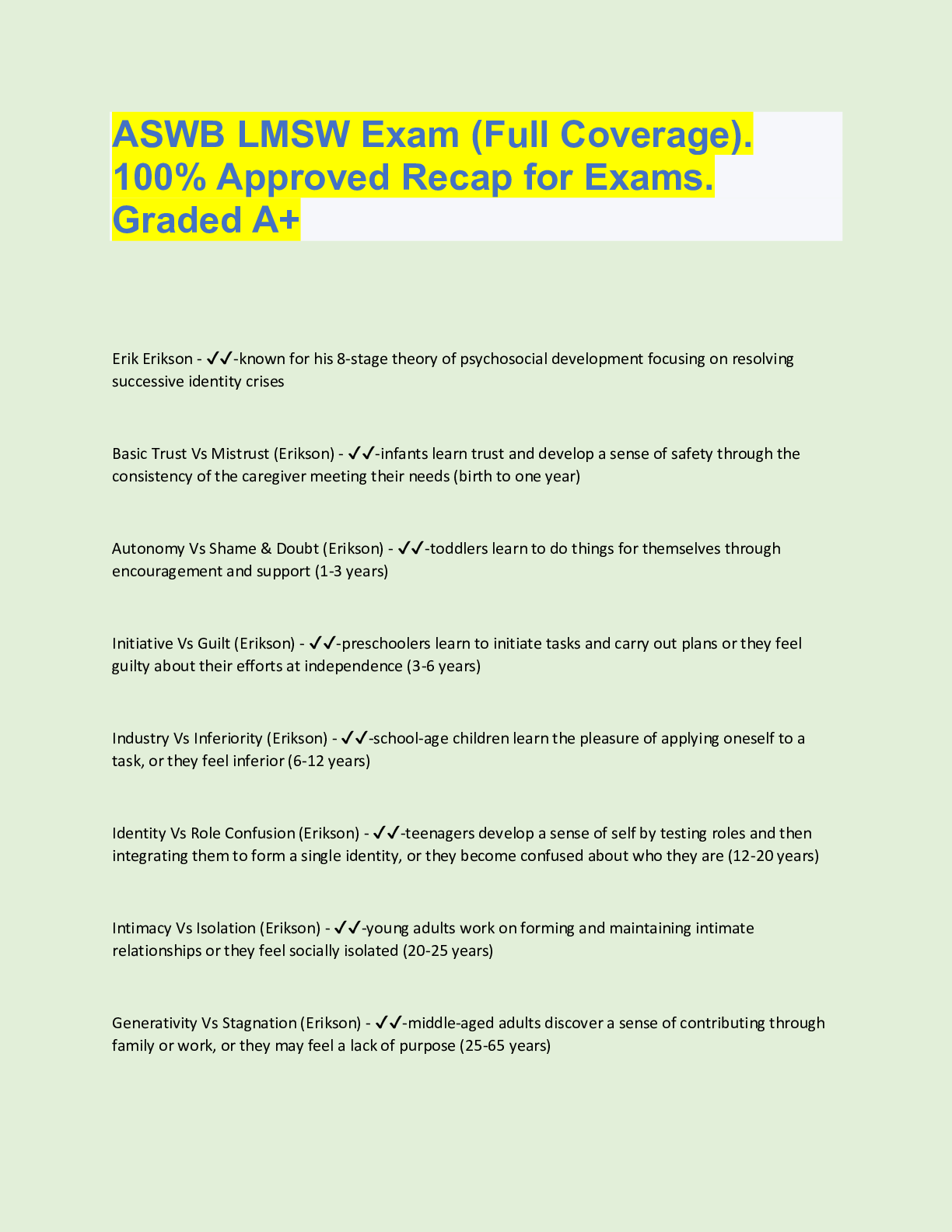
ASWB LMSW Exam (Full Coverage).
100% Approved Recap for Exams.
Graded A+
Erik Erikson - ✔✔-known for his 8-stage theory of psychosocial development focusing on resolving
successive identity crises
Basic Trust Vs
...
ASWB LMSW Exam (Full Coverage).
100% Approved Recap for Exams.
Graded A+
Erik Erikson - ✔✔-known for his 8-stage theory of psychosocial development focusing on resolving
successive identity crises
Basic Trust Vs Mistrust (Erikson) - ✔✔-infants learn trust and develop a sense of safety through the
consistency of the caregiver meeting their needs (birth to one year)
Autonomy Vs Shame & Doubt (Erikson) - ✔✔-toddlers learn to do things for themselves through
encouragement and support (1-3 years)
Initiative Vs Guilt (Erikson) - ✔✔-preschoolers learn to initiate tasks and carry out plans or they feel
guilty about their efforts at independence (3-6 years)
Industry Vs Inferiority (Erikson) - ✔✔-school-age children learn the pleasure of applying oneself to a
task, or they feel inferior (6-12 years)
Identity Vs Role Confusion (Erikson) - ✔✔-teenagers develop a sense of self by testing roles and then
integrating them to form a single identity, or they become confused about who they are (12-20 years)
Intimacy Vs Isolation (Erikson) - ✔✔-young adults work on forming and maintaining intimate
relationships or they feel socially isolated (20-25 years)
Generativity Vs Stagnation (Erikson) - ✔✔-middle-aged adults discover a sense of contributing through
family or work, or they may feel a lack of purpose (25-65 years)
Ego Integrity Vs Despair (Erikson) - ✔✔-older adults reflect on satisfaction with their lives or feel a sense
of failure (65 years to death)
Social Development - Micro - ✔✔-learning how to behave and interact well with others; learning how to
manage feelings in a way that is productive rather than counterproductive
Social Development - Macro - ✔✔-learning how people interact in groups and society (family,
community), especially in regards to social norms, institutional change, and inclusion
Emotional Development - ✔✔-learning self-awareness, self-regulation, social skills, cooperation,
attention, transitioning from one activity to another, self-confidence, forming and maintaining
relationships
Six Levels of Cognition - ✔✔-knowledge, comprehension, application, analysis, synthesis, evaluation
(KCAASE)
Knowledge - ✔✔-rote memorization, recognition, recall of facts (1st level of cognition)
Comprehension - ✔✔-understanding what facts mean (2nd level of cognition)
Application - ✔✔-correct use of facts, rules, or ideas (3rd level of cognition)
Analysis - ✔✔-breaking information down into its component parts (4th level of cognition)
Synthesis - ✔✔-combination of facts, ideas, or information to make a new whole (5th level of cognition)
Evaluation - ✔✔-judging or forming an opinion about the information or situation (6th level of
cognition)
Jean Piaget - ✔✔-known for his 4-stage theory of cognitive development in children
Sensorimotor Stage (Piaget) - ✔✔-infants and young toddlers explore using the senses and learn object
permanence (birth to 2 years)
Preoperational Stage (Piaget) - ✔✔-young children engage in symbolic thinking (pretend play and
imaginary friends) and concrete, egocentric thinking (2-7 years)
Concrete Operations Stage (Piaget) - ✔✔-school-age children engage in logical thinking, understanding
rules and cause-effect relationships (7-11 years)
Formal Operations Stage (Piaget) - ✔✔-by puberty, people are able to engage in abstract hypothetical
thinking, plan for the future, and test hypotheses (11 years through adulthood)
Lawrence Kohlberg - ✔✔-known for his theory of stages of moral development
Preconventional Morality (Kohlberg) - ✔✔-obeys authority out of fear of punishment; acts in own best
interests; conforms to receive rewards (childhood)
Conventional Morality (Kohlberg) - ✔✔-acts to gain approval from others; obeys laws and fulfills
obligations to maintain social system; avoids censure and guilt (adolescents & most adults)
Postconventional Morality (Kohlberg) - ✔✔-genuine interest in others' welfare; concerned with
individual rights and being morally right; guided by principles and concerns based on broad, universal
ethics and morality (some adults)
Learning Theory - Behaviorism - ✔✔-learning is viewed through change in behavior and the stimuli in
the external environment are the locus of learning; change the external environment and change
behavior
Learning Theory - Cognitive Theory - ✔✔-learning is viewed through internal mental processes (insight,
information processing, memory, perception) and the locus of learning is internal cognitive structures;
develop opportunities to foster capacity and skills to improve learning
Learning Theory - Humanism - ✔✔-learning is viewed as a person's activities aimed at reaching his or her
full potential, and the locus of learning is in meeting cognitive and other needs; develop the whole
person
Learning Theory - Social Theory - ✔✔-learning is obtained between people and their environment--their
interactions and observations in social contexts; establish opportunities for conversation and
participation
Respondent Behavior (Behaviorism) - ✔✔-involuntary behavior (anxiety, sexual response) that is
automatically elicited by certain behavior. A stimulus elicits a response.
Operant Behavior (Behaviorism) - ✔✔-voluntary behavior (walking, talking) that is controlled by its
consequences in the environment
Classical Conditioning - ✔✔-learning to associate an involuntary response and a stimulus (Pavlov's dogs
develop the expectation that they will be fed when a bell rings)
Operant Conditioning - ✔✔-learning to associate a voluntary response with a consequence (Skinner's
rats develop the expectation that they will get food by pressing a lever)
Best known applications of behavior modification - ✔✔-sexual dysfunction, phobic disorders,
compulsive behaviors (overeating, smoking), and training for people with intellectual disabilities or
Autism Spectrum Disorder
Behavioral theories suggest that personality is a result of... - ✔✔-interaction between the individual and
the environment
Behavioral theories focus on... - ✔✔-observable and measurable behaviors rather than internal thoughts
and feelings
advantages of client self-monitoring (Behaviorism) - ✔✔-inexpensive, practical, therapeutic
disadvantages of client self-monitoring (Behaviorism) - ✔✔-clients collecting inadequate/inaccurate
information or resisting to collect any at all
Positive Reinforcement (Operant Technique) - ✔✔-increases probability that behavior will occur: praise,
giving tokens, or otherwise rewarding positive behavior
Negative Reinforcement (Operant Technique) - ✔✔-behavior increases because a negative/aversive
stimulus is removed (i.e., remove shock)
Positive Punishment (Operant Technique) - ✔✔-presentation of undesirable stimulus following a
behavior for the purpose of decreasing or eliminating that behavior (i.e., spanking)
Negative Punishment (Operant Technique) - ✔✔-removal of a desirable stimulus following a behavior
for the purpose of decreasing or eliminating that behavior (i.e., time out)
Aversion Therapy - ✔✔-behavioral treatment aimed at reducing the attractiveness of a stimulus or
behavior by pairing it with an aversive stimulus (i.e., treating alcoholism with Antabuse)
Biofeedback - ✔✔-behavior training program that teaches a person how to control certain functions
such as heart rate, blood pressure, temperature, and muscle tension; often used for ADHD and Anxiety
Disorders
Extinction - ✔✔-withholding a reinforcer that normally follows a behavior; behavior that fails to produce
reinforcement will eventually cease
Flooding - ✔✔-a treatment procedure in which a client's anxiety is extinguished by prolonged real or
imagined exposure to high-intensity feared stimuli
In Vivo Desensitization - ✔✔-pairing and movement through a hierarchy of anxiety, from least to most
anxiety provoking situations; takes place in "real" settings
Modeling (Behaviorism) - ✔✔-method of instruction that involves an individual (the model)
demonstrating a behavior to be acquired by a client
Rational Emotive Therapy (RET) - ✔✔-a cognitively-oriented therapy which seeks to change a client's
irrational beliefs by argument, persuasion, and rational reevaluation and by teaching them to counter
self-defeating thinking with new, nondistressing self-statements
Shaping (Behaviorism) - ✔✔-method used to train a new behavior by prompting and reinforcing
successive approximations of the desired behavior
Systematic Desensitization - ✔✔-pairs anxiety-producing stimulus with a relaxation-producing response
(compliment, gift), since an anxiety-inhibiting response cannot occur at the same time as the anxiety
response
Token Economy - ✔✔-a client receives tokens as reinforcement for performing specified behaviors;
these function as currency and can be exchanged for goods, services, or privileges
Sexuality in infants and toddlers - ✔✔-babies are sexual in utero (males can have erections in the
uterus) and will rub their genitals before they can walk because it is pleasurable; children can experience
orgasm; by age 2, most children understand anatomical sex differences
Sexuality in children (age 3-7) - ✔✔-preschool children are very curious about bodies and enjoy physical
contact; imitating adult behavior (holding hands, kissing, playing house); sex play is normal at this age
(looking at genitals, playing doctor)
Sexuality in preadolescence (age 8-12) - ✔✔-puberty begins and children become more modest and self�conscious about their bodies; masturbation increases but the idea of sexual intercourse remains
unpleasant for most; same-gender sexual experiences are normal and not necessarily indicative of
sexual orientation; group dating is common; may have experiences of "making out", heavy petting, and
oral sex
Sexuality in adolescence (age 13-19) - ✔✔-increased interest in romantic and sexual relationships,
including intercourse; most adolescents explore relationships, fall in and out of love, and have sex
before the age of 20
Adult sexuality - ✔✔-women experience menopause around age 50; sex may become uncomfortable
due to physical changes in the vagina (these can be mitigated with lubricant and estrogen therapy); men
are less able to achieve erections and have less ejaculate; men should have prostate exams for cancer;
even among the very old, the need for touch and intimacy remains
Ethnicity - ✔✔-the idea that one is a member of a particular cultural, national, or racial group that may
share culture, religion, race, language, or place or origin
Race - ✔✔-a term of cultural classification (today based mainly on skin color and other physiological
markers) that has changed over time; related to a particular social, historical, and geographic context;
race used to be based on ethnicity or nationality, religion, or minority language groups
Culture - ✔✔-the enduring behaviors, ideas, attitudes, values, and traditions shared by a group of
people and transmitted from one generation to the next through interaction, customs, language,
religion, and media
Stage Model for Cultural & Ethnic Identity Development - ✔✔-1 - unexamined identity, in which ideas
are uncritically accepted
2 - identity search, in which ideas are explored and questioned and there is increased awareness of
other cultures
3 - identity achievement, in which people have a clear sense of their own identity as well as acceptance
of others
Status Model for Cultural & Ethnic Identity Development - ✔✔-1 - Preencounter
2 - Encounter
3 - Immersion-Emersion
4 - Internalization & Commitment
Preencounter (Ethnic Identity Development) - ✔✔-at this point, one may not be consciously aware of his
or her culture, race, or ethnicity and how it may affect his or her life
Encounter (Ethnic Identity Development) - ✔✔-one has a positive or negative experience which
provokes thought about the role of culture, ethnicity, or race (minorities typically experience
discrimination)
Immersion-Emersion (Ethnic Identity Development) - ✔✔-a period of exploration and learning, often
through interaction with others from the same cultural, racial, or ethnic groups
Internalization & Commitment (Ethnic Identity Development) - ✔✔-a secure sense of identity in which
one is comfortable socializing both within and outside of one's cultural groups
Medical vs. Social Model of Disability - ✔✔-medical model - disability is abnormal and a problem that
should be solved
social model - disability is a normal part of the human experience which social institutions and norms
should accommodate
Maslow's Hierarchy of Needs - ✔✔-physiological, safety, social (love and belonging), esteem, self�actualization
Physiological Needs (Maslow) - ✔✔-food, water, air, body temperature regulation, sleep, elimination,
health
Safety Needs (Maslow) - ✔✔-safety, security, stability, predictability
Social Needs (Maslow) - ✔✔-affection, belonging, acceptance, love, intimacy, companionship, and
friendship
Esteem Needs (Maslow) - ✔✔-achievement, competence, efficacy, worth, freedom, independence,
recognition, and respect
Self-Actualization Needs (Maslow) - ✔✔-personal growth, creativity, contribution, meaning, meeting
one's full potential
Deficiency Needs (Maslow) - ✔✔-also known as deficiency needs or D-needs; arise due to lack; satisfying
these basic needs helps to avoid unpleasant feelings or consequence
Growth Needs (Maslow) - ✔✔-also known as being needs or B-needs; self actualization; fall highest level
on pyramid; come from place of growth rather than lack
Attachment Theory (John Bowlby) - ✔✔-posits that children are biologically predisposed to develop
attachments to caregivers as a means of increasing the chances of their own survival
Secure Attachment - ✔✔-when caregivers respond quickly and effectively to a child's needs, the child
learns to self-soothe by relying on caregiver; as adults, these people are comfortable in relationships
and seek support when they need it
Ambivalent (Anxious/Preoccupied) Attachment - ✔✔-when caregivers provide inconsistent care, some
children cry and are difficult to console; as adults, these people are insecure and need reassurance
Avoidant Attachment - ✔✔-when caregivers provide inconsistent care, some children learn that it is
pointless to cry; as adults, these people are emotionally cut off and overly independent
Disorganized Attachment - ✔✔-when caregivers are abusive or neglectful, the child is overwhelmed by
constantly changing emotions and unmet needs; as adults, these people may have personality disorders
where they both crave intimacy and reject it
Biological Theory of Personality - ✔✔-suggests that genetics are responsible for personality based on
heritability research
Behavioral Theories of Personality - ✔✔-suggests that personality is a result of interaction between the
individual and their environment (measurable, observable interaction)
Psychodynamic Theory of Personality - ✔✔-emphasize the importance of the unconscious mind and
early childhood experiences
Humanist Theories of Personality - ✔✔-emphasize the importance of free will and individual experience,
as well as self-actualization
Trait Theories of Personality - ✔✔-posits that personality are made up of a collection of broad, relatively
stable behavioral predispositions
Conflict Theories - ✔✔-social theories derived from Karl Marx positing that society is fragmented into
groups that compete for social and economic resources
According to conflict theory, social order is maintained by... - ✔✔-consensus among those with the
greatest political, economic, and social resources
According to conflict theory, inequality exists because... - ✔✔-those in control of a disproportionate
share of society's resources actively defend their advantage
[Show More]