LMSW Practice Test Questions &
Answers. Exam Predictor Questions ,
rated A
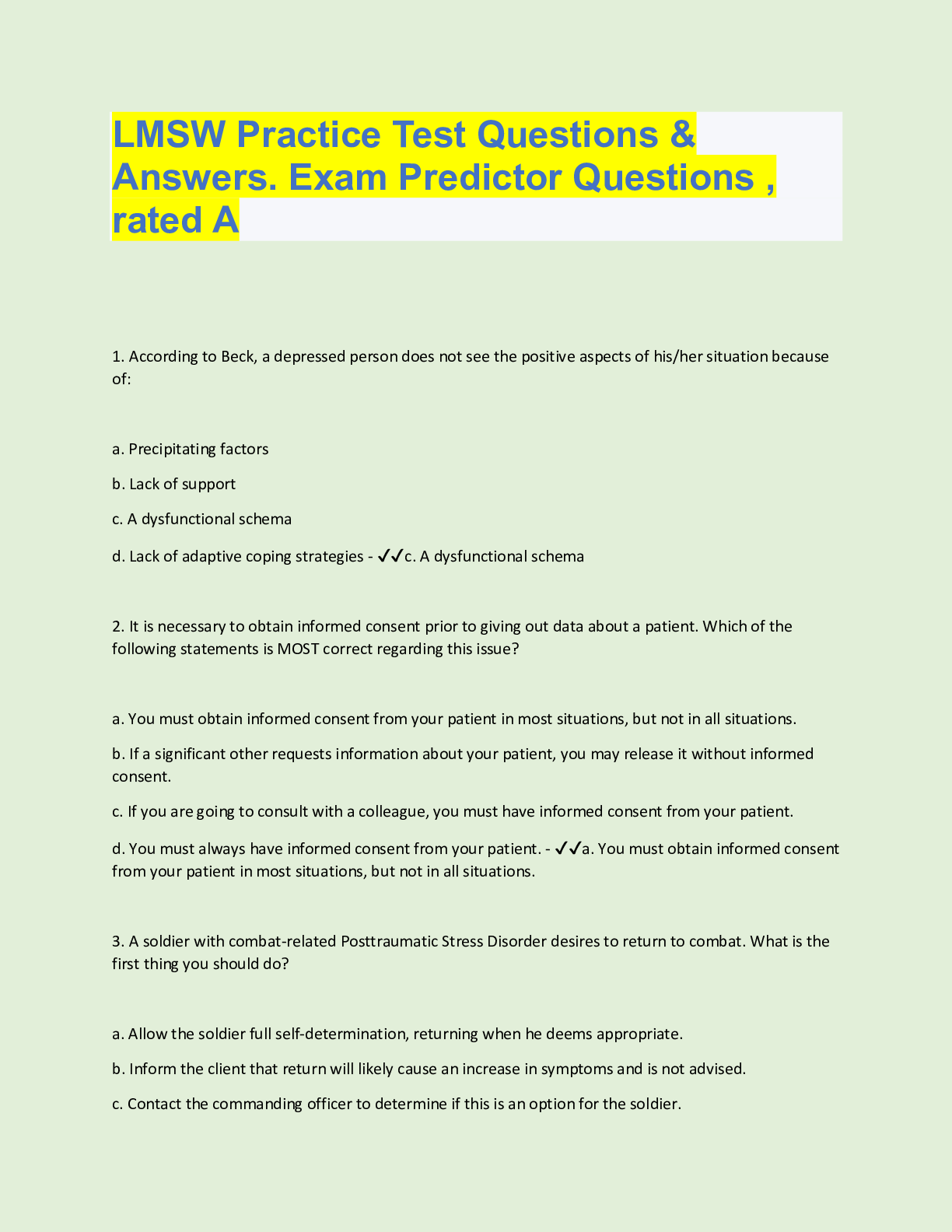
1. According to Beck, a depressed person does not see the positive aspects of his/her situation because
of:
a. Precipitating factors
b.
...
LMSW Practice Test Questions &
Answers. Exam Predictor Questions ,
rated A
1. According to Beck, a depressed person does not see the positive aspects of his/her situation because
of:
a. Precipitating factors
b. Lack of support
c. A dysfunctional schema
d. Lack of adaptive coping strategies - ✔✔c. A dysfunctional schema
2. It is necessary to obtain informed consent prior to giving out data about a patient. Which of the
following statements is MOST correct regarding this issue?
a. You must obtain informed consent from your patient in most situations, but not in all situations.
b. If a significant other requests information about your patient, you may release it without informed
consent.
c. If you are going to consult with a colleague, you must have informed consent from your patient.
d. You must always have informed consent from your patient. - ✔✔a. You must obtain informed consent
from your patient in most situations, but not in all situations.
3. A soldier with combat-related Posttraumatic Stress Disorder desires to return to combat. What is the
first thing you should do?
a. Allow the soldier full self-determination, returning when he deems appropriate.
b. Inform the client that return will likely cause an increase in symptoms and is not advised.
c. Contact the commanding officer to determine if this is an option for the soldier.
d. Assess progress in treatment and current level of functioning. - ✔✔d. Assess progress in treatment
and current level of functioning.
4. A man is referred by his primary care provider and presents with a diagnosis of Hypochondriasis.
What is the FIRST crucial step in treatment?
a. History taking
b. Establishment of trust and appreciation for the patient's problems
c. Education about the link between stress, emotions and lifestyle and physical health
d. Treatment planning - ✔✔b. Establishment of trust and appreciation for the patient's problems
5. Client: "I'm depressed. I've lost my hair at a much quicker rate than I thought possible. I'm terribly
embarrassed to go out in public. I'm feeling extremely anxious and uneasy about my baldness." Social
Worker: "You're anxious and uneasy about the transformations that are a natural process of aging." The
social worker's response is:
a. Encouragement
b. Summarization
c. Paraphrase
d. Reflection of feeling - ✔✔d. Reflection of feeling
6. How do you find the median of a set with an even number of items?
a. The larger of the two middle numbers is the median.
b. The two middle numbers are both medians.
c. Find the average of the two middle numbers.
d. A set with an even number of items does not have a median. - ✔✔c. Find the average of the two
middle numbers.
7. A young, beginning social worker has some intrapersonal and interpersonal struggles with women in
authority positions that stem from her poor relationship with her mother. The social worker's client is a
female 50-ish successful CEO of an Internet start-up. The social worker is likely to struggle in therapy
due to:
a. Counter-resistance
b. Counter-transference
c. Transference
d. Resistance - ✔✔b. Counter-transference
8. When treating elder adults with depression, the BEST approach to treatment is:
a. Cognitive behavioral therapy coupled with family interventions.
b. Significant reliance on psychiatry because medication management is most important.
c. Treatment of elder adults is similar to other adults, so no significant alterations are needed.
d. Coordination between medical and mental health due to the influence of medical conditions on
psychiatric symptomatology. - ✔✔d. Coordination between medical and mental health due to the
influence of medical conditions on psychiatric symptomatology.
9. Professional ethics and professional values differ in which of the following:
a. Values are a subset of ethics.
b. Values deal with what is right or wrong in practice, and ethics deals with the principles of practice.
c. Values and ethics are basically the same and are evaluated based on the specific situation.
d. When a social worker makes a judgment that is ethical, you can assume it is a judgment that also
upholds professional values. - ✔✔b. Values deal with what is right or wrong in practice, and ethics deals
with the principles of practice.
10. What is the first thing to assess in on-site basic crisis intervention, such as in the aftermath of a
natural disaster?
a. Immediate needs for physical safety, food and clothing
b. Trauma response
c. Future mental health risk
d. Needs for various concrete services (e.g., transportation, alternate housing) - ✔✔a. Immediate needs
for physical safety, food and clothing
7-year-old child is refusing to sleep in his own bed at night. When the parents sit with him in his room,
he is fine. When they leave the room, he begins to cry. When they come back in, he stops crying. This is
an example of
Operant conditioning
Classical conditioning
Punishment cycles
Higher order conditioning - ✔✔operant conditioning
Older individuals are often misdiagnosed with Alzheimer's when, in fact, the more accurate diagnosis is
Anxiety
Depression
Thyroid Disorder
Delirium - ✔✔Depression. Approximately 55% of the elderly suffer from depression and are often
misdiagnosed with Alzheimer's or Dementia. Anxiety (answer #1) is not correct, although anxiety can be
a problem in older adults; anxiety is not a characteristic that would be a symptom of Alzheimer's.
Thyroid disorder (answer #3) is not correct because this condition is a malfunction of the thyroid gland,
resulting in a variety of medical symptoms, usually not similar to symptoms of Alzheimer's. Delirium
(answer #4) is not correct, as Delirium is characterized by a disturbance of consciousness and a change
in cognition that develop over a short period of time.
A social worker is seeing a new client, who is a college student, for therapy. After speaking with the
client about her current enrollment at the university, the social worker spent a significant amount of
time urging the client to work less so she could focus on school. The social worker wants the client to get
all "A" grades this semester because she reminds him of his daughter at that same stage in life, as well
as the anxieties that he experienced during that time in his life. The client really wants to please the
social worker because he reminds her of her dad. Which of the following is reflected in the client?
Transference
Counter-transference
Projection
A dual relationship - ✔✔Tranference. In a therapeutic context, transference refers to redirection of a
client's feelings from a significant person to the social worker. Counter-transference (answer #2) is
incorrect because this is the redirection of a social worker's feelings toward a client, or more generally
speaking a social worker's emotional entanglement with a client, which was reflected in the first part of
the question; however, this does not describe what is being reflected in this client. Projection (answer
#3) is demonstrated when a person's own unacceptable or threatening feelings are repressed and then
attributed to someone else, which is not occurring in this case example. A dual relationship (answer #4)
is incorrect, as this refers to a situation where multiple roles exist (not just perceived) between a social
worker and a client, such as an actual father and daughter relationship between a social worker and
client.
A client was recently diagnosed with Multiple Sclerosis. She immediately began to learn everything she
could about the illness: reading books, journal articles, and the latest experimental research. The client's
response to her diagnosis is representative of which defense mechanism?
Intellectualization
Regression
Sublimation
Repression - ✔✔Intellectualization
A social worker has been working with a 35-year-old divorced woman who has joint custody of her son,
but is the custodial parent. Her ex-husband, whom the social worker has never met, is taking the client
to court in an attempt to gain full custody of the son. The social worker receives a subpoena from the
husband's attorney requesting records regarding the wife's therapy sessions with the social worker. The
social worker is required to do which of the following?
The social worker must release the entire record of the therapy sessions to the attorney
The social worker is allowed to release only those records that make direct reference to the wife's
relationship with the son, not her treatment issues
The social worker is required to respond to the subpoena, but is not required to release records since
the subpoena was issued by the attorney and not a judge
The social worker does not have to respond to the subpoena because the client's records are
confidential - ✔✔The social worker is required to respond to the subpoena, but is not required to
release records since the subpoena was issued by the attorney and not a judge
A 22-year-old female client is considering having an abortion. Her social worker is pro-choice and feels
passionately about the issue. Which of the following is the FIRST thing that the social worker should do
in this situation?
She should talk with the client about abortion alternatives
She should refer the client to another social worker
She should help the client obtain the services she needs to get an abortion
She should ask the client to share her rationale for choosing abortion - ✔✔The correct answer is #4 -
She should ask the client to share her rationale for choosing abortion. Keep in mind that a social worker
should always seek to understand. Talking with the client about abortion alternatives (answer #1) and
referring the client to another social worker (answer #2) are both not correct because once the client
has provided more information, the social worker can ascertain if the client lacks information about
other options or needs to be referred to another social worker. Helping the client obtain the services
she needs to get an abortion (answer #3) is not correct because if the social worker helps the client
obtain abortion services, she may miss an important opportunity to gain further understanding of the
client's circumstances and alternatives. Remember, the question asks for the FIRST thing the social
worker should do in this situation.
A teacher has noticed some dramatic behavioral changes in a 7-year-old boy over the recent weeks and
has referred him to the school social worker. The child appears distracted in class, no longer finishes his
daily assignments, has become aggressive toward peers, has soiled his pants on two occasions, and
appears apprehensive around adults. Which of the following might likely be the cause of this child's
behaviors?
Possible neglect at home
Possible sexual abuse
Onset of Conduct Disorder
Recent death of a loved one - ✔✔Possible sexual abuse
A 30-year-old gay male is seeking treatment in a mental health agency. The intake social worker begins
to gather information to determine this individual's qualification for services. The client states that he
has been feeling sad and hopeless, and is losing interest in activities in which he used to participate. He
states that he and his partner have recently broken up and that he has been spending less time with his
parents and siblings. The intake worker should refer this individual for treatment and identify his
presenting problem as
His Homosexuality
Relationship issues
Family issues
Depression - ✔✔Depression
A client asks the social worker to view his therapy records. The social worker knows that showing the
records to the client will be harmful given the client's profile. What is the social workers ethical
responsibility?
The social worker should show the client his or her records as the client has the right to view them
The social worker should limit the client's access to his records and provide assistance in interpreting
the records shown to the client
The social worker should deny the client access and explain the reasons for doing so
The social worker should consult with a colleague - ✔✔The social worker should limit the client's access
to his records and provide assistance in interpreting the records shown to the client
A politician recently admitted his arrangement with the pharmaceutical industry, which involved writing
key legislation to mandate vaccinations if the industry would, in return, finance the majority of his re�election campaign. According to Kohlberg's Theory of Moral Development, at which level of moral
development was the politician operating?
Pre-conventional Morality
Conventional Morality
Post-Conventional Morality
Morality of Social Contract - ✔✔The correct answer is #1 - Pre-conventional Morality. Pre-conventional
Morality is Level 1, Stage 2 and involves "you scratch my back and I'll scratch your back" types of
behavior. Conventional Morality (answer #2) and Post-Conventional Morality (answer #3) are both
incorrect, as they are both identified as levels involving moral reasoning that goes beyond a self-focused
perspective. Morality of Social Contract (answer #4) is not correct because it is a stage, not a level,
according to Kohlberg. Moreover, it involves higher moral reasoning than that demonstrated by the
politician.
A client has been drinking frequently since the death of his son last year. He states that he feels better
physically when he drinks more, especially in the mid-morning, and that he does not feel intoxicated as
often as he did immediately after his son's death. He expresses his desire to quit but says that he cannot
get away from the craving. The client feels embarrassed because his sister found him unconscious one
night as a result of his drinking. Which of the following would most likely be the social worker's FIRST
diagnosis?
Depression
Alcohol Dependence
Alcohol Abuse
Avoidant Personality Disorder - ✔✔Alcohol Dependence. Depression (answer #1) is not correct because
while the client may be depressed, more data would be needed to make this diagnosis. Alcohol Abuse
(answer #3) is not correct because the client would need to show at least two physiological factors and
five behavioral patterns over a twelve-month period, which is severe and exceeds the requirements for
Alcohol Abuse. Avoidant Personality Disorder (answer #4) is not correct because this question does not
provide sufficient information to determine this diagnosis.
A social worker has recently learned from the wife of a couple he is seeing that the wife believes that
she is a lesbian. She states she does not want to share this with her husband. During the next session,
the husband asks his wife if she likes women better than men. The wife answers "No." What is the FIRST
response that the social worker should make in this situation?
Encourage the wife to be honest
Encourage the husband to ask the wife after the session
Say nothing but plan on speaking with the wife after the session
Encourage the couple to discuss the issue - ✔✔Encourage the couple to discuss the issue. The
responsibility for establishing a relationship of honesty rests with the couple. The social worker can
facilitate the process of developing such a relationship by encouraging dialogue about this and other
important issues. Encouraging the wife to be honest (answer #1) is not the best answer for this scenario,
as the social worker would be indicating that he has information that the husband does not have. The
social worker may, at another time, need to help the wife decide how she will handle this information
with her husband. Encouraging the husband to ask the wife after the session (answer #2) and saying
nothing but planning on speaking with the wife after the session (answer #3) are both incorrect answers
because these would be interfering with the couple dealing with their own situation.
A social worker receives a new client who is seeking cognitive behavioral therapy, which is not the social
worker's treatment of expertise. The social worker should
Attempt this intervention
Refer the client to an expert
Explore the client's reasons for wanting cognitive behavioral therapy
Use his own techniques as he or she is well trained to meet the client's needs - ✔✔Explore the client's
reasons for wanting cognitive behavioral therapy. As the social worker discusses this with the client, it
may become evident that the social worker is able to provide the services the client desires.
Alternatively, the discussion may reveal the need to refer the client elsewhere. Attempting this
intervention (answer #1) is not correct because a social worker should be trained and competent in the
interventions he or she uses. Referring the client to an expert (answer #2) is not the best answer
because the social worker should find out more about the client's request before referring the client to
an expert in cognitive behavioral therapy. Using the social worker's own techniques as he or she is well
trained to meet the client's needs (answer #4) is not correct because the client has asked specifically for
cognitive behavioral therapy and should be part of the decision-making process regarding whether other
techniques could be as beneficial.
A 60-year-old female client has been meeting with a social worker to discuss dissatisfaction in her
marriage. Over the course of the first few sessions, the social worker noticed that the client spent little
time discussing substantive marital issues and instead discussed her accomplishments, even when it did
not fit into the conversation. She also talked about how she felt that it was important for her to spend
her time with other well-educated individuals. The client described work situations in which she became
angry and then tearful when not validated for her achievements. She also tried to get a manager fired
for not implementing her ideas. The most likely diagnosis for this client would fall into which category?
Cluster A
Cluster B
Cluster C
None of the above - ✔✔Narcissistic Personality Disorder- a Cluster B classification- is characterized by
many of the behaviors the client exhibits. Cluster B Personality Disorders are evidenced by dramatic,
erratic behaviors and include Histrionic, Narcissistic, Antisocial, and Borderline Personality Disorders.
Cluster A Personality Disorders (answer #1) is not correct because those disorders are considered to be
marked by odd, eccentric behavior and can result in diagnoses such as Paranoid, Schizoid, and
Schizotypal Personality Disorders. Cluster C Personality Disorders (answer #3) is not correct because
those disorders are distinguished by the anxious, fearful behavior commonly seen in Obsessive�Compulsive, Avoidant and Dependent Personality Disorders.
A social worker is interested in conducting a study of drug use among adults of different ethnic
backgrounds. Which of the following sampling strategies is most apt to yield a sample that reflects the
ethnic composition of the area?
Simple random sampling
Convenience sampling
Snowball sampling
Stratified sampling - ✔✔Stratified sampling. This form of sampling is used to ensure that there are
sufficient cases representing different values of a variable (in this case ethnic groups). Simple random
sampling (answer #1) is not correct because simple random sampling refers to the random selection of a
predetermined number of cases from a sampling frame, where each case in the sampling frame has an
equal probability of being selected for inclusion in the sample. Convenience sampling (answer #2) is not
correct because convenience sampling refers to cases that are selected for inclusion in a study sample
because they can be readily accessed by the researcher. Snowball sampling (answer #3) is not correct
because snowball sampling is a sampling strategy that involves compiling the sample as the study
progresses.
A 65-year-old Hispanic-looking woman walks into a clinic for her first therapy session. The social worker
is a bilingual therapist. Under these circumstances, what is the FIRST thing that the social worker should
do?
Greet the woman in Spanish to let her know that the social worker is respectful of her culture
Ask the woman if she would like to speak to the social worker in Spanish
Consult with the state to see if English is the official language and inquire about related laws
Greet the woman in English - ✔✔Greet the woman in Engl
[Show More]