NAADAC Ethical & Professional Issues
in Addiction Counseling. 100%
Coverage. Rated A+
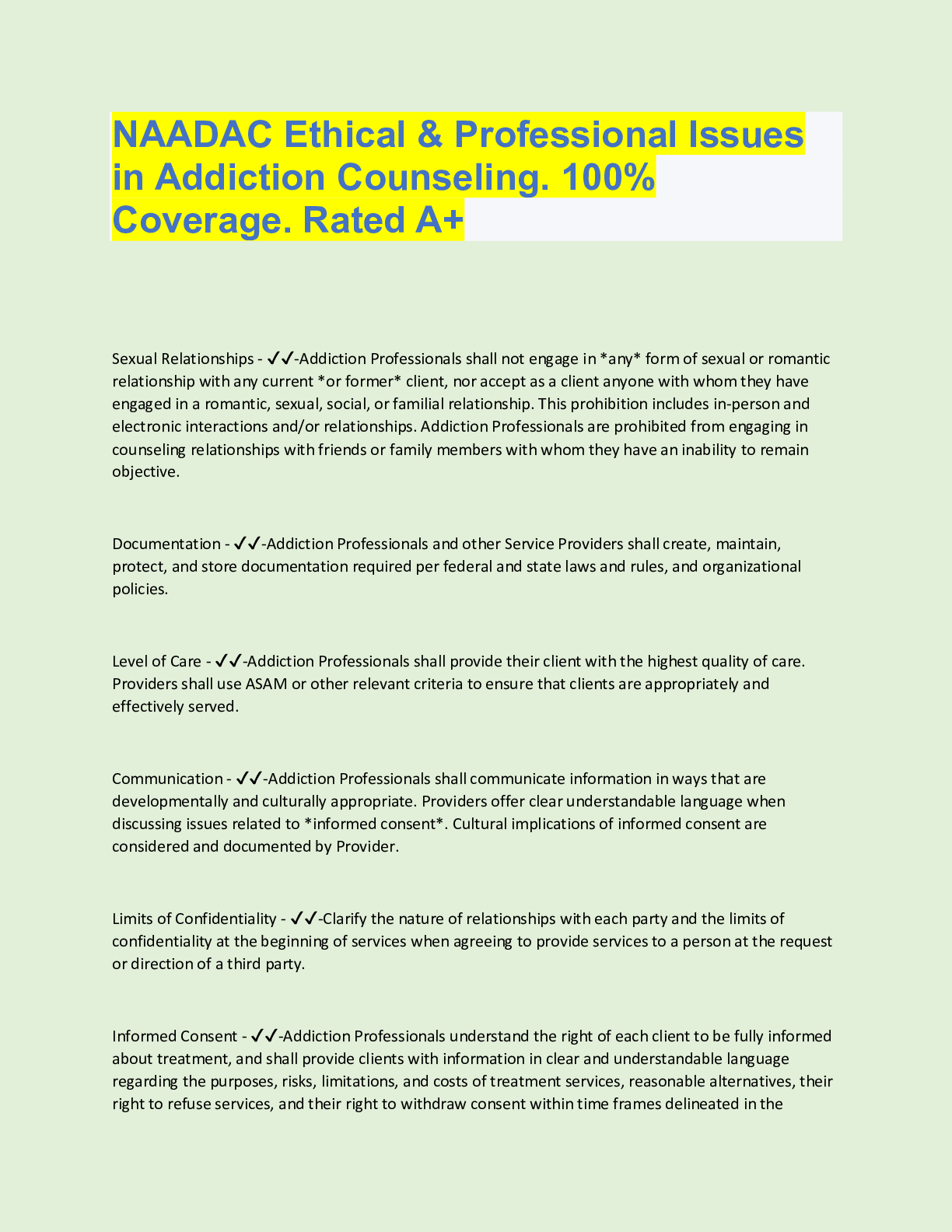
Sexual Relationships - ✔✔-Addiction Professionals shall not engage in *any* form of sexual or romantic
relationship with any cu
...
NAADAC Ethical & Professional Issues
in Addiction Counseling. 100%
Coverage. Rated A+
Sexual Relationships - ✔✔-Addiction Professionals shall not engage in *any* form of sexual or romantic
relationship with any current *or former* client, nor accept as a client anyone with whom they have
engaged in a romantic, sexual, social, or familial relationship. This prohibition includes in-person and
electronic interactions and/or relationships. Addiction Professionals are prohibited from engaging in
counseling relationships with friends or family members with whom they have an inability to remain
objective.
Documentation - ✔✔-Addiction Professionals and other Service Providers shall create, maintain,
protect, and store documentation required per federal and state laws and rules, and organizational
policies.
Level of Care - ✔✔-Addiction Professionals shall provide their client with the highest quality of care.
Providers shall use ASAM or other relevant criteria to ensure that clients are appropriately and
effectively served.
Communication - ✔✔-Addiction Professionals shall communicate information in ways that are
developmentally and culturally appropriate. Providers offer clear understandable language when
discussing issues related to *informed consent*. Cultural implications of informed consent are
considered and documented by Provider.
Limits of Confidentiality - ✔✔-Clarify the nature of relationships with each party and the limits of
confidentiality at the beginning of services when agreeing to provide services to a person at the request
or direction of a third party.
Informed Consent - ✔✔-Addiction Professionals understand the right of each client to be fully informed
about treatment, and shall provide clients with information in clear and understandable language
regarding the purposes, risks, limitations, and costs of treatment services, reasonable alternatives, their
right to refuse services, and their right to withdraw consent within time frames delineated in the
consent. Providers have an obligation to review with their client - in writing and verbally - the rights and
responsibilities of both Providers and clients. Providers shall have clients attest to their understanding of
the parameters covered by the Informed Consent.
Informed Consent includes: - ✔✔-a. explicit explanation as to the nature of all services to be provided
and methodologies and theories typically utilized;
b. purposes, goals, techniques, procedures, limitations, potential risks, and benefits of services;
c. the addiction professional's qualifications, credentials, relevant experience, and approach to
counseling;
d. right to confidentiality and explanation of its limits including duty to warn;
e. policies regarding continuation of services upon the incapacitation or death of the counselor;
f. the role of technology, including boundaries around electronic transmissions with clients and social
networking;
g. implications of diagnosis and the intended use of tests and reports;
h. fees and billing, nonpayment, policies for collecting nonpayment;
i. specifics about clinical supervision and consultation;
j. their right to refuse services, and
k. their right to refuse to be treated by a person-in-training, without fear of retribution.
Mandated Clients - ✔✔-When you work with clients who have been ordered to attend counseling and
related services, discuss legal and ethical limitations to confidentiality. Explain confidentiality, limits to
confidentiality, and the sharing of information for supervision and consultation purposes before the
beginning of therapeutic or service relationship. If the client refuses services, discuss with the client the
potential consequences of refusing the mandated services, while respecting client autonomy (right to
choose for themselves).
Previous Clients - ✔✔-Addiction Professionals considering initiating contact with or a relationship with a
previous client shall seek documented consultation or supervision prior to its initiation.
Advocacy - ✔✔-You are called to advocate on behalf of your clients at the individual, group,
institutional, and societal levels. You have an obligation to speak out about barriers and obstacles that
impede growth and development of clients. When advocating for a specific client, Providers obtain
written consent *prior* to engaging in advocacy efforts.
Referrals - ✔✔-Addiction Professionals shall recognize that each client is entitled to the full extent of
physical, social, psychological, spiritual, and emotional care required to meet their needs. Providers shall
refer to culturally- and linguistically-appropriate resources when a client presents with any impairment
that is beyond the scope of the Provider's education, training, skills, supervised expertise, and licensure.
Coverage - ✔✔-You shall make necessary coverage arrangements to accommodate interruptions such as
vacations, illness, or unexpected situation.
Abandonment - ✔✔-You shall not abandon any client in treatment. If you anticipate termination or
interruption of services to clients, notify each client promptly and seek transfer, referral, or continuation
of services in relation to each client's needs and preferences.
Confidentiality - ✔✔-Addiction Professionals understand that confidentiality and anonymity are
foundational to addiction treatment and embrace the duty of protecting the identity and privacy of each
client as a primary obligation. Counselors communicate the parameters of confidentiality in a
*culturally-sensitive manner*.
Sharing Information - ✔✔-Addiction Professionals shall encourage ongoing discussions with clients
regarding how, when, and with whom information is to be shared.
Imminent Danger - ✔✔-You may reveal client identity or confidential information without client consent
when a client presents a clear and imminent danger to themselves or to other persons, and to
emergency personnel who are directly involved in reducing the danger or threat. Counselors seek
supervision or consultation when unsure about the validity of an exception.
Court System - ✔✔-Addiction Professionals ordered to release confidential privileged information by a
court shall obtain written, informed consent from the client, take steps to prohibit the disclosure, or
have it limited as narrowly as possible because of potential harm to the client or counseling relationship.
Essential Information - ✔✔-Addiction Professionals shall release only essential information when
circumstances require the disclosure of confidential information.
Minors - ✔✔-Addiction Professionals shall p
[Show More]