EMT Special Populations EXAM
Questions and answers, Graded A+.
EMS personnel would MOST likely be called to the residence of a patient receiving home health care
when the home care provider: - ✔✔-has recognized a cha
...
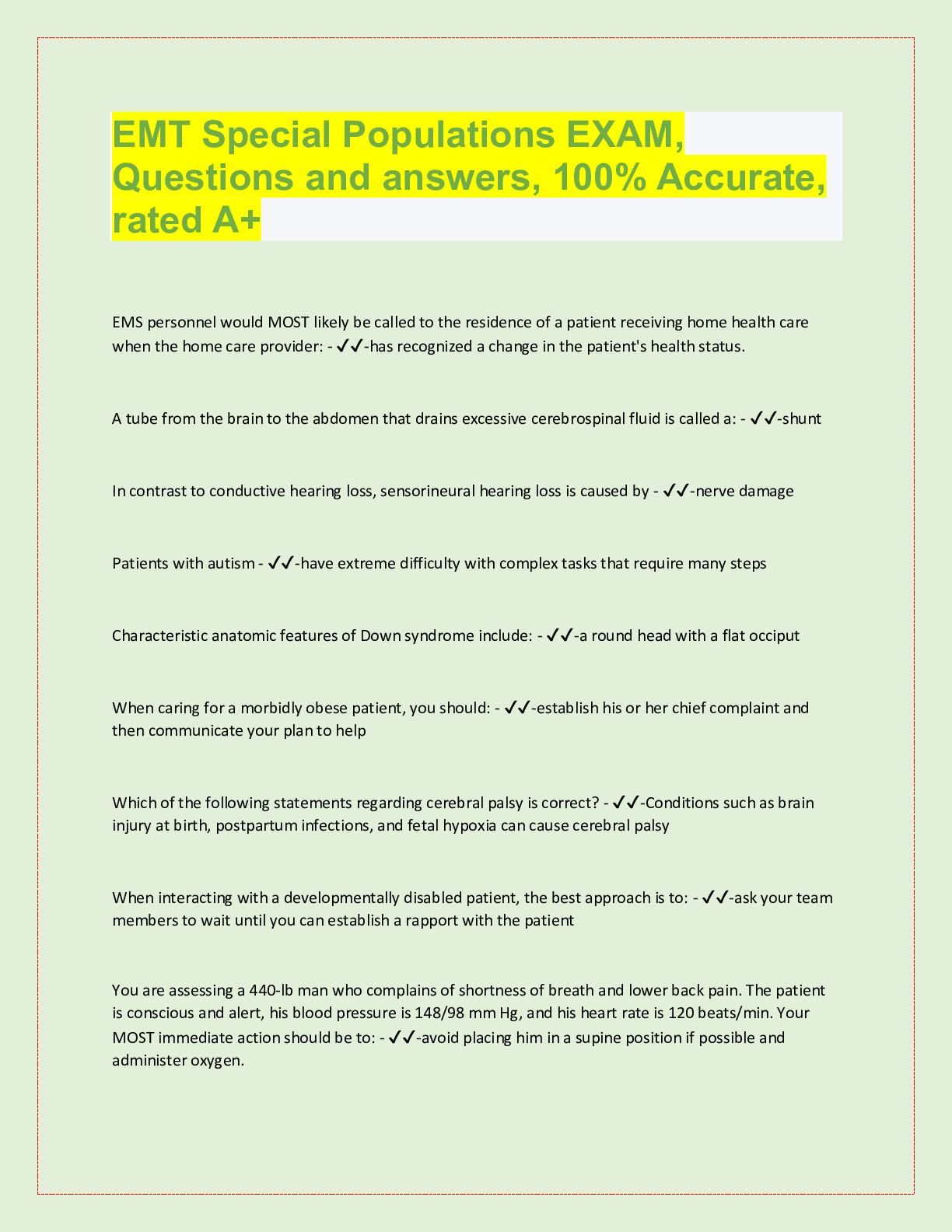
EMT Special Populations EXAM
Questions and answers, Graded A+.
EMS personnel would MOST likely be called to the residence of a patient receiving home health care
when the home care provider: - ✔✔-has recognized a change in the patient's health status.
A tube from the brain to the abdomen that drains excessive cerebrospinal fluid is called a: - ✔✔-shunt
In contrast to conductive hearing loss, sensorineural hearing loss is caused by - ✔✔-nerve damage
Patients with autism - ✔✔-have extreme difficulty with complex tasks that require many steps
Characteristic anatomic features of Down syndrome include: - ✔✔-a round head with a flat occiput
When caring for a morbidly obese patient, you should: - ✔✔-establish his or her chief complaint and
then communicate your plan to help
Which of the following statements regarding cerebral palsy is correct? - ✔✔-Conditions such as brain
injury at birth, postpartum infections, and fetal hypoxia can cause cerebral palsy
When interacting with a developmentally disabled patient, the best approach is to: - ✔✔-ask your team
members to wait until you can establish a rapport with the patient
You are assessing a 440-lb man who complains of shortness of breath and lower back pain. The patient
is conscious and alert, his blood pressure is 148/98 mm Hg, and his heart rate is 120 beats/min. Your
MOST immediate action should be to: - ✔✔-avoid placing him in a supine position if possible and
administer oxygen.
General care for a patient with a tracheostomy tube includes all of the following, EXCEPT: - ✔✔-
removing the tube if the area around it appears to be infected
Which of the following statements regarding interaction with the caregiver of a child or adult with
special health care needs is correct? - ✔✔-Communication with the patient's caregiver or family
members is important because they are the most familiar with the patient's condition
Common complications associated with central venous catheters include all of the following, EXCEPT: -
✔✔-rupture of a central vein.
An important aspect in the assessment of a patient who experienced a previous brain injury involves -
✔✔-speaking with the patient and family to establish what is considered normal for the patient
Which of the following would be the MOST practical method of communicating with a hearing-impaired
patient until his or her hearing aids can be located? - ✔✔-using a piece of paper and writing utensil to
ask questions
According to the "E" in the DOPE mnemonic, which of the following actions should you perform to
troubleshoot inadequate ventilation in a patient with a tracheostomy tube? - ✔✔-Check the mechanical
ventilator for malfunction
When enlisting the help of an interpreter who signs, it is important for you to ask the interpreter to: -
✔✔-report exactly what the patient signs and not to add any commentary
Airway management can be challenging in patients with Down syndrome because their - ✔✔-teeth are
misaligned and they have a large tongue
When caring for patients with cerebral palsy, it is important to remember that: - ✔✔-their limbs are
often underdeveloped and are prone to injury.
If suctioning of the tracheostomy tube is necessary, the EMT should: - ✔✔-attempt to use the patient's
suction device first because it is probably already sized correctly.
Spina bifida is MOST accurately defined as: - ✔✔-a birth defect caused by incomplete closure of the
spinal column.
When assessing or providing care to a patient with a developmental disability, you should: - ✔✔-be
observant for signs of fear or reluctance from the patient
Autism is MOST accurately defined as a: - ✔✔-pervasive developmental disorder characterized by
impairment of social interaction.
Because a tracheostomy tube bypasses the nose and mouth - ✔✔-secretions can build up in and around
the tube.
Cerebral palsy is characterized by poorly controlled ________ movement. - ✔✔-body
Under what circumstances is a left ventricular assist device used? - ✔✔-as a bridge to heart
transplantation while a donor heart is being located
Down syndrome is a genetic defect that occurs as the result of: - ✔✔-a triplication of chromosome 21
You respond to a residence for a 9-year-old female with Down syndrome who is sick. When you arrive at
the scene and assess the patient, you determine that she is unresponsive and has gurgling respirations.
You should: - ✔✔-open her airway with a manual maneuver, suction her oropharynx, and insert a simple
airway adjunct.
Vagal nerve stimulators may be an alternative treatment to medication for patients with: - ✔✔-chronic
seizure disorders
According to the Emergency Medical Treatment and Active Labor Act (EMTALA): - ✔✔-all health care
facilities must provide a medical assessment and required treatment, regardless of the patient's ability
to pay.
Which of the following statements regarding interaction with the caregiver of a child or adult with
special health care needs is correct? - ✔✔-Communication with the patient's caregiver or family
members is important because they are the most familiar with the patient's condition
Which of the following statements regarding gastrostomy (gastric) tubes is correct? - ✔✔-Patients with
a gastrostomy tube may still be at risk for aspiration
For which of the following conditions would you MOST likely encounter a ventricular peritoneum shunt?
- ✔✔-hydrocephalus
A service dog is easily identified by its - ✔✔-harness.
Which of the following statements regarding autism is correct? - ✔✔-Most cases of autism are
diagnosed by 3 years of age.
When interacting with a developmentally disabled patient, the best approach is to: - ✔✔-ask your team
members to wait until you can establish a rapport with the patient.
The purpose of a ventricular peritoneum shunt is to: - ✔✔-prevent excess CSF from accumulating in the
brain
A 70-year-old male complains of shortness of breath. During your assessment, you note that he has
bilateral hearing aids. When you ask him questions related to his chief complaint, he does not answer
you. You can hear a whistling sound coming from his hearing aids. You should: - ✔✔-try repositioning
the hearing aid or remove it and turn down the volume.
When caring for a patient who is visually impaired, it is important to: - ✔✔-tell him or her what is
happening, identify noises, and describe the situation and surroundings.
Which of the following statements regarding hearing aids is correct? - ✔✔-Hearing aids cannot restore
hearing to normal levels.
Which of the following statements regarding patients with developmental disabilities is correct? - ✔✔-
Patients with developmental disabilities are susceptible to the same disease processes as other patients.
You receive a call to a residence for an apneic 2-month-old male. When you arrive at the scene, the
infant's mother tells you that her son was born prematurely and that his apnea monitor has alarmed 4
times in the past 30 minutes. Your assessment of the infant reveals that he is conscious and active. His
skin is pink and dry, and he is breathing at an adequate rate and with adequate tidal depth. His oxygen
saturation reads 98% on room air. You should: - ✔✔-transport the infant to the hospital and bring the
apnea monitor with you.
A 13-year-old child is on a home ventilator. The parents called because the ventilator is malfunctioning
and the child has increasing respiratory distress. You should: - ✔✔-disconnect the ventilator and use a
bag-mask device
BY PLACING ON HAND ON TOP OF YOUR HEAD AND THE OTHER HAND OVER YOUR ABDOMEN, YOU ARE
ASKING A HEARING-IMPAIRED PATIENT IF HE/SHE IS: - ✔✔-sick
CEREBRAL PALSY IS A CONDITION THAT RESULTS FROM DAMAGE OR INJURY TO THE: - ✔✔-brain
You are dispatched to the residence of an Asian family for a child with a high fever. When you assess the
child, you note that he has numerous red marks on his back. The child's parents explain that these
represent coining--a traditional Asian healing practice in which hot coins are rubbed on the back. You
should: - ✔✔-Document this on the patient care report and advise the emergency department staff of
what the child's parents told you.
Blood loss in a child exceeding ____ of his or her total blood volume significantly increases the risk of
shock. - ✔✔-25%
The pulse rate of a child from ages 6 to 12 years is approximately: - ✔✔-70 to 120 beats/min
The tip of a central venous catheter rests in the ? - ✔✔-Vena Cava
Which of the following conditions would most likely cause a patient to slur words, speak very slowly or
speak in a monotone? - ✔✔-parkinsons disease
General techniques for communicating with hearing-impaired patients include? - ✔✔-Positioning
yourself approximately 18" directly in front of the patient.
Two thirds of children born with Down Syndrome have - ✔✔-Congenital heart disease.
A per son is said to be obese when he or she is------ over his of her ideal weight? - ✔✔-by 20% to 30%
Common associated conditions in patients with Spina Bifida include all of the following EXCEPT - ✔✔-
Spastic limb movement.
Characteristic anatomic features of Down Syndrome include - ✔✔-A round head with a flat occiput
A surgical procedure that creates an opening between the intestine and the surface of the body that
allows for elimination of waste products is called ? - ✔✔-colostomy
In contrast to adults, deterioration to cardiac arrest in infants and children is usually associated with: -
✔✔-severe hypoxia and bradycardia.
The MOST accurate method for determining if you are delivering adequate tidal volume to a child during
bag-mask ventilations is to - ✔✔-observe the chest for adequate rise
When questioning the parent of a child who ingested a poisonous substance, which of the following
questions would be of LEAST pertinence - ✔✔-Why did your child ingest the poison?
Early signs of respiratory distress in the child include - ✔✔-restlessn
[Show More]