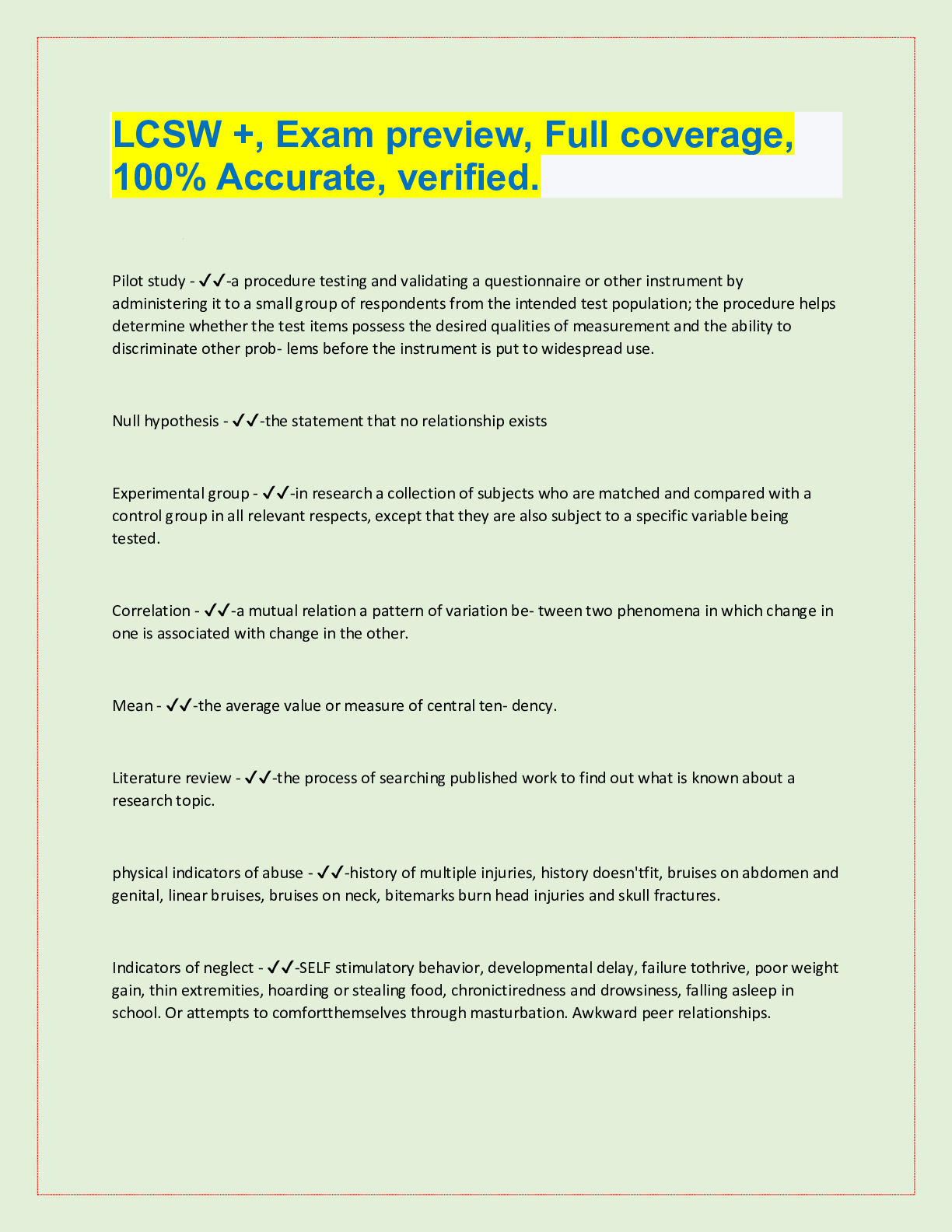
LCSW +, Exam preview, Full coverage,
100% Accurate, verified.
Pilot study - ✔✔-a procedure testing and validating a questionnaire or other instrument by
administering it to a small group of respondents from the inte
...
LCSW +, Exam preview, Full coverage,
100% Accurate, verified.
Pilot study - ✔✔-a procedure testing and validating a questionnaire or other instrument by
administering it to a small group of respondents from the intended test population; the procedure helps
determine whether the test items possess the desired qualities of measurement and the ability to
discriminate other prob- lems before the instrument is put to widespread use.
Null hypothesis - ✔✔-the statement that no relationship exists
Experimental group - ✔✔-in research a collection of subjects who are matched and compared with a
control group in all relevant respects, except that they are also subject to a specific variable being
tested.
Correlation - ✔✔-a mutual relation a pattern of variation be- tween two phenomena in which change in
one is associated with change in the other.
Mean - ✔✔-the average value or measure of central ten- dency.
Literature review - ✔✔-the process of searching published work to find out what is known about a
research topic.
physical indicators of abuse - ✔✔-history of multiple injuries, history doesn'tfit, bruises on abdomen and
genital, linear bruises, bruises on neck, bitemarks burn head injuries and skull fractures.
Indicators of neglect - ✔✔-SELF stimulatory behavior, developmental delay, failure tothrive, poor weight
gain, thin extremities, hoarding or stealing food, chronictiredness and drowsiness, falling asleep in
school. Or attempts to comfortthemselves through masturbation. Awkward peer relationships.
Behavioral and emotional indicators of abuse - ✔✔-a child who is remote withdrawn, detached
andunresponsive, ambivalent, regressive behavior, frozen watchfulness, hyperactive behavior, lying,
stealing, fighting, angry outburst, anxiety, depression, dissociation episodes
Sign of sexual abuse - ✔✔-- marked change in child's behavior, bedwetting, soiling the bed, falling asleep
in class, highly sexualized behavior, gripping in public.
Child neglect - ✔✔-the failure of those responsible for the care of a minor to provide the resources
needed for healthy physical emotional and social development.
Child abuse - ✔✔-physical or emotional injury on a dependent minor through
intentional beating uncontrolled corporal punishment persistent ridicule and degradation.
Physical indicators of abuse - ✔✔-history of multiple injuries, history doesn't fit, bruises
on abdomen, and genitals, linear bruises, bruises on neck, bite marks and burns, head injuries and skull
fractures.
Elder abuse - ✔✔-mistreatment of older people and relatively dependent people including physical
battering neglect financial or other exploitation and psychological harm
Physical abuse and neglect - ✔✔-bruises, welts, lacerations, punctures, burns, head
injuries, weight loss, untreated medical conditions and restraining the person,
Psychological abuse and neglect - ✔✔-sleep disturbance, change in eating patterns, unexplained
weight changes, depression and crying, low self-esteem, fearfulness and paranoia, confusion and
disorientation, apathy and agitation, social isolation and self-neglect.
Financial abuse - ✔✔-lack of food complaints of hunger, inability to pay bills,
over involvement of family members in financial affairs refusal to pay for services unexplained
withdrawals from bank account
crisis - ✔✔-overwhelming event that upsets one's psychological
equilibrium or baseline of functioning.
Maturational crises - ✔✔-precipitated by normal stress during the course of life.
Example, marriage, child birth retirement
Situational crises - ✔✔-precipitated by sudden traumatic event. Example, death of
a loved one, loss of job and illness
Crises intervention - ✔✔-1-6 weeks' sessions during period of crisis, supportive focused therapy.
low risk - ✔✔-limited thoughts of harm, no plan or intent, low
risk factors present
low risk intervention - ✔✔-individual social support, individual coping mechanism,
referrals for clinical contacts, establish future events to look forward too, and reassess frequently
Moderate risks - ✔✔-ideation with limited plans and no intent
moderate risk interventions - ✔✔-explore alternative to violence, remove lethal means to
harm, decrease isolation, explore the options of meds.
High risks - ✔✔-specific plan with intent, access to lethal weapon, limited
support, impaired self-control.
defense mechanism - ✔✔-help cope with the anxiety and frustration and unacceptable impulses. Help
relieve the tension between inner psych and demands of external world
primitive defense mechanisms - ✔✔-are more out of touch with reality for ex: denial, reaction
formation and projection
Higher levels of functioning - ✔✔-sublimation, undoing, rationalization, displacement,
identification and intellectualization
Rationalization - ✔✔-plausible reasons to justify an action or a plan.
Example- After not getting a job the person will say I'll be
better off at another company. After being turned down for a date the person will say they were not my
type
After person is abused they rationalize by hitting their
children as punishment after they were hit by their spouse.
Repression - ✔✔-refuses to let in awareness unacceptable impulses but
remains unconsciously operative in behavior.
Symbolization - ✔✔-a mental representation stands for some other
thing, example dreams.
Substitution - ✔✔-unattainable goal or emotion that is replaced by more
acceptable or attainable one
Splitting - ✔✔-associated be personality disorder which sees people as all
good or all bad
Regression - ✔✔-return to more infantile patterns of reacting or
thinking
Inhibition - ✔✔-loss of motivation to engage in pleasurable
activity
Incorporation - ✔✔-parts of a person that are
figuratively ingested
Idealization - ✔✔-overestimation of an admired aspect or attribute of another
Undoing - ✔✔-a process of which we avoid being punished for undesirable
thoughts or actions
Ex; a person is overly nice to
someone they just insulted in her mind
A spouse buys his spouse lavish gifts as a way to undo his
adulteress acts
Sublimation - ✔✔-displace unacceptable instincts for constructive and
socially acceptable behaviors.
Example: a person with depression may use professional dance to
help sublimate suicidal thoughts
Denial - ✔✔-distorts reality and does not
acknowledge emotion
Example: an alcoholic attending
recovery but continues to drink
Projection - ✔✔-places unacceptable feelings from the person feeling them
onto another person.
Ex: anxious person complaining
that someone else is anxious
Someone complaining that they nobody likes him yet doesn't
like himself or others
Introjection/internalization - ✔✔-is the internalization of outside events or characteristics
of other people. Refers to the process of taking it all in or swallowing it whole.
Ex: a victim uses identification with the aggressor's
behaviors to help protect himself
Putting on a seat belt before driving.
Intellectualization - ✔✔-process by which content is separated from repressed affect
Ex: when someone speaks of their traumatic event like they
were reading a script
Ex: a person of sexual assault may use intellectualization
by researching factual PTSD criteria instead of addressing her emotional pain
in therapy.
Identification - ✔✔-typically refers to the display of a particular
characteristic of trait that has been absorbed into one's own personality.
Ex; following in the footsteps of your father's profession.
Displacement - ✔✔-a defense mechanism in which affect is transferred from one
object to another
Compulsively eats lollipops
after quitting smoking
Compulsively washes hands after being shamed for
masturbating
Yelling at spouse because you cannot yell at your spouse
Piagets theory - ✔✔-people actively construct higher levels of knowledge.
Disequilibrium- motivation for
cognitive development. Equilibirum- achieved thru assimilation and
accommodation which leads to adaptation
4 stages to Paiget theory - ✔✔-Sensorimotor stage, Pre-operational Stage, Concrete Operational Stage,
Formal Operational Stage.
Sensorimotor stage - ✔✔-From birth to age 2 infants learn three
achievements. Object permanence, causality, symbolic thought.
Object permanence - ✔✔-at 8 months' child will recognize that object
exist even when out of sight
Causality - ✔✔-at 10 months' child will recognize it can use
its hands to pick up a toy
Symbolic thought - ✔✔-at 18 months' child is learning language and uses language
symbols to think about actions before performing them
Preoperational Stage - ✔✔-ages 2-7 the key characteristic is symbolic functioning
which allows a child 2 learn thru the use of mental images. Child will engage
in symbolic play
Precausal preasoning - ✔✔-limits understanding of cause and effect and is evidenced by
magical thinking.
Egocentrism - ✔✔-limits perspective to take another person's perspective.
Child believe he likes dolls because she likes dolls
Irreversibility - ✔✔-child cannot recognize that an action can be done and
undone. A child does not recognize that a dish full of water is the same as it
is being poured into a beaker.
Concrete Operational Stage - ✔✔-ages 7-11- child capable of performing operations using
logic and abstract thinking.
Seriation - ✔✔-child places block in order by height
Classification - ✔✔-child sets block together by color.
Decentering - ✔✔-ability to take into account multiple aspects of
problem and solve it.
Reversibility - ✔✔-learning that actions can be reversed
Conservation - ✔✔-learning that quantity and length of an item is unrelated to
arrangement and appearance.
Formal operational stage - ✔✔-11 to adulthood- increase in thinking about
thinking return to egocentiricism. Is able to think more abstractly and
hypothetically
Trust vs Mistrust - ✔✔-0- 18 months- developing trust between caregiver
and infant.
Autonomy vs Shame and Doubt - ✔✔-18 months -3- toddler is learning their independence such as
walking
and exploring.
Initiative vs guilt - ✔✔-3-6- learning to carry out goals without
infringing on others
Industry vs inferiority - ✔✔-6-12- achieve a sense of competence by beginning school and
learning to do things.
Identity vs role confusion - ✔✔-12-18- learning new roles that will occupy as an adult while
developing a sense of self and personal identity
Intimacy vs isolation - ✔✔-18-40 -begin to from intimate relationships with other
people.
Success- comfortable in
relationships with a sense of commitment and care
Failure- unable to develop intimacy which can lead to
isolation and feeling of exclusion.
Generativity vs stagnation - ✔✔-40-65 to participate that gives the person a
sense of purpose
Ego Strength vs. Despair - ✔✔-Despair 65 - death- for older adults to look back on life
and feel a sense of fulfillment.
Asian Americans - ✔✔-establish credibility as a professional, explain principles
of family therapy involve elders in the process.
Address somatic complaints
Stay focused on the problem
Respect family hierarchy
Avoid being confrontational
Reframe problems into positive terms
African American - ✔✔-Recognizes the totality in life experiences in culture
Therapist is more disclosing
Importance is based on changing environment is not only good
for the person but the community
Focused place on personal rituals and cultural
considerations.
Native American - ✔✔-use active listening and reflective
responses
Do not interrupt client
Ask permission to ask about personal matters
Avoid excessive note taking or asking to many questions
Pay attention to dreams, rituals and experiences
Keep promises
Accept long periods of silence
Greet client with warmth and firm hand shake
Client time to adjust to new setting
Latino American - ✔✔-use family as a method of
treatment
Assess acculturation
Explore migration immigration experiences
Respect father and father figure in family
Interview family members individually
Discuss family belief and history of behavioral health
services
Engage
family in first meeting with warmth and persoanlismo
Alcohol intoxication - ✔✔-aggressive behaviors impaired judgment
slurred speech, emotional lability unsteady gait, impaired attention and memory
Alcohol signs of withdrawal - ✔✔-sweating tachycardia, hand tremor, insomnia, nausea or
vomiting, transient illusions or hallucinations, anxiety grand mal seizures
delirium and tremors.
Alcohol Wernickes Encephalopathy - ✔✔-caused by thiamine deficiency associated with
alcoholism symptoms include confusion, loss of muscle, coordination leg tremors
and vision changes, abnormal eye movement double vision eyelid dropping
Korsakoffs Syndrome - ✔✔-- amnesia and confabulation memory loss by fabricating
memories
Amphetamines and Cocaine intoxication - ✔✔-euphoria anxiety hyperactivity, grandiosity, confusion,
anger paranoia auditory hallucinations, tachycardia, nausea vomiting weight
loss muscular weakness confusion seizures.
[Show More]

.png)