ESB TEST 2 Pool Questions and
answers, 100% Accurate, rated A
Research Process - ✔✔Question, design, findings, publishing
True Experiment - ✔✔designs in which the researcher manipulates ALL independent variables; tot
...
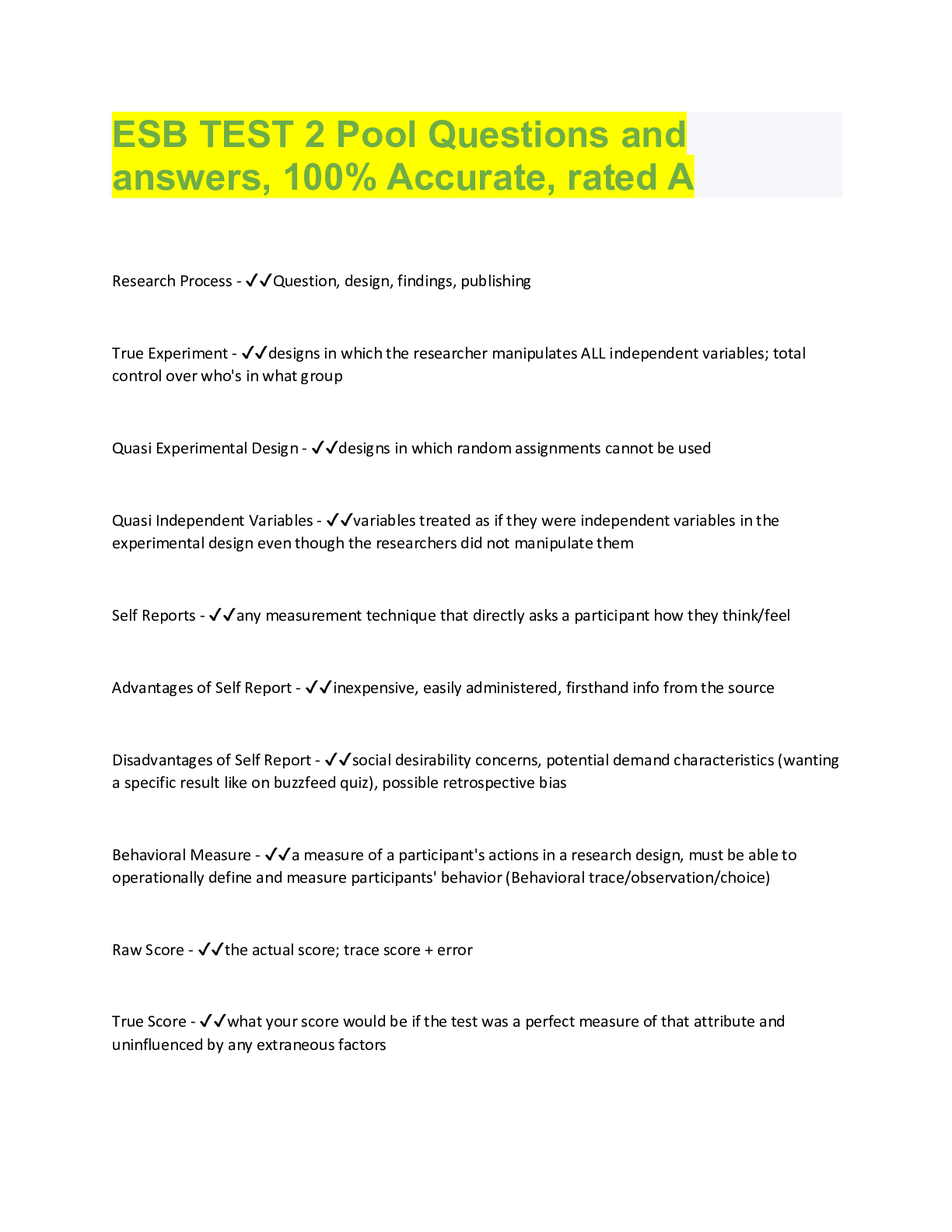
ESB TEST 2 Pool Questions and
answers, 100% Accurate, rated A
Research Process - ✔✔Question, design, findings, publishing
True Experiment - ✔✔designs in which the researcher manipulates ALL independent variables; total
control over who's in what group
Quasi Experimental Design - ✔✔designs in which random assignments cannot be used
Quasi Independent Variables - ✔✔variables treated as if they were independent variables in the
experimental design even though the researchers did not manipulate them
Self Reports - ✔✔any measurement technique that directly asks a participant how they think/feel
Advantages of Self Report - ✔✔inexpensive, easily administered, firsthand info from the source
Disadvantages of Self Report - ✔✔social desirability concerns, potential demand characteristics (wanting
a specific result like on buzzfeed quiz), possible retrospective bias
Behavioral Measure - ✔✔a measure of a participant's actions in a research design, must be able to
operationally define and measure participants' behavior (Behavioral trace/observation/choice)
Raw Score - ✔✔the actual score; trace score + error
True Score - ✔✔what your score would be if the test was a perfect measure of that attribute and
uninfluenced by any extraneous factors
Error - ✔✔extraneous influences that will cause the raw score to deviate from the true score; (random
error + bias)/systematic error
Random Error - ✔✔variation from the measure's true score due to unsystematic or chance factors,
present if you get different results when the same measure was used multiple times
Systematic Error - ✔✔aka bias, error that consistently pushes scores in a given direction, worse than
random error bc leads to inaccurate conclusions
Strategies for Minimizing Error - ✔✔standardization of experiments, reduce scorer biases
Observer/Scorer Bias - ✔✔misinterpreting an observation based on the researcher's existing beliefs,
previous experiences, expectations, etc
Ceiling Effect - ✔✔occurs when the upper boundary of a measurement tool is set too low, leading
everyone to select the highest response
Floor Effect - ✔✔occurs when the lower boundary of a measurement tool is set too high, leading
everyone to select the lowest response
Reliability - ✔✔stability or consistency of a measure
Validity - ✔✔the degree to which a tool measures what it claims to; to be valid, a measure must first be
reliable
Population - ✔✔the entire group of interest in a research study from which a sample is drawn
Sample - ✔✔a subset of the population from which the researcher collects data
Sampling Plan - ✔✔explicit strategy used for recruiting participants from the population; goal is to
represent the population you are sampling
Probability Sampling Method - ✔✔everyone in the population of interest has an equal chance of being
recruited
Simple Random Sampling - ✔✔participants are randomly selected from the population
Strata Random Sampling - ✔✔subset is randomly selected from various subpopulations or categories
Cluster Random Sampling - ✔✔dividing the total population into groups and randomly selecting which
groups participate
Non Probability Sampling - ✔✔everyone in a population of interest does NOT get an equal chance of
being recruited, creates bias
Convenience Sampling - ✔✔nonrandom selection of participants readily available to the researcher
Quota Sampling - ✔✔freely choosing any participant as long as they meet an established quota
Purposive Sampling - ✔✔sample chosen based on who the researcher thinks would be appropriate for
the study
Snowball Sampling - ✔✔existing study participants recruit future participants from among their
acquaintances
Non Responsive Bias - ✔✔a potential systematic difference between those who refused to participate in
a study and those who did, difficult to determine nature/extent
Volunteer Subject Problem - ✔✔those who volunteer to participate may be characteristically different
from those who choose not to participate
Steps for Research - ✔✔review the literature, formulate a research question, pick a design, pick data
collection technique
Qualitative Research - ✔✔a generic term representing a variety of methodologies that focus on
obtaining an in-depth account of participants' perspectives
Quantitative Research - ✔✔a generic term for methods that seek to objectively examine associations
between variables, predict outcomes, and make comparisons
Mixed Methods - ✔✔a blend of qualitative and quantitative that
[Show More]