Ham Radio - General Class - Question
Pool (Answered) 100% accurate.
G0A01 -What is one way that RF energy can affect human body tissue? A. It heats body tissue B. It
causes radiation poisoning C. It causes the blood
...
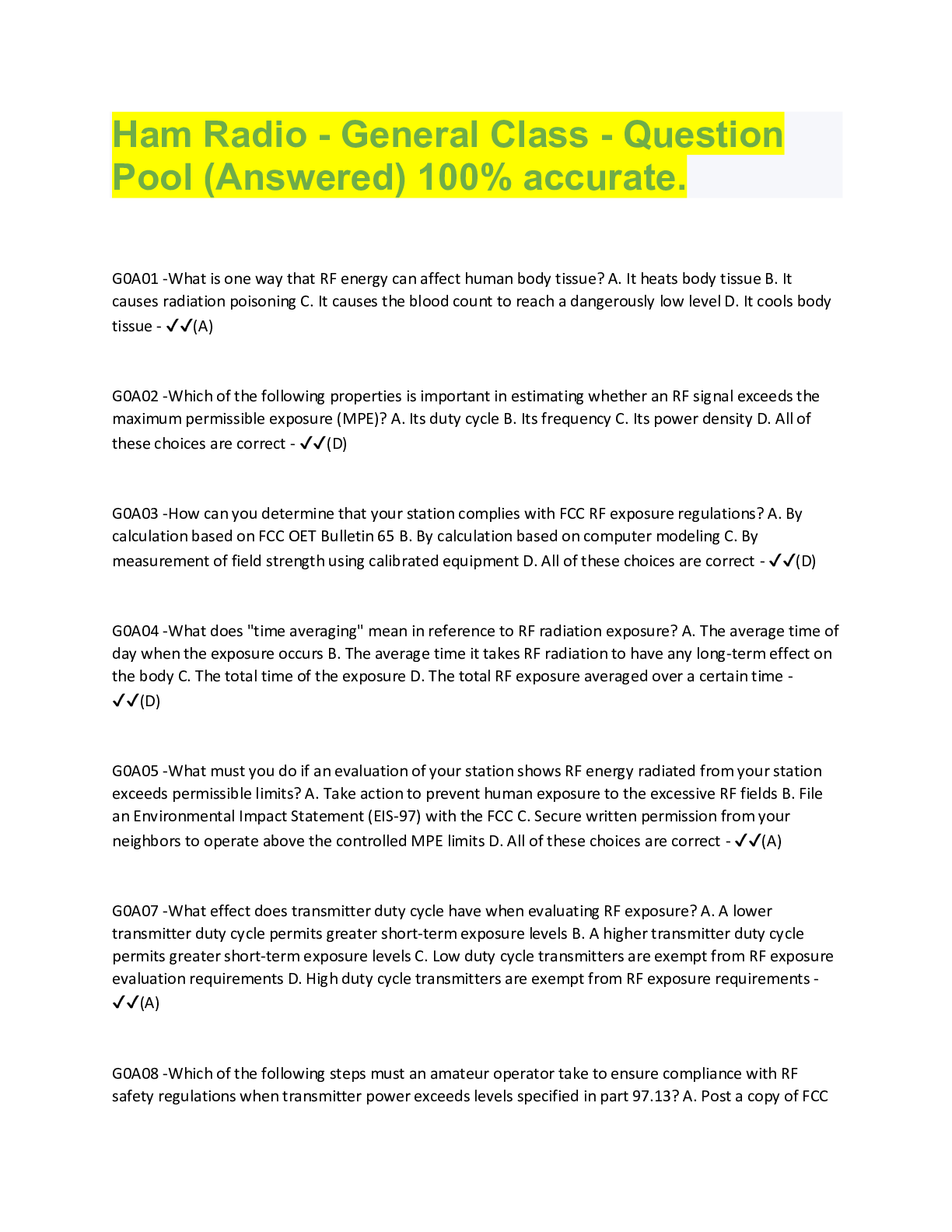
Ham Radio - General Class - Question
Pool (Answered) 100% accurate.
G0A01 -What is one way that RF energy can affect human body tissue? A. It heats body tissue B. It
causes radiation poisoning C. It causes the blood count to reach a dangerously low level D. It cools body
tissue - ✔✔(A)
G0A02 -Which of the following properties is important in estimating whether an RF signal exceeds the
maximum permissible exposure (MPE)? A. Its duty cycle B. Its frequency C. Its power density D. All of
these choices are correct - ✔✔(D)
G0A03 -How can you determine that your station complies with FCC RF exposure regulations? A. By
calculation based on FCC OET Bulletin 65 B. By calculation based on computer modeling C. By
measurement of field strength using calibrated equipment D. All of these choices are correct - ✔✔(D)
G0A04 -What does "time averaging" mean in reference to RF radiation exposure? A. The average time of
day when the exposure occurs B. The average time it takes RF radiation to have any long-term effect on
the body C. The total time of the exposure D. The total RF exposure averaged over a certain time -
✔✔(D)
G0A05 -What must you do if an evaluation of your station shows RF energy radiated from your station
exceeds permissible limits? A. Take action to prevent human exposure to the excessive RF fields B. File
an Environmental Impact Statement (EIS-97) with the FCC C. Secure written permission from your
neighbors to operate above the controlled MPE limits D. All of these choices are correct - ✔✔(A)
G0A07 -What effect does transmitter duty cycle have when evaluating RF exposure? A. A lower
transmitter duty cycle permits greater short-term exposure levels B. A higher transmitter duty cycle
permits greater short-term exposure levels C. Low duty cycle transmitters are exempt from RF exposure
evaluation requirements D. High duty cycle transmitters are exempt from RF exposure requirements -
✔✔(A)
G0A08 -Which of the following steps must an amateur operator take to ensure compliance with RF
safety regulations when transmitter power exceeds levels specified in part 97.13? A. Post a copy of FCC
Part 97 in the station B. Post a copy of OET Bulletin 65 in the station C. Perform a routine RF exposure
evaluation D. All of these choices are correct - ✔✔(C)
G0A09 -What type of instrument can be used to accurately measure an RF field? A. A receiver with an S
meter B. A calibrated field-strength meter with a calibrated antenna C. A betascope with a dummy
antenna calibrated at 50 ohms D. An oscilloscope with a high-stability crystal marker generator - ✔✔(B)
G0A10 -What is one thing that can be done if evaluation shows that a neighbor might receive more than
the allowable limit of RF exposure from the main lobe of a directional antenna? A. Change from
horizontal polarization to vertical polarization B. Change from horizontal polarization to circular
polarization C. Use an antenna with a higher front-to-back ratio D. Take precautions to ensure that the
antenna cannot be pointed in their direction - ✔✔(D)
G0A11 -What precaution should you take if you install an indoor transmitting antenna? A. Locate the
antenna close to your operating position to minimize feed-line radiation B. Position the antenna along
the edge of a wall to reduce parasitic radiation C. Make sure that MPE limits are not exceeded in
occupied areas D. No special precautions are necessary if SSB and CW are the only modes used - ✔✔(C)
G0A12 -What precaution should you take whenever you make adjustments or repairs to an antenna? A.
Ensure that you and the antenna structure are grounded B. Turn off the transmitter and disconnect the
feed line C. Wear a radiation badge D. All of these choices are correct - ✔✔(B)
G0A13 -What precaution should be taken when installing a ground-mounted antenna? A. It should not
be installed higher than you can reach B. It should not be installed in a wet area C. It should limited to 10
feet in height D. It should be installed so no one can be exposed to RF radiation in excess of maximum
permissible limits - ✔✔(D)
G0B01 -Which wire or wires in a four-conductor line cord should be attached to fuses or circuit breakers
in a device operated from a 240-VAC single-phase source? A. Only the hot wires B. Only the neutral wire
C. Only the ground wire D. All wires - ✔✔(A)
G0B02 -What is the minimum wire size that may be safely used for a circuit that draws up to 20 amperes
of continuous current? A. AWG number 20 B. AWG number 16 C. AWG number 12 D. AWG number 8 -
✔✔(C)
G0B03 -Which size of fuse or circuit breaker would be appropriate to use with a circuit that uses AWG
number 14 wiring? A. 100 amperes B. 60 amperes C. 30 amperes D. 15 amperes - ✔✔(D)
G0B04 -Which of the following is a primary reason for not placing a gasoline-fueled generator inside an
occupied area? A. Danger of carbon monoxide poisoning B. Danger of engine over torque C. Lack of
oxygen for adequate combustion D. Lack of nitrogen for adequate combustion - ✔✔(A)
G0B05 -Which of the following conditions will cause a Ground Fault Circuit Interrupter (GFCI) to
disconnect the 120 or 240 Volt AC line power to a device? A. Current flowing from one or more of the
hot wires to the neutral wire B. Current flowing from one or more of the hot wires directly to ground C.
Over-voltage on the hot wire D. All of these choices are correct - ✔✔(B)
G0B06 -Why must the metal enclosure of every item of station equipment be grounded? A. It prevents
blowing of fuses in case of an internal short circuit B. It prevents signal overload C. It ensures that the
neutral wire is grounded D. It ensures that hazardous voltages cannot appear on the chassis - ✔✔(D)
G0B07 -Which of the following should be observed for safety when climbing on a tower using a safety
belt or harness? A. Never lean back and rely on the belt alone to support your weight B. Always attach
the belt safety hook to the belt D-ring with the hook opening away from the tower C. Ensure that all
heavy tools are securely fastened to the belt D-ring D. Make sure that your belt is grounded at all times -
✔✔(B)
G0B08 -What should be done by any person preparing to climb a tower that supports electrically
powered devices? A. Notify the electric company that a person will be working on the tower B. Make
sure all circuits that supply power to the tower are locked out and tagged C. Unground the base of the
tower D. All of these choices are correct - ✔✔(B)
G0B09 -Why should soldered joints not be used with the wires that connect the base of a tower to a
system of ground rods? A. The resistance of solder is too high B. Solder flux will prevent a low
conductivity connection C. Solder has too high a dielectric constant to provide adequate lightning
protection D. A soldered joint will likely be destroyed by the heat of a lightning strike - ✔✔(D)
G0B10 -Which of the following is a danger from lead-tin solder? A. Lead can contaminate food if hands
are not washed carefully after handling B. High voltages can cause lead-tin solder to disintegrate
suddenly C. Tin in the solder can "cold flow" causing shorts in the circuit D. RF energy can convert the
lead into a poisonous gas - ✔✔(A)
G0B11 -Which of the following is good engineering practice for lightning protection grounds? A. They
must be bonded to all buried water and gas lines B. Bends in ground wires must be made as close as
possible to a right angle C. Lightning grounds must be connected to all ungrounded wiring D. They must
be bonded together with all other grounds - ✔✔(D)
G0B12 -What is the purpose of a transmitter power supply interlock? A. To prevent unauthorized access
to a transmitter B. To guarantee that you cannot accidentally transmit out of band C. To ensure that
dangerous voltages are removed if the cabinet is opened D. To shut off the transmitter if too much
current is drawn - ✔✔(C)
G0B13 -What must you do when powering your house from an emergency generator? A. Disconnect the
incoming utility power feed B. Insure that the generator is not grounded C. Insure that all lightning
grounds are disconnected D. All of these choices are correct - ✔✔(A)
G0B14 -Which of the following is covered by the National Electrical Code? A. Acceptable bandwidth
limits B. Acceptable modulation limits C. Electrical safety inside the ham shack D. RF exposure limits of
the human body - ✔✔(C)
G0B15 -Which of the following is true of an emergency generator installation? A. The generator should
be located in a well ventilated area B. The generator should be insulated from ground C. Fuel should be
stored near the generator for rapid refueling in case of an emergency D. All of these choices are correct -
✔✔(A)
G0B16 -When might a lead acid storage battery give off explosive hydrogen gas? A. When stored for
long periods of time B. When being discharged C. When being charged D. When not placed on a level
surface - ✔✔(C)
G1A01 -On which of the following bands is a General Class license holder granted all amateur frequency
privileges? A. 60, 20, 17, and 12 meters B. 160, 80, 40, and 10 meters C. 160, 60, 30, 17, 12, and 10
meters D. 160, 30, 17, 15, 12, and 10 meters - ✔✔(C)
G1A02 -On which of the following bands is phone operation prohibited? A. 160 meters B. 30 meters C.
17 meters D. 12 meters - ✔✔(B)
G1A03 -On which of the following bands is image transmission prohibited? A. 160 meters B. 30 meters
C. 20 meters D. 12 meters - ✔✔(B)
G1A04 -Which of the following amateur bands is restricted to communication on only specific channels,
rather than frequency ranges? A. 11 meters B. 12 meters C. 30 meters D. 60 meters - ✔✔(D)
G1A05 -Which of the following frequencies is in the General Class portion of the 40 meter band? A.
7.250 MHz B. 7.500 MHz C. 40.200 MHz D. 40.500 MHz - ✔✔(A)
G1A06 -Which of the following frequencies is in the 12 meter band? A. 3.940 MHz B. 12.940 MHz C.
17.940 MHz D. 24.940 MHz - ✔✔(D)
G1A07 -Which of the following frequencies is within the General Class portion of the 75 meter phone
band? A. 1875 kHz B. 3750 kHz C. 3900 kHz D. 4005 kHz - ✔✔(C)
G1A08 -Which of the following frequencies is within the General Class portion of the 20 meter phone
band? A. 14005 kHz B. 14105 kHz C. 14305 kHz D. 14405 kHz - ✔✔(C)
G1A09 -Which of the following frequencies is within the General Class portion of the 80 meter band? A.
1855 kHz B. 2560 kHz C. 3560 kHz D. 3650 kHz - ✔✔(C)
G1A10 -Which of the following frequencies is within the General Class portion of the 15 meter band? A.
14250 kHz B. 18155 kHz C. 21300 kHz D. 24900 kHz - ✔✔(C)
G1A11 -Which of the following frequencies is available to a control operator holding a General Class
license? A. 28.020 MHz B. 28.350 MHz C. 28.550 MHz D. All of these choices are correct - ✔✔(D)
G1A12 -When General Class licensees are not permitted to use the entire voice portion of a particular
band, which portion of the voice segment is generally available to them? A. The lower frequency end B.
The upper frequency end C. The lower frequency end on frequencies below 7.3 MHz and the upper end
on frequencies above 14.150 MHz D. The upper frequency end on frequencies below 7.3 MHz and the
lower end on frequencies above 14.150 MHz - ✔✔(B)
G1A13 -Which, if any, amateur band is shared with the Citizens Radio Service? A. 10 meters B. 12 meters
C. 15 meters D. None - ✔✔(D)
G1A14 -Which of the following applies when the FCC rules designate the Amateur Service as a secondary
user on a band? A. Amateur stations must record the call sign of the primary service station before
operating on a frequency assigned to that station B. Amateur stations are allowed to use the band only
during emergencies C. Amateur stations are allowed to use the band only if they do not cause harmful
interference to primary users D. Amateur stations may only operate during specific hours of the day,
while primary users are permitted 24 hour use of the band - ✔✔(C)
G1A15 -What is the appropriate action if, when operating on either the 30 or 60 meter bands, a station
in the primary service interferes with your contact? A. Notify the FCC's regional Engineer in Charge of
the interference B. Increase your transmitter's power to overcome the interference C. Attempt to
contact the station and request that it stop the interference D. Move to a clear frequency - ✔✔(D)
G1B01 -What is the maximum height above ground to which an antenna structure may be erected
without requiring notification to the FAA and registration with the FCC, provided it is not at or near a
public use airport? A. 50 feet B. 100 feet C. 200 feet D. 300 feet - ✔✔(C)
G1B02 -With which of the following conditions must beacon stations comply? A. A beacon station may
not use automatic control B. The frequency must be coordinated with the National Beacon Organization
C. The frequency must be posted on the Internet or published in a national periodical D. There must be
no more than one beacon signal in the same band from a single location - ✔✔(D)
G1B03 -Which of the following is a purpose of a beacon station as identified in the FCC Rules? A.
Observation of propagation and reception B. Automatic identification of repeaters C. Transmission of
bulletins of general interest to Amateur Radio licensees D. Identifying net frequencies - ✔✔(A)
G1B04 -Which of the following must be true before amateur stations may provide communications to
broadcasters for dissemination to the public? A. The communications must directly relate to the
immediate safety of human life or protection of property and there must be no other means of
communication reasonably available before or at the time of the event B. The communications must be
approved by a local emergency preparedness official and conducted on officially designated frequencies
C. The FCC must have declared a state of emergency D. All of these choices are correct - ✔✔(A)
G1B05 -When may music be transmitted by an amateur station? A. At any time, as long as it produces
no spurious emissions B. When it is unintentionally transmitted from the background at the transmitter
C. When it is transmitted on frequencies above 1215 MHz D. When it is an incidental part of a manned
space craft retransmission - ✔✔(D)
G1B06 -When is an amateur station permitted to transmit secret codes? A. During a declared
communications emergency B. To control a space station C. Only when the information is of a routine,
personal nature D. Only with Special Temporary Authorization from the FCC - ✔✔(B)
G1B07 -What are the restrictions on the use of abbreviations or procedural signals in the Amateur
Service? A. Only "Q" codes are permitted B. They may be used if they do not obscure the meaning of a
message C. They are not permitted D. Only "10 codes" are permitted - ✔✔(B)
G1B08 -When choosing a transmitting frequency, what should you do to comply with good amateur
practice? A. Review FCC Part 97 Rules regarding permitted frequencies and emissions? B. Follow
generally accepted band plans agreed to by the Amateur Radio community. C. Before transmitting, listen
to avoid interfering with ongoing communication D. All of these choices are correct - ✔✔(D)
G1B09 -When may an amateur station transmit communications in which the licensee or control
operator has a pecuniary (monetary) interest? A. When other amateurs are being notified of the sale of
apparatus normally used in an amateur station and such activity is not done on a regular basis B. Only
when there is no other means of communications readily available C. When other amateurs are being
notified of the sale of any item with a monetary value less than $200 and such activity is not done on a
regular basis D. Never - ✔✔(A)
G1B10 -What is the power limit for beacon stations? A. 10 watts PEP output B. 20 watts PEP output C.
100 watts PEP output D. 200 watts PEP output - ✔✔(C)
G1B11 -How does the FCC require an amateur station to be operated in all respects not specifically
covered by the Part 97 rules? A. In conformance with the rules of the IARU B. In conformance with
Amateur Radio custom C. In conformance with good engineering and good amateur practice D. All of
these choices are correct - ✔✔(C)
G1B12 -Who or what determines "good engineering and good amateur practice" as applied to the
operation of an amateur station in all respects not covered by the Part 97 rules? A. The FCC B. The
Control Operator C. The IEEE D. The ITU - ✔✔(A)
G1C01 -What is the maximum transmitting power an amateur station may use on 10.140 MHz? A. 200
watts PEP output B. 1000 watts PEP output C. 1500 watts PEP output D. 2000 watts PEP output - ✔✔(A)
G1C02 -What is the maximum transmitting power an amateur station may use on the 12 meter band? A.
1500 PEP output, except for 200 watts PEP output in the Novice portion B. 200 watts PEP output C. 1500
watts PEP output D. An effective radiated power equivalent to 50 watts from a half-wave dipole - ✔✔(C)
G1C03 -What is the maximum bandwidth permitted by FCC rules for Amateur Radio stations when
transmitting on USB frequencies in the 60 meter band? A. 2.8 kHz B. 5.6 kHz C. 1.8 kHz D. 3 kHz - ✔✔(A)
G1C04 -Which of the following is a limitation on transmitter power on the 14 MHz band? A. Only the
minimum power necessary to carry out the desired communications should be used B. Power must be
limited to 200 watts when transmitting between 14.100 MHz and 14.150 MHz C. Power should be
limited as necessary to avoid interference to another radio service on the frequency D. Effective
radiated power cannot exceed 3000 watts - ✔✔(A)
G1C05 -Which of the following is a limitation on transmitter power on the 28 MHz band? A. 100 watts
PEP output B. 1000 watts PEP output C. 1500 watts PEP output D. 2000 watts PEP output - ✔✔(C)
G1C06 -Which of the following is a limitation on transmitter power on 1.8 MHz band? A. 200 watts PEP
output B. 1000 watts PEP output C. 1200 watts PEP output D. 1500 watts PEP output - ✔✔(D)
G1C07 -What is the maximum symbol rate permitted for RTTY or data emission transmission on the 20
meter band? A. 56 kilobaud B. 19.6 kilobaud C. 1200 baud D. 300 baud - ✔✔(D)
G1C08 -What is the maximum symbol rate permitted for RTTY or data emission transmitted at
frequencies below 28 MHz? A. 56 kilobaud B. 19.6 kilobaud C. 1200 baud D. 300 baud - ✔✔(D)
G1C09 -What is the maximum symbol rate permitted for RTTY or data emission transmitted on the 1.25
meter and 70 centimeter bands A. 56 kilobaud B. 19.6 kilobaud C. 1200 baud D. 300 baud - ✔✔(A)
G1C10 -What is the maximum symbol rate permitted for RTTY or data emission transmissions on the 10
meter band? A. 56 kilobaud B. 19.6 kilobaud C. 1200 baud D. 300 baud - ✔✔(C)
G1C11 -What is the maximum symbol rate permitted for RTTY or data emission transmissions on the 2
meter band? A. 56 kilobaud B. 19.6 kilobaud C. 1200 baud D. 300 baud - ✔✔(B)
G1D01 -Which of the following is a proper way to identify when transmitting using phone on General
Class frequencies if you have a CSCE for the required elements but your upgrade from Technician has
not appeared in the FCC database? A. Give your call sign followed by the words "General Class" B. No
special identification is needed C. Give your call sign followed by "slant AG" D. Give your call sign
followed the abbreviation "CSCE" - ✔✔(C)
G1D02 -What license examinations may you administer when you are an accredited VE holding a
General Class operator license? A. General and Technician B. General only C. Technician only D. Extra,
General and Technician - ✔✔(C)
G1D03 -On which of the following band segments may you operate if you are a Technician Class
operator and have a CSCE for General Class privileges? A. Only the Technician band segments until your
upgrade is posted on the FCC database B. Only on the Technician band segments until your license
arrives in the mail C. On any General or Technician Class band segment D. On any General or Technician
Class band segment except 30 and 60 meters - ✔✔(C)
G1D04 -Which of the following is a requirement for administering a Technician Class operator
examination? A. At least three VEC accredited General Class or higher VEs must be present B. At least
two VEC accredited General Class or higher VEs must be present C. At least two General Class or higher
VEs must be present, but only one need be VEC accredited D. At least three VEs of Technician Class or
higher must be present - ✔✔(A)
G1D05 -Which of the following is sufficient for you to be an administering VE for a Technician Class
operator license examination? A. Notification to the FCC that you want to give an examination B.
Receipt of a CSCE for General Class C. Possession of a properly obtained telegraphy license D. An FCC
General Class or higher license and VEC accreditation - ✔✔(D)
G1D06 -When must you add the special identifier "AG" after your call sign if you are a Technician Class
licensee and have a CSCE for General Class operator privileges, but the FCC has not yet posted your
upgrade on its Web site? A. Whenever you operate using General Class frequency privileges B.
Whenever you operate on any amateur frequency C. Whenever you operate using Technician frequency
privileges D. A special identifier is not required as long as your General Class license application has been
filed with the FCC - ✔✔(A)
G1D07 -Volunteer Examiners are accredited by what organization? A. The Federal Communications
Commission B. The Universal Licensing System C. A Volunteer Examiner Coordinator D. The Wireless
Telecommunications Bureau - ✔✔(C)
G1D08 -Which of the following criteria must be met for a non-U.S. citizen to be an accredited Volunteer
Examiner? A. The person must be a resident of the U.S. for a minimum of 5 years B. The person must
hold an FCC granted Amateur Radio license of General Class or above C. The person's home citizenship
must be in the ITU 2 region D. None of these choices is correct; non-U.S. citizens cannot be volunteer
examiners - ✔✔(B)
G1D09 -How long is a Certificate of Successful Completion of Examination (CSCE) valid for exam element
credit? A. 30 days B. 180 days C. 365 days D. For as long as your current license is valid - ✔✔(C)
G1D10 -What is the minimum age that one must be to qualify as an accredited Volunteer Examiner? A.
12 years B. 18 years C. 21 years D. There is no age limit - ✔✔(B)
G1E01 -Which of the following would disqualify a third party from participating in stating a message
over an amateur station? A. The third party's amateur license had ever been revoked B. The third party
is not a U.S. citizen C. The third party is a licensed amateur D. The third party is speaking in a language
other than English, French, or Spanish - ✔✔(A)
G1E02 -When may a 10 meter repeater retransmit the 2 meter signal from a station having a Technician
Class control operator? A. Under no circumstances B. Only if the station on 10 meters is operating under
a Special Temporary Authorization allowing such retransmission C. Only during an FCC declared general
state of communications emergency D. Only if the 10 meter repeater control operator holds at least a
General Class license - ✔✔(D)
G1E03 -In what ITU region is operation in the 7.175 to 7.300 MHz band permitted for a control operator
holding an FCC-issued General Class license? A. Region 1 B. Region 2 C. Region 3 D. All three regions -
✔✔(B)
G1E04 -Which of the following conditions require an Amateur Radio station licensee to take specific
steps to avoid harmful interference to other users or facilities? A. When operating within one mile of an
FCC Monitoring Station B. When using a band where the Amateur Service is secondary C. When a station
is transmitting spread spectrum emissions D. All of these choices are correct - ✔✔(D)
G1E05 -What types of messages for a third party in another country may be transmitted by an amateur
station? A. Any message, as long as the amateur operator is not paid B. Only messages for other licensed
amateurs C. Only messages relating to Amateur Radio or remarks of a personal character, or messages
relating to emergencies or disaster relief D. Any messages, as long as the text of the message is recorded
in the station log - ✔✔(C)
G1E06 -Which of the following applies in the event of interference between a coordinated repeater and
an uncoordinated repeater? A. The licensee of the non-coordinated repeater has primary responsibility
to resolve the interference B. The licensee of the coordinated repeater has primary responsibility to
resolve the interference C. Both repeater licensees share equal responsibility to resolve the interference
D. The frequency coordinator bears primary responsibility to resolve the interference - ✔✔(A)
G1E07 -With which foreign countries is third party traffic prohibited, except for messages directly
involving emergencies or disaster relief communications? A. Countries in ITU Region 2 B. Countries in
ITU Region 1 C. Every foreign country, unless there is a third party agreement in effect with that country
D. Any country which is not a member of the International Amateur Radio Union (IARU) - ✔✔(C)
G1E08 -Which of the following is a requirement for a non-licensed person to communicate with a
foreign Amateur Radio station from a station with an FCC granted license at which a licensed control
operator is present? A. Information must be exchanged in English B. The foreign amateur station must
be in a country with which the United States has a third party agreement C. The control operator must
have at least a General Class license D. All of these choices are correct - ✔✔(B)
G1E09 -What language must you use when identifying your station if you are using a language other
than English in making a contact using phone emission? A. The language being used for the contact B.
Any language if the US has a third party agreement with that country C. English D. Any language of a
country that is a member of the ITU - ✔✔(C)
G1E10 -What portion of the 10 meter band is available for repeater use? A. The entire band B. The
portion between 28.1 MHz and 28.2 MHz C. The portion between 28.3 MHz and 28.5 MHz D. The
portion above 29.5 MHz - ✔✔(D)
G2A01 -Which sideband is most commonly used for voice communications on frequencies of 14 MHz or
higher? A. Upper sideband B. Lower sideband C. Vestigial sideband D. Double sideband - ✔✔(A)
G2A02 -Which of the following modes is most commonly used for voice communications on the 160, 75,
and 40 meter bands? A. Upper sideband B. Lower sideband C. Vestigial sideband D. Double sideband -
✔✔(B)
G2A03 -Which of the following is most commonly used for SSB voice communications in the VHF and
UHF bands? A. Upper sideband B. Lower sideband C. Vestigial sideband D. Double sideband - ✔✔(A)
G2A04 -Which mode is most commonly used for voice communications on the 17 and 12 meter bands?
A. Upper sideband B. Lower sideband C. Vestigial sideband D. Double sideband - ✔✔(A)
G2A05 -Which mode of voice communication is most commonly used on the high frequency amateur
bands? A. Frequency modulation B. Double sideband C. Single sideband D. Phase modulation - ✔✔(C)
G2A06 -Which of the following is an advantage when using single sideband as compared to other analog
voice modes on the HF amateur bands? A. Very high fidelity voice modulation B. Less bandwidth used
and higher power efficiency C. Ease of tuning on receive and immunity to impulse noise D. Less subject
to static crashes (atmospherics) - ✔✔(B)
G2A07 -Which of the following statements is true of the single sideband (SSB) voice mode? A. Only one
sideband and the carrier are transmitted; the other sideband is suppressed B. Only one sideband is
transmitted; the other sideband and carrier are suppressed C. SSB voice transmissions have higher
average power than any other mode D. SSB is the only mode that is authorized on the 160, 75 and 40
meter amateur bands - ✔✔(B)
G2A08 -Which of the following is a recommended way to break into a conversation when using phone?
A. Say "QRZ" several times followed by your call sign B. Say your call sign during a break between
transmissions from the other stations C. Say "Break. Break. Break." and wait for a response D. Say "CQ"
followed by the call sign of either station - ✔✔(B)
G2A09 -Why do most amateur stations use lower sideband on the 160, 75 and 40 meter bands? A.
Lower sideband is more efficient than upper sideband at these frequencies B. Lower sideband is the only
sideband legal on these frequency bands C. Because it is fully compatible with an AM detector D.
Current amateur practice is to use lower sideband on these frequency bands - ✔✔(D)
G2A10 -Which of the following statements is true of SSB VOX operation? A. The received signal is more
natural sounding B. VOX allows "hands free" operation C. Frequency spectrum is conserved D. Provides
more power output - ✔✔(B)
G2A11 -What does the expression "CQ DX" usually indicate? A. A general call for any station B. The caller
is listening for a station in Germany C. The caller is looking for any station outside their own country D. A
distress call - ✔✔(C)
G2B01 -Which of the following is true concerning access to frequencies? A. Nets always have priority B.
QSO's in process always have priority C. No one has priority access to frequencies, common courtesy
should be a guide D. Contest operations must always yield to non-contest use of frequencies - ✔✔(C)
G2B02 -What is the first thing you should do if you are communicating with another amateur station and
hear a station in distress break in? A. Continue your communication because you were on frequency
first B. Acknowledge the station in distress and determine what assistance may be needed C. Change to
a different frequency D. Immediately cease all transmissions - ✔✔(B)
G2B03 -If propagation changes during your contact and you notice increasing interference from other
activity on the same frequency, what should you do? A. Tell the interfering stations to change frequency
B. Report the interference to your local Amateur Auxiliary Coordinator C. As a common courtesy, move
your contact to another frequency D. Increase power to overcome interference - ✔✔(C)
G2B04 -When selecting a CW transmitting frequency, what minimum frequency separation should you
allow in order to minimize interference to stations on adjacent frequencies? A. 5 to 50 Hz B. 150 to 500
Hz C. 1 to 3 kHz D. 3 to 6 kHz - ✔✔(B)
G2B05 -What is the customary minimum frequency separation between SSB signals under normal
conditions? A. Between 150 and 500 Hz B. Approximately 3 kHz C. Approximately 6 kHz D.
Approximately 10 kHz - ✔✔(B)
G2B06 -What is a practical way to avoid harmful interference when selecting a frequency to call CQ on
CW or phone? A. Send "QRL?" on CW, followed by your call sign; or, if using phone, ask if the frequency
is in use, followed by your call sign B. Listen for 2 minutes before calling CQ C. Send the letter "V" in
Morse code several times and listen for a response D. Send "QSY" on CW or if using phone, announce
"the frequency is in use", then send your call and listen for a response - ✔✔(A)
G2B07 -Which of the following complies with good amateur practice when choosing a frequency on
which to initiate a call? A. Check to see if the channel is assigned to another station B. Identify your
station by transmitting your call sign at least 3 times C. Follow the voluntary band plan for the operating
mode you intend to use D. All of these choices are correct - ✔✔(C)
G2B08 -What is the "DX window" in a voluntary band plan? A. A portion of the band that should not be
used for contacts between stations within the 48 contiguous United States B. An FCC rule that prohibits
contacts between stations within the United States and possessions on that band segment C. An FCC
rule that allows only digital contacts in that portion of the band D. A portion of the band that has been
voluntarily set aside for digital contacts only - ✔✔(A)
G2B09 -Who may be the control operator of an amateur station transmitting in RACES to assist relief
operations during a disaster? A. Only a person holding an FCC issued amateur operator license B. Only a
RACES net control operator C. A person holding an FCC issued amateur operator license or an
appropriate government official D. Any control operator when normal communication systems are
operational - ✔✔(A)
G2B10 -When may the FCC restrict normal frequency operations of amateur stations participating in
RACES? A. When they declare a temporary state of communication emergency B. When they seize your
equipment for use in disaster communications C. Only when all amateur stations are instructed to stop
transmitting D. When the President's War Emergency Powers have been invoked - ✔✔(D)
G2B11 -What frequency should be used to send a distress call? A. Whatever frequency has the best
chance of communicating the distress message B. Only frequencies authorized for RACES or ARES
stations C. Only frequencies that are within your operating privileges D. Only frequencies used by police,
fire or emergency medical services - ✔✔(A)
G2B12 -When is an amateur station allowed to use any means at its disposal to assist another station in
distress? A. Only when transmitting in RACES B. At any time when transmitting in an organized net C. At
any time during an actual emergency D. Only on authorized HF frequencies - ✔✔(C)
G2C01 -Which of the following describes full break-in telegraphy (QSK)? A. Breaking stations send the
Morse code prosign BK B. Automatic keyers are used to send Morse code instead of hand keys C. An
operator must activate a manual send/receive switch before and after every transmission D.
Transmitting stations can receive between code characters and elements - ✔✔(D)
G2C02 -What should you do if a CW station sends "QRS"? A. Send slower B. Change frequency C.
Increase your power D. Repeat everything twice - ✔✔(A)
G2C03 -What does it mean when a CW operator sends "KN" at the end of a transmission? A. Listening
for novice stations B. Operating full break-in C. Listening only for a specific station or stations D. Closing
station now - ✔✔(C)
G2C04 -What does it mean when a CW operator sends "CL" at the end of a transmission? A. Keep
frequency clear B. Operating full break-in C. Listening only for a specific station or stations D. Closing
station - ✔✔(D)
G2C05 -What is the best speed to use answering a CQ in Morse Code? A. The fastest speed at which you
are comfortable copying B. The speed at which the CQ was sent C. A slow speed until contact is
established D. 5 wpm, as all operators licensed to operate CW can copy this speed - ✔✔(B)
G2C06 -What does the term "zero beat" mean in CW operation? A. Matching the speed of the
transmitting station B. Operating split to avoid interference on frequency C. Sending without error D.
Matching your transmit frequency to the frequency of a received signal. - ✔✔(D)
G2C07 -When sending CW, what does a "C" mean when added to the RST report? A. Chirpy or unstable
signal B. Report was read from S meter reading rather than estimated C. 100 percent copy D. Key clicks -
✔✔(A)
G2C08 -What prosign is sent to indicate the end of a formal message when using CW? A. SK B. BK C. AR
D. KN - ✔✔(C)
G2C09 -What does the Q signal "QSL" mean? A. Send slower B. We have already confirmed by card C. I
acknowledge receipt D. We have worked before - ✔✔(C)
G2C10 -What does the Q signal "QRQ" mean? A. Slow down B. Send faster C. Zero beat my signal D.
Quitting operation - ✔✔(B)
G2C11 -What does the Q signal "QRV" mean? A. Y
[Show More]