TMC Exam A, Questions and answers.
Graded A. latest update.
A patient receiving mechanical ventilation has received Halcion in the last twenty minutes. The physician
orders the institution of spontaeneous breathing
...
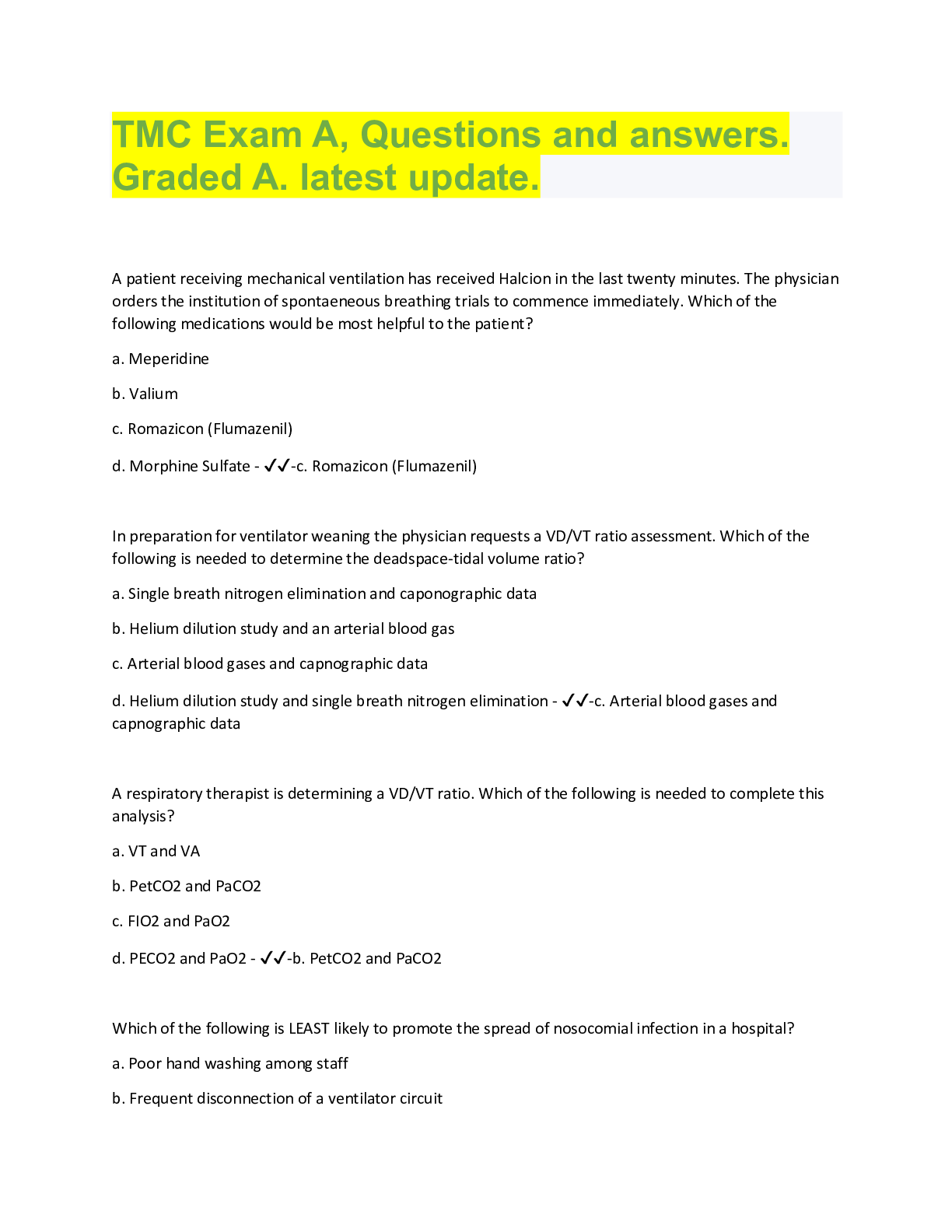
TMC Exam A, Questions and answers.
Graded A. latest update.
A patient receiving mechanical ventilation has received Halcion in the last twenty minutes. The physician
orders the institution of spontaeneous breathing trials to commence immediately. Which of the
following medications would be most helpful to the patient?
a. Meperidine
b. Valium
c. Romazicon (Flumazenil)
d. Morphine Sulfate - ✔✔-c. Romazicon (Flumazenil)
In preparation for ventilator weaning the physician requests a VD/VT ratio assessment. Which of the
following is needed to determine the deadspace-tidal volume ratio?
a. Single breath nitrogen elimination and caponographic data
b. Helium dilution study and an arterial blood gas
c. Arterial blood gases and capnographic data
d. Helium dilution study and single breath nitrogen elimination - ✔✔-c. Arterial blood gases and
capnographic data
A respiratory therapist is determining a VD/VT ratio. Which of the following is needed to complete this
analysis?
a. VT and VA
b. PetCO2 and PaCO2
c. FIO2 and PaO2
d. PECO2 and PaO2 - ✔✔-b. PetCO2 and PaCO2
Which of the following is LEAST likely to promote the spread of nosocomial infection in a hospital?
a. Poor hand washing among staff
b. Frequent disconnection of a ventilator circuit
c. Changing small volume nebulizer equipment every 48 hours
d. Use of unit dose medication - ✔✔-d. Use of unit dose medication
Which of the following can be used to estimate the level of Hemoglobin?
a. C(a-v)O2
b. PAO2
c. Theophylline level
d. RBC - ✔✔-d. RBC
Which of the following alarms would be most important for a patient receiving positive pressure
ventilation by a pressure-cycled ventilator?
a. Low volume
b. I:E ratio
c. Low FIO2
d. High pressure - ✔✔-a. Low volume
Patients with large necks who experience frequent dislodging of their tracheostomy tubes need (a)
a. Longer tracheostomy tube
b. Shorter tracheostomy tube
c. Larger tracheostomy tube
d. Nasal intubation - ✔✔-a. Longer tracheostomy tube
Which of the following would be most effective at resolving a humidity deficit for a patient who is
intubated with an 8.0-mm endotracheal tube?
a. Large volume nebulizer
b. Concha heated humidifier
c. HME
d. Bubble humidifier - ✔✔-b. Concha heated humidifier
A patient with suspected myasthenia gravis in the emergency room should receive which of the
following to confirm a diagnosis?
a. Norcuron
b. Edrophonium bromide
c. Neostigmine
d. Meperidine (Demerol) - ✔✔-b. Edrophonium bromide
Which of the following is an important action when drawing an arterial blood gas sample?
a. Choose a radial site with adequate ulnar circulation
b. Use a 16 gauge needle
c. Compress the site prior to puncture
d. Run the sample within 15 minutes - ✔✔-a. Choose a radial site with adequate ulnar circulation
Which of the following would be most helpful for a patient with fixed upper airway obstruction?
a. Aerosolized epinephrine
b. Beta II agonist medication
c. Corticosteroids
d. Heliox therapy - ✔✔-d. Heliox therapy
Which of the following oxygen modalities would be appropriate for a 220-lb (100-kg) male with diabetic
ketoacidosis who requires 40% supplemental oxygen?
a. Air-entrainment mask
b. Non-rebreathing mask
c. Nasal cannula
d. Simple mask - ✔✔-a. Air-entrainment mask
While administering a treatment with Albuterol to a patient with COPD, the therapist notes a sudden
change in the patient's color to marked cyanosis. The patient appears apneic and the heart rate on the
pulse oximeter indicates 30/min. The therapist should FIRST
a. Administer oxygen by non-rebreathing mask
b. Auscultate breath sounds
c. Begin mouth-to-mouth resuscitation
d. Go get help - ✔✔-c. Begin mouth-to-mouth resuscitation
A 70-kg (154-lb) female patient is receiving mechanical ventilation on the following settings:
Mode: assist/control
Mandatory rate: 14
Total rate: 14
VT: 500 mL
FiO2: 0.55
PEEP: 12 cmH2O
Arterial blood gases revel
pH 7.49 / PaCO2 32 / PaO2 109 / HCO3 24 / BE 0
The respiratory therapist should
a. Decrease mandatory rate
b. Decrease FIO2
c. Increase mandatory rate
d. Decrease PEEP - ✔✔-d. Decrease PEEP
Prior to the removal of chest tubes, which of the following should be done?
a. The chest tube should be expose to normal atmospheric pressure
b. Clamp the chest tube for 24 hours
c. Flush the chest tube with normal saline
d. Suction pressure should be increased temporarily - ✔✔-b. Clamp the chest tube for 24 hours
Which of the following will help a patent to speak while intubated with a tracheostomy tube?
a. Pass-Muir valve
b. Inner cannula
c. Double lumen endotracheal tube
d. Obturator - ✔✔-a. Pass-Muir valve
Prior to obtaining an MEP value with a pressure manometer, the respiratory therapist notes the needle
is pointing at a positive pressure of -4 cmH2O prior to the maneuver. During the MEP maneuver, the
needle reaches 32 cmH2O. The therapist should
a. Report the problem to the medical director
b. Record an MEP of -28 cmH2O
c. Record an MEP of 28 cmH2O
d. Record an MEP of 36 cmH2O - ✔✔-d. Record an MEP of 36 cmH2O
A 70-kg (154-lb) male patient is receiving mechanical ventilation. After increasing PEEP, the following
data is available:
Arterial blood gases reveal
pH 7.32 / PaCO2 47 / PaO2 80 / HCO3 26 / BE+2
C.I. 2.5 / PAP 14 / CVP 4 / PCWP 8
The respiratory therapist should do which of the following?
a. Administer sodium bicarbonate
b. Decrease mandatory rate
c. Remove 100 mL of deadspace
d. Decrease FIO2 - ✔✔-c. Remove 100 mL of deadspace
What would occur on a time-cycled ventilator with a fixed rate if the inspiratory flow rate were
increased?
a. Decrease in tidal volume
b. Increase in inspiratory time
c. Decrease in inspiratory time
d. Increase in tidal volume - ✔✔-d. Increase in tidal volume
Why should a respiratory therapist FIRST open the airway of a patient who is apneic?
a. To protect the neck if the patient has experience physical trauma
b. The patient may be experiencing upper airway occlusion
c. The physical contact may help to trigger a spontaneous breath
d. To facilitate the placement of an oropharyngeal airway - ✔✔-b. The patient may be experiencing
upper airway occlusion
Which of the following is a strategy that may help reduce or prevent autoPEEP in a patient with ARDS?
a. Sedation of the patient
b. Increasing minute ventilation
c. Matching PEEP
d. High flow rates - ✔✔-d. High flow rates
A pediatric patient has a non-productive cough. A chest radiograph reveals a foreign body in the right
mainstem bronchi. Which of the following should be used to alleviate the problem?
a. Tonsil suction device
b. Bronchoscope
c. Suction catheter
d. Laryngoscope - ✔✔-b. Bronchoscope
An adult male is being suctioned though an 8.0-mm ET tube with a 12 Fr. suction catheter at a pressure
of 90 mmHg. Secretion removal has been ineffective. Which of the following modifications should be
recommended?
a. Decrease suction pressure to 80 mmHg
b. Increase suction catheter size to 14 FR
c. Increase suction pressure to 110 mmHg
d. Change to a 10-mm ET tube - ✔✔-c. Increase suction pressure to 110 mmHg
Which of the following is the most significant complication of bronchoscopy?
a. Laryngospasms
b. Coughing
c. Hypotension
d. Vagal nerve stimulation - ✔✔-a. Laryngospasms
Which of the following can be instructed to a COPD patient to help reduce FRC?
a. Serial coughing
b. Autogenic drainage
c. Pursed-lip breathing
d. Incentive spirometry - ✔✔-c. Pursed-lip breathing
A Bronchogram would be most helpful in evaluating and diagnosing which of the following?
a. ARDS
b. Myoplasma pneumoni
[Show More]