Attempt Score 96 out of 100 points
Time Elapsed 50 minutes out of 1 hour
Instructions • Time limit: 1 hour
• 27 true/false and multiple-choice questions
• Open-notes
• Do not hit the BACK button as this will loc
...
Attempt Score 96 out of 100 points
Time Elapsed 50 minutes out of 1 hour
Instructions • Time limit: 1 hour
• 27 true/false and multiple-choice questions
• Open-notes
• Do not hit the BACK button as this will lock you out of the exam.
• The timer will continue if you leave this exam without submitting it.
Results Displayed Submitted Answers, Feedback
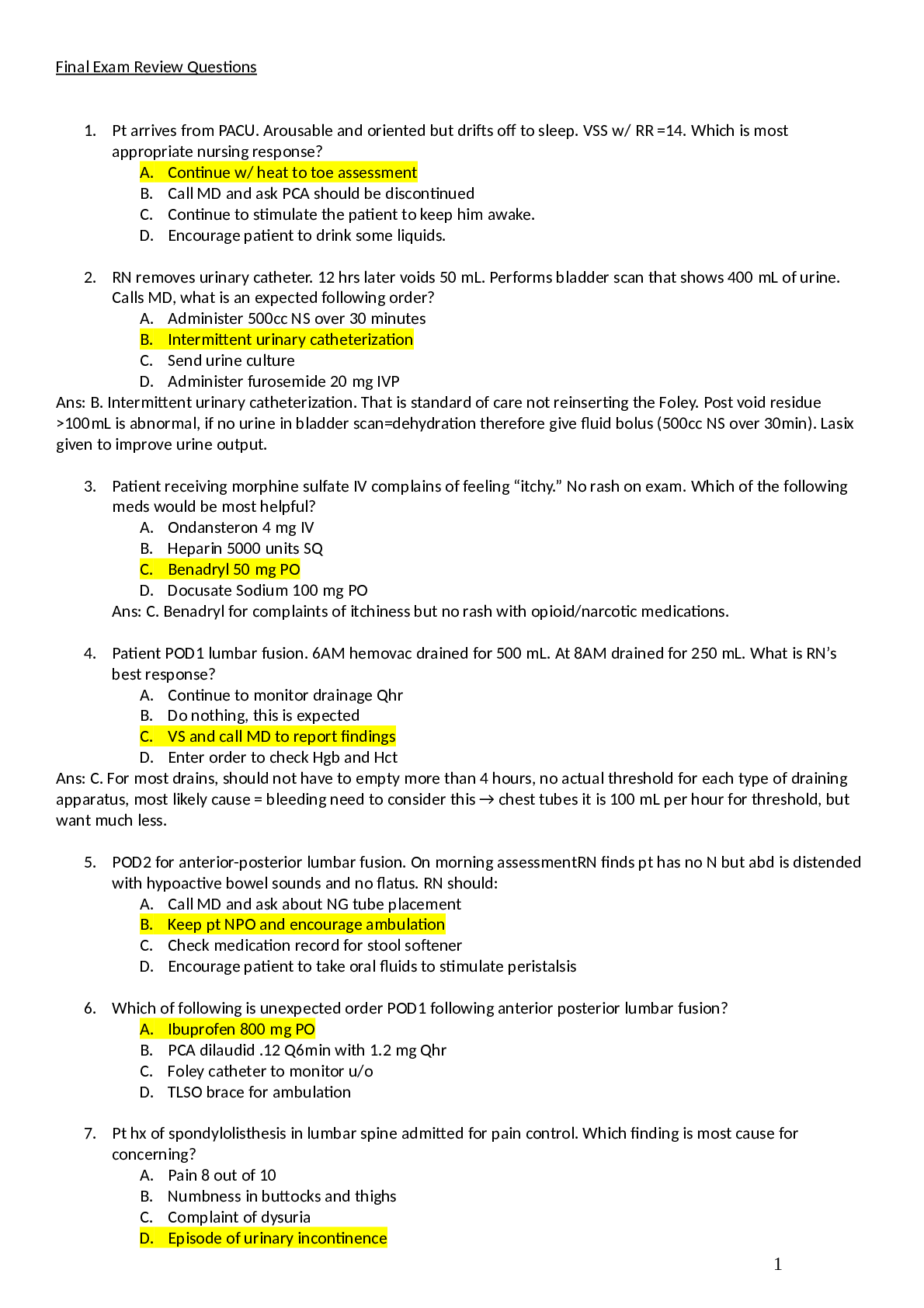
• Question 1
4 out of 4 points
The lectures talked about specific strategies for using the Bible in counseling. Which of the following would NOT be endorsed based on the lecture discussion
Selected Answer: I could use counseling techniques that teach clients how to legitimately get revenge on an abusing spouse
• Question 2
4 out of 4 points
The lectures talk about the “level of risk” that different forms of prayer during counseling take. What is true from that discussion?
Selected Answer: The use of meditation, as a form of prayer, or praying directly for a client in-session should come after the counselor knows the client well, knows something about the spiritual history of the client, and has developed a degree of trust in the therapeutic relationship
• Question 3
4 out of 4 points
The lecture discussed the value of, and some principles for using meditation in Christian counseling. Which of the following statements best corresponds with the lecture content?
Selected Answer: In Christian meditation, we are really changing the pattern from expecting answers to one of patiently waiting on God
• Question 4
4 out of 4 points
The week five lecture talked about “depreciative desires” as a hindrance to reading Scripture for spiritual formation. What would be an example of that hindrance in the life of a client?
Selected Answer: All of these concepts were represented in the discussion of “depreciative desires”
• Question 5
4 out of 4 points
According to the lectures, a guiding principle for using scripture in counseling is
Selected Answer: Christian counselors should use scripture in their counseling but should always ask "in what ways, under what circumstances" prior to quoting scripture.
• Question 6
4 out of 4 points
Which answer below best describes the statement: “We can always count on God’s Word, but we must be careful of our interpretations and applications,” -- from the Five Potential Problems When Using the Bible in Christian Counseling lecture?
Selected Answer: The “overconfidence” trap
• Question 7
4 out of 4 points
In our Christian counseling, if we want to help our client read the Bible for spiritual formation, what is true?
Selected Answer: We need to help our clients develop the personal discipline to diligently approach God’s word
• Question 8
4 out of 4 points
In the lecture discussion on potential problems when using the Bible in counseling, the lecturer referred to “relying excessively on the Bible when other strategies might be more helpful to the client at that moment.” What “trap” may that quote illustrate?
Selected Answer: The “overreliance” trap
• Question 9
4 out of 4 points
The lectures talked about several ways that Scripture could be used in counseling. Which of the following are legitimate ways to use Scripture with our clients?
Selected Answer: All of these are appropriate ways to use Scripture in counseling
• Question 10
4 out of 4 points
Healing prayer can best be described as:
Selected Answer: All the above
• Question 11
4 out of 4 points
Although the lectures emphasized the importance of inside-out change, the lectures also explained the value of outside-in change. What is the function of dislocating experiences in the context of outside-in change?
Selected Answer: Sometimes a traumatic personal experience can cause a client to look at deeper issues of the heart.
• Question 12
4 out of 4 points
The lectures explain that comments by the lecturer about Christian counseling are in the “soul care” tradition, and as such, spiritual formation is emphasized. Which answer below would NOT be true of Formative Reading of the Bible, as discussed in the lecture?
Selected Answer: It is the same as informative reading.
• Question 13
0 out of 4 points
In the context of the discussion on inside/out, outside/in change, the lecture used the term “condemnation engineering” as an example of a mechanism of outside-in change. What is an example of that mechanism?
Selected Answer: A counselor works hard to produce change in the life of a client when the client is “stuck”
• Question 14
4 out of 4 points
Based on the week five lecture, what are some appropriate ways to use scripture in counseling?
Selected Answer: Directly using scripture, implicitly utilizing scriptural principles within counseling strategies, and using scripture to evaluate to determine if a counseling strategy is biblically consistent or biblically neutral
• Question 15
4 out of 4 points
As a Christian counselor, I can use the Bible in an anthropological way. What would be an example of that in counseling?
Selected Answer: I help my client to understand the common struggles of humanity
• Question 16
4 out of 4 points
Some beginning Christian counselors may be tempted to quote a quick verse, or give an easy biblical solution without delving into deeper issues in the life of the client. What caution about using the Bible in counseling might that illustrate?
Selected Answer: Using the Bible as a smokescreen
• Question 17
4 out of 4 points
The lecture defines the “Trinitarian Relationship in Counseling” as:
Selected Answer: The recognition that God is the ever present part of each counseling session.
• Question 18
4 out of 4 points
If we want our clients to “set the stage” for formative reading of Scripture, what should we encourage them to do?
Selected Answer: All of these
• Question 19
4 out of 4 points
The lectures discussed using the METAMORPH grid by filling in the biblical references and spiritual formation columns. What is the purpose behind doing that?
Selected Answer: We need to learn how to help clients think biblically and correct faulty thought patterns.
• Question 20
3 out of 3 points
A basic principle of prayer is that when we get closer to God, we also get closer to people as well.
Selected Answer: True
• Question 21
3 out of 3 points
According to the lecture, helping a client change his/her behavior is never beneficial in producing true inner change.
Selected Answer: False
• Question 22
3 out of 3 points
In the lecture discussion of prayer in Christian counseling, the definition of prayer focused more on connecting with God, rather than learning how to pray to get our petitions answered.
Selected Answer: True
• Question 23
3 out of 3 points
With regard to prayer and Christian counseling, the lecture refocused the question away from whether prayer should be a part of counseling, to a focus on what types of prayer minister best to our clients.
Selected Answer: True
• Question 24
3 out of 3 points
Similar to our consideration of using Scripture in Christian counseling, since prayer is a godly endeavor, we should always open up our counseling sessions with a spoken prayer.
Selected Answer: False
• Question 25
3 out of 3 points
Empathy that facilitates client change contains three essential forms of being. Which choice is NOT one of those forms?
Selected Answer: Being at
• Question 26
3 out of 3 points
Success in forming a collaborative engagement directed toward the achievement of goals that will be perceived as beneficial to the client depends of the counselor’s ability to ____________ .
Selected Answer: Create a particular kind of environment or atmosphere
• Question 27
3 out of 3 points
____________________ involves asking a logical train of systematic questions designed to elicit as much information about the clients as possible.
Selected Answer: Clinical interviewing
[Show More]





.png)