LCDC EXAM STUDY Questions and
answers, 100%Accurate, rated A
Two main types of cells in the nervous system - ✔✔-glia and neurons
Glia - ✔✔-Cells that out number neurons, cannot process information like neurons, make
...
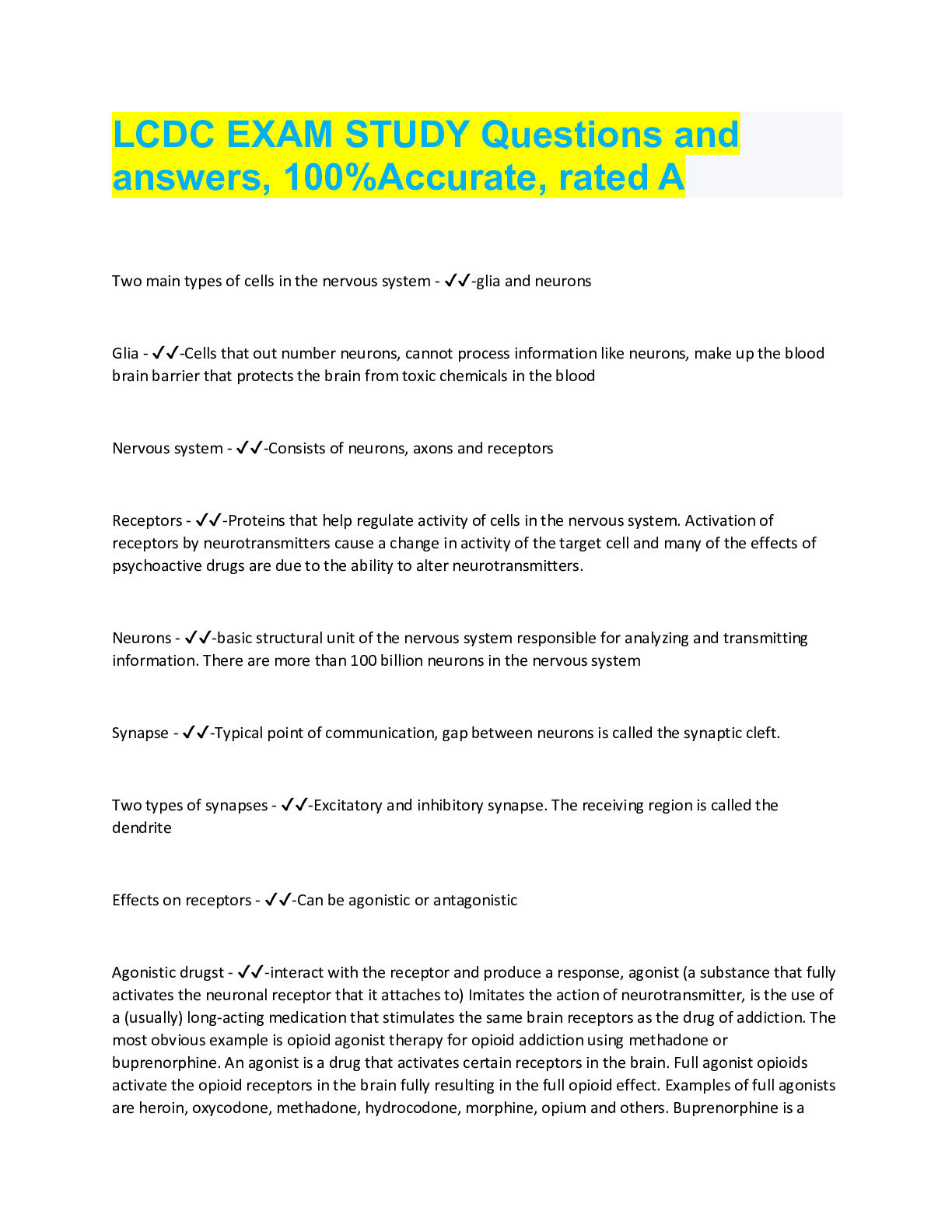
LCDC EXAM STUDY Questions and
answers, 100%Accurate, rated A
Two main types of cells in the nervous system - ✔✔-glia and neurons
Glia - ✔✔-Cells that out number neurons, cannot process information like neurons, make up the blood
brain barrier that protects the brain from toxic chemicals in the blood
Nervous system - ✔✔-Consists of neurons, axons and receptors
Receptors - ✔✔-Proteins that help regulate activity of cells in the nervous system. Activation of
receptors by neurotransmitters cause a change in activity of the target cell and many of the effects of
psychoactive drugs are due to the ability to alter neurotransmitters.
Neurons - ✔✔-basic structural unit of the nervous system responsible for analyzing and transmitting
information. There are more than 100 billion neurons in the nervous system
Synapse - ✔✔-Typical point of communication, gap between neurons is called the synaptic cleft.
Two types of synapses - ✔✔-Excitatory and inhibitory synapse. The receiving region is called the
dendrite
Effects on receptors - ✔✔-Can be agonistic or antagonistic
Agonistic drugst - ✔✔-interact with the receptor and produce a response, agonist (a substance that fully
activates the neuronal receptor that it attaches to) Imitates the action of neurotransmitter, is the use of
a (usually) long-acting medication that stimulates the same brain receptors as the drug of addiction. The
most obvious example is opioid agonist therapy for opioid addiction using methadone or
buprenorphine. An agonist is a drug that activates certain receptors in the brain. Full agonist opioids
activate the opioid receptors in the brain fully resulting in the full opioid effect. Examples of full agonists
are heroin, oxycodone, methadone, hydrocodone, morphine, opium and others. Buprenorphine is a
partial agonist meaning, it activates the opioid receptors in the brain, but to a much lesser degree than a
full agonist. A pure opioid antagonist used in medicine is naloxone (not to be confused with naltrexone).
Antagonisitic - ✔✔-Drugs interact with the receptor but prevent a response, agonist drugs which bind to
the neurotransmitters in the brain, antagonist drugs do the opposite: they block the brain's
neurotransmitters. The action of neurotransmitter is obstructed. Buprenorphine also acts as an
antagonist, meaning it blocks other opioids, while allowing for some opioid effect of its own to suppress
withdrawal symptoms and cravings.
Agonist-antagonist opioids - ✔✔-In pharmacology the term agonist-antagonist is used to refer to a drug
which exhibits some properties of an agonist (a substance that fully activates the neuronal receptor that
it attaches to) and some properties of an antagonist (a substance that attaches to a receptor but does
not activate it or if it displaces an agonist at that receptor it seemingly deactivates it thereby reversing
the effect of the agonist).
Agonist-antagonist opioids[edit]
The best known agonist-antagonists are opioids. Examples of such opioids are:
buprenorphine[1] (Suboxone, Subutex)
pentazocine
butorphanol
nalbuphine
Naloxone (Narcan) - ✔✔-opioid antagonists that is a short acting drug which will bring a patient out of
an opiate overdose by stripping the opiate from the opiate receptor and is a life saving drug.
Naltrexone, - ✔✔-opioid antagonists that is a short acting opiate/alcohol blocking agent has been used
for the last 30 years. Naltrexone blocks the pharmacological effects of 25 mg / in the introduction of
heroin for 24 hours, a double dose (100 mg) acts within 48 hours, and 150 mg will affect during for 3
days. Long-term appointment does not cause tolerance and dependence. To cut the long story short,
when comparing Naltrexone vs Naloxone it is obvious that Naltrexone is stronger for alcohol
dependence but Naloxone acts faster and remains longer.
Acetylcholine (ACH), epinephrine, dopamine, serotonin and endorphins - ✔✔-Neurotransmitters most
likely altered by drug abuse
Somatic Nervous System - ✔✔-Carries sensory information from outside the body into the CNS and
motor information out.
Automatic nervous system (ANS) - ✔✔-cell bodies are located within the brain or spinal cord but their
axons project outside the CNS to involuntary muscles.
Automatic nervous system has two componenets - ✔✔-These componenents contest with each other:
sympathatheic (fight or flight) and parasympathetic (rest and digest).
Sympathetic System - ✔✔-speeds up hear and breathing rates is vasoconstrictor amphetamine
(Benzedrine) benzylpiperazine (BZP)
cathine (found in Catha edulis) cathinone (found in Catha edulis, khat) cocaine (found in Erythroxylum
coca, coca)
ephedrine (found in Ephedra) lisdexamfetamine (Vyvanse)
maprotiline (Ludiomil) MDMA (Ecstasy, Molly)
methamphetamine (Meth, Crank, Desoxyn) methcathinone methylenedioxypyrovalerone (MDPV)
methylphenidate (Ritalin) 4-methylaminorex
oxymetazoline (Afrin, Vicks Sinex) pemoline (Cylert)
phenmetrazine (Preludin) propylhexedrine (Benzedrex)
pseudoephedrine (Sudafed, SudoGest, also found in Ephedra species)
GABA - ✔✔-inhibitory neurotransmitter, sedatives are dependent upon their binding to the GABA
receptors (gamma-aminobutyric acid) is an inhibitory neurotransmitter that is very widely distributed in
the neurons of the cortex. GABA contributes to motor control, vision, and many other cortical functions.
It also regulates anxiety.
Depressants - ✔✔-Depressants/sedative-hypnotics (central nervous system depressants). Drugs in this
class slow/depress the activity of the central nervous system. Examples of drugs in this classification
include, but are not limited to, alcohol,
benzodiazepines, and barbiturates. They are usually taken orally. The desired effects are a reduction of
anxiety with possible elation secondary to decreased
alertness and judgment. Other acute effects include sedation, impaired judgment, impaired ability to
operate vehicles or machinery, or respiratory and cardiac
depression with overdose. The action of sedative-hypnotics is a depression of the activity at all excitable
tissues; in general, it binds to GABA (inhibitory) receptors
resulting in sedation
Stimulants - ✔✔-Drugs in this class increase central nervous system activity. This classification includes
cocaine, amphetamines, methamphetamines, and
methylphenidate (Ritalin). Routes of administration vary, powered cocaine is snorted intranasally, can
be liquified and injected intravenously, or it can be smoked as freebase or, more often, as crack.
Amphetamines can be taken orally, injected intravenously, or smoked. Methylphenidate (Ritalin) is
taken orall
Hallucinogens/dissociatives. - ✔✔-These drugs change sensory perception and have the ability to alter
reality and produce hallucination-like effects. This classification includes naturally occurring and
synthetically prepared drugs that include LSD, mescaline, psilocybin, psilocin, MDMA (ecstasy), PCP, and
ketamine
MDMA effects - ✔✔-can include nausea, clenching of the jaw and teeth, muscle tension, blurred vision,
panic attacks, confusion, depression, anxiety, paranoid psychosis, increased body temperature, and
cardiac arrest . Acts on
several different neurotransmitter sites to produce effects like LSD hallucinations and amphetamine-like
arousal
LSD - ✔✔-can include panic attacks, increased blood pressure, heart palpitations, tremors, nausea,
muscle weakness, increased body temperature, ataxia, and in some cases accidental death is structurally
related to serotonin and many of the behavioral effects are probably related to their binding to the
serotonin receptors.
PCP - ✔✔-can include psychotic reactions, bizarre behavior, outbursts of hostility and violence, and
feelings of severe anxiety, doom, or impending death
Ketamine - ✔✔-can include a frightening experience of complete sensory
detachment, explained as a near-death experience, paranoia, boredom, and possible coma
Cannabinoids/cannabinols - ✔✔-his category includes marijuana, hashish, and THC.
The usual route of administration is smoking or oral. Its usual length of action 78 from smoking is 2 to 4
hours and through oral means is 5 to 12 hours. The desired
effects are a sense of relaxation and well-being, euphoria, detachment, altered level of consciousness,
altered perceptions, altered sense of time, and possible
sexual arousal
Effects of cannabinoid use - ✔✔-re slowed reaction time, altered perceptions,
panic, anxiety, nausea, dizziness, depersonalization, paranoid thoughts, and trouble expressing
thoughts. The effects are believed to be caused by the binding
of the drug at specific THC receptor sites in the brain. Intoxication may cause increases in respiration
and heart rate and a slight increase in body temperature.
Upon examination, the users may exhibit red eyes, mild dilation of pupils, mild tremors, decreased
coordination, decreased strength, less ability to perform
complex motor tasks, and dry mouth. Mentally, the user may express feelings of depersonalization, an
alteration in mood, disorganization, anxiety, panic, problems with memory, paranoid thoughts, and
possible hallucinations
Long-term, chronic canabinoid use - ✔✔-can lead to problems such as dependence,
panic, anxiety, paranoid thoughts, etc. They may also include respiratory problems, the possibility of an
impaired immune system, possible reproductive
problems, including low birth weight infants, and amotivational syndrome. Withdrawal usually consists
of cravings, anxiety, irritability, nausea, anorexia,
agitation, restlessness, tremors, and depression
Inhalants - ✔✔-These drugs consist mainly of chemicals that can be legally purchased and that are
normally used for nonrecreational purposes. These include industrial solvents and aerosol sprays that
include, but are not limited to, gasoline, kerosene, airplane glue, lacquer thinner, acetone, nail polish
remover, lighter fluid, metallic paints, and typewriter correction fluids. Also included are amyl, butyl and
isobutyl nitrite, and nitrous oxide gas
Inhalants effects - ✔✔-Inhalants reduce inhibition and produce euphoria, dizziness, slurred speech, an
unsteady gait, and drowsiness. Nystagmus, the constant involuntary movement of the eyes, may be
noted. The nitrites alter consciousness and enhance sexual pleasure. The individual may experience
giddiness, headaches, and a sense that the user is about to pass out.An overdose of these substances
may produce hallucinations, muscle spasms, headaches, dizziness, loss of balance, irregular heartbeat,
and coma from lack of
oxygen
Inhalants other effects - ✔✔-An overdose of these substances may produce hallucinations, muscle
spasms,
headaches, dizziness, loss of balance, irregular heartbeat, and coma from lack of oxygen . Tolerance
does not seem to develop with inhalants with the exception of nitrous oxide for which tolerance can
develop. There does not seem to be withdrawal symptoms from these substances, which indicate there
is not physical dependence.
The critical acute effect of inhalants results from the method of administration, which can result in loss
of consciousness, coma, or death from lack of oxygen.
Respiratory arrest, cardiac arrhythmia, or asphyxiation may occur. Many of these substances are highly
toxic, and chronic use may cause damage to the liver, kidneys, brain, and lungs.
Anabolic steroids - ✔✔-Anabolic steroids are synthetic illicit drugs that are used to
increase muscle mass and improve athletic performance. These drugs resemble the male sex hormone,
testosterone. Some anabolic steroids are approved for
medical use and are classified as schedule III drugs.
Drugs in this classification include Depo-Testosterone, Durabolin, Danocrine, and Halotestin. Some
anabolic steroids used for veterinary medicine are illicitly sold
for human use and may be sold legally outside of the United States
Effects of steroids - ✔✔-Anabolic steroids are either injected or taken orally. Combining oral and
injectable steroids is known as "stacking". These drugs increase muscle strength, reduce body mass, and
increase aggressiveness,
competitiveness, and combativeness there is no immediate danger of death or serious medical
problems from high dosage levels of anabolic steroids; there are serious complications from long-term
use. There is no evidence that one can develop tolerance to anabolic steroids. Physical and psychological
dependence on anabolic steroids does occur, and there are
withdrawal symptoms. Withdrawal symptoms include depression, fatigue, restlessness, insomnia, loss of
appetite, and decreased interest in sex. Some of the acute and chronic effects of anabolic steroids on
males include
atrophy of testicles, impaired production of sperm, infertility, early baldness, acne, and enlargement of
the breasts. For females, there are masculizing effects
including increased facial and body hair, lowered voice, and irregular or the stopping of the menstrual
cycle. There is an increased risk of coronary artery disease. Anabolic steroids may cause jaundice and
liver tumors. Mood swings with periods of unreasonable and uncontrolled anger and violence may be
noted
Ethics - ✔✔-Ethics are the rules of conduct recognized in a particular profession, the shared standards of
what is good practice. Note that the ethicalness and the legality of an action are two different things,
and occasionally they are in conflict. Ethical codes delineate mandatory ethics, the minimal standard of
conduct that is acceptable. Ideally, counselors practice aspirational ethics, which focus on the spirit
behind the code. For example, mandatory ethics permit a counselor to have a romantic relationship with
a former client 2 years after the client's treatment ends. Aspirational ethics suggest that doing so even
after 2 years is inadvisable.
Decision-making Models - ✔✔-Decision-making models provide a framework for systematically choosing
a course of action when ethical codes do not specify how to act in a particular situation. The steps of
one decision-making model are identify the problem, review the code of ethics and relevant laws,
consult with another professional, consider possible courses of action and their consequences, choose a
course of action, and evaluate the results
Fundamental Ethical Principles - ✔✔-Autonomy. Respect the client's independence and self�determination. Nonmaleficence. Do not harm the client.
Beneficence. Provide benefit for the client. Justice. Be fair to the client. Fidelity. Be faithful to the client.
Veracity. Be truthful with the client.
The NAADAC Principles - ✔✔-The National Association of Alcoholism and Drug Abuse Counselors
(NAADAC) is a professional association that offers certification in substance abuse counseling. The
principles (NAADAC, 1995) address nondiscrimination, responsibility, competence, legal and moral
standards, public statements, publication credit, client welfare,
confidentiality, client relationships, interprofessional relationships, remuneration, and societal
obligations.
Ethical Standards - ✔✔-The ethical standards for LCDCs appear in the Texas Administrative Code and as
LCDC Rule 150.121. The ethical standards address these important topics: applicants and licensed
counselors' responsibility to comply with the standards, nondiscrimination,
maintaining high quality service to clients, protecting the profession from unqualified or unethical
persons, counselor sobriety, upholding the law and conducting oneself in a professional manner,
documentation, publication credit, client welfare, privacy and
confidentiality, dual relationships, relationships with other professionals, and fees. Actions against a
license for violating the ethical standards are described in LCDC Rule
150.122. They include refusal to issue or renew a license, suspension or revocation of a license, placing a
counselor on probation if the counselor's license has been suspended, and reprimand of a license
holder.
42 CFR - ✔✔-refers specifically to information that can be used to identify a person as an alcohol or drug
abuser, or the recipient of a substance related diagnosis, referral, or
treatment. Federal law (42 Code of Federal Regulations, Part 2) prohibits counselors from divulging
the fact that someone is in treatment or any details of their treatment without the client's written
consent, when the client is in a clear state of mind. This applies to former clients, deceased clients, and
those who merely applied to a treatment program but never attended.
HIPAA - ✔✔-covers all personal health information that can be used to identify an individual.
Exceptions to confidentiality - ✔✔-Confidentiality is not absolute; there are
circumstances in which releases of information are not required to disclose client information. Clients
should be told of these circumstances as part of the process
of securing their informed consent for treatment. In every case, only the information required by law is
to be disclosed. Some exceptions include instances
in which information necessary to provide services may be shared among staff of a program, reporting
child abuse or neglect (Public Law 99-401), threatening to harm another person, threatening suicide,
committing or threatening a crime on program property or against program staff, medical emergencies,
elder abuse, and court orders.
Privilege - ✔✔-a legal concept that refers to a client's right to keep
confidential information out of legal proceedings. Technically, the client holds the privilege, so
counselors may not disclose information in legal proceedings unless
the client waives privilege or certain other conditions, which vary from State to State, are met.
Informed consent and releases of information - ✔✔-Client consents to release information about their
treatment must contain certain specific information. This
includes, but is not limited to, the purpose of the disclosure, the person to receive the disclosed
information, and the date or condition under which the consent will expire. The consent may be
revoked in writing or verbally, at the client's discretion. Counselors have to obtain consent from minor
clients before releasing
information. By law, releases of information must include a statement that the recipient of the
disclosure cannot make subsequent disclosures unless federal regulations permit them to do so.
Duty to warn - ✔✔-a client threatens to harm another person who is reasonably identifiable, the
counselor has a duty to warn the appropriate authorities of that threat. In Texas, counselors do not have
a duty to warn the intended victim. In some States, cou
[Show More]