ECS 1501 ASSIGNMENT 6 Latest 2022/2023
Traditional Organizational Functions - CORRECT ANSWER traditional functions within organizations include marketing + sales, supply chain management, accounting & finance, human
...
ECS 1501 ASSIGNMENT 6 Latest 2022/2023
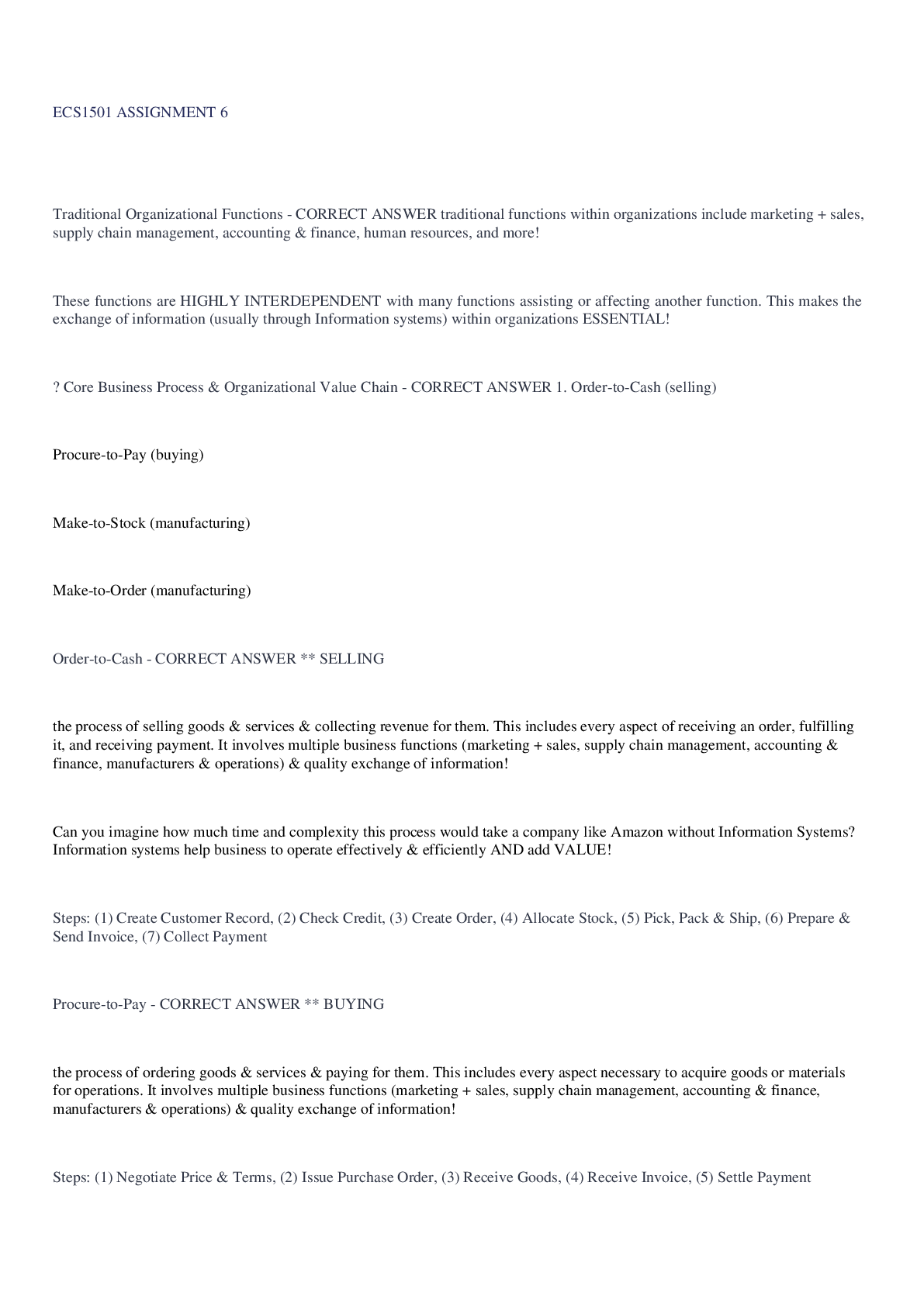
Traditional Organizational Functions - CORRECT ANSWER traditional functions within organizations include marketing + sales, supply chain management, accounting & finance, human resources, and more!
These functions are HIGHLY INTERDEPENDENT with many functions assisting or affecting another function. This makes the exchange of information (usually through Information systems) within organizations ESSENTIAL!
✭ Core Business Process & Organizational Value Chain - CORRECT ANSWER 1. Order-to-Cash (selling)
2. Procure-to-Pay (buying)
3. Make-to-Stock (manufacturing)
4. Make-to-Order (manufacturing)
Order-to-Cash - CORRECT ANSWER ** SELLING
- the process of selling goods & services & collecting revenue for them. This includes every aspect of receiving an order, fulfilling it, and receiving payment. It involves multiple business functions (marketing + sales, supply chain management, accounting & finance, manufacturers & operations) & quality exchange of information!
* Can you imagine how much time and complexity this process would take a company like Amazon without Information Systems? Information systems help business to operate effectively & efficiently AND add VALUE!
Steps: (1) Create Customer Record, (2) Check Credit, (3) Create Order, (4) Allocate Stock, (5) Pick, Pack & Ship, (6) Prepare & Send Invoice, (7) Collect Payment
Procure-to-Pay - CORRECT ANSWER ** BUYING
- the process of ordering goods & services & paying for them. This includes every aspect necessary to acquire goods or materials for operations. It involves multiple business functions (marketing + sales, supply chain management, accounting & finance, manufacturers & operations) & quality exchange of information!
Steps: (1) Negotiate Price & Terms, (2) Issue Purchase Order, (3) Receive Goods, (4) Receive Invoice, (5) Settle Payment
Make-to-Stock - CORRECT ANSWER ** MANUFACTURING
- the process of manufacturing goods, either based on forecasts or orders.
- The make-to-stock process is based on forecasts or budgeted sales figures and is simpler since it is usually used with standard or commodity products (cheap, high volume).
Steps: (1) Procure Inputs, (2) Schedule Production, (3) Production, (4) Quality Control,
(5) Stock Product
Make-to-Order - CORRECT ANSWER ** MANUFACTURING
- the process of manufacturing goods, either based on forecasts or orders.
- The make-to-order process is more complex since it is used with designed or specialized products (expensive, low volume), so extra steps like designing or additional engineering is required.
Steps: (1) Process Sales Order, (2) Design/Engineer Product, (3) Procure Inputs, (4) Schedule Production, (5) Quality Control, (6) Ship Product
Example Supply Chain with Core Business Processes Included - CORRECT ANSWER
* See Image Below!
✭ Value Chain Analysis - CORRECT ANSWER used to identify opportunities where IS can be utilized to gain a competitive advantage; analyzing a company's activities (listed below) to identify which processes/activities need to be optimized to gain a competitive advantage.
- Core activities (inbound & outbound logistics, operations, marketing & sales, service) are those that DIRECTLY create value for the customer while support activities (firm infrastructure, human resource management, technology development, & procurement) are those that enable the core activities to function efficiently, but do NOT DIRECTLY create value for the customer.
- These core activities differ among industries, but the idea behind the value chain is companies will perform better than their competitors if they perform better in one of more key business processes!
Value System - CORRECT ANSWER combining the value chain of multiple organizations through information systems (IS) to facilitate the flow of information to operate effectively & efficiently!
Enterprise Systems - CORRECT ANSWER information systems (IS) that span the breadth of the organization; involves multiple business functions (marketing + sales,
supply chain management, accounting & finance, manufacturers & operations) & NEEDS quality exchange of information!
- The two most likely benefits realized from utilizing enterprise systems are improvements in (1) availability of information and (2) increased interaction throughout the organization.
OLD Enterprise Systems: Legacy (Stand-Alone Applications) & Proprietary Systems
NEW Enterprise Systems: Integrated Enterprise System Approach
Old Enterprise Systems - CORRECT ANSWER ** Legacy Systems (Stand-Alone Applications): EACH department has its OWN system to conduct daily business activities that were NOT designed to communicate with other systems. These were NOT particularly useful for other areas in the firm!
- This is inefficient because people must take the time to access, correct, coordinate, and more throughout MULTIPLE systems! Pitfalls of this system include infrastructure specific, inefficient processes, & potential for inaccuracies!
** Proprietary Systems: from vendors, these were NOT designed to share information with other vendors' systems. There was a problem "knitting together" information because of a lack of integration.
Integrated Enterprise System Approach - CORRECT ANSWER NEW Enterprise System that streamlines operations across the ENTIRE value chain, improving effectiveness & efficiency! Contains internally (information flow WITHIN the organization) & externally (information flow OUTSIDE the organization - includes supply chain & customer relationship management).
- Each module within an enterprise system replaces a legacy (stand-alone) system!
Software Types to Improve Enterprise Systems - CORRECT ANSWER 1. Packaged Software ("Off the Shelf"): this software often does NOT require configuration & are usually divided into modules. Special functionality may require customizing the packaged (or vanilla) version. An example of this includes Microsoft Word!
2. Customer Software: enterprise software is extraordinarily complex & often requires configuring. This software entail significant costs & often creates a version that can NOT be upgraded with reprogramming, so a cost-benefit analysis should be performed prior to any customizations.
Business Process Management - CORRECT ANSWER evolved from "business process reengineering"
- actively managing a company's business processes like process modeling, redesign, & improvement. The benefits of this approach include reduced costs & cycle time, better
production & service quality, improved customer interaction, better information sharing & visibility, and more!
** Steps of BPM: (1) develop a vision, (2) identify critical processes to be redesigned, (3) understanding & measuring existing processes, (4) identifying ways information systems (IS) can be improved, & (5) designing and implementing new processes.
✭ Best Practice Software - CORRECT ANSWER most Enterprise Resource Planning (ERP) vendors build best practices into their ERP systems, which identify necessary changes & allow future updates to run smoother. HOWEVER, this may NOT always be the best strategy - if a company has a competitive advantage from a unique business process, forcing best practices may HURT!
✭ Enterprise Resource Planning (ERP) - CORRECT ANSWER uses a central information repository that is consistent and can be used for different functional modules. They also have built-in control systems that help businesses mirror organizational processes, support segregation of duties, and monitor business activities. They help comply with government regulations & reporting requirements and while they do NOT solve ALL problems, they help tremendously.
- Choosing an ERP System: MUST account for business needs, system functionality (ESPECIALLY the MOST critical system processes), & management practices.
- Configuration is IMPORTANT when installing these systems!
- This system supports the core business process (order-to-cash, procure-to-pay, etc.) but also support industry specific core processes (EX: health care for a hospital!)
- Limitations of ERP: they can require organizations to change their processes (once implemented, a company is locked in), difficult & costly to make changes, modifications require extra & costly programming
✭ ERP Core (Internal) & Extended (Support - External) Components - CORRECT ANSWER Core (Internal)
1. Financial Management: supports accounting, financial reporting, performance management, & corporate governance
2. Operations Management: simplify, standardize, & automate business processes related to inbound & outbound logistics, product development, manufacturing, & sales + service
3. Human Resource Management: employee recruitment, assignment tracking, performance reviews, payroll, & regulatory requirements
Extended (Support - External) - Supply Chain Management & Customer Relationship Management.
✭ How to Achieve Enterprise Resource Planning (ERP) - CORRECT ANSWER 1. Secure Executive Sponsorship: this is the primary reason for ERP FAILURE! Critical for buy in, resource allocation/availability, authorizing business improvement, & removing obstacles!
2. Help From Outside Experts: this system is complex, so experts can specify needs, select a suitable vendor, manage implementation project, provide technical expertise
3. Train Users Thoroughly: this system has a learning curve, so training employee adequately can alleviate concerns, mitigate productivity loss, & set expectations
4. Take a Multidisciplinary Approach to Implementation: involving ALL business functions helps ensure needs are met & buy-in is achieved
5. Evolve the Implementation: recent trend is to move away from LARGE ERP system to cloud-based ERP for increased scalability + agility! Furthermore, managing a business in real time can utilize in-memory computing & mobile access!
Amazon's "Streetcar" Inventory Robot - CORRECT ANSWER http://www.youtube.com/watch?v=6KRjuuEVEZs
- This allows Amazon's warehouse to be DYNAMIC! They can store products anywhere since the robots know what is on each pod! You can NOT do this with a traditional warehouse!
Bias - CORRECT ANSWER a disproportionate weight in favor of or against an idea or thing, usually in a way that is closed-minded, prejudicial or unfair"
- In statistics, bias is a "systematic distortion of a statistical result due to a factor NOT allowed in its derivation"
Why do Bias Exist:
1. Humans are bias: conscious, unconscious, and societal bias
2. Our bias are "trained" into the algorithms: historical data/sample selection bias (populations can differ). Correlated data/questions to biased variables (e.g race gender). Current research is attempting to identify and "remove" such correlations with biased variables.
3. Ethics in AI continue to face tension: profit motives?
Different Kinds of Bias - CORRECT ANSWER ✭ Artificial Intelligence (AI): machines are NOT always right! If the users input some biases, the analytics will export biases!
- Racial: Northpointe's "risk assessment" is widely used in the sentencing and evaluation of individuals to assist with criminal profiling. This is commonly used for criminal profiling. They said race was NOT a question asked, but other questions asked could be correlated with race, leading to bias.
- Gender: there are large gender bias in many aspects of life like opportunities, wages, and more. For example, women having the same income & higher credit scores than their husband were 10-20x less likely to be approved for the Apple credit card (this exists with banks and other firms also)!
Business Case - CORRECT ANSWER a complete justification for making or continuing to make an investment in a new or ongoing information system; it demonstrates how the investment is justified & superior to its alternatives.
- Build a strong, integrated set of arguments, ferret systems that do NOT add value, show the benefits of IS to the organization, lay out the costs & benefits, make "go" or "no go" decisions, and use them to justify continued funding
- You MUST identify costs - tangible costs like total cost of ownership (TCO), non- recurring costs (acquisition) & recurring costs (use and maintenance) + the case's tangible (estimated sales gain) & intangible (improved customer service) benefits
- When presenting the case, KNOW YOUR STUFF: know who you are presenting to, what their background is, what they care about, convert benefits to common language (like financial terms such as $ per time period), devise common variables & goals, and understand the sensitive topics
4 Stakeholders involved in Making a Business Case - CORRECT ANSWER 1. Management: greater strategic focus with largest project sizes & longest project duration
2. Steering Committee: identifies & assess all possible systems development projects an organization could take; cross-functional focus with greater organizational change. Formal cost-benefit analysis is conducted here, and these committees have larger & riskier projects
3. User department: narrow, non-strategic focus with faster development
4. IS Executive: focus on integrating existing systems to experience fewer development delays; these stakeholders are LESS concerned with a cost-benefit analysis
Productivity Paradox - CORRECT ANSWER stems from the difficulty many businesses and early professionals had showing worker output increased with technology (EX: paradox created for banks after investment in ATM technology).
If you make a case for a technology investment, you MUST consider the productivity paradox: you MUST establish potential drawbacks and changes BEFORE implementation to accurately understand the project and its potential benefits/risks.
✭ Systems Development Process - CORRECT ANSWER contains many different aspects:
- Software Types
- IS Development
- System Analyst
-
Software Types (Systems Development Process) - CORRECT ANSWER one is NOT better than the other, so a firm must conduct a cost-benefit analysis and other analysis to make a reasonable recommendation! Furthermore, they are often used together if they can be INTEGRATED in a beneficial way!
1. Packaged Software ("Off the Shelf"): this software is less costly & risky, easier to implement, and of higher quality than customized software, but it may NOT be specific to the problems/scenario! An example of this includes Microsoft Word!
2. Customized Software: tailored to an organization's specific problems and needs, meaning the organization ONLY pays for what they are going to use!
3. Open Source Software: can be a financial bargain due to its low up-front costs, but there can be MANY hidden support costs since there is NO vendor to call when a problem arises. This means companies need to internalize support or hire a commercial vendor to provide software support services!
IS Development (Systems Development Process) - CORRECT ANSWER - picture it as a hierarchical LEGO structure: there is a large organizational problem at the top, which can be decomposed into many smaller problem beneath it! These smaller problems can be translated into a computer program, which can proceed to be pieced into an overall comprehensive solution/system!
- One method for deciding among different IS investments or when considering alternative designs for a given system is weighted multicriteria analysis. Furthermore, data flows represent the movement of data through an organization of within an IS system.
System Analyst (Systems Development Process) - CORRECT ANSWER studies the problems and needs of an organization to determine how people, methods, and information technology can best bring about improvements in an organization. These
analysts assist system users and other business personnel define their requirements for new or enhanced information systems!
- There is a continuous, mutual relationship between system analysts and system users: users know what is needed(✭), while the analysts know how to design it!
✭ Systems Development Life Cycle (SDLC) - CORRECT ANSWER this is a CYCLICAL process! At any moment, the cycle can revert to its prior stage (EX: if a company in the design phase notices they need more analysis, they can easily go back!)
1. Systems Planning & Selection: identify resource capabilities & constraints, the best approach - formal or informal (ad-hoc) process, the role of the business case(s), and intangible benefits like project size and risk. These factors must align with the firm's objectives, strategy, and tangible benefits.
Tangible benefits are those that are easily quantifiable (like revenue), while intangible benefits are those that are difficult to quantify/measure like customer's opinions!
2. Systems Analysis: determining the optimal approach through data collection, modeling, & logistics to begin creating enough models so an optimal path can be chosen.
3. Systems Design: combines analysis (phase 2) models with optimal architecture or system design. This phase adds human-computer interface, databases & files, + processing & logistics to construct a prototype of what the user will view on their screen.
4. Systems Implementation & Operation: convert the design into a system, implement the database, create user guidelines, conduct training, & switch to the new system
5. MAINTENANCE (see respective slide)
✭ Types of Conversion Strategies (Step 4):
(a) Parallel: old & new systems are used simultaneously. This strategy is the safest with the lowest risk, but a major drawback is the requirement for double entry! However, if the new system does NOT work, the firm can easily revert to the old one!
(b) Direct: the old system is discontinued one day and the new one is used the next. This strategy is used when, for some reason, it isn't possible for different departments to be on different systems.
(c) Phased: parts of the new system are implemented over time. Since many ERP systems consist of various modules, a phased (+ often a pilot) approach is often used!
(d) Pilot (single location): entire system is used in one location.
STUDY TIP: Acronym for remembering SDLC: Planes & Skys (planning & selection) all (analysis) day (design) in October (implementation & operation)
Repeating the Systems Development Life Cycle (SDLC) - CORRECT ANSWER changes, maintenance, and upgrades will be needed, so it is crucial change requests are appropriate & justified! These requests go through their own mini SDLC!
- Since EACH maintenance phase is repeated constantly for EACH SDLC phase, the total amount of development for the system's maintenance typically exceeds (>) the initial amount of development for the SDLC!
Alternate Approaches to Designing & Building Systems - CORRECT ANSWER - Prototyping: trial-and-error. Develop core needs, implement good features & learn from poor ones, then repeat. Show the users something tangible and make changes EARLY in the SDLC!
- "Agile" methodology: use evolutional system's development approach to create small, client-approved parts of the system as the project progresses.
✭ Acquiring IS - CORRECT ANSWER - Reasons for external acquisition: limited or overworked staff, limited skill set, poor performance of internal sources, free up resources, time, etc.
Steps for External Acquisition:
1. Systems Planning & Selection: identify resource capabilities & constraints, the best approach - formal or informal (ad-hoc) process, the role of the business case(s), and intangible benefits like project size and risk. These factors must align with the firm's objectives, strategy, and tangible benefits.
2. Systems Analysis: determining the optimal approach through data collection, modeling, & logistics to begin creating enough models so an optimal path can be chosen.
3. Development of a Request for Proposal: requires information regarding a company's current situation, how the new system will be used, requirements for the new system, constraints, time available, etc. This is often outsourced to a consulting company to help manage and select the appropriate vendor!
4. Proposal Evaluation: compare financials, difference between proposed solution to the firm's requested features, and noting similarities + differences. Some variations are insignificant while others are dealbreakers, but each proposal should be evaluated in terms of risk and the probability things will/won't work with its respective impact.
5. Vendor Selection: once everything has been evaluated, vendors should be scored & ranked for easy comparison.
Outsourcing - CORRECT ANSWER moving business processes or tasks to another country to utilize talented workers or reduce costs. Companies will generally ONLY outsource processes/tasks that are NOT part of their core competencies.
- Key Reasons for Outsourcing: reduce or control costs, free up internal resources, gain access to world-class capabilities, increase the revenue potential of the organization, reduce time to market, increase process efficiencies and time to focus on core activities, and to compensate for lack of skill or specific capabilities.
Computer Crime - CORRECT ANSWER - using a computer to commit an illegal act, like destroying data, embezzling funds (when a person who has access to or lawful possession of money or property fails to return it to its owner), or supporting criminal activity, is a crime. These usually target confidentiality, integrity, and availability (CIA).
** Types of Computer Crimes:
1. Unauthorized Access: stealing information or the use of computer system, accessing systems with the intent to commit information modification
2. Information Modification: changing data for financial gain (e.g embezzlement) or defacing a website (e.g hacktivists making a statement)
** Who Commits Computer Crimes:
1. Most often, it is a current or former employee
2. Secondly, it is a person with technical knowledge who commit sabotage for personal gain
3. Third is career criminals 4. Outside Crackers
Hackers vs. Crackers - CORRECT ANSWER - Hackers: anyone with enough knowledge to gain authorized access to computers, they do NOT damage or steal information belonging to others
- Crackers: individuals who break into computer systems with the intent to commit crime or do damage (black hats)
- Hacktivists: crackers who are motivated by political or ideological goals and who use cracking to promote their interests
Threats to IS can be _(1)_ (like employee mistakes) or _(2)_(trojan horses, hackers, etc.).
They can also come from _(3)_ (like disgruntled or former employees, EX: Edward Snowden), _(4)_ (like hackers), or mobile threats ("jailbreaking" into one's phone to remove manufacturers' or other restrictions). - CORRECT ANSWER (1) unintentional (like employee mistakes
(2) intentional (trojan horses, hackers, etc.).
(3) inside sources
(4) external sources
Computer Virus - CORRECT ANSWER infect a computer before spreading to other computers via email attachments or other documents; they take advantage of human emotion to spread (EX: I love you" virus)
Denial-of-Service - CORRECT ANSWER overload servers by sending too many requests for a server to handle, so it shuts down
Malware - CORRECT ANSWER malicious software
Botnet - CORRECT ANSWER a network of private computers infected with malware and controlled as a group without the owners' knowledge
Adware - CORRECT ANSWER form of malware that sits on your computer and tracks your activity to customize your banners/ads
Ransomware - CORRECT ANSWER form of malware that is designed to block access to a computer system until a sum of money has been paid
Trojan Horse - CORRECT ANSWER a type of malware that downloads onto a computer disguised as a legitimate program
Spyware - CORRECT ANSWER monitors the activity on a computer; can have legal usage like monitoring a child AND illegal usage like capturing credit card numbers
Spam - CORRECT ANSWER bulk email sent to millions of users at extremely low cost, but spam filters help combat this
Cookies - CORRECT ANSWER a small file web-sites place on a user's computer; can be legal like capture items from a shopping cart AND illegal like capturing credit card numbers
Phishing - CORRECT ANSWER casting of email messages to attempt users to send sensitive information
- Spear Phishing: where a single targeted email is sent to a specific individual (like a COO) from a very realistic party (like the office of the CEO, which references the people the COO works with by name) seeking specific information (like product development) - seems VERY REAL
Internet Hoaxes - CORRECT ANSWER false messages circulated about topics of interest; users should verify the content of emails before sharing
Industrial Espionage - CORRECT ANSWER describes covert activities, such as theft of trade secrets, bribery, blackmail, and technological surveillance, to gain an advantage over rivals.
Cybersquatting - CORRECT ANSWER buying & holding a domain name with the intent to sell; the 1999 Anti-Cybersquatting Consumer Protection Act makes it a crime if the intent is to profit from the goodwill of a trademark belonging to someone else.
Identity Theft - CORRECT ANSWER one of the fastest growing crimes - stealing of SSN, credit cards, bank account numbers, and more - make it EXTREMELY hard for an individual to restore their identity once compromised
Shoulder-Surfing - CORRECT ANSWER looking over one's shoulder while the person is inserting key information
Social Engineering - CORRECT ANSWER the use of deception to manipulate individuals into divulging confidential or personal information that may be used for fraudulent purposes
Cyber-harassment, -stalking, -bullying - CORRECT ANSWER all three are closely related and may overlap. Usually targeted toward young or old individuals for sexual or financial reasons.
- Cyberharassment: using a computer to communicate obscene, vulgar, or threatening content that causes someone to endure distress
- Cyberstalking: tracking an individual, performing harassing acts NOT otherwise covered by cyberharassment, or inciting others to perform harassing acts
- Cyberbullying: deliberately causing emotional distress
Software Piracy - CORRECT ANSWER when a legit business or individual buys software and makes copies of them for distribution. Piracy is a global (illegal) business - in some countries like Georgia or Zimbabwe, that % of illegal software can exceed 90%.
- Copyrights refer to the product or "creation of the mind" (i.e something like music), while patents refer to a specific process for doing something (like a specific process for how to make software).
✭ 2 Critical Federal Laws - CORRECT ANSWER 1. The Computer Fraud & Abuse Act of 1986: it is a crime to (1) access government computers or communications, (2) extort money by damaging computer systems, (3) threaten the president, vice president, member of Congress, or administration officials
2. Electronic Communication Privacy Act of 1986: it is a crime to break into any electronic communications service, including telephone services & this act prohibits the interception of any type of electronic communications
✭ Cyberwar - CORRECT ANSWER an organized attempt by a country's military to protect their own or disrupt/destroy the information & communication system of another country.
- Vulnerabilities: command & control systems, intelligence collection, tactical communication systems & methods, troop & weapon positioning systems, friend or foe identification systems, smart weapons systems
- Countries do NOT want to admit they engage in Cyberwar, but they do.
✭ An example of this is Stuxnet, a malware on an Iranian system, was first blamed on patriot hackers before information released it was developed by the U.S & Israel scientists. It exploited security gaps that system creators were unaware of, called "zero days," which can be sold for $100,000+ .
- Patriot Hackers: independent citizens or supporters of a country that perpetrate attacks on perceived or real enemies
✭ Cyberterroism - CORRECT ANSWER involves cyberattacks, NOT by government agencies, but by independent individuals or groups to leverage their personal gains. An attack can be launched from ANYONE TO ANYWHERE!
✭ Securing IS - CORRECT ANSWER must consider these primary goals.
1. Availability: ensuring that legitimate users can access the system
2. Integrity: preventing unauthorized manipulations of data & systems
3. Confidentiality: protecting data from unauthorized access
4. Accountability: ensuring actions can be traced
STUDY TIP: Acronym for remembering: CIAA
✭ 4 Main Processes of IS Security - CORRECT ANSWER 1. Assess Risk
2. Develop Security Strategy
3. Implement Controls
4. Monitor Security
5. Review & Update Security Process
Assess Risk (Step 1 of Securing IS) - CORRECT ANSWER 4 different options here: (a) risk reduction involves actively installing countermeasures
(b) risk acceptance means accepting any occurred losses because they will cost less than trying to avoid them
(c) risk transference means have someone else, like an insurance agency, absorb the risk
(d) risk avoidance means using alternative means by avoiding risky tasks
Develop Security Strategy (Step 2 of Securing IS) - CORRECT ANSWER 3 types of controls:
(a) preventative means preventing outsiders from using a facility
(b) detective means identifying where a problem occurred
(c) corrective means mitigating the impact of a problem after it has occurred
- Use "least permissions & privileges" - this means ONLY provide individuals with the information or systems that they need to accomplish their work!
- Policies & Procedures could include (a) information - how information can be handled, stored, or transmitted, (b) security - access limitations, (c) use - appropriate usage of in house systems (d) backup - requirements for backing up information, (e) account management - procedures for adding & removing users who left the organization, (f) incident handling procedures - procedures to follow when handling a breach, (g) disaster recovery plan - all the steps needed to restore a computer if a natural or deliberate disaster occurs
Backups are CRUCIAL for a business' recovery! They can be "cold" which are cheap but take longer to implement, or "hot" which are more expensive but take less time! Time, location, & other factors need to be considered!
Implement Controls (Step 3 of Securing IS) - CORRECT ANSWER decide which controls to implement and the correct personnel to train regarding security policies & measures.
- Two broad categories for reducing risk are technological & human-based approaches, but a comprehensive strategy should include BOTH!
- Firewall: part of a computer system designed to detect intrusion & prevent unauthorized access; can filter based on ingoing or outgoing traffic, traffic source, destination, etc!
Monitor Security (Step 4 of Securing IS) - CORRECT ANSWER continuously monitor the effectiveness of your system - focus most attention on the high-risk and most essential/profitable ones!
Review & Update Security Process (Step 5 of Securing IS) - CORRECT ANSWER analyze internal & external threats, the business landscape, and more to identify areas to make improvements!
then REPEAT from whichever necessary process!
Excel INDEX () Function & Specifying Selection Criteria: A6 - CORRECT ANSWER * See Image Below
- we can use the phrase "Is Not Null" in the criteria section for an attribute to ONLY return the attributes that have a value! After exporting the file from Access to Excel, we can use the "TRIM ()" function to clean up rows that have messy formats!
Nested IF () statement in Excel: A6 - CORRECT ANSWER * See Image Below!
* How to fix Pivot Tables Slicer if they do not change all charts in the same dashboard (page): click on slicer tools, report connections, then checkbox each of the pivot tables/charts created.
Tableau: A7 - CORRECT ANSWER Tableau classifies data (e.g., our Excel columns) into dimensions and measures.
- A dimension refers to qualitative (non-numeric) data, e.g., names of cities or states.
- A measure is numeric data (e.g., latitude, longitude, wind speed, etc.). Dimensions have a datatype (e.g., Abc for String/Text) symbol before them and a recognizable blue pill when you select them. Measures have a # symbol before them and a green pill when you select them.
✭ For a given table, Tableau by default displays the dimensions first then the measures.
Tableau Example: A7 - CORRECT ANSWER suppose we want to display for each State (i.e., State Name) the number (i.e., COUNT() ) of accidents in our current dataset. State Name is non-numeric (or categorical), and we call this a dimension (if you're looking for it in Tableau, it's listed as a dimension under US_States Summary). The number of accidents (COUNT()) is a measure. We already created a "Number of Accidents" column ("measure") in Excel, but let's learn how to create it in Tableau. In other words, we want to create a COUNT() of accident IDs as a measure.
Python: Extra Credit - CORRECT ANSWER importance of indentation, strings, comments, primary data types (string, integer, float, bool), mathematical & logical operators + expressions, conditional expressions (IF, ELIF, ELSE), lists, for & while loops, pandas
[Show More]