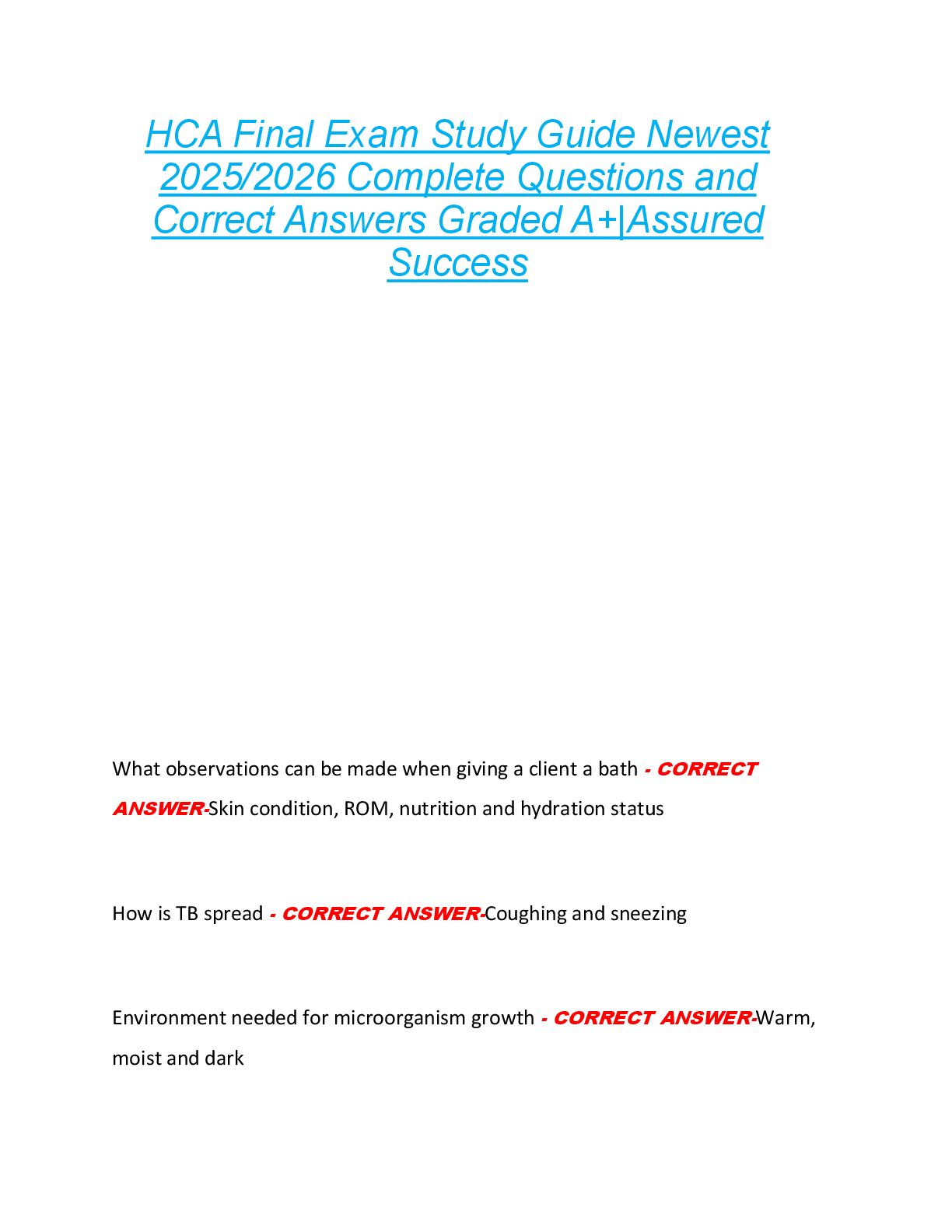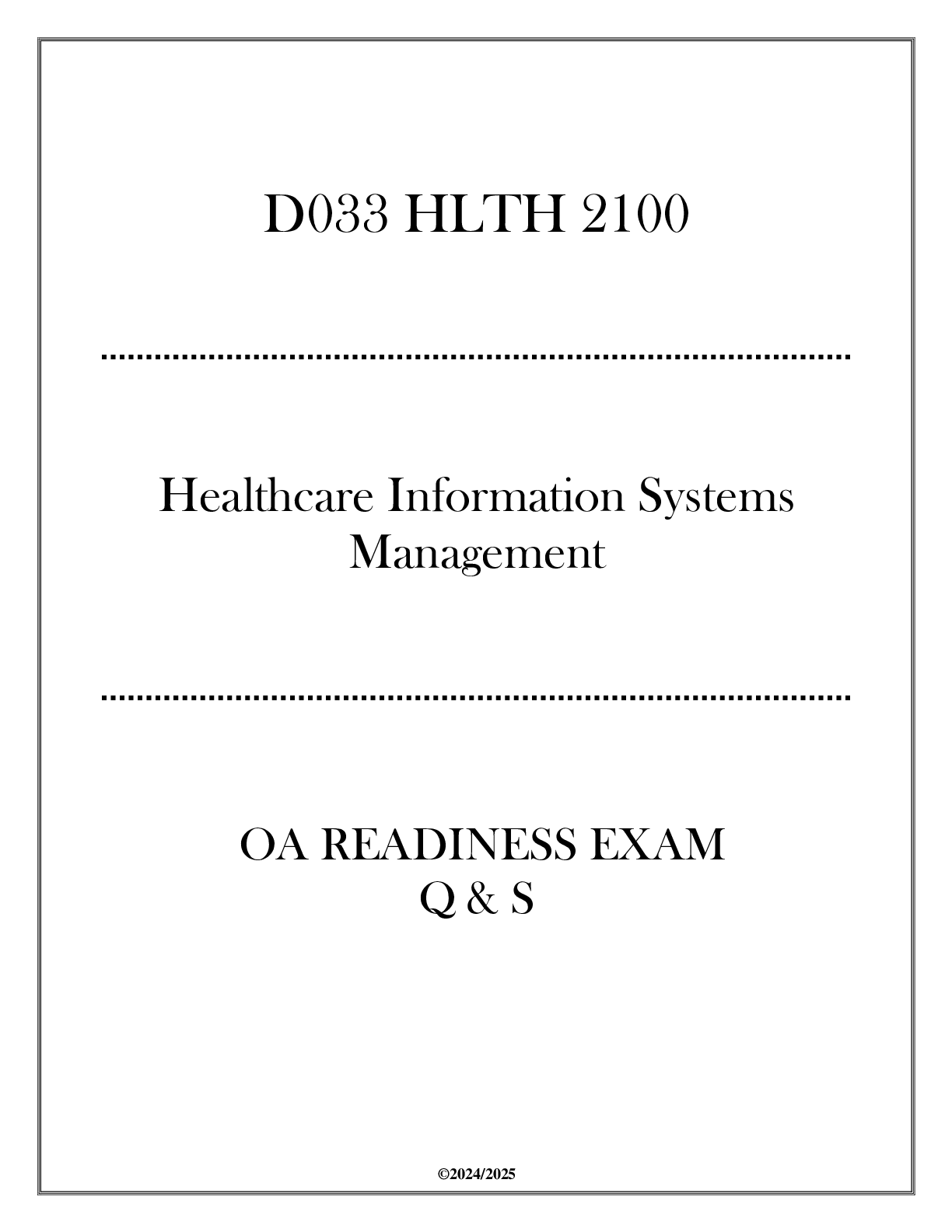
(D033) HLTH 2100 Healthcare Information Systems Management - OA Readiness Exam Q & S 2024
$ 12

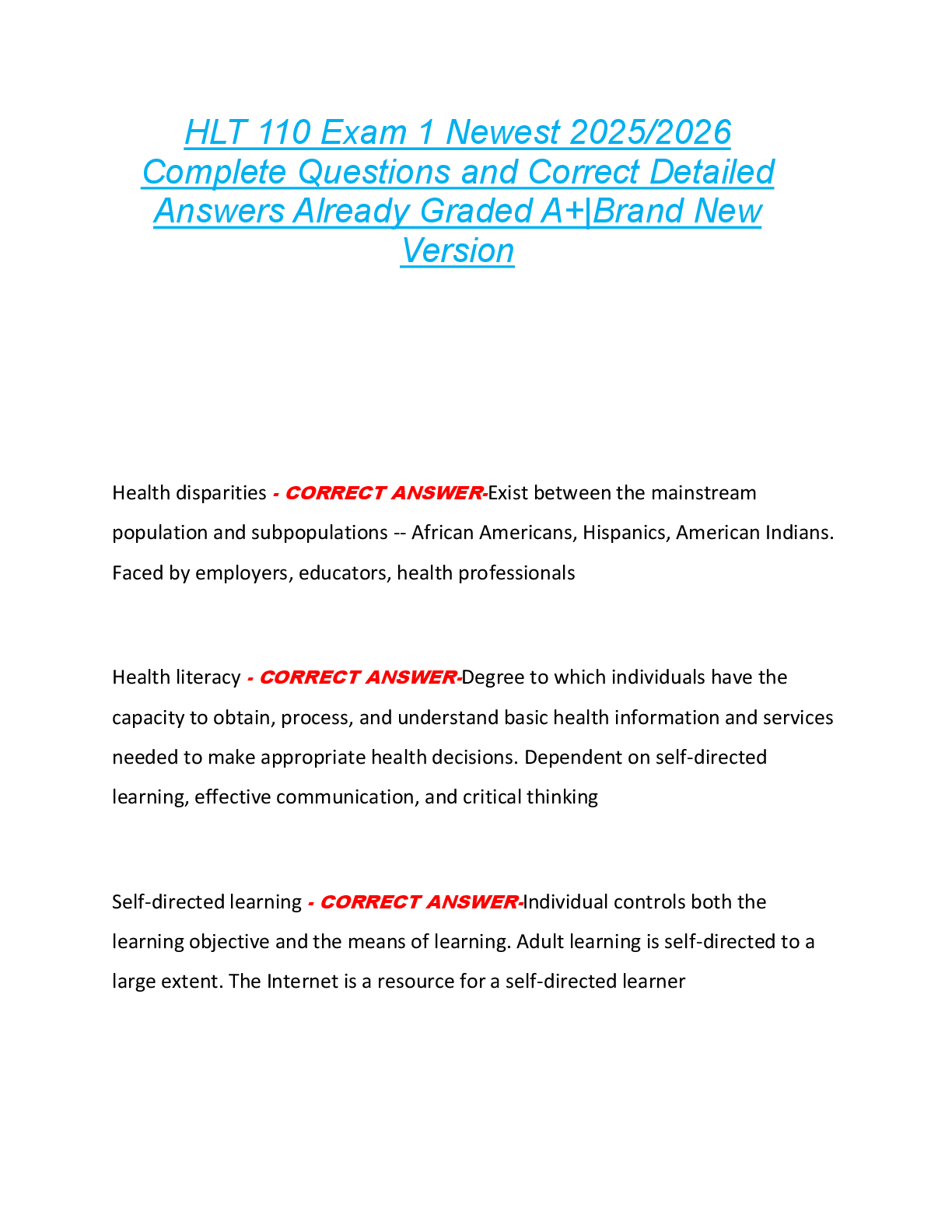
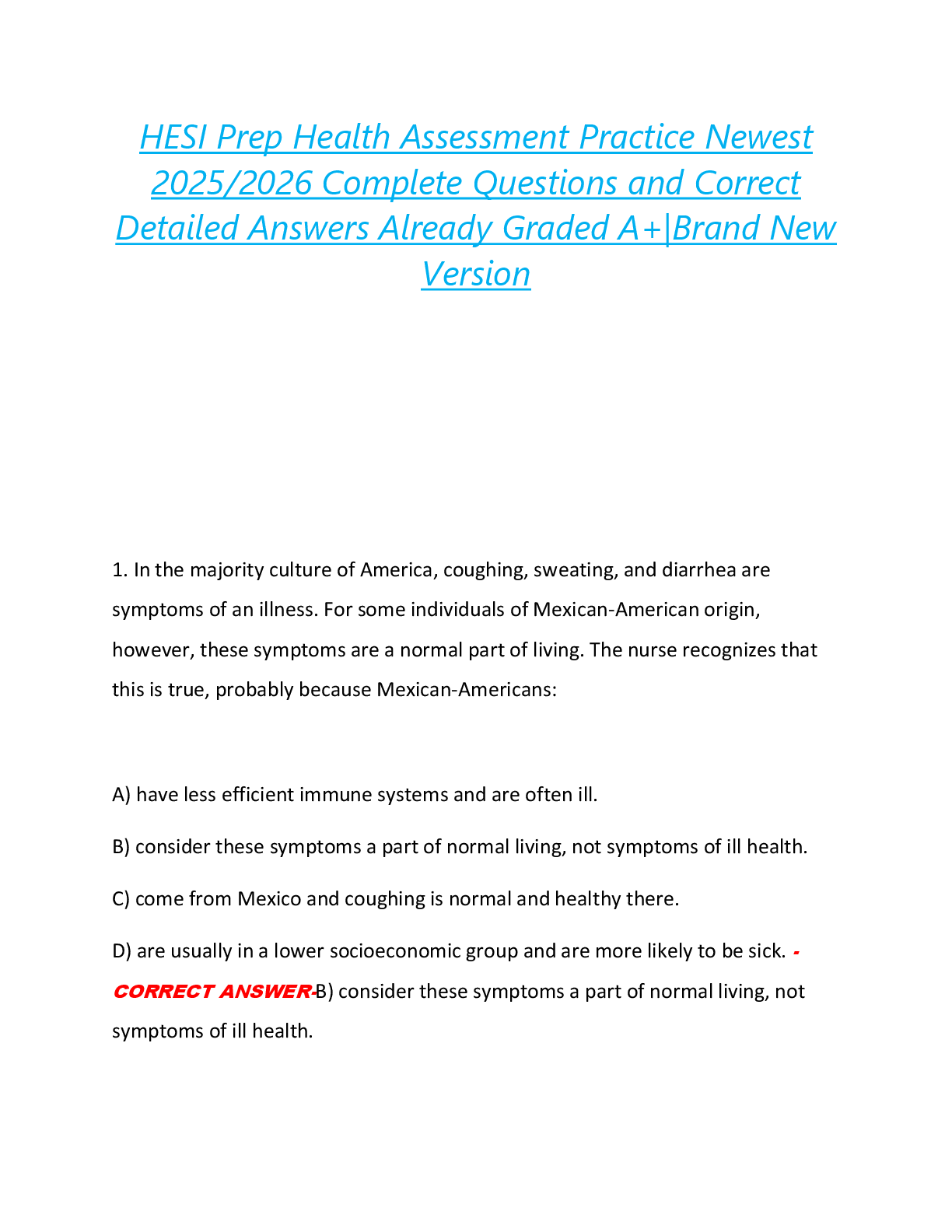
Health Assessment Exam1 ANSWERS 100% CORRECT FALL-2021 LATEST SOLUTION GUARANTEED GRADE A+
Law > EXAM > Tutorial letter 201/1/2023 Advanced Indigenous Law LCP4804 Super-semester Department of Public, Cons (All)
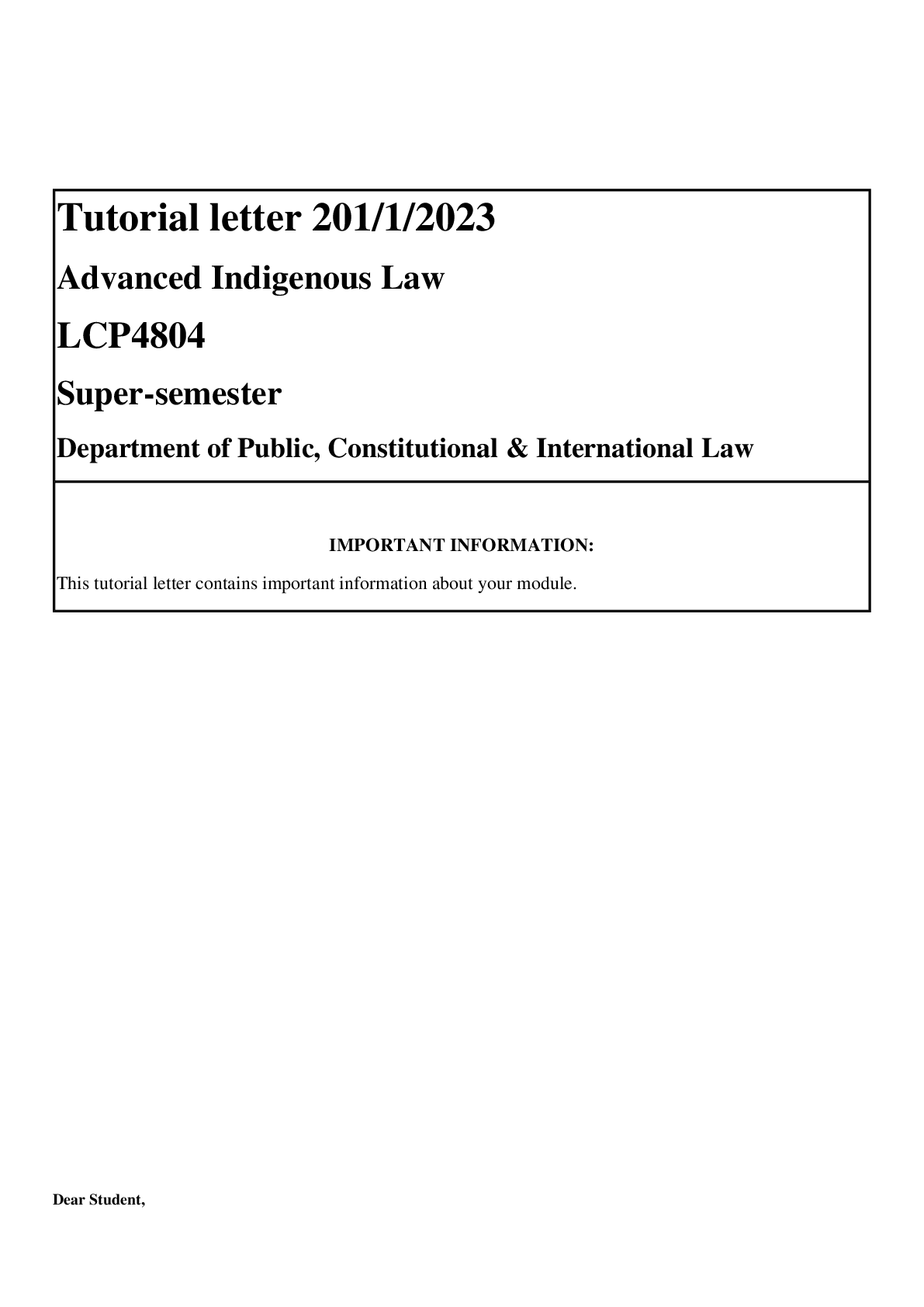
Tutorial letter 201/1/2023 Advanced Indigenous Law LCP4804 Super-semester Department of Public, Constitutional & International Law IMPORTANT INFORMATION: This tutorial letter contains importan ... t information about your module. Dear Student, Read this tutorial letter carefully. It contains suggested answers for Assignment 01 and Assignment 02 for the “Super Semester” of 2023. We hope that the feedback on Assignments will provide an insight into what is expected of you in the examination. We trust that you have found the assignments stimulating, and that you are coping with the workload. THIS IS YOUR FINAL TUTORIAL LETTER FOR THE SEMESTER OF 2023. It contains the following: 1 ASSIGNMENT 01: MULTIPLE-CHOICE ASSIGNMENT ANSWERS 2 ASSIGNMENT 02: WRITTEN ASSIGNMENT ANSWERS 3 THE EXAMINATION: FORMAT, PREPARATION AND WRITING The Study Guide The only Study Guide for LCP4804 must be used together with the prescribed textbook and contains most of the prescribed cases and statutes that are topical to this module. In order to understand the important issues discussed in the assignments and relevant to the examination this Study Guide is the starting point. You must pay particular attention to Activities/Feedbacks and Self-Assessments, which together with cases and statutes are more instructive for the purpose of answering assessment questions. FEEDBACK ON ASSIGNMENT 01: MULTIPLE CHOICE ASSIGNMENT Assignment 01 was relatively simple and should not have given you too much trouble. This was a compulsory assignment, consisting of multiple choice questions. You had to choose either options (1) (2) (3) & (4) for each of the questions as the correct answer. You did not have to give reasons for your answers. The following is the feedback on Assignment 01: QUESTION CORRECT ANSWER 1 1 2 2 3 4 4 2 5 3 6 1 7 2 8 1 9 4 10 1 You must make sure that you study the cases listed in these questions so that you can discuss them in the examination, giving the legal question that was answered by the court; The decision of the court and reasons for judgment. FEEDBACK ON ASSIGNMENT 02: WRITTEN ASSIGNMENT Question 1 (i) The Constitution envisions the customary law of South Africa that is free of the distortions that were brought into the system through the application of the repugnancy jurisprudence (must be Africanised) and (must conform to constitutional precepts). Firstly, the courts are therefore required to free customary law of the domination by the common law so that customary law could be viewed in the light of its own values and norms (Alexkor vs Richtersveld Community), subject to constitutional constraints. The courts overlooked this requirement in both the above cases – which resulted in the failure of Africanisation. Secondly, the courts have to transform customary law in line with section 39(2) of the Constitution to develop customary law to make sure that its purport and objects conform with the Bill of Rights. This would be in line with the Bill of Rights – i.e constitutionalisation. Both courts in Mabena and Mabuza failed to Africanise the law, they only managed to constitutionalise it. For instance, in Mabena the father of the deceased husband relied on his understanding of customary law rights as head of the family as protected by the Constitution. He urged the court to Africanise the law in line with the first requirement above. However, the court rejected this request and applied the second requirement in terms of which his wife relied on the Constitution as allowing her, as an equal member of society, to consent to the marriage of her daughter in the absence of her husband. Her action was accordingly affirmed. The court developed customary law to allow her to act as she did in terms of her equality with her absent husband. At the same time the court also approved the deceased husband’s decision to negotiate his own marriage without assistance from his father – affirming the right of an independent adult young man to act as equal in law. The court constitutionalized the law, however, it refused to affirm African culture i.e to insist on the participation of elders. If the woman’s mother had seen herself as equal to her husband, and therefore able to represent her marital family – in the same way as her husband would do, she would have contributed to Africanisation. As an African her culture requires her to act as a member of her group – ie to represent her marital family. But she saw herself as a constitutional being, and acted as an individual who had a personal right to equality. The court agreed with her and emphasized her own equality as an individual – thus defining equality in the Western sense - which downplayed her African cultural background as a communal being. In the same case the participation of the deceased husband was not seen as an act of someone who represented his family in the negotiations, in terms of African culture, but as affirming his own equality in terms of the Constitution. Therefore, equality was interpreted in the Western sense – no Africanisation was achieved in Mabena. With reference to Mabuza a similar approach was followed. Whilst the husband insisted on the observance of African culture, insisting on the performance of ukumekeza, the wife relied on the development of African law by the Bill of Rights (again African culture vs Constitution). The court agreed with her and the role of ukumekeza was rejected. Similarly, no Africanisation was achieved in Mabuza. ................................................................................continued....................................................................... [Show More]
Last updated: 2 years ago
Preview 1 out of 17 pages
Buy this document to get the full access instantly
Instant Download Access after purchase
Buy NowInstant download
We Accept:

Can't find what you want? Try our AI powered Search
Connected school, study & course
About the document
Uploaded On
Mar 28, 2023
Number of pages
17
Written in
All
This document has been written for:
Uploaded
Mar 28, 2023
Downloads
0
Views
141
Scholarfriends.com Online Platform by Browsegrades Inc. 651N South Broad St, Middletown DE. United States.
We're available through e-mail, Twitter, Facebook, and live chat.
FAQ
Questions? Leave a message!
Copyright © Scholarfriends · High quality services·






.png)
.png)