DANCE 101 Final
From the following list, what transition(s) do the mythology of America’s “frontier brinkmanship” negotiate?
Select all that apply.
Correct!
From wilderness to civilization.
Correct!
Fr
...
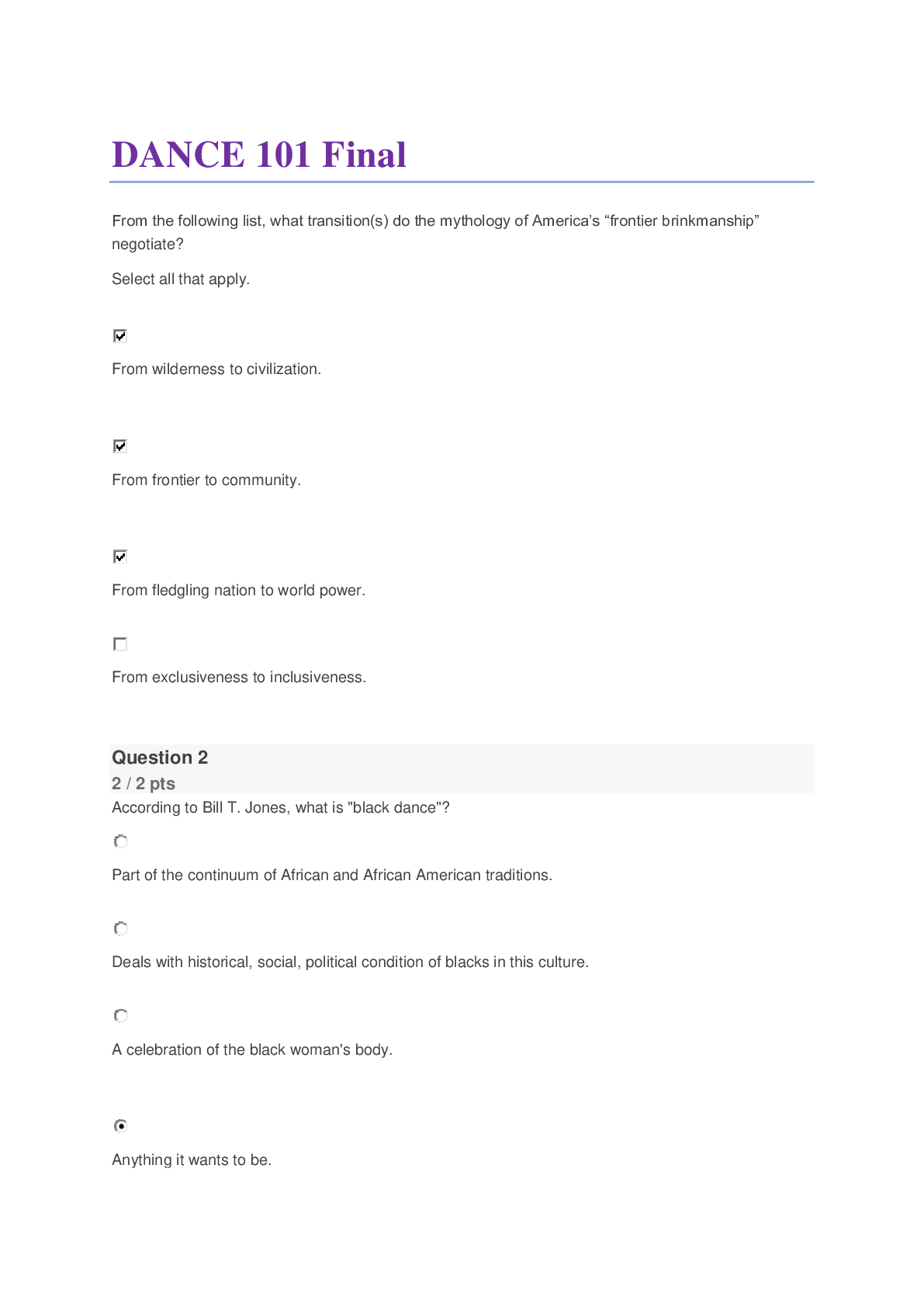
DANCE 101 Final
From the following list, what transition(s) do the mythology of America’s “frontier brinkmanship” negotiate?
Select all that apply.
Correct!
From wilderness to civilization.
Correct!
From frontier to community.
Correct!
From fledgling nation to world power.
From exclusiveness to inclusiveness.
Question 2
2 / 2 pts
According to Bill T. Jones, what is "black dance"?
Part of the continuum of African and African American traditions.
Deals with historical, social, political condition of blacks in this culture.
A celebration of the black woman's body.
Correct!
Anything it wants to be.
Question 3
2 / 2 pts
According to Sally Banes, break-dance shares similarities with many cultural forms. Match the descriptions below to the forms she believes break dance shares similarities.
Correct!
Capoeira
Correct!
Caribbean music
Correct!
Reggae
Correct!
African/Afro-American dance traditions
Question 4
2 / 2 pts
According to Knapp, the division between younger and older audiences in the 1960s was distinguished by four areas of contention. Which answers below are part of those areas? Choose all that apply.
Correct!
Music
Correct!
Politics
Life magazine
Correct!
Appearance
Question 5
2 / 2 pts
What was the majority of Americans’ attitudes towards modern artists and artworks during the Cold War?
The great majority of Americans held new artistic movements as proof of the creativity, the intellectual freedom, and the cultural power of the US.
Correct!
The great majority of Americans disliked or even despised modern art.
The great majority of Americans were embarrassed by the hysterical denunciations of anything avant-garde.
All of the above.
Question 6
2 / 2 pts
What did NOT interest Eleo Pomare in choreographing dance in the 60s?
To instigate.
To be forecasters of things to come.
To confront audience with the harsh realities of the time.
Correct!
To show audiences the beauty of the black dancer.
Question 7
2 / 2 pts
Match the break-dance sequence to its description:
Correct!
Entry
Correct!
Footwork
Correct!
Freeze
Correct!
Exit
Question 8
2 / 2 pts
Skip to question text.
According to the resources, how is “multiculturalism” defined?
1. Used the notion of "identity" to establish their collective visibility.
2. Reclaimed the term African-American (first used in the 1890s) because it described a group with its own continuous cultural history, its own rituals and its own diaspora.
3. A society that was the complicated sum of many distinct parts.
4. Performance artists made work that targeted the mainstream's ignorance of the ethnic cultures within its midst.
1., 2., 3., and 4.
2., and 4.
Correct!
3.
4.
Question 9
2 / 2 pts
Skip to question text.
Which of the following is part of the "ironies"of the musical Oklahoma! in its mythologizing?
1. Oklahoma means "Red People" in Choctaw.
2. The author, Lynn Riggs, was himself part Cherokee.
3. The original play was set in Oklahoma territory.
4. Statehood meant that Native Americans would become land owners.
1., 2. and 3.
Correct!
1., 2., and 4.
1., 3., and 4.
1., 2., 3., and 4.
Question 10
2 / 2 pts
According to McMains, Dancing with the Stars models a way for Latinos to keep part of their culture but become more American by toning down overt sexuality and African movement influences. This approach exemplifies what American theme?
Correct!
Assimilation
Anti-assimilation
Personal transformation
Overcoming adversity
Question 11
2 / 2 pts
Hair was a popular, “rock musical” Broadway hits in the 1960s. Which of the following statements are NOT true about Hair?
Acknowldged emergent music forms and iconcoclastic manner of appearances.
Grounded in documentary-like approach to life as it is actually lived.
Steeped in emergent political issues and life-styles of younger generation.
Correct!
Rendered the emergent life-style comical and unthreatening.
This is true of Bye-Bye Birdie, another rock musical of the 1960s. (Knapp, Countermythology, p. 2)
Question 12
2 / 2 pts
What dance form, or technique, in Common Ground was used to bring abled bodies and disabled bodies together?
Correct!
Contact improvisation
Contact improv
Question 13
2 / 2 pts
Match the dance, music and cultural form(s) to the musical numbers in which they are found.
Each answer will be used only once.
Correct!
The Farmer and the Cowman
Correct!
(Everything's Up to Date in) Kansas City
Correct!
Dance at the Gym
Correct!
America
Correct!
Hair
These different dances are discussed in the Study Guide questions 4.9.5, 4.8.7, 4.3.13, 4.3.10, 4.4.9.
Question 14
2 / 2 pts
What did Allan Kaprow view as the significant preoccupation of art?
Its failure to become an "-ism" was its success.
To present dance as fundamentally about the human body and its movements.
Collaboration between artists and dancers and the way they altered each others notions of the body in space.
Correct!
To become dazzled by the space and objects of everyday life.
Question 15
0.67 / 2 pts
The account given in Porgy (and Porgy and Bess) seemed unrealistic to those who knew what life for urban blacks was like because:
Select all that apply.
You Answered
Charleston was similar to the Harlem Renaissance that fenced off and explored the American black experience as a separate domain.
Correct!
Charleston had an assimilationist aspect to race relations.
Correct!
Charleston was integrated to a significant extent.
Correct!
Charleston had many blacks among the professional class.
You Answered
in Charleston, mobility between segregated blacks and dominant whites was not an option.
Question 16
2 / 2 pts
The 'circle' in hip hop dance embodies all the African aesthetics below except one. Which one?
Creation through competition and improvisation
Movement is used like a language in order to communicate.
Hierarchy is erased when there is no one at the 'front'.
Correct!
A living continuum is preserved through directly repeating the movements of the teacher.
Question 17
2 / 2 pts
Why is dancing the mambo professionally on stage important?
Correct!
Professionalization is significant in helping preserve the mambo.
Culture is preserved when dancers yell “Azucar!”
Professional dancers each represent a different musical line.
None of the above.
From study guide question 6.6.4, Torres believed that professionalization assured higher quality of the dancing and quality ensured people will see it.
Question 18
2 / 2 pts
What element of a Ruth St. Denis photo does Peggy Choy name as indicating its inauthenticity?
Correct!
Open mouth
Bent elbows
Closeness to the ground
Crossed eyes
Question 19
2 / 2 pts
Match the choreographer on left to their response to the question below:
“What does it mean to be an Asian/Asian American choreographer?”
Correct!
Kimoto
Correct!
Wong
Correct!
Lee
Question 20
2 / 2 pts
According to McMains, when Europeans and North Americans appropriated and refined dances from Latin American:
a. improvisation was minimized,
b. rhythms were made more complicated,
c. and vertical posture was emphasized.
True
Correct!
False
Question 21
1 / 1 pts
Skip to question text.
What is the name of the musical number/song and name of the musical for Video #1?Click to view
Correct!
The Farmer and the Cowman in Oklahoma!
Question 22
2 / 2 pts
In video #1, how does "Social dance serve as an obvious metaphor"?
Please keep your answer short, no longer than one sentence.
You Answered
Square or line dances serve as metaphor for social order.
Reconciliation as metaphor between Farmers and Ranchers.
Question 23
1 / 1 pts
Skip to question text.
Video #2 Technique: What is the name of this hip-hop style?
Click to view
Please do not use punctuation or special characters.
Correct!
Krump
Krumping
Question 24
1 / 1 pts
True or False: "Breaking isn't just an urgent response to pulsating music. It is also a ritual combat that transmutes aggression into art."
Correct!
True
False
This is a quote from Sally Banes, in "Ch. 12 Breaking is Hard to Do," pg. 123. Also illustrated through the video of Krump.
Question 25
1 / 1 pts
Skip to question text.
List the title of the dance for Video #3.
Click to view
Please do NOT use any special characters or punctuation.
Correct!
Outside In
Outside/In
outside-in
Question 26
1 / 1 pts
(1 points): List the name of the choreographer for Video #3.
Please do NOT use any special characters or punctuation.
Correct!
Marks
Victoria Marks
Question 27
1 / 1 pts
Skip to question text.
Video #4: What is the name of this Roland Petit modern ballet?
Click to view
Please do not use punctuation or special characters.
Correct!
This is in 5.6 "Making White Nights" video at question 5.6.5.
Le jeune homme et la mort
Question 28
2 / 2 pts
Briefly explain why this dance was forbidden in Soviet Russia.
Please keep your answer short, no longer than one sentence.
Your Answer:
At that time, Soviet Russia emphasized on everything should be social and everything should be in group. Therefore, the individual expression of modern art was not recognized as valuable and forbidden by Soviet Russia due to the political issue.
In Soviet Russia everything had to be social and in a group and expression of the individual imagination found in modern art was not valuable. Baryshnikov defected because he wanted to dance Petit's ballet.
[Show More]

.png)







x.png)




.png)






ddtete3.png)