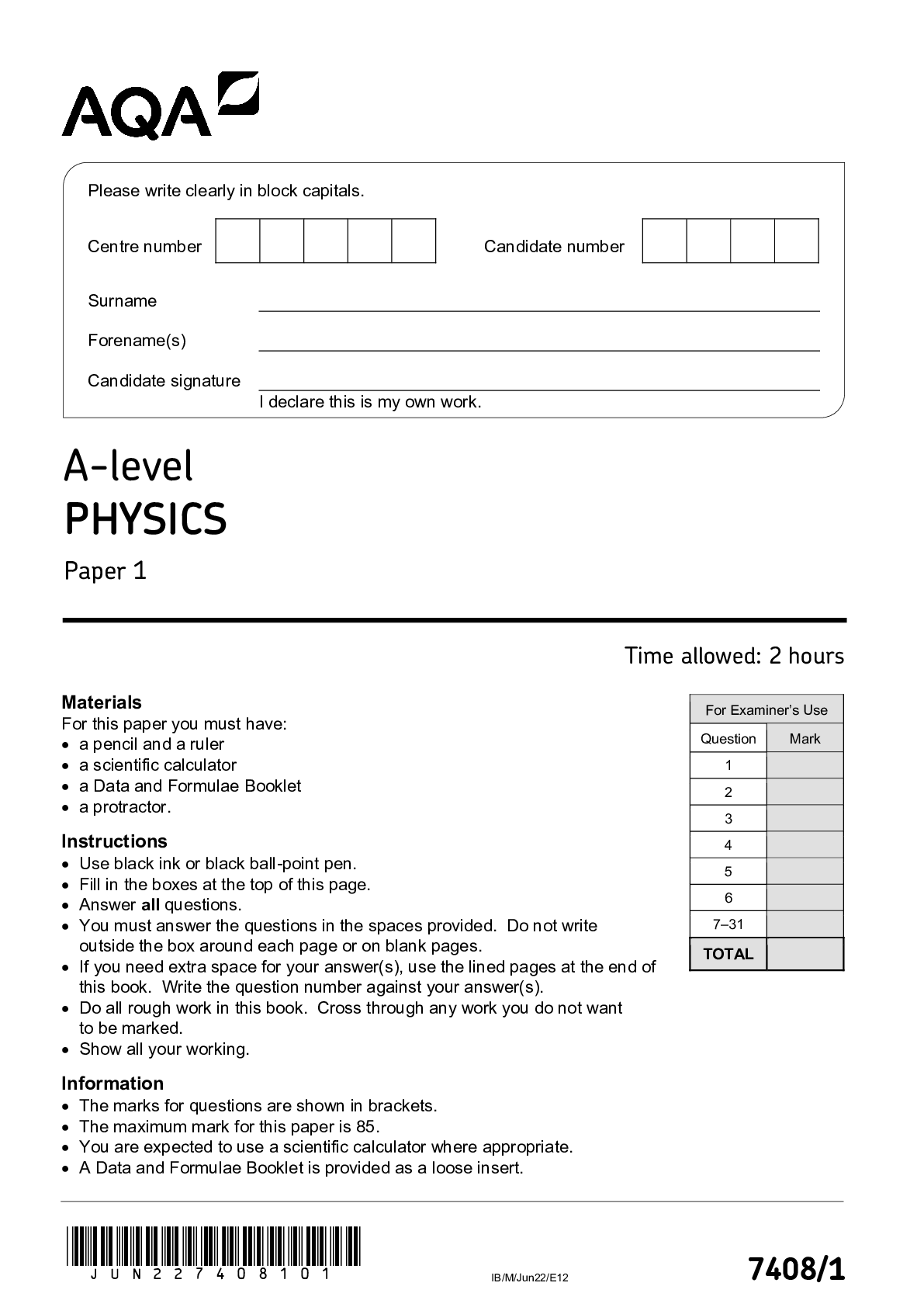
Physics  >  AQA Question Papers  >  AQA--A-level PHYSICS Paper 1 2 *02* IB/M/Jun22/7408/1 (All)

AQA--A-level PHYSICS Paper 1 2 *02* IB/M/Jun22/7408/1

Document Content and Description Below

A-level PHYSICS Paper 1 2 *02* IB/M/Jun22/7408/1 Do not write outside the Section A box Answer all questions in this section. 0 1 Two stable isotopes of helium are 4 2 He and 3 2 He. 0 ... 1 . 1 An atom of 4 2 He is produced in a rock that contains uranium. It is produced following the radioactive decay of a 238 92U atom. The decay also creates an atom of thorium (Th). Write an equation for the decay of 238 92U. [2 marks] 238 92U → 0 1 . 2 A 3 2 He nucleus can be produced by the decay of a tritium nucleus 3 1 H. State and explain which exchange particle is responsible for this decay. [2 marks] Do not write outside the box 3 *03* Turn over ► IB/M/Jun22/7408/1 Do not write outside the Helium was discovered by analysing the light in the box absorption spectrum of the Sun. Figure 1 shows the positions of the brightest lines, labelled A to F, in the emission spectrum of helium. The brightest lines in the emission spectra of sodium and hydrogen are also shown. Figure 1 0 1 . 3 Before helium was identified, some scientists suggested that the lines of the helium spectrum seen in the absorption spectrum of the Sun were due to the presence of sodium and hydrogen. Discuss, with reference to the lines A to F in Figure 1, the evidence for and against this suggestion. [2 marks] Question 1 continues on the next page 4 *04* IB/M/Jun22/7408/1 Do not write outside the 0 1 box . 4 Calculate, in eV, the change in energy level responsible for the spectral line labelled E in Figure 1. [3 marks] change in energy level = eV 0 1 . 5 Explain, with reference to the processes within an atom, the difference between an emission spectrum and an absorption spectrum. [3 marks] 12 5 *05* Turn over ► IB/M/Jun22/7408/1 Do not write outside the 0 2 box Carbon-14 decays into nitrogen-14 with the release of a beta (β−) particle and an antineutrino ( e v ). 0 2 . 1 State the change of quark character in β− decay. [1 mark] 0 2 . 2 Figure 2 shows the distribution of kinetic energies of β− particles from the decay of carbon-14. Figure 2 Explain how Figure 2 supports the existence of the antineutrino. [2 marks] Question 2 continues on the next page 6 *06* IB/M/Jun22/7408/1 Do not write outside the box The existence of the antineutrino was confirmed by experiments in which antineutrinos interact with protons. The equation for this interaction is: e v + p → e+ + X 0 2 . 3 Identify particle X. [1 mark] 0 2 . 4 The positron released in this interaction is annihilated when it encounters an electron. A pair of gamma photons is then produced. Particle X can be absorbed by a nucleus. This produces another gamma ray. Table 1 contains data for three gamma photons detected during an antineutrino–proton interaction experiment. Table 1 Gamma photon Photon energy / J G1 5.0 × 10⁻¹⁴ G2 6.6 × 10⁻¹⁴ G3 1.0 × 10⁻¹³ [Show More]

Last updated: 2 years ago

Preview 1 out of 36 pages

Buy Now

Instant download

We Accept:

Payment methods accepted on Scholarfriends (We Accept)
Preview image of AQA--A-level PHYSICS Paper 1 2 *02* IB/M/Jun22/7408/1 document

Buy this document to get the full access instantly

Instant Download Access after purchase

Buy Now

Instant download

We Accept:

Payment methods accepted on Scholarfriends (We Accept)

Reviews( 0 )

$8.00

Buy Now

We Accept:

Payment methods accepted on Scholarfriends (We Accept)

Instant download

Can't find what you want? Try our AI powered Search

223
0

Document information


Connected school, study & course


About the document


Uploaded On

Apr 01, 2023

Number of pages

36

Written in

All

Seller


Profile illustration for Cate
Cate

Member since 2 years

0 Documents Sold

Additional information

This document has been written for:

Uploaded

Apr 01, 2023

Downloads

 0

Views

 223

Document Keyword Tags


$8.00
What is Scholarfriends

Scholarfriends.com Online Platform by Browsegrades Inc. 651N South Broad St, Middletown DE. United States.

We are here to help

We're available through e-mail, Twitter, Facebook, and live chat.
 FAQ
 Questions? Leave a message!

Follow us on
 Twitter

Copyright © Scholarfriends · High quality services·