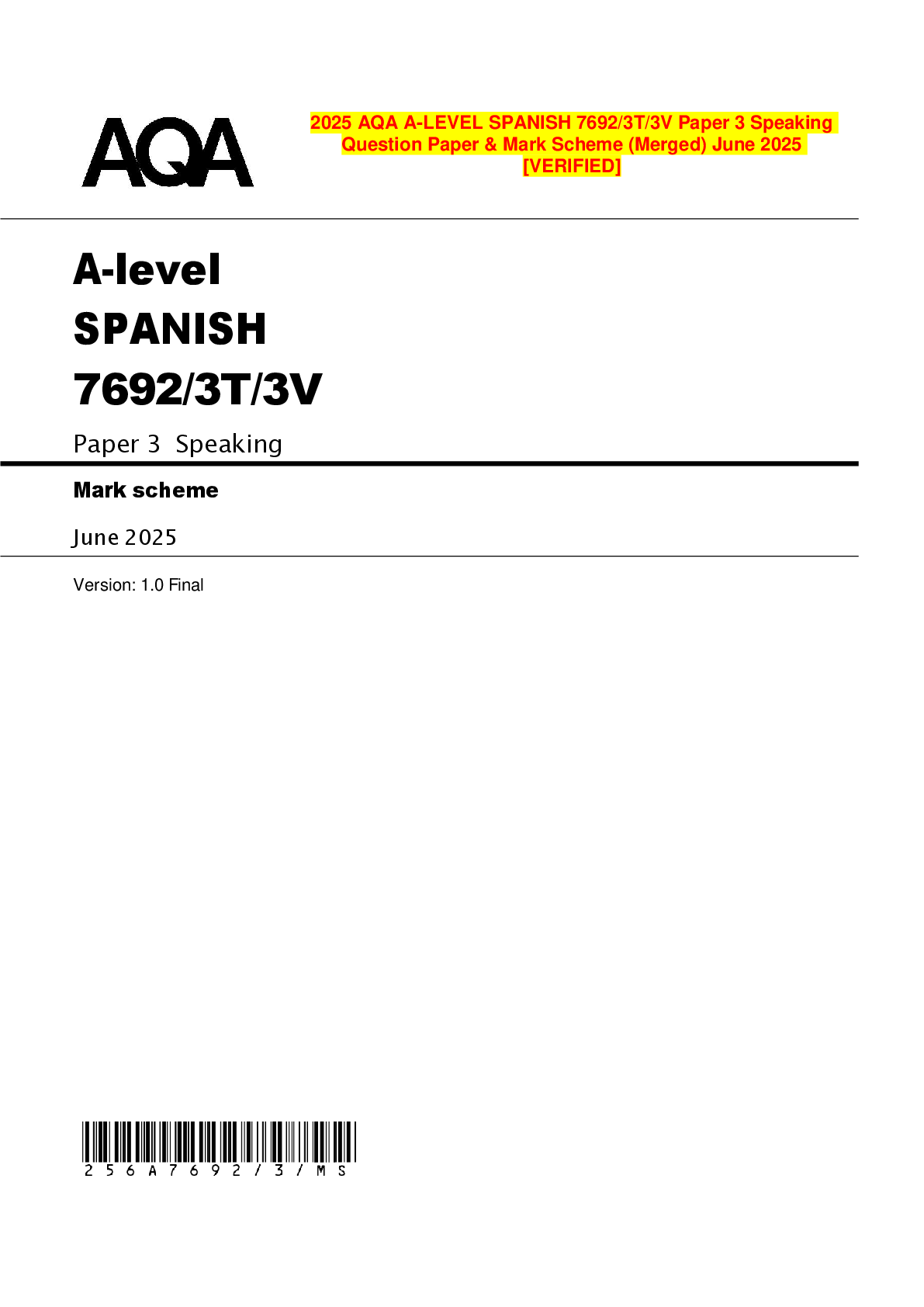
A-level
SPANISH
7692/3T/3V
Paper 3 Speaking
Mark scheme
June 2022
Version: 1.0 Final
*226A7692/3/MS*
MARK SCHEME – A-LEVEL SPANISH – 7692/3T/3V – JUNE 2022
2
questions, by a panel of subject teachers. This mark
...
A-level
SPANISH
7692/3T/3V
Paper 3 Speaking
Mark scheme
June 2022
Version: 1.0 Final
*226A7692/3/MS*
MARK SCHEME – A-LEVEL SPANISH – 7692/3T/3V – JUNE 2022
2
questions, by a panel of subject teachers. This mark scheme includes any amendments made at the
standardisation events which all associates participate in and is the scheme which was used by them in
this examination. The standardisation process ensures that the mark scheme covers the students’
responses to questions and that every associate understands and applies it in the same correct way.
As preparation for standardisation each associate analyses a number of students’ scripts. Alternative
answers not already covered by the mark scheme are discussed and legislated for. If, after the
standardisation process, associates encounter unusual answers which have not been raised they are
required to refer these to the Lead Examiner.
It must be stressed that a mark scheme is a working document, in many cases further developed and
expanded on the basis of students’ reactions to a particular paper. Assumptions about future mark
schemes on the basis of one year’s document should be avoided; whilst the guiding principles of
assessment remain constant, details will change, depending on the content of a particular examination
paper.
Further copies of this mark scheme are available from aqa.org.uk
Copyright information
AQA retains the copyright on all its publications. However, registered schools/colleges for AQA are permitted to copy material from this booklet for their own
internal use, with the following important exception: AQA cannot give permission to schools/colleges to photocopy any material that is acknowledged to a third
party even for internal use within the centre.
Copyright © 2022 AQA and its licensors. All rights reserved
MARK SCHEME – A-LEVEL SPANISH – 7692/3T/3V – JUNE 2022
3
Level of response marking instructions
Level of response mark schemes are broken down into levels, each of which has a descriptor. The
descriptor for the level shows the average performance for the level. There are marks in each level.
Before you apply the mark scheme to a student’s answer read through the answer and annotate it (as
instructed) to show the qualities that are being looked for. You can then apply the mark scheme.
Step 1 Determine a level
Start at the lowest level of the mark scheme and use it as a ladder to see whether the answer meets the
descriptor for that level. The descriptor for the level indicates the different qualities that might be seen in
the student’s answer for that level. If it meets the lowest level then go to the next one and decide if it
meets this level, and so on, until you have a match between the level descriptor and the answer. With
practice and familiarity you will find that for better answers you will be able to quickly skip through the
lower levels of the mark scheme.
When assigning a level you should look at the overall quality of the answer and not look to pick holes in
small and specific parts of the answer where the student has not performed quite as well as the rest. If
the answer covers different aspects of different levels of the mark scheme you should use a best fit
approach for defining the level and then use the variability of the response to help decide the mark within
the level, ie if the response is predominantly level 3 with a small amount of level 4 material it would be
placed in level 3 but be awarded a mark near the top of the level because of the level 4 content.
Step 2 Determine a mark
Once you have assigned a level you need to decide on the mark. The descriptors on how to allocate
marks can help with this. The exemplar materials used during standardisation will help. There will be an
answer in the standardising materials which will correspond with each level of the mark scheme. This
answer will have been awarded a mark by the Lead Examiner. You can compare the student’s answer
with the example to determine if it is the same standard, better or worse than the example. You can then
use this to allocate a mark for the answer based on the Lead Examiner’s mark on the example.
You may well need to read back through the answer as you apply the mark scheme to clarify points and
assure yourself that the level and the mark are appropriate.
Indicative content in the mark scheme is provided as a guide for examiners. It is not intended to be
exhaustive and you must credit other valid points. Students do not have to cover all of the points
mentioned in the Indicative content to reach the highest level of the mark scheme.
An answer which contains nothing of relevance to the question must be awarded no marks.
MARK SCHEME – A-LEVEL SPANISH – 7692/3T/3V – JUNE 2022
4
The mark scheme corresponds to the two parts of the NEA in speaking
(1) discussion of the sub-theme based on and developed around the stimulus card chosen
by the student
(2) the short presentation by the student of the research project and subsequent longer
discussion led by the examiner.
Thus for the NEA in speaking as a whole the marks allocated to AOs are as follows:
AOs CARD RESEARCH
PRESENTATION
RESEARCH
DISCUSSION
TOTAL
AO1 5 10 15
AO2 5 5
AO3 10 10 20
AO4 5 5 10 20
Students asking questions
During the discussion on the stimulus card students are required to ask two questions arising from the
content of the stimulus card and our instructions to students on the front of each card will direct them
to consider possible questions in their preparation time. These questions will require only a brief
response on the part of the examiner.
As the asking of the questions is linked directly to interpreting and responding to the information on
the stimulus card we have rewarded this under Assessment Objective 2.
Assessment objective 2
If a student does not ask two questions the examiner will invite the student to do so before the end of
the discussion of the sub-theme. To meet the requirement to ask questions, a student must seek
information or opinion. Asking for repetition or clarification will not meet the requirement. The
student’s questions must arise from material on the card and must contain a conjugated verb.
Rephrasing or repetition of the printed questions will not meet the requirement.
If a student only asks one question, a maximum of 4 marks can be awarded for AO2. If a student asks
no questions, a maximum of 3 marks can be awarded for AO2.
Assessment Objective 4
For part 2 of the NEA, students must identify a subject or a key question which is of interest to them
and which relates to a country or countries where the target language is spoken. AO4 assesses
knowledge and understanding of, and critical and analytical response to, different aspects of the culture
and society of countries/communities where the language is spoken.
If a student’s presentation does not consistently relate to a country where the target language is spoken
this will affect the marks that can be awarded under AO4. Examiners will assess the performance as if
there was not an issue, arrive at a mark and then move to the next band down.
Further guidance on the choice of a suitable IRP title is available in our Teaching Guide and from our
IRP advisers.
MARK SCHEME – A-LEVEL SPANISH – 7692/3T/3V – JUNE 2022
5
Notes
Fluency is defined as delivery at a pace which reflects natural discourse, although not of the level
associated with a native speaker. Hesitation and pauses may occur to allow for a word to be found, for
a phrase to be formulated or for self-correction and/or repair strategies to be used. The use of self�correction and/or repair strategies will not be penalised.
If a student only asks one question, a maximum of 4 marks can be awarded for AO2. If a student asks
no questions, a maximum of 3 marks can be awarded for AO2.
DISCUSSION OF SUB-THEME
Assessment Objective 1: Understand and respond in speech to spoken language including face-to
face interaction.
Mark Descriptors
5
Delivery is fluent throughout. The ideas and opinions expressed are nearly always developed,
independently of prompts. Students give an appropriate response to nearly all unpredictable
elements.
4 Delivery is mainly fluent. The ideas and opinions expressed are mostly developed,
independently of prompts. Students give an appropriate response to most unpredictable
elements.
3 Delivery is sometimes fluent. The ideas and opinions expressed are sometimes
developed, independently of prompts. Students give an appropriate response to some
unpredictable elements.
2 Delivery is occasionally fluent. The ideas and opinions expressed are occasionally
developed, independently of prompts. Students give an appropriate response to a few
unpredictable elements.
1
Delivery is rarely fluent. The ideas and opinions expressed are rarely developed,
independently of prompts. Students give an appropriate response to very few unpredictable
elements.
0 Nothing in the performance is worthy of a mark.
DISCUSSION OF SUB-THEME
Assessment Objective 2: Understand and respond in speech to written language drawn from a variety
of sources.
Mark Descriptors
5
Students’ responses show that they have a very good understanding of the material on the
card.
4 Students’ responses show that they have a good understanding of the material on the card.
3 Students’ responses show that they have some understanding of the material on the card.
2 Students’ responses show that they have a limited understanding of the material on the card.
1
Students’ responses show that they have a very limited understanding of the material on the
card.
0 Nothing in the performance is worthy of a mark.
MARK SCHEME – A-LEVEL SPANISH – 7692/3T/3V – JUNE 2022
6
Notes
The material on the card is defined as the text containing the target-language heading, any statement of
opinion, any factual/statistical information and the printed questions.
Notes
Pronunciation and intonation are not expected to be of native speaker standard.
Serious errors are defined as those which adversely affect communication.
Award the higher mark in the band if you would have considered placing the response in the band
above; award the lower mark in the band if you would have considered placing the response in the band
below.
Idiom refers to a form of expression that is particular to the target language.
Minor errors include:
confusion of noun/adjective eg peligro/peligroso
occasional slips in gender/adjectival agreements.
Serious errors include:
incorrect verb forms
incorrect use of pronouns
errors in basic idiomatic expressions eg es muy calor: soy 17.
DISCUSSION OF SUB-THEME
Assessment Objective 3: Manipulate the language accurately, in spoken and written forms, using
a range of lexis and structure.
Mark Descriptors
9–10
A wide range of vocabulary and complex language and a good knowledge of appropriate idiom
are demonstrated. Highly accurate application of grammar with occasional minor errors.
Pronunciation and intonation are very good.
7–8
A good range of vocabulary and complex language and some knowledge of appropriate idiom
are demonstrated. Mostly accurate application of grammar with some minor errors.
Pronunciation and intonation are good.
5–6
Some variety of vocabulary and complex language is demonstrated. Accurate application of
grammar is uneven. Pronunciation and intonation are fairly good.
3–4
Little variety of vocabulary and structures is demonstrated. Accurate application of grammar is
limited. Pronunciation and intonation are mostly intelligible.
1–2
Very little variety of vocabulary and structures is demonstrated. Accurate application of
grammar is very limited. Pronunciation and intonation are poor.
0 Nothing in the performance is worthy of a mark.
MARK SCHEME – A-LEVEL SPANISH – 7692/3T/3V – JUNE 2022
7
Complex language includes:
subordinate clauses
− Relative
− Conditional
− Purpose etc
appropriate use of subjunctive
formation of regular and irregular verbs in a variety of tenses
reflexive verbs
use of impersonal expressions using reflexive verbs or verbs with indirect object pronoun eg gustar,
faltar, interesar etc
value judgements
verb + infinitive (+ preposition) expressions.
DISCUSSION OF SUB-THEME
Assessment Objective 4: Show knowledge and understanding of, and respond critically and
analytically to, different aspects of the culture and society of countries/communities where the
language is spoken.
Mark Descriptors
5
Very good critical and analytical response
Very good knowledge and understanding of those aspects of the sub-theme covered in the
discussion. Students consistently select relevant information to support their arguments. They
consistently use appropriate evidence to justify their conclusions, demonstrating a very good
evaluation of the sub-theme.
4
Good critical and analytical response
Good knowledge and understanding of those aspects of the sub-theme covered in the
discussion. Students often select relevant information to support their arguments. They
often use appropriate evidence to justify their conclusions, demonstrating a good evaluation
of the sub-theme.
3
Reasonable critical and analytical response
Reasonable knowledge and understanding of those aspects of the sub-theme covered in the
discussion. Students sometimes select relevant information to support their arguments.
They sometimes use appropriate evidence to justify their conclusions, demonstrating a
reasonable evaluation of the sub-theme.
2
Limited critical and analytical response
Some knowledge and understanding of those aspects of the sub-theme covered in the
discussion. Students occasionally select relevant information to support their arguments.
They occasionally use appropriate evidence to justify their conclusions, demonstrating a
limited evaluation of the sub-theme.
1
Very limited critical and analytical response
A little knowledge and understanding of those aspects of the sub-theme covered in the
discussion. Students rarely select relevant information to support their arguments. Theyrarely
use appropriate evidence to justify their conclusions, demonstrating a very limited evaluation of
the sub-theme.
0 Nothing in the performance is worthy of a mark.
MARK SCHEME – A-LEVEL SPANISH – 7692/3T/3V – JUNE 2022
8
Possible content
Tarjeta A: Los valores tradicionales y modernos
General:
During their studies students will have read and listened to different source materials from which they
will have acquired relevant knowledge of the sub-theme in the context of Spanish-speaking countries.
Depending on these materials students will respond to the card and the examiner’s questions in
different ways. As well as relating their knowledge of the sub-theme students are expected to
evaluate the information on the card and to express views on the information contained in it and on
other aspects of the sub-theme.
The printed questions serve as a starting point for discussion and are not normally to be asked in
immediate succession. Students’ responses to each question will be followed up by the examiner in
order to develop the discussion in different directions.
Points related to the three questions:
• ¿Cómo reaccionas tú ante esta información?
Students’ responses will be based on the information on the card and may cover the following:
• the International Day of the Family on 15 May is celebrated to raise awareness of the importance of
the family and its values
• a survey in Mexico revealed that over 80% of Mexicans are satisfied with their family life and that a
happy family does not depend on how much they have in material terms, but the love there is
between them
• other important aspects in a happy family life are generosity, honesty, respect, tolerance and
equality.
• En tu opinión, ¿por qué juega la familia un papel muy importante en la vida de los hispanos?
This question invites the student to evaluate the information on the card and to express opinions.
Thoughtful and developed answers could include:
• the fact that families in the Hispanic world usually seem close and grandparents play an important
part in the upbringing of the children
• historically families in Spain were brought up as Catholics and followed the traditions of the Church
• many young people live with their parents until they are in their thirties.
• ¿Qué diferencias hay entre las familias del mundo hispánico de ahora y las del pasado?
This question provides an opportunity for the student to go beyond the narrow focus of the card and to
demonstrate wider knowledge and understanding of the sub-theme. This knowledge can relate to any
Spanish-speaking country. Responses could include:
• modern families in the Hispanic world tend to be smaller as the birth rate has gone down
considerably over the last 50 years
• some Hispanic families today may be made up of single parents, divorced couples with new
partners and children, or same sex couples due to the changes in attitudes and laws
• most women work outside the home and men help with housework, whereas in the past, being a
mother equated to being a housewife and undertaking all of the domestic chores.
MARK SCHEME – A-LEVEL SPANISH – 7692/3T/3V – JUNE 2022
9
Possible content
Tarjeta B: El ciberespacio
General:
During their studies students will have read and listened to different source materials from which they
will have acquired relevant knowledge of the sub-theme in the context of Spanish-speaking countries.
Depending on these materials students will respond to the card and the examiner’s questions in
different ways. As well as relating their knowledge of the sub-theme students are expected to
evaluate the information on the card and to express views on the information contained in it and on
other aspects of the sub-theme.
The printed questions serve as a starting point for discussion and are not normally to be asked in
immediate succession. Students’ responses to each question will be followed up by the examiner in
order to develop the discussion in different directions.
Points related to the three questions:
• ¿Cómo reaccionas tú ante esta información?
Students’ responses will be based on the information on the card and may cover the following:
• the Christmas card posted online from the right-wing political party, Vox, in Cádiz was very
controversial as all three Kings were white
• the card went viral on Twitter
• many people have accused Vox of po
[Show More]

fnhgb.png)