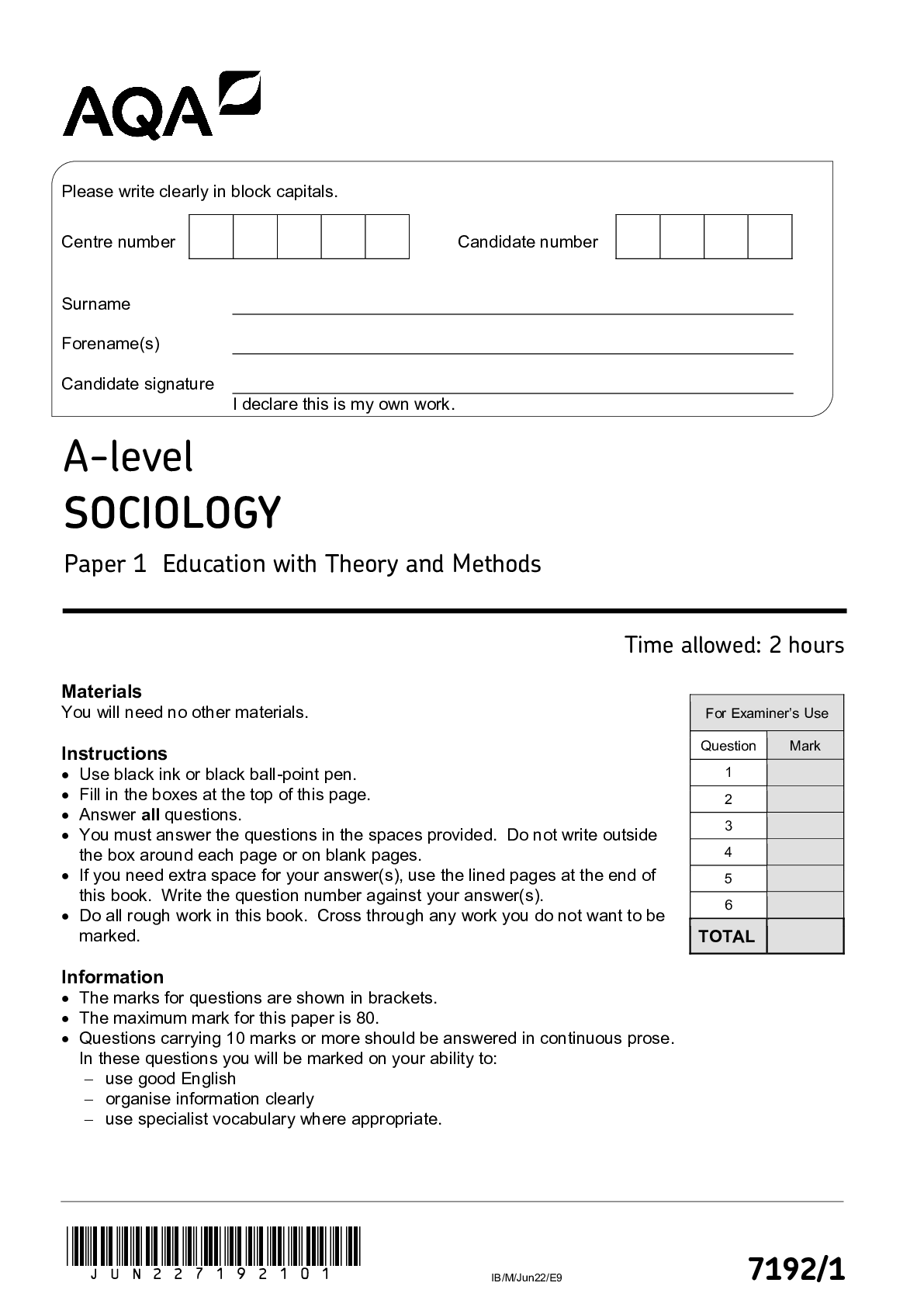
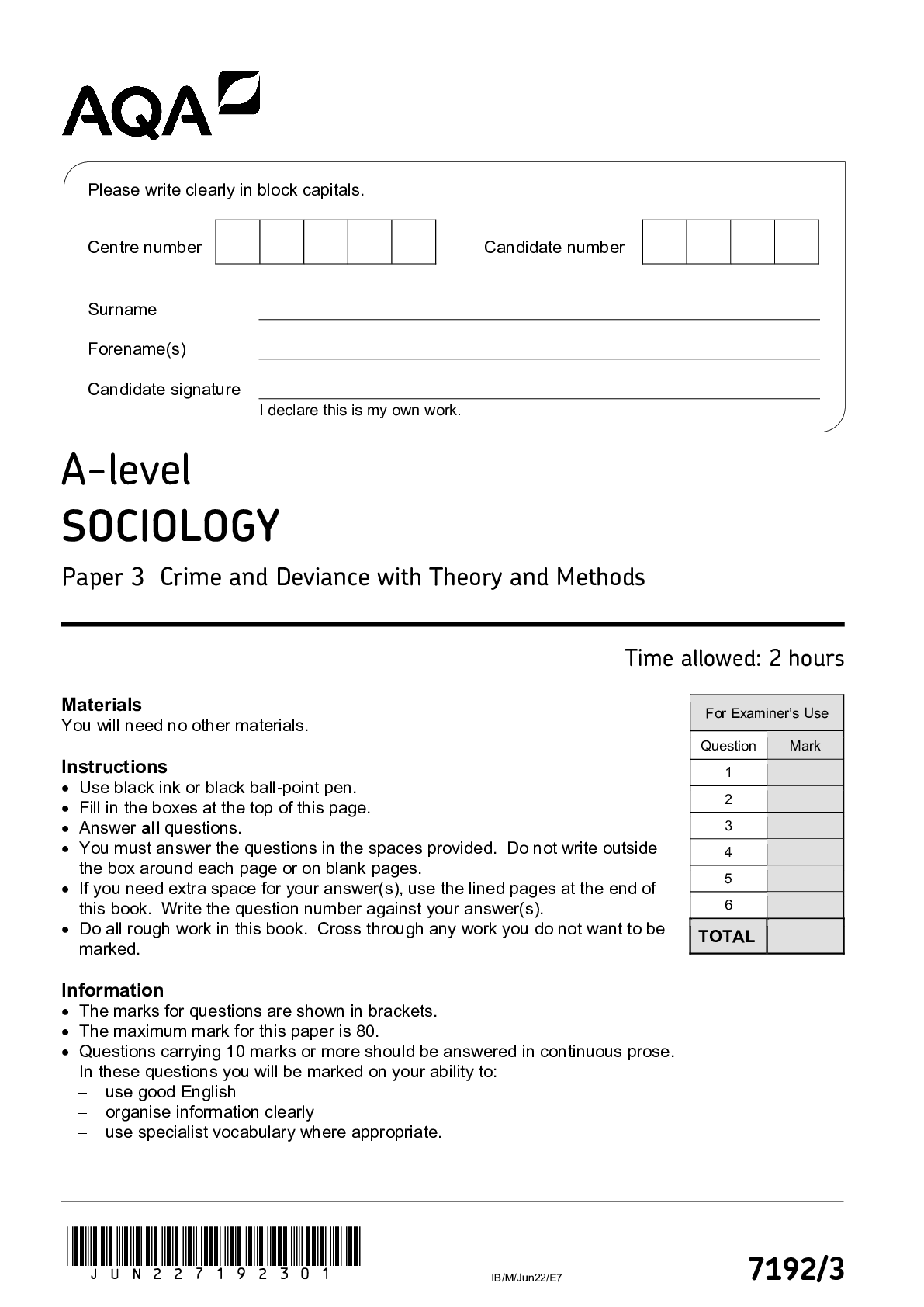
Materials
You will need no other materials.
Instructions
• Use black ink or black ball-point pen.
• Fill in the boxes at the top of this page.
• Answer all questions.
• You must answer the questions in the spaces p
...
Materials
You will need no other materials.
Instructions
• Use black ink or black ball-point pen.
• Fill in the boxes at the top of this page.
• Answer all questions.
• You must answer the questions in the spaces provided. Do not write outside
the box around each page or on blank pages.
• If you need extra space for your answer(s), use the lined pages at the end of
this book. Write the question number against your answer(s).
• Do all rough work in this book. Cross through any work you do not want to be
marked.
Information
• The marks for questions are shown in brackets.
• The maximum mark for this paper is 80.
• Questions carrying 10 marks or more should be answered in continuous prose.
In these questions you will be marked on your ability to:
− use good English
− organise information clearly
− use specialist vocabulary where appropriate.
A-level
SOCIOLOGY
Paper 1 Education with Theory and Methods
Please write clearly in block capitals.
Centre number Candidate number
Surname
Forename(s)
Candidate signature
I declare this is my own work.
2
*02*
IB/M/Jun22/7192/1
Do not write
outside the Education box
Answer all questions.
0 1 Outline two ways in which schools may promote competition between pupils.
[4 marks]
Extra space
4
3
*03*
Turn over ►
IB/M/Jun22/7192/1
Do not write
outside the 0 2 Outline three ways in which the education system may be seen as patriarchal. box
[6 marks]
Extra space
6
4
*04*
IB/M/Jun22/7192/1
Do not write
outside the 0 3 Read Item A below and answer the question that follows. box
Item A
Teachers may label and treat some groups of pupils differently from others. Schools and
staff will have views about appropriate pupil behaviour and attitudes to school.
Relationships and processes within schools may lead to anti-school subcultures.
Applying material from Item A, analyse two ways in which relationships and processes
within schools may lead to anti-school subcultures.
[10 marks]
Extra space
5
*05*
Turn over ►
IB/M/Jun22/7192/1
Do not write
outside the
box
10
6
*06*
IB/M/Jun22/7192/1
Do not write
outside the 0 4 Read Item B below and answer the question that follows. box
Item B
Since the introduction of marketisation policies to education, over 30 years ago,
competition has grown between increasingly diverse types of schools. New Right
theorists argue that every parent is free to choose the best school for their child. They
also claim that this efficiently drives up standards and ensures that schools are
responsive to the needs of parents and pupils.
However, some sociologists argue that there are limits to these choices. They also
argue that marketisation policies may reinforce existing inequalities in educational
achievement.
Applying material from Item B and your knowledge, evaluate the view that marketisation
policies have increased diversity and choice in the education system.
[30 marks]
7
*07*
Turn over ►
IB/M/Jun22/7192/1
Do not write
outside the
box
8
*08*
IB/M/Jun22/7192/1
Do not write
outside the
box
Extra space
9
*09*
Turn over ►
IB/M/Jun22/7192/1
Do not write
outside the
box
10
*10*
IB/M/Jun22/7192/1
Do not write
outside the
box
30
11
*11*
Turn over ►
IB/M/Jun22/7192/1
Do not write
outside the Methods in Context box
0 5 Read Item C below and answer the question that follows.
Item C
Investigating the reasons for subject choices made by pupils
As well as compulsory subjects at school, pupils can often choose optional ones. Pupils
may choose different subjects for a variety of reasons. They may have a personal
interest or talent in a subject or act on the basis of advice given by parents,
professionals working within schools or others. However, there are patterns in subject
choices linked to class, gender and ethnicity which could result from factors external to
schools.
One way of studying differences in the subject choices made by pupils is to use group
interviews. This type of interview can encourage deeper thought as participants can
develop ideas put forward by other group members. However, participants may be
influenced by peer pressure. Furthermore, some pupils, teachers and parents may find
it difficult to find a time to meet as a group.
Applying material from Item C and your knowledge of research methods, evaluate the
strengths and limitations of using group interviews to investigate the reasons for subject
choices made by pupils.
[20 marks]
12
*12*
IB/M/Jun22/7192/1
Do not write
outside the
box
13
*13*
Turn over ►
IB/M/Jun22/7192/1
Do not write
outside the Extra space box
14
*14*
IB/M/Jun22/7192/1
Do not write
outside the
box
20
15
*15*
Turn over ►
IB/M/Jun22/7192/1
Do not write
outside the Theory and Methods box
0 6 Outline and explain two reasons why of
[Show More]