Pearson Edexcel_Further Mathematics_9FM0/4B Mark Scheme_2021 | PAPER 4B: Further Statistics 2
Physics > Lab Experiment > Measuring the Speed of Light – Lab Activity_PHYS 02150 Physics of Everyday Life (All)
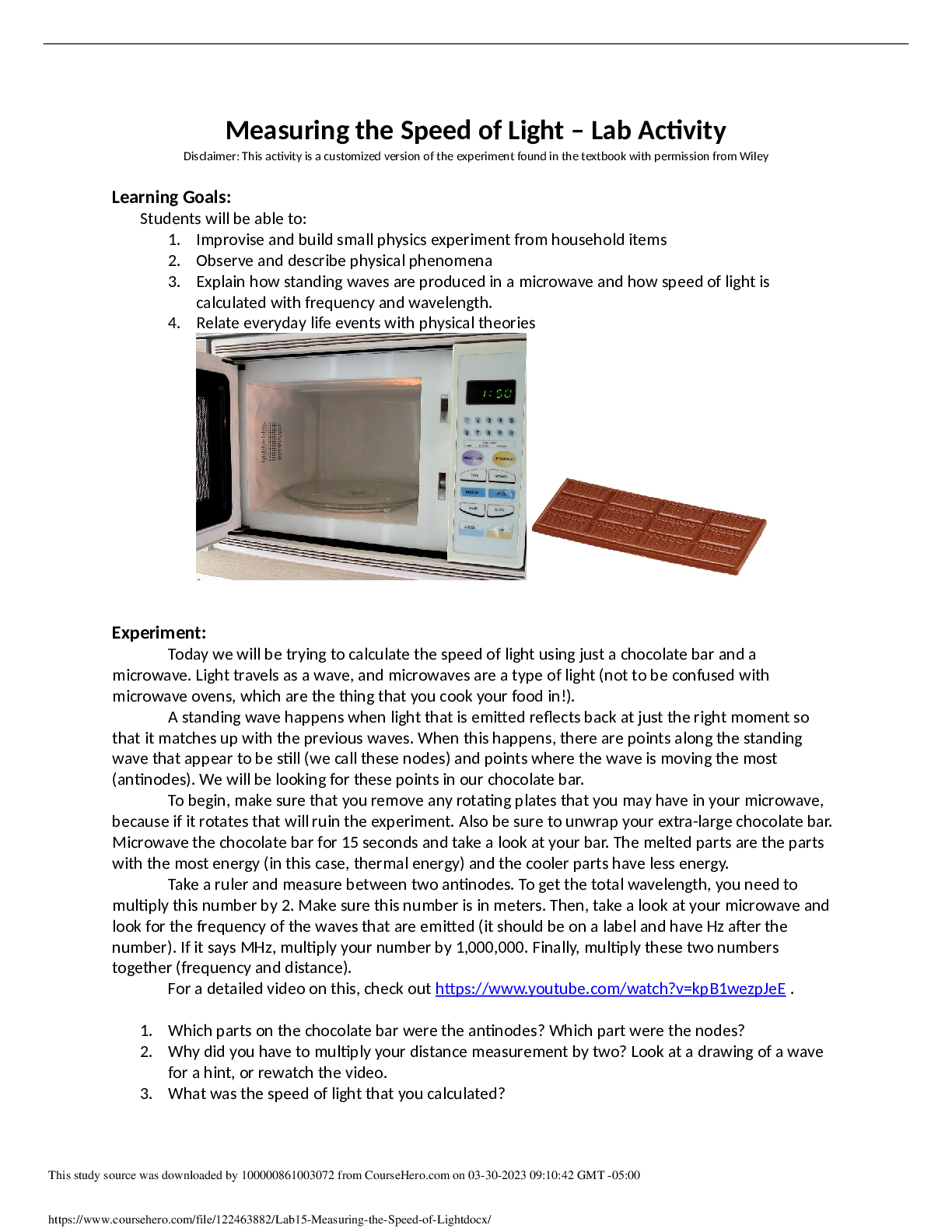
Measuring the Speed of Light – Lab Activity Disclaimer: This activity is a customized version of the experiment found in the textbook with permission from Wiley Learning Goals: Students will be a ... ble to: 1. Improvise and build small physics experiment from household items 2. Observe and describe physical phenomena 3. Explain how standing waves are produced in a microwave and how speed of light is calculated with frequency and wavelength. 4. Relate everyday life events with physical theories Experiment: Today we will be trying to calculate the speed of light using just a chocolate bar and a microwave. Light travels as a wave, and microwaves are a type of light (not to be confused with microwave ovens, which are the thing that you cook your food in!). A standing wave happens when light that is emitted reflects back at just the right moment so that it matches up with the previous waves. When this happens, there are points along the standing wave that appear to be still (we call these nodes) and points where the wave is moving the most (antinodes). We will be looking for these points in our chocolate bar. To begin, make sure that you remove any rotating plates that you may have in your microwave, because if it rotates that will ruin the experiment. Also be sure to unwrap your extra-large chocolate bar. Microwave the chocolate bar for 15 seconds and take a look at your bar. The melted parts are the parts with the most energy (in this case, thermal energy) and the cooler parts have less energy. Take a ruler and measure between two antinodes. To get the total wavelength, you need to multiply this number by 2. Make sure this number is in meters. Then, take a look at your microwave and look for the frequency of the waves that are emitted (it should be on a label and have Hz after the number). If it says MHz, multiply your number by 1,000,000. Finally, multiply these two numbers together (frequency and distance). For a detailed video on this, check out https://www.youtube.com/watch?v=kpB1wezpJeE . 1. Which parts on the chocolate bar were the antinodes? Which part were the nodes? 2. Why did you have to multiply your distance measurement by two? Look at a drawing of a wave for a hint, or rewatch the video. 3. What was the speed of light that you calculated? [Show More]
Last updated: 2 years ago
Preview 1 out of 2 pages
Buy this document to get the full access instantly
Instant Download Access after purchase
Buy NowInstant download
We Accept:

Can't find what you want? Try our AI powered Search
Connected school, study & course
About the document
Uploaded On
Apr 02, 2023
Number of pages
2
Written in
All
This document has been written for:
Uploaded
Apr 02, 2023
Downloads
0
Views
106
Scholarfriends.com Online Platform by Browsegrades Inc. 651N South Broad St, Middletown DE. United States.
We're available through e-mail, Twitter, Facebook, and live chat.
FAQ
Questions? Leave a message!
Copyright © Scholarfriends · High quality services·

.png)


-2.png)
-2.png)