History > MARK SCHEMES > Mark Scheme (Results) Summer 2022 Pearson Edexcel GCSE In History (1HIA) Paper B4: British Depth Stu (All)
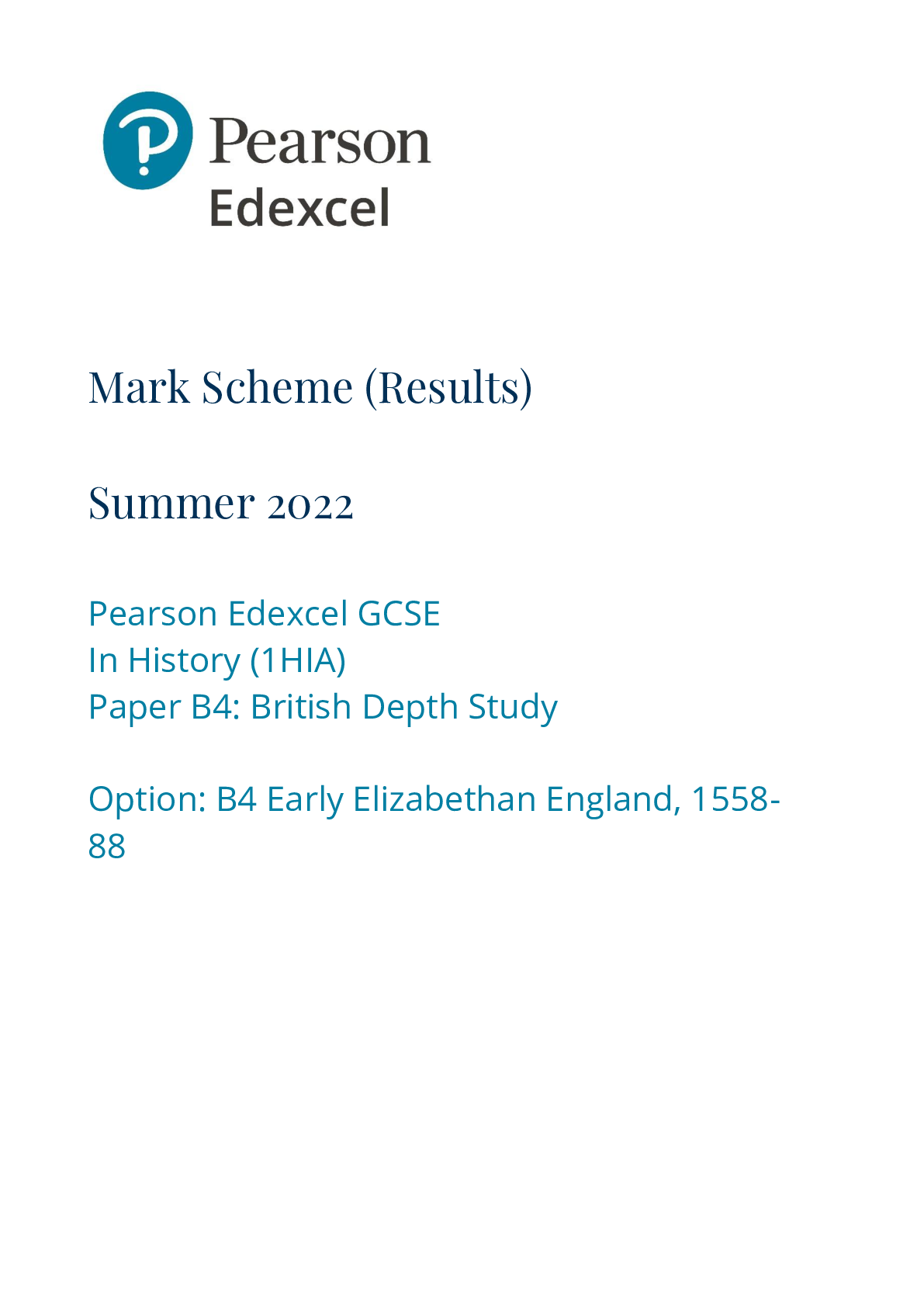
Mark Scheme (Results) Summer 2022 Pearson Edexcel GCSE In History (1HIA) Paper B4: British Depth Study Option: B4 Early Elizabethan England, 1558- 88 Edexcel and BTEC Qualifications
Document Content and Description Below
Mark Scheme (Results) Summer 2022 Pearson Edexcel GCSE In History (1HIA) Paper B4: British Depth Study Option: B4 Early Elizabethan England, 1558- 88 Edexcel and BTEC Qualifications Edexcel an ... d BTEC qualifications are awarded by Pearson, the UK’s largest awarding body. We provide a wide range of qualifications including academic, vocational, occupational and specific programmes for employers. For further information visit our qualifications websites at www.edexcel.com or www.btec.co.uk. Alternatively, you can get in touch with us using the details on our contact us page at www.edexcel.com/contactus. Pearson: helping people progress, everywhere Pearson aspires to be the world’s leading learning company. Our aim is to help everyone progress in their lives through education. We believe in every kind of learning, for all kinds of people, wherever they are in the world. We’ve been involved in education for over 150 years, and by working across 70 countries, in 100 languages, we have built an international reputation for our commitment to high standards and raising achievement through innovation in education. Find out more about how we can help you and your students at: www.pearson.com/uk Summer 2022 Question Paper Log Number P68670A Publications Code 1HIA_B4_2022_MS All the material in this publication is copyright © Pearson Education Ltd 2022 General Marking Guidance • All candidates must receive the same treatment. Examiners must mark the first candidate in exactly the same way as they mark the last. • Mark schemes should be applied positively. Candidates must be rewarded for what they have shown they can do rather than penalised for omissions. • Examiners should mark according to the mark scheme not according to their perception of where the grade boundaries may lie. • There is no ceiling on achievement. All marks on the mark scheme should be used appropriately. • All the marks on the mark scheme are designed to be awarded. Examiners should always award full marks if deserved, i.e. if the answer matches the mark scheme. Examiners should also be prepared to award zero marks if the candidate’s response is not worthy of credit according to the mark scheme. • Where some judgement is required, mark schemes will provide the principles by which marks will be awarded and exemplification may be limited. • When examiners are in doubt regarding the application of the mark scheme to a candidate’s response, the team leader must be consulted. • Crossed out work should be marked UNLESS the candidate has replaced it with an alternative response. How to award marks when level descriptions are used 1. Finding the right level The first stage is to decide which level the answer should be placed in. To do this, use a ‘best-fit’ approach, deciding which level most closely describes the quality of the answer. Answers can display characteristics from more than one level, and where this happens markers must use the guidance below and their professional judgement to decide which level is most appropriate. For example, one stronger passage at L4 would not by itself merit a L4 mark, but it might be evidence to support a high L3 mark, unless there are substantial weaknesses in other areas. Similarly, an answer that fits best in L3 but which has some characteristics of L2 might be placed at the bottom of L3. An answer displaying some characteristics of L3 and some of L1 might be placed in L2. 2. Finding a mark within a level After a level has been decided on, the next stage is to decide on the mark within the level. The instructions below tell you how to reward responses within a level. However, where a level has specific guidance about how to place an answer within a level, always follow that guidance. Levels containing two marks only Start with the presumption that the work will be at the top of the level. Move down to the lower mark if the work only just meets the requirements of the level. Levels containing three or more marks Markers should be prepared to use the full range of marks available in a level and not restrict marks to the middle. Markers should start at the middle of the level (or the upper-middle mark if there is an even number of marks) and then move the mark up or do [Show More]
Last updated: 2 years ago
Preview 1 out of 11 pages
Buy this document to get the full access instantly
Instant Download Access after purchase
Buy NowInstant download
We Accept:

Reviews( 0 )
$8.00
Can't find what you want? Try our AI powered Search
Document information
Connected school, study & course
About the document
Uploaded On
Apr 04, 2023
Number of pages
11
Written in
All

Additional information
This document has been written for:
Uploaded
Apr 04, 2023
Downloads
0
Views
49



.png)