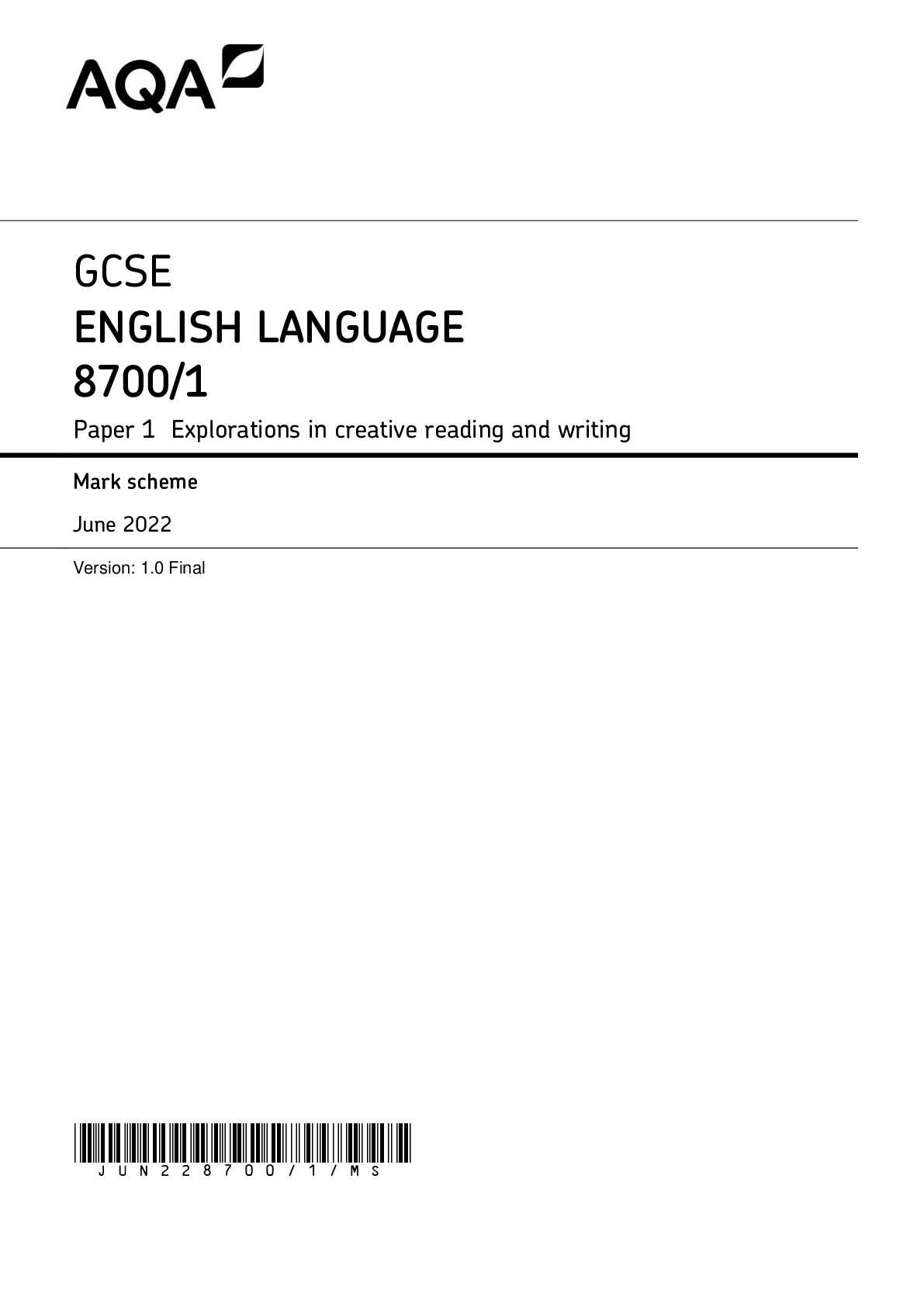
English Language > MARK SCHEMES > GCSE ENGLISH LANGUAGE 8700/1 Paper 1 Explorations in creative reading and writing Mark scheme June 2 (All)
GCSE ENGLISH LANGUAGE 8700/1 Paper 1 Explorations in creative reading and writing Mark scheme June 2022 Version: 1.0 Final *JUN228700/1/MS* MARK SCHEME – GCSE ENGLISH LANGUAGE – 8700/1 – JUNE 2022 2
Document Content and Description Below
GCSE ENGLISH LANGUAGE 8700/1 Paper 1 Explorations in creative reading and writing Mark scheme June 2022 Version: 1.0 Final *JUN228700/1/MS* MARK SCHEME – GCSE ENGLISH LANGUAGE – 8700/1 � ... � JUNE 2022 2 Mark schemes are prepared by the Lead Assessment Writer and considered, together with the relevant questions, by a panel of subject teachers. This mark scheme includes any amendments made at the standardisation events which all associates participate in and is the scheme which was used by them in this examination. The standardisation process ensures that the mark scheme covers the students’ responses to questions and that every associate understands and applies it in the same correct way. As preparation for standardisation each associate analyses a number of students’ scripts. Alternative answers not already covered by the mark scheme are discussed and legislated for. If, after the standardisation process, associates encounter unusual answers which have not been raised they are required to refer these to the Lead Examiner. It must be stressed that a mark scheme is a working document, in many cases further developed and expanded on the basis of students’ reactions to a particular paper. Assumptions about future mark schemes on the basis of one year’s document should be avoided; whilst the guiding principles of assessment remain constant, details will change, depending on the content of a particular examination paper. Further copies of this mark scheme are available from aqa.org.uk Copyright information AQA retains the copyright on all its publications. However, registered schools/colleges for AQA are permitted to copy material from this booklet for their own internal use, with the following important exception: AQA cannot give permission to schools/colleges to photocopy any material that is acknowledged to a third party even for internal use within the centre. Copyright © 2022 AQA and its licensors. All rights reserved. MARK SCHEME – GCSE ENGLISH LANGUAGE – 8700/1 – JUNE 2022 3 Introduction The information provided for each question is intended to be a guide to the kind of answers anticipated and is neither exhaustive nor prescriptive. All appropriate responses should be given credit. Level of response marking instructions Level of response mark schemes for GCSE English Language are broken down into four levels (where appropriate). In the first column each level is identified with one or two key words that represent the differences in the skills then described. These key words show the progression from Level 1 to 4 and are: Level 4 Perceptive, detailed Level 3 Clear, relevant Level 2 Some, attempts Level 1 Simple, limited. This is followed in the second column by a description of the different qualities required in the student’s answer for that level. These are called the skills descriptors. In order to reach a given level, a student must fulfil one or more of the skills descriptors for that level. The third column of the mark scheme is the Indicative Standard. This is an important feature of the mark scheme for GCSE English Language. It provides exemplification of the skills descriptors at each level and offers a small number of different comments at the required standard to give an indication of the quality of response that is typical for that level. It shows the progression from Level 1 to 4. The Indicative Standard is not intended to be a model answer nor a complete response, and it does not exemplify required content. Students may reach a given level by making one or more comments of the quality demonstrated by the Indicative Standard and do not have to meet all the skill descriptors at that level. The standardising scripts will further exemplify each of the levels. You must refer to the standardising material throughout your marking. Step 1 Annotate the response When marking a response you should first read through the student’s answer and annotate each section using the comments from the statement bank to show the qualities that are being demonstrated, as instructed during standardising. You can then award a level and a mark. Step 2 Determine a level Start at the lowest level of the mark scheme and use it as a ladder to see whether the answer meets the descriptors for that level. The descriptors for the level indicate the different qualities that might be seen in the student’s answer for that level. If it meets the lowest level then go to the next one and decide if it meets this level, and so on, until you have a match between the level descriptor and the answer. With practice and familiarity you will find that for better answers you will be able to quickly skip through the lower levels of the mark scheme. The Indicative Standard column in the mark scheme will help you determine the correct level. Remember, students may reach a given level by making one or more comments of the quality demonstrated by the Indicative Standard and do not have to meet all the skill descriptors at that level. It is not the number of references, but the quality of the comments that will determine the level. The annotation you added to the script at Step 1 will help you determine the correct level. MARK SCHEME – GCSE ENGLISH LANGUAGE – 8700/1 – JUNE 2022 4 Step 3 Determine a mark Once you have assigned a level you need to decide on the mark. This requires you to fine tune within the level to see how well each of the skills descriptors for that level has been met. A student only has to meet a skills descriptor at a given level once to be awarded that level. Since responses rarely match a level in all respects, you need to balance out the range of skills achieved and allow strong performance in some aspects to compensate for other skills that may be only partially fulfilled. Again, the annotation added at Step 1 will help you determine the mark. Reference to the standardising scripts throughout the marking period is essential. This will help you apply the level descriptors accurately and consistently. There will usually be an answer in the standardising materials which will correspond with each level of the mark scheme. This answer will have been awarded a mark by the Lead Examiner. You can compare the student’s answer with the example to determine if it is the same standard, better or worse than the example. You can then use this to allocate a mark for the answer based on the Lead Examiner’s mark on the example. You may well need to read back through the answer as you apply the mark scheme to clarify points and assure yourself that the level and the mark are appropriate. An answer which contains nothing of relevance to the question must be awarded no marks. Advice In fairness to students, all examiners must use the same marking methods. The following advice may seem obvious, but all examiners must follow it closely. 1. Refer constantly to the mark scheme and standardising scripts throughout the marking period. 2. Always credit accurate, relevant and appropriate responses that are not necessarily covered by the mark scheme or the standardising scripts. 3. Use the full range of marks. Do not hesitate to give full marks if the response merits it. 4. Remember the key to accurate and fair marking is consistency. 5. If you have any doubt about how to allocate marks to a response, consult your Team Leader. MARK SCHEME – GCSE ENGLISH LANGUAGE – 8700/1 – JUNE 2022 5 SECTION A: READING – Assessment Objectives AO1 • Identify and interpret explicit and implicit information and ideas. • Select and synthesise evidence from different texts. AO2 • Explain, comment on and analyse how writers use language and structure to achieve effects and influence readers, using relevant subject terminology to support their views. AO3 • Compare writers’ ideas and perspectives, as well as how these are conveyed, across two or more texts. AO4 • Evaluate texts critically and support this with appropriate textual references. SECTION B: WRITING – Assessment Objectives AO5 • Communicate clearly, effectively and imaginatively, selecting and adapting tone, style and register for different forms, purposes and audiences. • Organise information and ideas, using structural and grammatical features to support coherence and cohesion of texts. AO6 • Candidates must use a range of vocabulary and sentence structures for clarity, purpose and effect, with accurate spelling and punctuation. (This requirement must constitute 20% of the marks for each specification as a whole). MARK SCHEME – GCSE ENGLISH LANGUAGE – 8700/1 – JUNE 2022 6 Assessment Objective Section A AO1 ✓ AO2 ✓ AO3 N/A AO4 ✓ Section B AO5 ✓ AO [Show More]
Last updated: 2 years ago
Preview 1 out of 19 pages
Buy this document to get the full access instantly
Instant Download Access after purchase
Buy NowInstant download
We Accept:

Reviews( 0 )
$7.00
Can't find what you want? Try our AI powered Search
Document information
Connected school, study & course
About the document
Uploaded On
Apr 05, 2023
Number of pages
19
Written in
All

Additional information
This document has been written for:
Uploaded
Apr 05, 2023
Downloads
0
Views
149


.png)