Types of Nursing Programs:
Associate degree: 2-year program; entry educational level for registered nurses
◆Baccalaureate degree: 4-year program; focuses more on management and leadership
◆Diploma: 3-year hospital-b
...
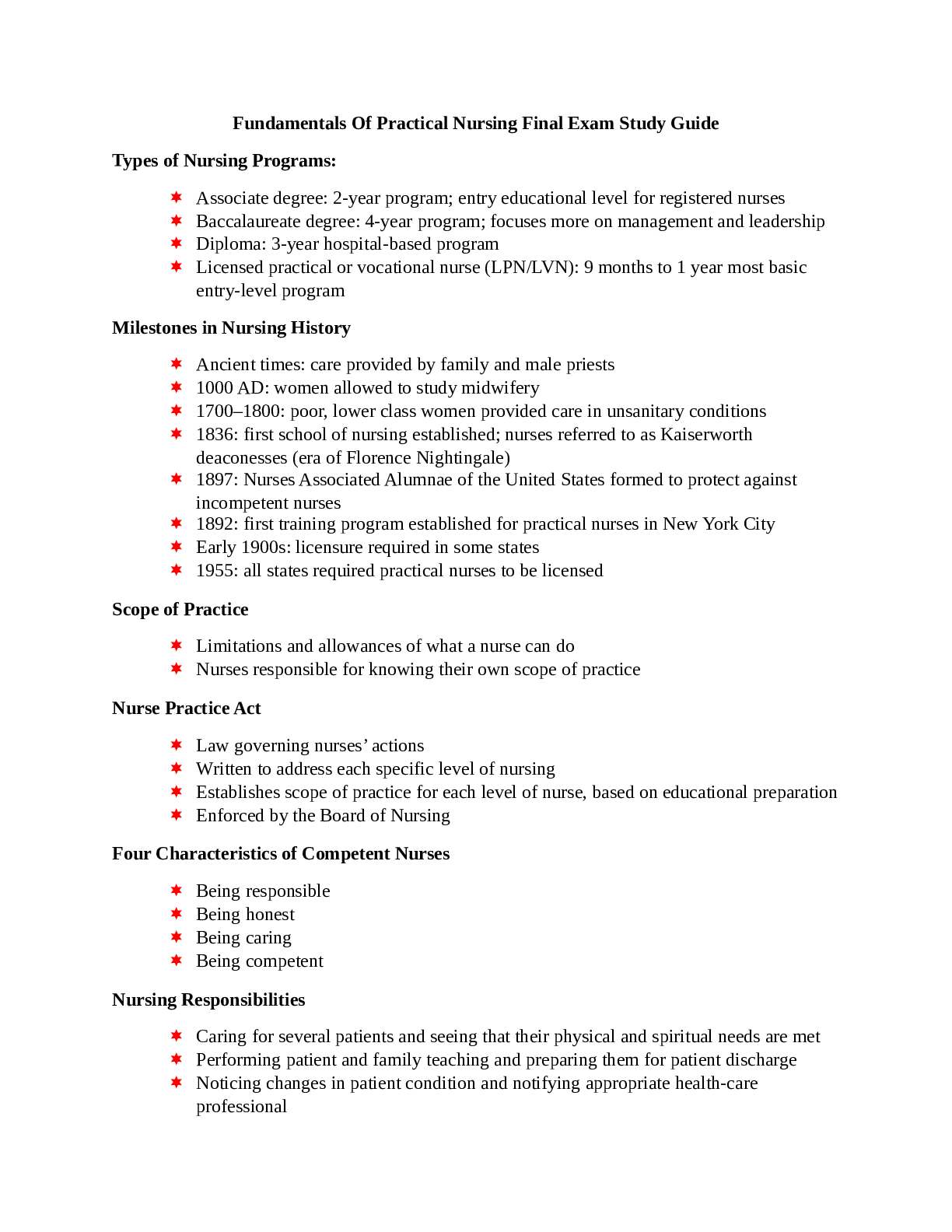
Types of Nursing Programs:
Associate degree: 2-year program; entry educational level for registered nurses
◆Baccalaureate degree: 4-year program; focuses more on management and leadership
◆Diploma: 3-year hospital-based program
◆Licensed practical or vocational nurse (LPN/LVN): 9 months to 1 year most basic entry-level program
Milestones in Nursing History
Ancient times: care provided by family and male priests
◆1000 AD: women allowed to study midwifery
◆1700–1800: poor, lower class women provided care in unsanitary conditions
◆1836: first school of nursing established; nurses referred to as Kaiserworth deaconesses (era of Florence Nightingale)
◆1897: Nurses Associated Alumnae of the United States formed to protect against
incompetent nurses
◆1892: first training program established for practical nurses in New York City
◆Early 1900s: licensure required in some states
◆1955: all states required practical nurses to be licensed
Scope of Practice
◆Limitations and allowances of what a nurse can do
◆Nurses responsible for knowing their own scope of practice
Nurse Practice Act
◆Law governing nurses’ actions
◆Written to address each specific level of nursing
◆Establishes scope of practice for each level of nurse, based on educational preparation
◆Enforced by the Board of Nursing
Four Characteristics of Competent Nurses
◆Being responsible
◆Being honest
◆Being caring
◆Being competent
Nursing Responsibilities
◆Caring for several patients and seeing that their physical and spiritual needs are met
◆Performing patient and family teaching and preparing them for patient discharge
◆Noticing changes in patient condition and notifying appropriate health-care professional
[Show More]





.png)
.png)
.png)


.png)

