Neuro NCLEX Practice Questions and
Answers Already Graded A+
A client is seen by a primary care provider because of difficulty walking. A neurological
assessment is done. A nurse informs the client that which assessme
...
Neuro NCLEX Practice Questions and
Answers Already Graded A+
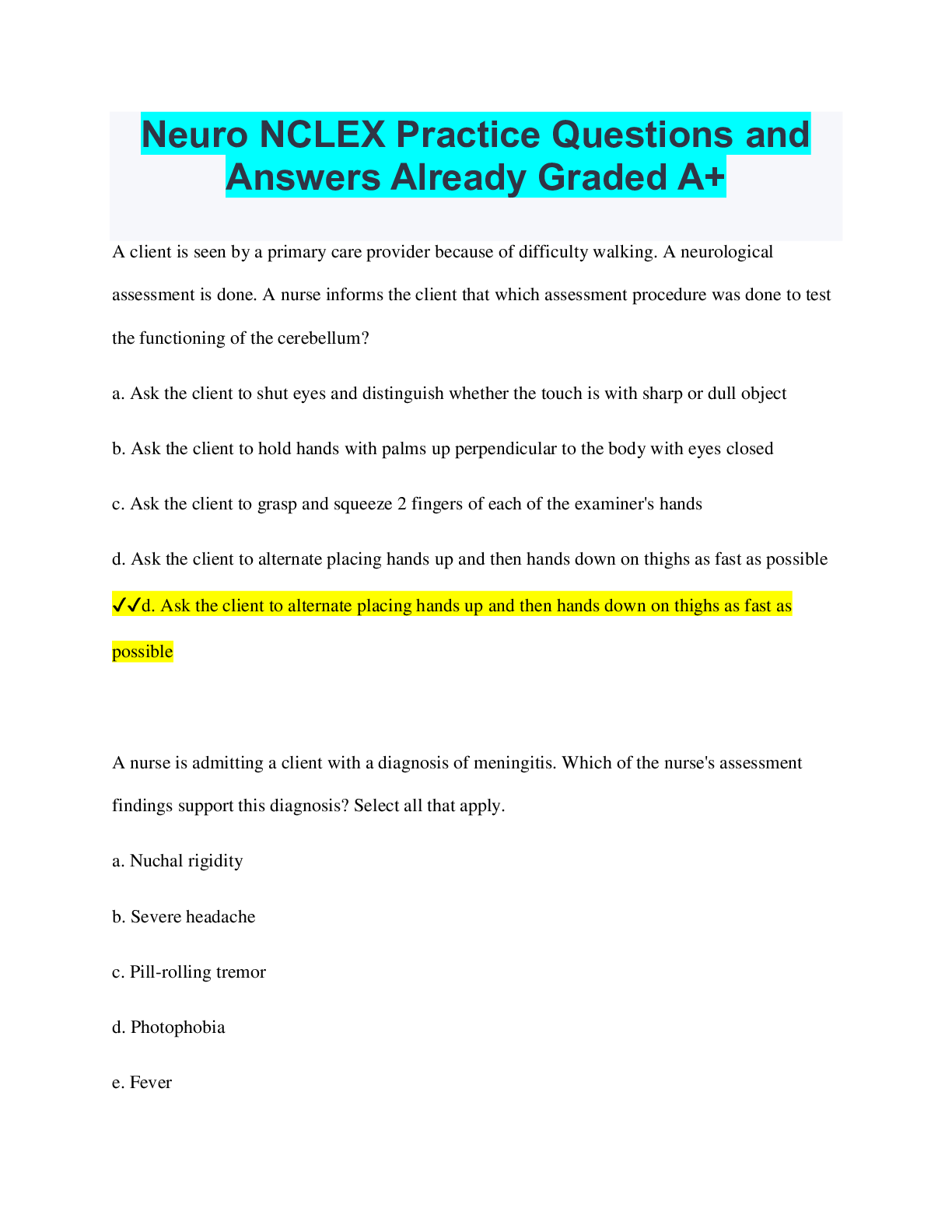
A client is seen by a primary care provider because of difficulty walking. A neurological
assessment is done. A nurse informs the client that which assessment procedure was done to test
the functioning of the cerebellum?
a. Ask the client to shut eyes and distinguish whether the touch is with sharp or dull object
b. Ask the client to hold hands with palms up perpendicular to the body with eyes closed
c. Ask the client to grasp and squeeze 2 fingers of each of the examiner's hands
d. Ask the client to alternate placing hands up and then hands down on thighs as fast as possible
✔✔d. Ask the client to alternate placing hands up and then hands down on thighs as fast as
possible
A nurse is admitting a client with a diagnosis of meningitis. Which of the nurse's assessment
findings support this diagnosis? Select all that apply.
a. Nuchal rigidity
b. Severe headache
c. Pill-rolling tremor
d. Photophobia
e. Fever
f. Micrographia ✔✔a. Nuchal rigidity
b. Severe headache
d. Photophobia
e. Fever
A client with a history of epilepsy has consecutive seizures lasting more than 5 minutes and is in
status epilepticus. Which intervention should be included in this client's immediate treatment?
Select all that apply.
a. Administer dexamethasone IV
b. Adminiter O2 and prepare for endotracheal intubation
c. Prepare for immediate defibrillation
d. Continue to protect the patient from injury
e. Administer lorazepam IV
f. Transfer to a facility with expertise in treating status epilepticus ✔✔b. Adminiter O2 and
prepare for endotracheal intubation
d. Continue to protect the patient from injury
e. Administer lorazepam IV
A nurse learns in report that a client admitted with a vertebral fracture has a halo external
fixation device in place. Based on this information, for which intervention should the nurse plan?
a. Ensure the weight with the traction is hanging
b. Remove the vest at bedtime
c. Perform pin site care
d. Progressively loosen the pins in the skull each day ✔✔c. Perform pin site care
A client with a deteriorating mental status after suffering a stroke has a rectal temperature of
102.3F. For which reason should a nurse initiate interventions to bring the temperature to a
normal level?
a. A normal temp will strengthen the client's immune system against infection
b. Hyperthermia lowers the incidence of mortality
c. A normal temp will decrease the score on the GCS
d. Hyperthermia increases the likelihood of a larger area of brain infarct ✔✔d. Hyperthermia
increases the likelihood of a larger area of brain infarct
A client seeks medical attention at an ED after experiencing left-sided weakness and slurred
speech. The client receives a diagnosis with an ischemic stroke and is evaluated for treatment
with thrombolytic therapy. Which finding would contraindicate this therapy?
a. A normal CT scan of the brain
b. A serious head injury 4 weeks prior
c. A history of diabetes mallitus
d. The onset of neurological deficits 2 hours earlier ✔✔b. A serious head injury 4 weeks prior
Following an industrial accident in which a client sustained a severe craniocerebral trauma, the
client develops the complication of DI. A nurse suspects this complication is occurring when
observing which symptom?
a. Hyperglycemia
b. Large amounts of urinary output
c. Elevated urine specific gravity
d. Decrease in level of consciousness ✔✔b. Large amounts of urinary output
A nurse is caring for a group of clients on a medical unit in a rural hospital. Which client would
the nurse be least likely to monitor for the potential complication of a brain abscess?
a. Client with endocarditis
b. Client with idiopathic epilepsy
c. Client who has had a liver transplant
d. Client with meningitis ✔✔b. Client with idiopathic epilepsy
An elderly client with Parkinson's disease is prescribed levodopa and carbidopa (Sinemet).
Which point should a nurse include in the teaching plan for the client and spouse?
a. The client is at increased risk for falls due to dizziness and OH
b. The client should stop taking multivitamins
c. The medications should not be taken with food
d. The medication has very few adverse effects ✔✔a. The client is at increased risk for falls due
to dizziness and OH
A client with a diagnosis of Guillian-Barre syndrome is scheduled to receive plasmapheresis
treatments. A nurse explains to the client's spouse that the purpose of the plasmapheresis is to:
a. Remove excess fluid from the bloodstream
b. Restore protein levels in the blood
c. Remove circulating antibodies from the bloodstream
d. Infuse lipoproteins to restore the myelin sheath ✔✔c. Remove circulating antibodies from the
bloodstream
[Show More]







.png)