Week 3 Checkpoint Quiz.
According to the text, how do the views of stronger, more developed critical thinkers
toward authority differ from those in earlier stages of cognitive development? Your Answer:
Developed cri
...
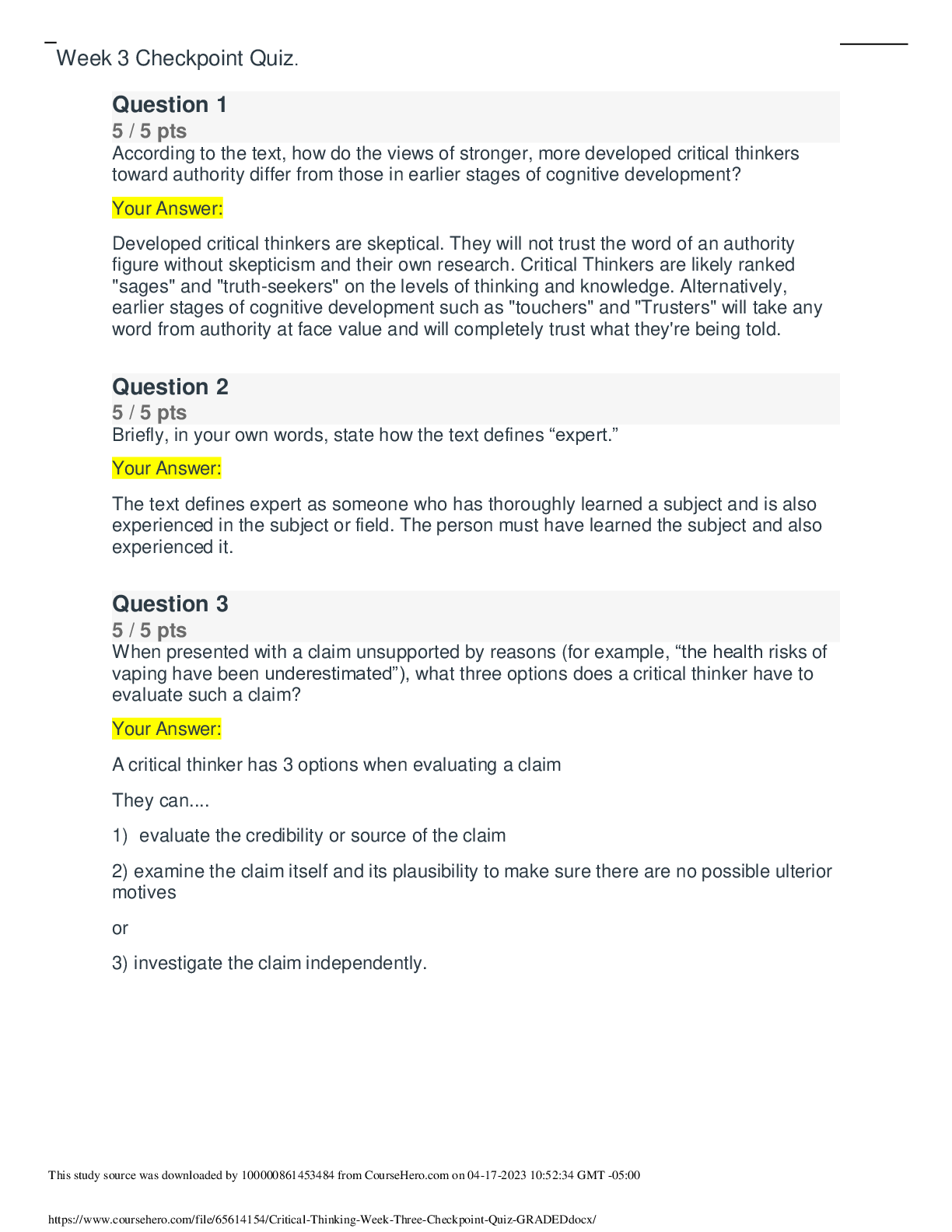
Week 3 Checkpoint Quiz.
According to the text, how do the views of stronger, more developed critical thinkers
toward authority differ from those in earlier stages of cognitive development? Your Answer:
Developed critical thinkers are skeptical. They will not trust the word of an authority figure without skepticism and their own research. Critical Thinkers are likely ranked "sages" and "truth-seekers" on the levels of thinking and knowledge. Alternatively, earlier stages of cognitive development such as "touchers" and "Trusters" will take any word from authority at face value and will completely trust what they're being told.
Briefly, in your own words, state how the text defines “expert.”
Your Answer:
The text defines expert as someone who has thoroughly learned a subject and is also experienced in the subject or field. The person must have learned the subject and also experienced it.
When presented with a claim unsupported by reasons (for example, “the health risks of
vaping have been underestimated”), what three options does a critical thinker have to evaluate such a claim?
Your Answer:
A critical thinker has 3 options when evaluating a claim They can....
1) evaluate the credibility or source of the claim
2) examine the claim itself and its plausibility to make sure there are no possible ulterior motives
or
3) investigate the claim independently.
Is the following statement true or untrue? Explain your answer. “If a claim cannot be confirmed by an independent investigation, then it must be false.”
Your Answer:
If a claim cannot be confirmed by independent investigation, than we need to disconfirm the claim with independent investigation to say that the claim is false. Without disconfirming the claim we cannot say that it is false. We should withhold or suspend judgement or make no judgement at all. therefore, the above statement is untrue.
Is the following statement true or untrue? Explain your answer. “If we do not believe that a claim is true, then we must believe that the claim is false.”
Your Answer:
If we do not believe that a claim is true, then we should pass no judgement on the claim until we have evaluated it with independent research. If we are able to prove that the claim is false, then we must believe that the claim is false. We can not pass judgement alone on only our belief that the claim is not true.
What four conditions must an argument meet if we are to accept the worthiness and reasonableness of its conclusions?
Your Answer:
There are four conditions that must be met to accept the conclusions (or reasons) it proposes:
" 1. To the best of our knowledge and understanding, the reason is true"
2. The logical relationship between the reason and the claim is such that the reason implies, entails, strongly warrants or strongly supports the claim, such that the claim must be or very probably true if the reason is assumed to be true
3. the relevance of the reason to the claim is such that the truth of the claim actually depends on the truth of the reason
4. the flow of the reasoning is such that the truth of reason must not be dependent on the truth of the claim" (Facione, 2016)
In an argument with two or more independent reasons, if one of those reasons turns out to be false, how does a critical thinker apply the test of logical strength to the argument? Should the critical thinker reject such an argument? Explain your answer.
Your Answer:
The test of logical strength is that if the reason were true, it would imply, entail, strongly warrant or strongly support the conclusion making the claim true or very probably true. If one of the reasons was false we should not accept this reason. However, if the argument has multiple reasons, we would need to find problems with the soundness of all the arguments being advanced before we can reject the claim.
Erwin is charged with statutory rape, which is defined as a having sex with a minor, a person under the age of 18. Erwin argues: “You can’t arrest me just because she’s 17 and I’m 21. Yes, we had sex, but it was consensual, plus she will be 18 in two weeks, and we are planning to get married.” Which of the four tests of worthiness does Erwin’s argument fail? Explain your answer.
Your Answer:
Erwins argument fails the test of relevance which states that the truth of the claim depends on the truth of the reason. Erwins claim that he cant be arrested for statutory rape relies on his reason that the sex was consensual and that she will be 18 in two weeks and that they were planning on getting married. However, his claim is false as Erwin did commit statutory rape and he can not be excused from responsibility for his actions .
Erwin fails The Test of truthfulness premises. Erwin should get arrested because it is the law that he had sex with a minor. The law states that anyone under the age of 18 is considered a minor. Now unless her parents gave their consent then he shouldn't get arrested. But he based his argument off of her turning 18 in 2 weeks. She is not 18 now she is 17 and still considered a minor.
Go to Individual Exercises at the end of Chapter 7 and evaluate Example 4, which begins “If God intended marriage…” Assume the premises are true. Applying only tests 2, 3, and 4 (logical strength, relevance and non-circularity), what condition of worthiness and reasonableness does this argument not meet? Explain your answer.
Your Answer:
"If god intended marriage for the sole purpose of human reproduction, and if same-sex couples are entirely incapable of human reproduction, then it follows that god did not intend marriage for same-sex couples"
This statement violates the second test, the test of relevance. The reasoning behind the claim that god did not intend marriage for same sex couples is that because same sex couples do not reproduce or make babies. However, this reasoning is not sound
because some hetero couples who marry may choose not to have children or one of the people in the relationship may be sterile. Their reasoning has little association with their claim.
Janet says: “Daria is not a person of color, so I see no reason why we should listen to her on the issue of minority race relations. Jose is Hispanic; he’s the one we should listen to.” As a critical thinker, can you describe, in your own words, the flaw in Janet’s claim? Once you have completed your description in your own words, state which of the tests of worthiness and reasonableness Janet’s argument fails and which fallacy she commits.
Your Answer:
Janet believes that because Daria is not a person of color they are deficient in their argument on minority race relations and should not be listened too. This is a flawed claim on Janets behalf because Darias race is not relevant to her opinion on minority race relations. Janets claim fails the Test of Relevance and uses the fallacy of Ad Hominem Attacks to try to discredit Daria.
[Show More]