TDLR Esthetics Laws and Regulations
with Verified Solutions
To be eligible for an operators license: ✔✔submit a completed application on a departmentapproved form, pay the $50 fee, be at least 17, have obtained a high
...
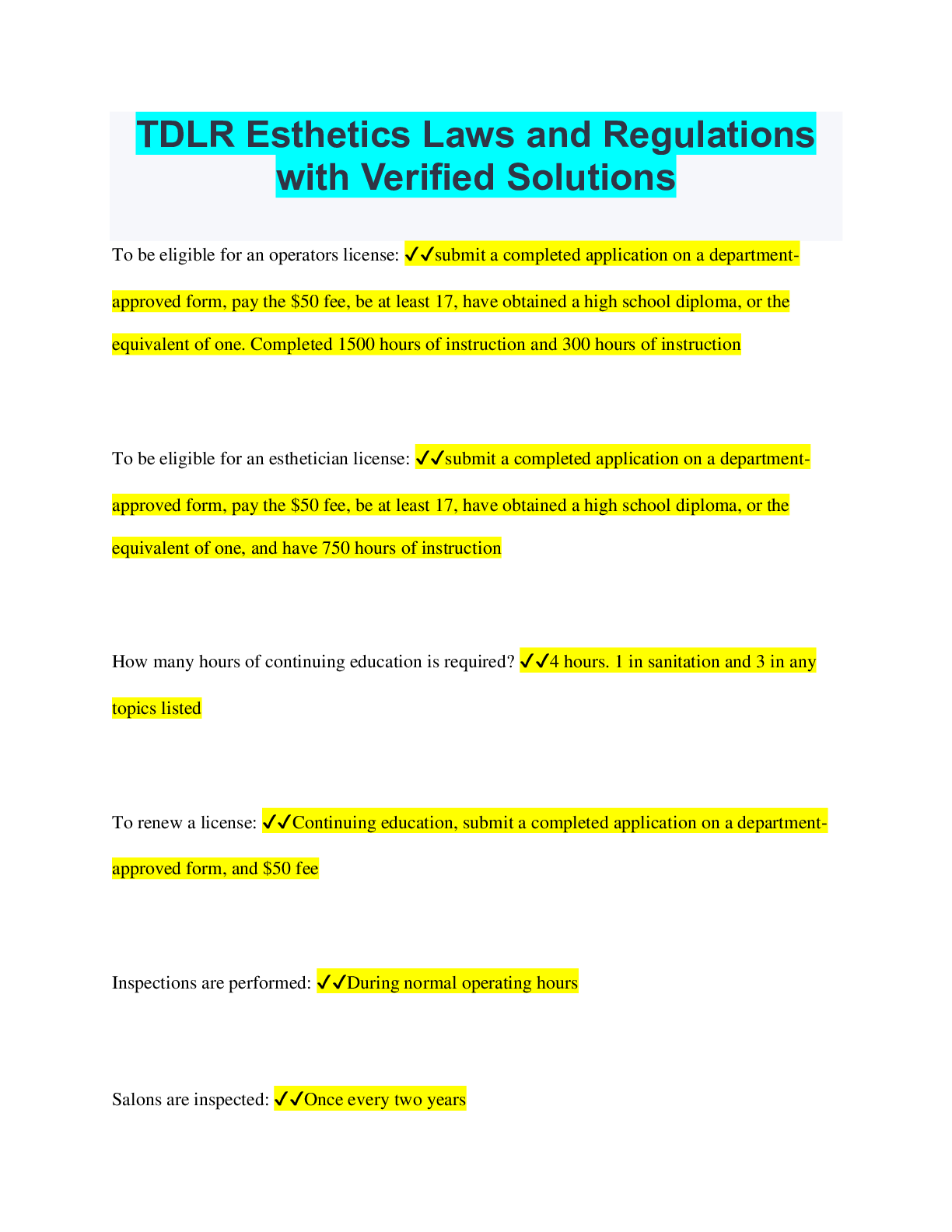
TDLR Esthetics Laws and Regulations
with Verified Solutions
To be eligible for an operators license: ✔✔submit a completed application on a departmentapproved form, pay the $50 fee, be at least 17, have obtained a high school diploma, or the
equivalent of one. Completed 1500 hours of instruction and 300 hours of instruction
To be eligible for an esthetician license: ✔✔submit a completed application on a departmentapproved form, pay the $50 fee, be at least 17, have obtained a high school diploma, or the
equivalent of one, and have 750 hours of instruction
How many hours of continuing education is required? ✔✔4 hours. 1 in sanitation and 3 in any
topics listed
To renew a license: ✔✔Continuing education, submit a completed application on a departmentapproved form, and $50 fee
Inspections are performed: ✔✔During normal operating hours
Salons are inspected: ✔✔Once every two years
Beauty schools are inspected: ✔✔At least twice per year
Specialty certificate holders: ✔✔may only perform the practice authorized by the specialty
certificate
All current licenses may be posted: ✔✔at the licensee's workstation in public view or made
available in a notebook at the salon reception desk
Current photograph of the licensee should be: ✔✔1 1/2 inches by 1 1/2 inches
Licensees shall notify TDLR of any name changes: ✔✔Within 30 days
Licensees must notify TDLR of any address change: ✔✔Within 30 days
Licensees shall wear clean top and bottom outer garments and footwear, which includes: ✔✔Tee
shirts, blouses, sweaters, dresses, smocks, pants, jeans, shorts, and similar clothing. Does not
include lingerie or see-through clothing
Licensees responsible for: ✔✔Compliance with the health and safety standards
Fee for beauty and specialty salons: ✔✔$106: renewal $69
Fee for dual shop: ✔✔$130; renewal $100
Fee for mobile shop: ✔✔$106; renewal $69
Chlorine bleach solutions: ✔✔Chemical used to destroy bacteria and to disinfect implements and
non-porous surfaces; solution should be mixed fresh at least once per day. There are 3 categories
Low Level Disinfection ✔✔Add two teaspoons of household bleach (5.25%) to one gallon
water; soak 10 minutes minimum
High Level Disinfection ✔✔Add one-third (1/3) cup of household bleach (5.25%) to one gallon
of water; soak 20 minutes minimum
Blood and Body Fluid Cleanup and Disinfection ✔✔Add one and three-quarters ( 1 3/4) cups of
household (5.25%) bleach to one gallon of water. Also referred to as 10% bleach solution
Clean or cleansing ✔✔Washing with liquid soap and water, detergent, antiseptics, or other
adequate methods to remove all visible debris or residue. Not disinfection
Disinfect or disinfection ✔✔The use of chemicals to destroy pathogens on implements and other
hard, non-porous surfaces render an item safe for handling, use, and disposal
Disinfectant: ✔✔An EPA-registered bactericidal, fungicidal, and virucidal disinfectant used in
accordance with the manufacturer's instructions, or a chlorine bleach solution
EPA-registered bactericidal, fungicidal, virucidal disinfectant ✔✔Is a low-level disinfectant used
to destroy bacteria and to disinfect implements and non-porous surfaces
Sterilize or sterilization ✔✔To eliminate all forms of bacteria or other microorganisms by use of
an autoclave or dry heat sterilizer
Sanitize or sanitization ✔✔To reduce the number of microorganisms to a safe level by use of
ultraviolet sanitizer
Multi-use Items ✔✔Items constructed of hard materials with smooth surfaces such as metal,
glass, or plastic typically for use on more than one client. Includes, but not limited to clippers,
scissors, combs, nippers, tweezers, and some nail files
Single-use Items ✔✔Porous items made or constructed of cloth, wood, or other absorbent
materials having rough surfaces usually intended for single use including but not limited to
tissues, orangewood sticks, cotton balls, thread, surgical tape, extension pads, some buffer
blocks, and gauze
EPA: ✔✔Implements and surfaces shall first be thoroughly cleaned of all visible debris prior to
disinfection. Become inactivated and ineffective when visibly contaminated with debris, hair,
dirt, and particles
Some EPA disinfectants may be: ✔✔Sprayed on the instruments, tools, or equipment to be
disinfected
Disinfectants in which implements are to immersed: ✔✔Shall be prepared fresh daily or more
often if solution becomes diluted or soiled
Disinfectants shall always be used: ✔✔In accordance with the manufacturer's recommendation
or other guidance
These chemicals are harsh and may affect the use of scissors and other sharp objects
✔✔Recommends leaving items in the solution with accordance with the manufacturer's
recommendation for effective disinfection
Chlorine bleach at the appropriate concentration is ✔✔An effective disinfectant for all purposes
in a salon
Chlorine bleach solutions shall be ✔✔Mixed daily
Chlorine bleach shall be kept ✔✔In a closed or covered container and not exposed to sunlight
Chlorine bleach may affect the use of scissors and other sharp objects ✔✔Leave only in for 2
minutes, or 5 minutes for disinfecting for blood contamination
Chlorine bleach vapors might react with vapors from other chemicals ✔✔Bleach shall not be
placed or stored near other chemicals used in salons (acrylic monomers, alcohol, or other
disinfecting products) or near flame
Licensees shall clean ✔✔Their hands with soap and water or hand sanitizer prior to performing
any services and as necessary during the service to ensure client health and safety
All establishments and licensees shall use ✔✔clean and disinfected equipment, tools,
implements, and supplies, and shall employ good hygiene habits while providing services
Shall not perform a service ✔✔if the licensee has reason to believe the client has contagious
condition such as head lice, nits, ringworm, conjunctivitis, or inflamed, broken, raised, or
swollen skin or nail tissue; or open wound/sore in the area to be serviced
Multi-use equipment shall be ✔✔cleaned and disinfected before use on each client. chairs and
dryers do not need to disinfected
Single-use equipment shall be ✔✔discarded after use on a single client
Electrical equipment ✔✔That cannot be immersed in liquid shall be wiped clean and disinfected
prior to each use on a client
All clean and disinfected implements and materials shall be stored ✔✔In a clean, dry, debris-free
environment including drawers, cases, tool belts, rolling trays, or hung from hooks. Must be
stored separate from soiled implements and materials. Ultraviolet electrical sanitizers are
permissible for use as a dry storage container. Non-cosmetology related supplies must be stored
in separate drawers or locations
Trash containers ✔✔must be emptied daily and kept clean by washing or using plastic liners
Towels ✔✔must be washed in hot water and bleach; clean towels must be used on each client
Soiled towels ✔✔should be removed after use on each client and deposited in a suitable
receptacle
Estheticians shall ✔✔Wash their hands with soap and water or use a liquid hand sanitizer, prior
to performing any services on a client. Gloves shall be worn during any type of extraction
Equipment, implements, tools, and materials ✔✔shall be properly cleaned and disinfected after
servicing each client in accordance to this rule
Facial-chairs and beds (including headrest) ✔✔shall be cleaned and disinfected after providing
service to each client. Their chair shall be made of or covered in a material that can be
disinfected
After each client, multiple use ✔✔Such as metal tweezers and comedone-extractors shall be
cleaned and disinfected
Single-use items that are to be discarded after the service, include: ✔✔Cotton pads, cotton balls,
gauze, wooden applicators, disposable gloves, tissues, thread, disposable wipes, lancets, fabric
strips, and other items used for a similar purpose
Items that will be replaced with clean items for each client, includes : ✔✔Disposable and terry
cloth towels, hair caps, headbands, brushes, gowns, makeup brushes, spatulas that contact skin or
products from multi-use containers, sponges, and other items used for a similar purpose
Items subject to possible cross contamination such as : ✔✔Creams, cosmetics, astringents,
lotions, removers, waxes, moisturizers, masks, oils, and other preparations shall be used in a
manner so as not to contaminate the remaining product
Applicators shall not be re-dipped in product; other procedures to avoid cross contamination are
✔✔1. Disposing of the remaining product before beginning services on each client
2. Using a single-use disposable implement to apply product and disposing of such implement
after use
3. Using an applicator bottle to apply the product
Shall clean the areas of the client's body ✔✔on which the temporary hair removal service is to be
administered
Estheticians performing temporary hair removal services involving the use of depilatories,
preparations or tweezing techniques shall ✔✔dispose of after each use all products or single use
items that have been in contact with a client's skin
All wax pots ✔✔shall be cleaned and disinfected in accordance with manufacturer's
recommendations. No applicators should be left standing in the wax at any time and wax may
not be reused under any circumstances
Blood can carry many pathogens ✔✔which is why licensees should never touch a client's open
sore or wound. Powdered alum, styptic powder, or a cyanoacrylate (liquid bandage) may be used
to contract the skin to stop minor bleeding and should be applied to the open area with a
disposable cotton-tipped instrument that is immediately discarded after application
Blood or body fluid contact on surface areas (tables, chairs, or the floor) ✔✔An EPA-registered
hospital grade disinfectant, a tuberculocidal disinfectant, or a 10% bleach solution (1 3/4) cups of
household (5.25%) bleach to one gallon of water, shall be used per manufacturer's instructions
immediately to clean up all visible blood or body fluids
Any non-porous instrument comes in contact with blood or body fluids ✔✔Immediately cleaned
and disinfected with EPA hospital grade, tubercluocidal, or totally immersed in 10% bleach
solution for 5 minutes
Any porous instrument that comes in contact with blood or body fluids ✔✔Immediately doublebagged and discarded in a closed trash container or biohazard box
Prohibited products ✔✔Methyl Methacrylate Liquid Monomers (MMA), razor-type callus
shavers, alum or other astringents in stick or lump form, and fumigants such as formalin
(formaldehyde) tablets or liquids
Licensees will not provide a service or use products banned by ✔✔The FDA
MMA will not be ✔✔bought, sold, used, or applied to any person
Person may not perform a practice of cosmetology unless ✔✔the person holds a certificate or
license
Person may only operate a beauty shop ✔✔if they have a license to operate the business
Person holding a beauty shop license ✔✔may maintain an establishment in which any practice of
cosmetology is performed
Requirement for first renewal of license ✔✔hold a high school diploma, hold the equivalent of a
high school diploma, and have passed an examination that measures the person's ability to
benefit from training
The department can enter and inspect schools ✔✔at any time during business hours
The department inspects schools ✔✔at least twice a year
[Show More]