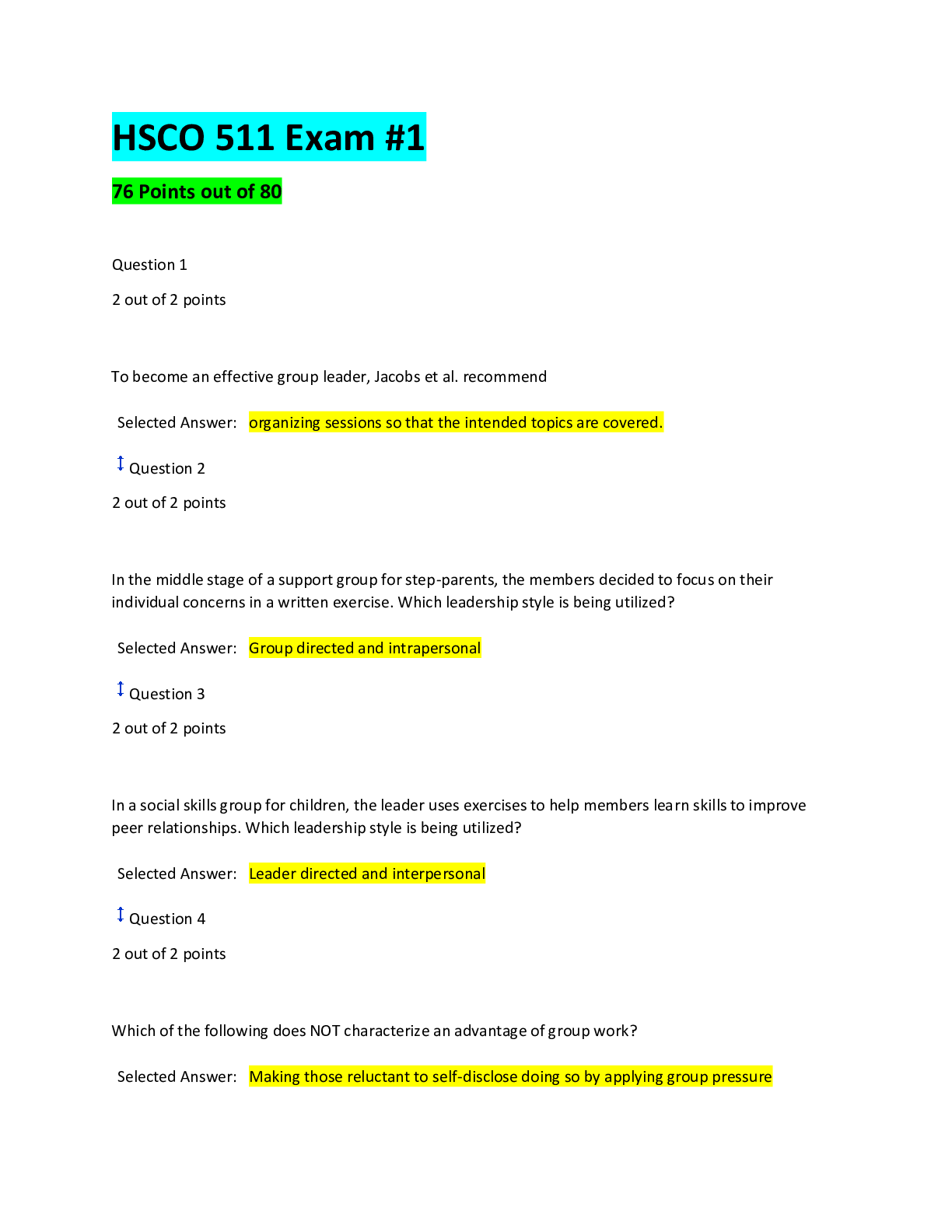
HSCO 511 Exam #1
Question 1
To become an effective group leader, Jacobs et al. recommend
Question 2
In the middle stage of a support group for step-parents, the members decided to
...
HSCO 511 Exam #1
Question 1
To become an effective group leader, Jacobs et al. recommend
Question 2
In the middle stage of a support group for step-parents, the members decided to focus on their individual concerns in a written exercise. Which leadership style is being utilized?
Question 3
In a social skills group for children, the leader uses exercises to help members learn skills to improve peer relationships. Which leadership style is being utilized?
Question 4
Which of the following does NOT characterize an advantage of group work?
Question 5
Which of the following is FALSE regarding ethical group practices? The leader should
Question 6
While other models typically include four or more group stages, Jacobs et al. propose three stages. In which stage do members benefit the most from being in the group?
Question 7
Which one is NOT an important group dynamic for a support group?
Question 8
According to Jacobs et al., the single most important therapeutic force of a group is the
Question 9
Which of the following is NOT one of Jacobs et al.’s perspectives on the relationship between content and process in a group meeting?
Question 10
Which of the following is FALSE about the purpose of a group?
Question 11
The most important concept of group leadership is having
Question 12
If there are group members who are not clear about the group’s purpose, the following is recommended, EXCEPT
Question 13
If the leader sees that a change of purpose is needed, he or she should
Question 14
Which of the following distinguishes a group from a network?
Question 15
Which one is task-focused rather than relationship-focused?
Question 16
Interdependence, a key quality of groups, requires
Question 17
Audiences, bystanders and crowds are ______ while coworkers, sports teams, and study groups are ______.
Question 18
Group formation is influenced significantly by all these factors EXCEPT
Question 19
This theory assumes that how secure and comfortable you were with your primary caregiver influences your relationships, including group memberships, throughout your entire life.
Question 20
Donald decides that he wants to do more for the group. He starts helping other members by taking on some of their work and organizing fund raisers. Donald is providing _____ support.
Question 21
In a therapy group, members expect everyone to communicate and share their thoughts and feelings. All members agree on informal rules regarding who should talk and for how long. This group has high levels of _____ compatibility.
Question 22
Which of the following is TRUE about member screening?
Question 23
All of the following are appropriate ways to begin a session EXCEPT:
Question 24
These are common group planning mistakes, EXCEPT:
Question 25
“Big picture” planning involves
Question 26
When planning a session, the following is recommended, EXCEPT:
Question 27
0 out of 2 points
To set a positive tone in the first session of the group, the leader should NOT
Question 28
Explaining how the group will be conducted and the role of the group leader will accomplish the following, EXCEPT
Question 29
Which exercise is NOT appropriate to use in the first session of a group?
Question 30
According to Jacobs et al., which of the following can be a MISTAKE with regard to group rules?
Question 31
Which of the following is NOT associated with “second session let down?”
Question 32
A multicomponent approach to cohesion assumes
Question 33
Liking for a group is _____ cohesion, whereas goal-focused team work is _____ cohesion.
Question 34
A number of experts who study group development believe that
Question 35
Which statement describes a group at the orientation, or forming, stage of development?
Question 36
_____ norms articulate what people typically do; _____ norms articulate what people should avoid doing.
Question 37
Which one is NOT a characteristic of norms?
Question 38
Most roles fit into one of two broad categories: _____ roles and _____ roles.
Question 39
When a group is formally organized in a hierarchical structure,
Question 40
Sherif’s study of the autokinetic effect indicated that group norms
[Show More]