Foundations in Personal Finance - Practice for Certificate
Exam with complete solution
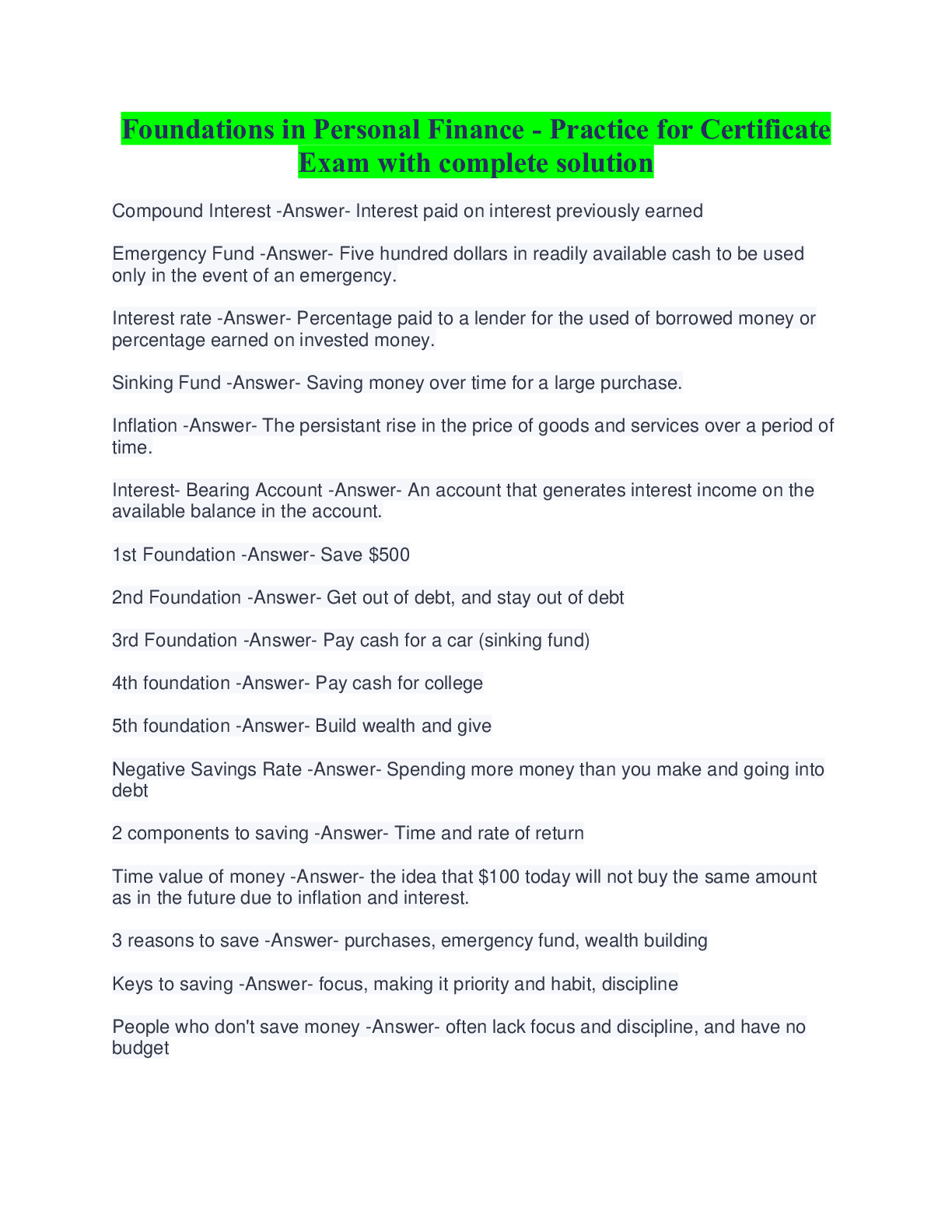
Compound Interest -Answer- Interest paid on interest previously earned
Emergency Fund -Answer- Five hundred dollars in readily av
...
Foundations in Personal Finance - Practice for Certificate
Exam with complete solution
Compound Interest -Answer- Interest paid on interest previously earned
Emergency Fund -Answer- Five hundred dollars in readily available cash to be used
only in the event of an emergency.
Interest rate -Answer- Percentage paid to a lender for the used of borrowed money or
percentage earned on invested money.
Sinking Fund -Answer- Saving money over time for a large purchase.
Inflation -Answer- The persistant rise in the price of goods and services over a period of
time.
Interest- Bearing Account -Answer- An account that generates interest income on the
available balance in the account.
1st Foundation -Answer- Save $500
2nd Foundation -Answer- Get out of debt, and stay out of debt
3rd Foundation -Answer- Pay cash for a car (sinking fund)
4th foundation -Answer- Pay cash for college
5th foundation -Answer- Build wealth and give
Negative Savings Rate -Answer- Spending more money than you make and going into
debt
2 components to saving -Answer- Time and rate of return
Time value of money -Answer- the idea that $100 today will not buy the same amount
as in the future due to inflation and interest.
3 reasons to save -Answer- purchases, emergency fund, wealth building
Keys to saving -Answer- focus, making it priority and habit, discipline
People who don't save money -Answer- often lack focus and discipline, and have no
budget
Why should emergency fund and spending money be kept separate -Answer- To make
sure its only spent for emergencies and not as easy to access and spend it.
What is the purpose of fully funded emergency fund -Answer- To have money for
unexpected financial emergencies
Saving should bring -Answer- contentment
Emergency Fund interest -Answer- Is not important because an emergency fund is not
used to growth wealth
Savings habits -Answer- should not be based on income
should be determined in the budget
Americans savings rates -Answer- are usually not high
Emergency fund after school -Answer- should be 3-6 months of expenses
Investing -Answer- should start now
Essential elements of wealth building -Answer- discipline, time, compound interest
Why do you need an emergency fund -Answer- Emergencies can happen at any age.
Why in emergency fund the 1st foundation? -Answer- An emergency fund allows you to
have money available for any surprise expenses and can help you avoid debt
Calculate compound interest: $1000 at 6% for 3 years -Answer- $1,191.02
Savings rates -Answer- Compares after-tax income to the money people spend on a
variety of items
Overdraft -Answer- occurs when money is withdrawn from a bank account and the
available balance goes below zero
zero-based budget -Answer- a cash flow plan that spends every dollar of your income
(total income- total expenses = 0)
Envelope system -Answer- series of envelopes that are divided into categories and
used to hold cash for monthly expenses
Impulse purchase -Answer- an item that is bought without previous planning of the long
term effects
Reconcile -Answer- To match your bank statement with your checkbook and should be
done at least once each month.
Budget -Answer- a written cash flow plan
Fixed expenses -Answer- expenses that remain the same from month to month
Discretionary expenses -Answer- expenses that you do not need (but like to have)
Cash flow statement -Answer- summary of all the income and outgoing over a certain
period (summarizes money you have already spent)
Check Register -Answer- record of all your transactions
Overdrawing your checking account Consequences -Answer- Bounced Checks (fees
from store)
Overdraft fee from bank
Stress
A budget -Answer- does not make overspending more likely (made for the future)
Budget should include -Answer- variable expenses, fixed expenses, discretionary
expenses, income
A typical millionaire -Answer- spends less money than he or she makes
Rent is -Answer- fixed expense
Eating Out -Answer- discretionary expense
Car repairs -Answer- intermittent expense
Groceries -Answer- variable expense
A written budget should stop -Answer- overspending, guilt, management by crisis
Irregular income -Answer- can be budgeted too!
70% -Answer- American living paycheck to paycheck
Bank's record keeping -Answer- reconciliation sheet, account register, monthly account
statement
account register (check register) -Answer- Most current account balance
Money -Answer- #1 cause of divorce in America
Debit Card -Answer- spends money directly from your checking account
Pay yourself first -Answer- putting a portion of your income to saving and investing each
month
Online bill pay -Answer- allows you to make payments from your checking account
without having to write a check and send it in the mail
Automatic account transfers -Answer- easiest way to build savings for sinking fund or
emergency fund
Reasons cash flow plans don't work -Answer- you leave things out, overcomplicate your
plan, donʹt write a budget, and/or donʹt live on your budget.
Payment options from a checking account -Answer- Writing checks, debit card purchase
(online or in store), online bill pay
Why should you have a paper and electronic financial record? -Answer- 1. As a
reference for filing taxes, 2. So that you always have an
accurate account balance, 3. So that you can catch errors made by the bank, 4. So that
youʹre aware of fraudulent
activity on your account.
What circumstances might affect a budget? -Answer- change in or loss of income,
change in family (divorce, death, birth),
accountability -Answer- taking responsibility and assisting wise decisions
allowance -Answer- money given to a child by his/ her parent or guardian typically on a
weekly basis
commission -Answer- a fee paid for providing a service
fiscal -Answer- having to do with money
free spirit -Answer- a person who thinks, "everything will work out fine," and typically
hates to deal with numbers
nerd -Answer- one who is picky about budgeting and numbers
self-esteem -Answer- one's attitude about themselves
value system -Answer- a person's priorities, beliefs, and standards considered important
work ethic -Answer- how motivated, loyal, and honest you are in your work
Determines a FICO score -Answer- 1 Getting a personal loan from a bank
2 Using Credit Cards
3 Taking out a Mortgage on a House
Good Ideas for Getting Out of Debt -Answer- 1 stop borrowing money
2 Get a part time job or work overtime
3 sell something
Something you can do with a credit card, but not a debit card -Answer- Go into debt
Things you can purchase with a debit card -Answer- 1 Rent a car
2 purchase something online
3 airline ticket
Fair Credit Reporting Act (FCRA) -Answer- 1.enacted by congress to help with concerns
about credit reports, privacy and fairness
2. consumers are allowed one free credit report every year
3. creditors must inform consumers if credit denied based on a credit report and which
credit bureau provided the report
Steps in :Drive Free" -Answer- 1 plan your purchase in advance using a sinking fund.
2. place your money in a mutual fund so that your money can make more money
3. start with an inexpensive car and move up as your savings increases
Most cost effective option for purchasing a home -Answer- 1. buy it outright---100%
down
2. if unable to do #1: 15 year mortgage with at least 10% down.
Debt Snowball method -Answer- 1. List your debts in order from smallest to largest
balance and focus on paying smallest debt off first
2. Attack your debt with intensity
3. Every time you pay off a debt, you add its old minimum payment to your next debt
payment.
Paycheck Garnishment -Answer- court ordered attachment that allows a lender to take
money owed directly from a borrower's paycheck.
Using credit instead of cash for a purchase -Answer- Most spend more when using
credit compared to using cash.
Credit myths -Answer- 1. lottery will make you rich
2. You have "arrived" when you get approved for credit cards
3. Debt is a tool to build wealth
Without a FICO score, you qualify for a mortgage by -Answer- 1. History of rental and
utilities payments
2. amount of down payment
3. Employment History
A credit score measures -Answer- the risk of you not repaying debt
Signs that your identify may have been stolen -Answer- 1. call from a collection agency
about a debt that isn't yours
2. bank and billing statements don't arrive on time.
3. your credit report has accounts you didn't open
How long does account information say on your credit report? -Answer- 10 years
(bankruptcy is longer)
Three credit bureaus -Answer- Experian, TransUnion, Equifax
You (do, do not) have established credit to buy a house -Answer- Do not
Zero -Answer- Amount of money you have to pay back when you are identify theft
vitctim
Every year -Answer- You can and should be checking your free credit report
2 big items you CAN do with debit card -Answer- rent a car
check into a hotel
Federal Trade Commission (FTC) -Answer- US agency that regulates the consumer
credit system and enforces laws related to it.
Fair Credit Reporting Act (FCRA) -Answer- only allows people with legitimate reason to
check a person's credit
Teens -Answer- huge target of credit card compaines
Co-signing -Answer- taking financial responsibility for a loan if the original borrower
cannot pay; NOT a good idea
Debt Snowball -Answer- preferred method of debt repayment: list all debts, from
smallest to largest, make minimum payments to all debts except the smallest which gets
the largest possible payments, once that is payed off, take that money and apply it the
next debt on the list.
Credit Report -Answer- a detailed report of an individual's credit history
Loan Term -Answer- time frame that a loan agreement is for.
Annual Percentage Rate (APR) -Answer- Cost of borrowing money on an annual
basis(includes interest rate,and other related fees)
Depreciation -Answer- A decrease on loss in value
Annual Fee -Answer- A yearly fee that's charged by the credit card company just for
having the credit card
Introductory Rate -Answer- An interest rate charged to a customer during the early
stages of a loan; the rate often goes up after this period
Lease -Answer- A long term rental agreement on a car (secured long term-debt)
Upside down -Answer- When a person owes more on an item like a house or car than it
is worth
Credit Card -Answer- a card issued by a bank that allows users to finance a purchase
Secured loan -Answer- When something of value is collateral for a loan---if you don't
make your payments the bank takes that item
Unsecured loan -Answer- based on a borrowers ability to repay the loan
Adjustable Rate Mortgage (ARM) -Answer- interest rate that changes based on market
conditions. NOT a good idea because the rate could adjust higher and you may not be
able to afford the payments when it does.
[Show More]

.png)
.png)
.png)
.png)

.png)



.png)
.png)
 Janice Loftus, Ken Leo, Sorin Daniliuc, Noel Boys, Belinda Luke, Hong Ang, Karyn Byrnes (Test Bank).png)
.png)