HSCO 511 TEST BANK
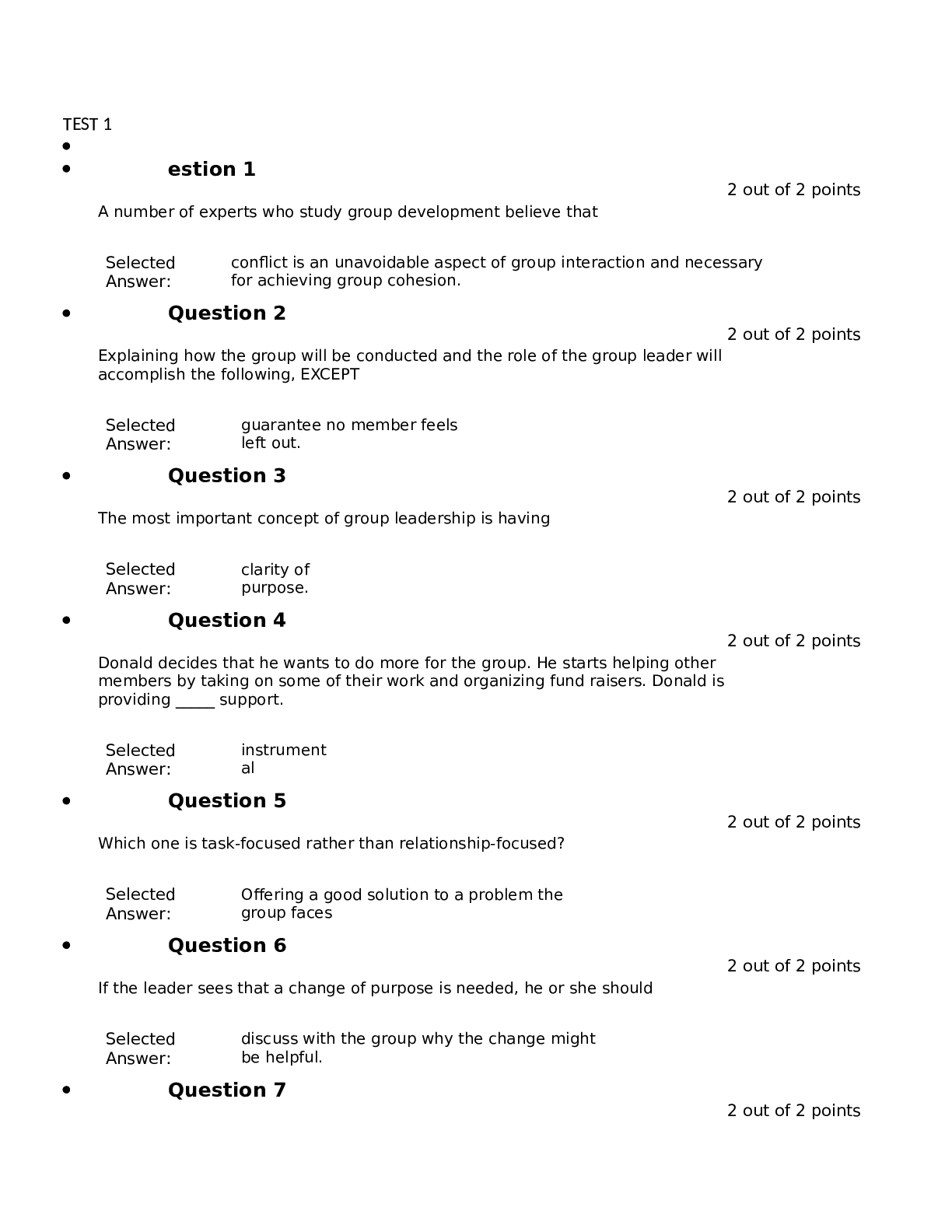
• Question 1
A number of experts who study group development believe that
• Question 2
Explaining how the group will be conducted and the role of the group leader will acc
...
HSCO 511 TEST BANK
• Question 1
A number of experts who study group development believe that
• Question 2
Explaining how the group will be conducted and the role of the group leader will accomplish the following, EXCEPT
• Question 3
The most important concept of group leadership is having
• Question 4
Donald decides that he wants to do more for the group. He starts helping other members by taking on some of their work and organizing fund raisers. Donald is providing _____ support.
• Question 5
Which one is task-focused rather than relationship-focused?
• Question 6
If the leader sees that a change of purpose is needed, he or she should
• Question 7
Which of the following is NOT associated with “second session let down?”
• Question 8
Which of the following does NOT characterize an advantage of group work?
• Question 9
Which of the following is NOT one of Jacobs et al.’s perspectives on the relationship between content and process in a group meeting?
• Question 10
Sherif’s study of the autokinetic effect indicated that group norms
• Question 11
Which exercise is NOT appropriate to use in the first session of a group?
• Question 12
Interdependence, a key quality of groups, requires
• Question 13
All of the following are appropriate ways to begin a session EXCEPT:
• Question 14
While other models typically include four or more group stages, Jacobs et al. propose three stages. In which stage do members benefit the most from being in the group?
• Question 15
In a therapy group, members expect everyone to communicate and share their thoughts and feelings. All members agree on informal rules regarding who should talk and for how long. This group has high levels of _____ compatibility.
• Question 16
In a social skills group for children, the leader uses exercises to help members learn skills to improve peer relationships. Which leadership style is being utilized?
• Question 17
According to Jacobs et al., which of the following can be a MISTAKE with regard to group rules?
• Question 18
If there are group members who are not clear about the group’s purpose, the following is recommended, EXCEPT
• Question 19
Audiences, bystanders and crowds are ______ while coworkers, sports teams, and study groups are ______.
• Question 20
Most roles fit into one of two broad categories: _____ roles and _____ roles.
• Question 21
In the middle stage of a support group for step-parents, the members decided to focus on their individual concerns in a written exercise. Which leadership style is being utilized?
• Question 22
This theory assumes that how secure and comfortable you were with your primary caregiver influences your relationships, including group memberships, throughout your entire life.
• Question 23
A multicomponent approach to cohesion assumes
• Question 24
When planning a session, the following is recommended, EXCEPT:
• Question 25
According to Jacobs et al., the single most important therapeutic force of a group is the
• Question 26
Which of the following is FALSE about the purpose of a group?
• Question 27
To set a positive tone in the first session of the group, the leader should NOT
• Question 28
_____ norms articulate what people typically do; _____ norms articulate what people should avoid doing.
• Question 29
When a group is formally organized in a hierarchical structure,
• Question 30
Which of the following is TRUE about member screening?
• Question 31
Which one is NOT an important group dynamic for a support group?
• Question 32
Which of the following distinguishes a group from a network?
• Question 33
Liking for a group is _____ cohesion, whereas goal-focused team work is _____ cohesion.
• Question 34
To become an effective group leader, Jacobs et al. recommend
• Question 35
Which one is NOT a characteristic of norms?
• Question 36
Which of the following is FALSE regarding ethical group practices? The leader should
• Question 37
These are common group planning mistakes, EXCEPT:
• Question 38
Group formation is influenced significantly by all these factors EXCEPT
• Question 39
“Big picture” planning involves
• Question 40
Which statement describes a group at the orientation, or forming, stage of development?
TEST 2
• Question 1
Leadership is best defined as
• Question 2
The control of a charismatic leader comes from what type of power?
• Question 3
Improvement in task performance that occurs when people work in the presence of others is known as social
• Question 4
The tendency for individuals to become less productive as group size increases is known as
• Question 5
Which of the following is NOT recommended when drawing out a member?
• Question 6
The leader should cut off a member for all of the following reasons EXCEPT if the member
• Question 7
According to Jacobs et al., silence from a member may indicate all of the following EXCEPT that the member
• Question 8
Which is FALSE according to Forsyth?
• Question 9
In which of the following situations would it NOT be appropriate for the leader to use the technique of cutting off?
• Question 10
According to Forsyth, persistence, supplication, discussion, and instruction are all examples of
• Question 11
Which of the following should NOT be used to deepen the focus of a session?
• Question 12
A leader who says, “In a word or phrase, how are you feeling about being in this group" is initiating a _______ round.
• Question 13
Group polarization is the
• Question 14
Which is true?
• Question 15
Co-leaders who differ somewhat in their approach, and who are pulling the group in opposite directions may benefit most from using which model of co-leadership?
• Question 16
From a group dynamics perspective, obedience was high in the Milgram experiment because of the
• Question 17
Hersey and Blanchard’s life cycle theory suggests that effective leaders emphasize
• Question 18
Jacobs et al. do not advise shifting the focus
• Question 19
Jacobs et al. suggest using summarizing for all of the following reasons EXCEPT to
• Question 20
If I think a good leader should be intelligent, responsible, competitive, and well-balanced, I probably take a(n) _______ approach to leadership.
• Question 21
Clarifying rambling or confusing comments made by a member can be done using each of the following techniques EXCEPT
• Question 22
A group member has been talking for some time. The leader asks members to pair up with a partner and discuss their thoughts and feelings about what the member has shared. In this instance, the leader
• Question 23
Obedience rates in Milgram’s studies were lowest in the ______ condition.
• Question 24
The cohesiveness of a team is indicated by the following, EXCEPT:
• Question 25
Near the end of a session, a member wants to share something deep and personal. The leader should
• Question 26
An inexperienced leader who lacks cutting off or drawing out skills may spend too much time __________ the focus.
• Question 27
What is the meaning of the phrase, the “romance of teams?”
• Question 28
All of the following are true with regard to dyads EXCEPT
• Question 29
Steiner found that group productivity depends mainly on
• Question 30
Which of the following is FALSE regarding dyads? The leader should
• Question 31
Teams with members who vary in ability and skill
• Question 32
Teams are
• Question 33
An inspirational approach to leading others that involves elevating followers’ motivation, confidence, and satisfaction is____________ leadership.
• Question 34
The implicit leadership theory argues that
• Question 35
An essential leadership skill is monitoring nonverbal cues. Which of the following is NOT recommended when noticing several group members nodding their heads?
• Question 36
The leader may use his or her eyes to do each of the following EXCEPT
• Question 37
When setting up a round, the leader needs to do each of the following EXCEPT
• Question 38
Studies suggest that social loafing can be avoided if
• Question 39
The “I” in the ODDI decision process model stands for
• Question 40
According to Rogelberg’s research, who is likely to most dislike meetings?
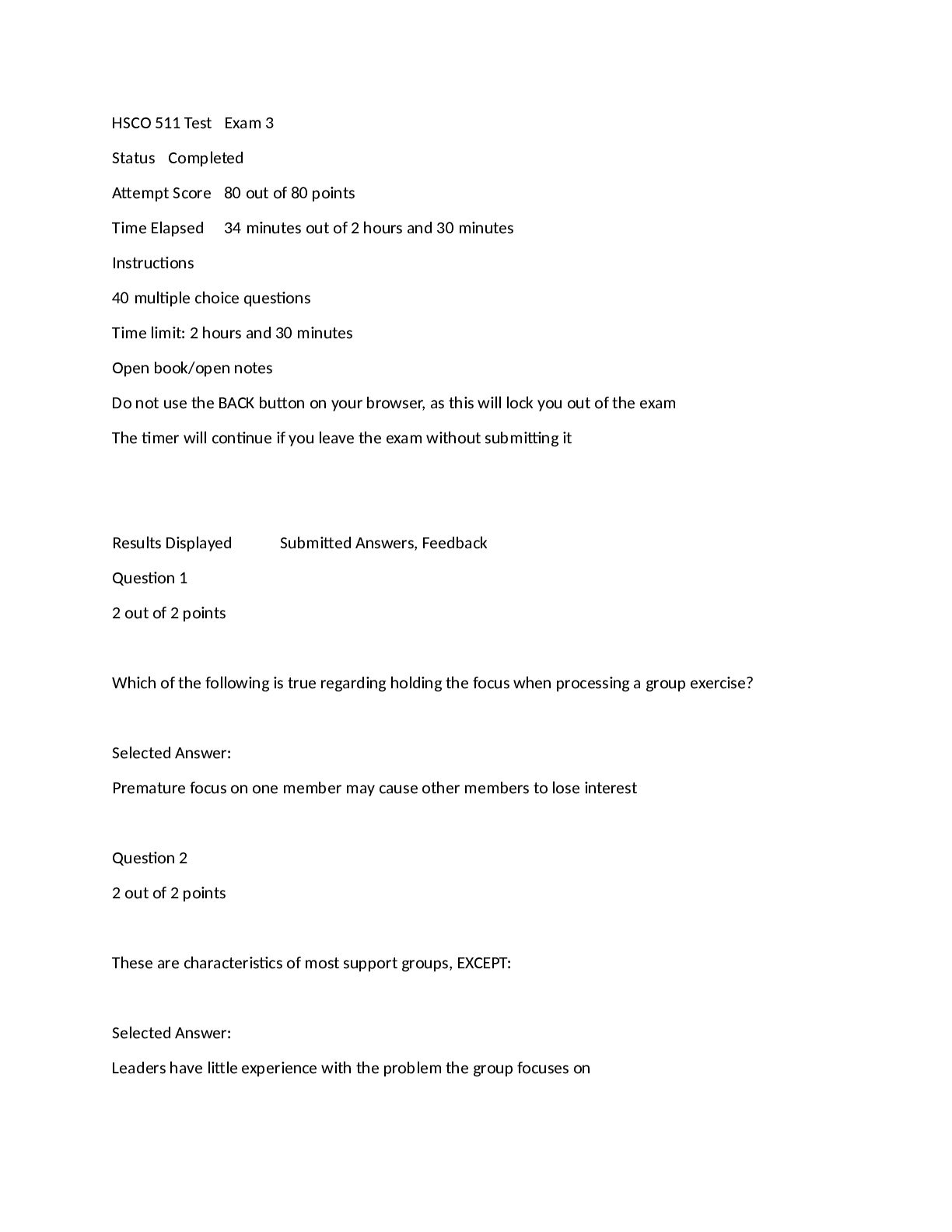
• TEST 3Question 1
During conflicts, people are most likely to misinterpret and misperceive ________ behavior.
• Question 2
Balance theory predicts that hostility is greatest when group members who dislike each other also disagree with each other. Tension is greatest when group members
• Question 3
Feedback from one group member to another is most closely associated with which therapeutic factor?
• Question 4
Which of the following is NOT an important consideration when using touching exercises?
• Question 5
Which of the following is NOT true regarding the use of feedback during the closing stage of group?
• Question 6
Individuals’ perceptions of their environment are usually based on two dimensions:
• Question 7
Interpersonal psychotherapy groups stress dealing with issues that occur within the group itself, rather than reviewing what the members are experiencing outside of the group or what they experienced in the past. This focus is usually referred to as a(n) _______ orientation.
• Question 8
Asking a member to leave a group might be done for all of the following reasons EXCEPT
• Question 9
Which of the following is NOT recommended as a way to handle a member’s emotional reaction to an exercise?
• Question 10
Which of the following is true regarding apportioning time to members?
• Question 11
When a member begins crying during the session, the leader should
• Question 12
According to equilibrium theory, if a group discussion lacks intimacy, participants will probably
• Question 13
Studies of the impact of noise on people indicate that
• Question 14
Which is NOT one of the basic causes of group conflict discussed by Forsyth?
• Question 15
Feedback exercises are most valuable when
• Question 16
Spinning-off is appropriate for the following reasons, EXCEPT
• Question 17
Asking members to position themselves somewhere between two walls in the room that represents their level of comfort in the group in an example of conducting a _________exercise.
• Question 18
Which of the following is NOT a recommended leadership technique for handling a talkative member?
• Question 19
Which is FALSE about leading the middle stage of a group?
• Question 20
These are reasons for using exercises in a group, EXCEPT:
• Question 21
All of the following is true about distracting members EXCEPT
• Question 22
According to the authors, all of the following are important, but which is the MAIN focus of the closing stage of the group?
• Question 23
A mixed-motive situation occurs when
• Question 24
In the working phase, it is important for leaders to
• Question 25
A member who says to another “Don’t worry, everything will be ok, you just have to make the best of things” is a _________ member.
• Question 26
If a member shares a deep personal concern in a non-therapy group, the leader should FIRST
• Question 27
When a group member breaches confidentiality, the authors recommend that the leader do which of the following first?
• Question 28
Which of the following is a good reason for leaders to participate in an exercise?
• Question 29
Which of the following is NOT true regarding holding the focus when processing a group exercise?
• Question 30
Which is NOT true about the closing phase of a session?
• Question 31
According to Jacobs et al., which of the following is FALSE about the focus on process in a therapy group?
• Question 32
When introducing an exercise, leaders should clearly present the directions for all of the following reasons EXCEPT to
• Question 33
Many 12-step programs build _______ into their change program by requiring long-term members to assist newcomers.
• Question 34
All of the following represent common mistakes made in middle sessions EXCEPT?
• Question 35
0 out of 2 points
Personal space zones are smaller
• Question 36
0 out of 2 points
Although ALL of the following are important, the MOST important thing to attend to when leading an exercise is
• Question 37
To deepen the focus of the group and the level of commitment of members, Jacobs et al. suggest all of the following EXCEPT
• Question 38
Which is NOT one of the characteristics of most support groups?
• Question 39
According to the dual concern model, which conflict management strategy reflects low concern for both self and other?
• Question 40
Which of the following is NOT a purpose or goal of the closing phase of a session?
[Show More]