OPOTA Refresher Test Questions and
Answers Already Passed
Where is the area an Officer may search, incident to a lawful arrest of a person? ✔✔The area
with in the persons immediate control at the arrest location.
Why
...
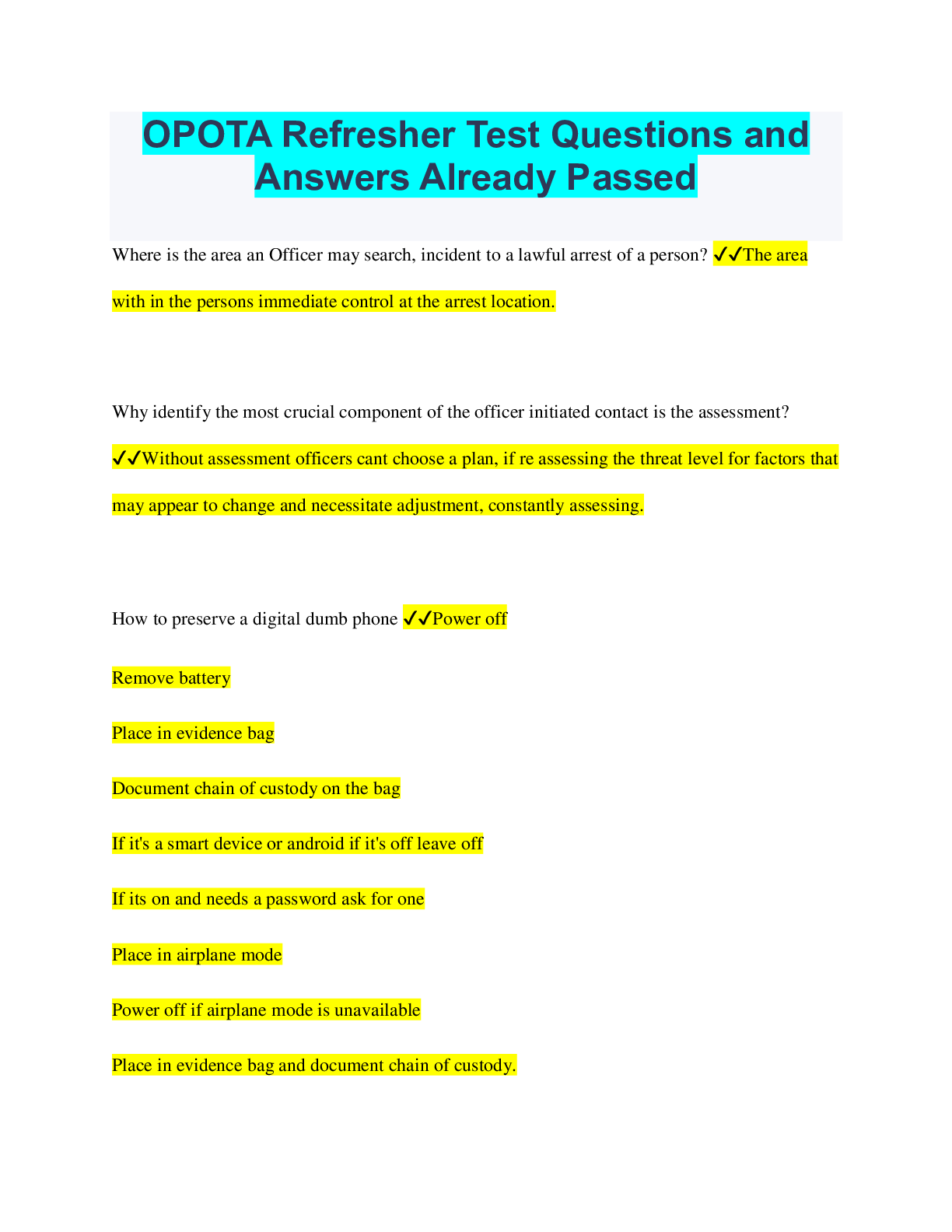
OPOTA Refresher Test Questions and
Answers Already Passed
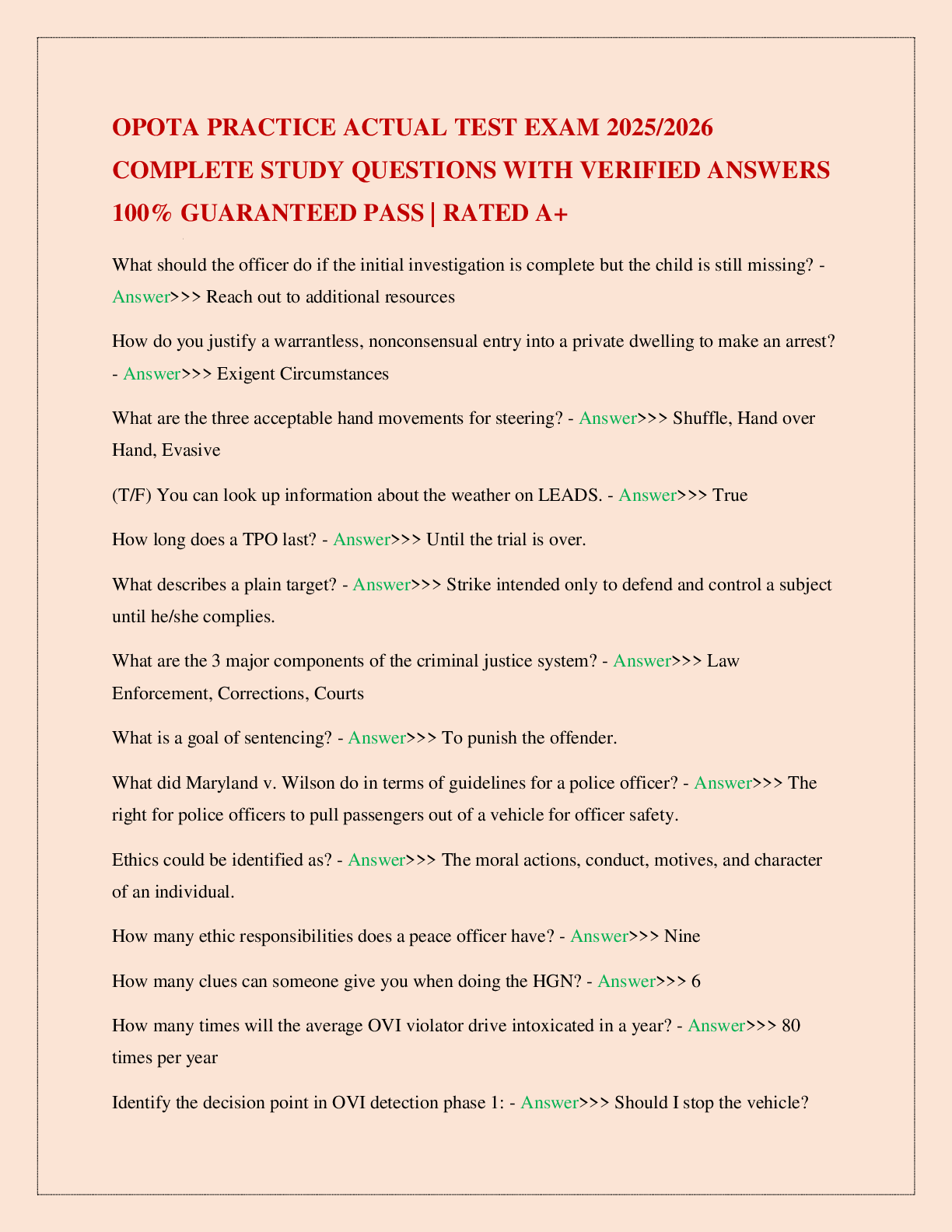
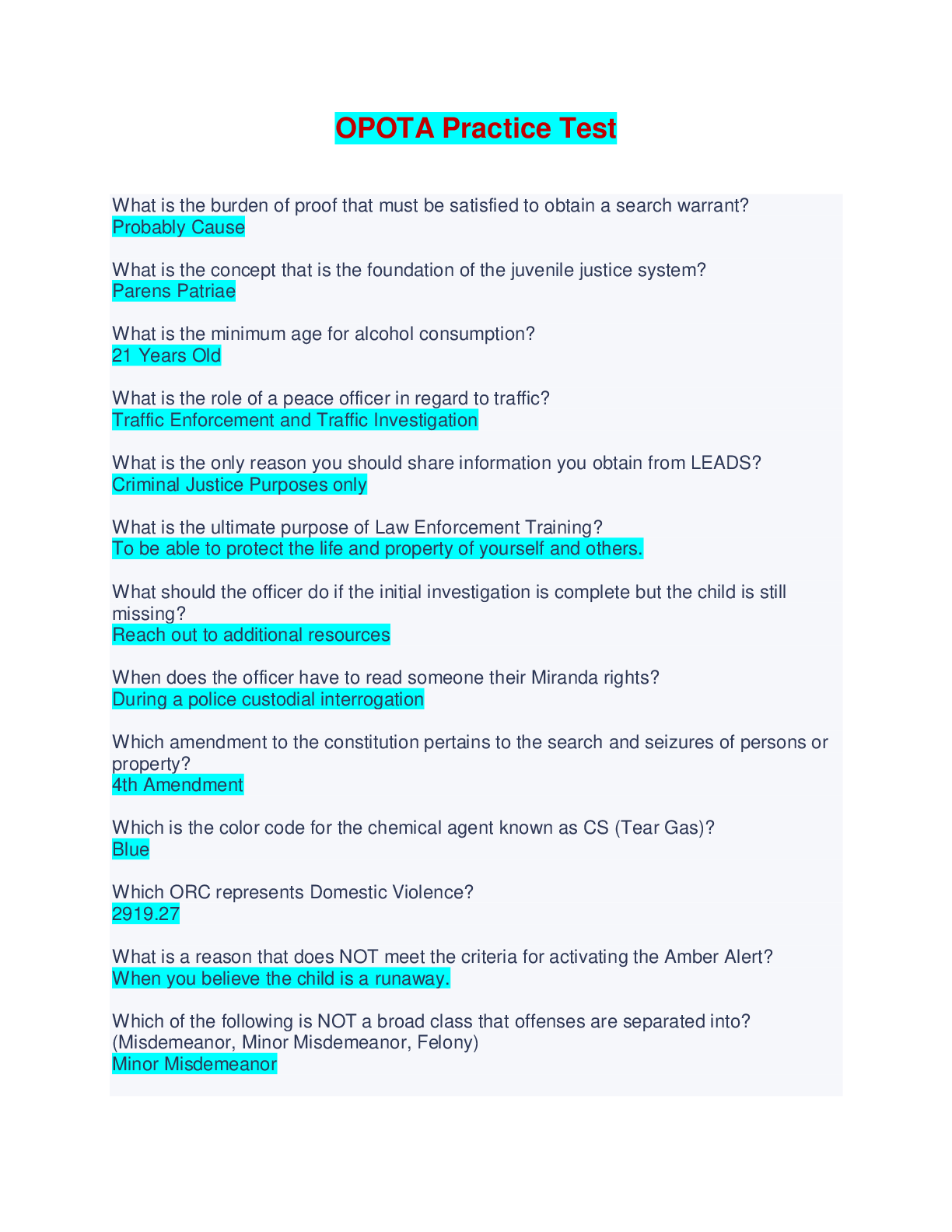
Where is the area an Officer may search, incident to a lawful arrest of a person? ✔✔The area
with in the persons immediate control at the arrest location.
Why identify the most crucial component of the officer initiated contact is the assessment?
✔✔Without assessment officers cant choose a plan, if re assessing the threat level for factors that
may appear to change and necessitate adjustment, constantly assessing.
How to preserve a digital dumb phone ✔✔Power off
Remove battery
Place in evidence bag
Document chain of custody on the bag
If it's a smart device or android if it's off leave off
If its on and needs a password ask for one
Place in airplane mode
Power off if airplane mode is unavailable
Place in evidence bag and document chain of custody.
What is the difference between critical stress incident and cumulative stress ✔✔Critical Stress-is
any event which has a stressful impact sufficient enough to overwhelm the usually effective
coping skills.
Cumulative stress- arousal that slowly builds up over time, which may lead to the erosion of
coping mechanisms or to a state of mental exhaustion.
5 Police culture to save Officers Below 100 ✔✔Wear seat belt
Wear vest
Watch speed
WIN WHAT'S IMPORTANT NOW
Complacency kills.
Explain the steps in the decision making model and the application of plus. ✔✔Define the
problem
Identify alternative solutions available to address the problem
Evaluate the identified alternatives
Make a decision
Implement the decision
Evaluate the decision.
P- Policy
L- Legal
U-Universal
S-Self
When can an officer use deadly force to achieve seizure according to the fourth amendment.
✔✔To protect themselves or others from immediate threats or serious physical injury,
To prevent the escape of the fleeing "dangerous" suspect.
What is the difference between active and passive resistance? ✔✔Active resistance-is when a
person exhibits resistive movement to avoid physical control or as a passive resister presents a
credible threat to an officer (lying on hands and not responding to commands to make hands
visible.)
Passive resistance- is when a person exhibits no resistive movement in response to verbal and
other direction.
What are the factors used in judging reasonable force ✔✔Severity of the crime suspected,
whether the suspect is an immediate threat to the safety of officers or others, is the suspect
actively resisting, and is she/he attempting to evade arrest by flight.
When can an officer conduct a protective search of a motor vehicle? ✔✔The officer must
articulate a reasonable suspicion that the vehicle contains some type of weapon and the suspect
or another person reasonably has access, or will have access to the weapon.
When can an officer search a motor vehicle an the containers within it? ✔✔Whenever probable
cause exists to believe contraband or evidence is contained in the vehicle or its containers, the
court concluded that officers who establish probable cause to believe contraband is hidden in a
motor vehicle may search the vehicle without a search warrant. Thee rationale for the motor
vehicle exception to the search warrant requirements is based on the fact that a vehicle could
easily be moved from the jurisdiction in which the warrant was to be obtained.
What determines when a person is considered to be seized? ✔✔He/she feels that they are not
free to leave, USSC says the threatening presence of several police officers, physical touching of
the person, display of weapon by the officer, the use of language or tone of voice by officers.
Describe when probable cause exist to perform an arrest or search ✔✔The facts and
circumstances within the officers knowledge and which he or she has reasonably trustworthy
information sufficient to warrant a person to believe that an offense has been or is being
committed by the persons arrested, The elements required to establish probable cause to arrest
are different from those required to establish probable cause to search, Probable cause to arrest
deals with acts previously committed by the suspect and the officer must show substantial and
trustworthy evidence that the law has been violated and the person about to be arrested
committed that unlawful act, probable cause to search deals with the probability that evidence or
contraband is presently located in a specific place.
When can an officer use the rationale from Terry to detain a person ✔✔An officer may detain a
person based upon the officers reasonable articulate suspicion that criminal activity was being
planned or was in the process of being executed, this does not authorize police to detain anyone
under mere suspicion, the officer must be able to articulate the reason for his or her belief that
criminal activity was being planned or was in the process of being executed,An officer may give
weight to his or her experience and to the reasonable inference that he she is entitled to draw
from the facts, in light of that experience, Officers should apply the totality of circumstances,
while none of the circumstances alone would justify a Terry stop considered together they may
amount to reasonable suspicion, if during the detention additional facts are uncovered that supply
the officer with probably cause to arrest the individual may be arrested, if grounds for arrest are
not discovered in a reasonable amount of time, the detainee must be released.
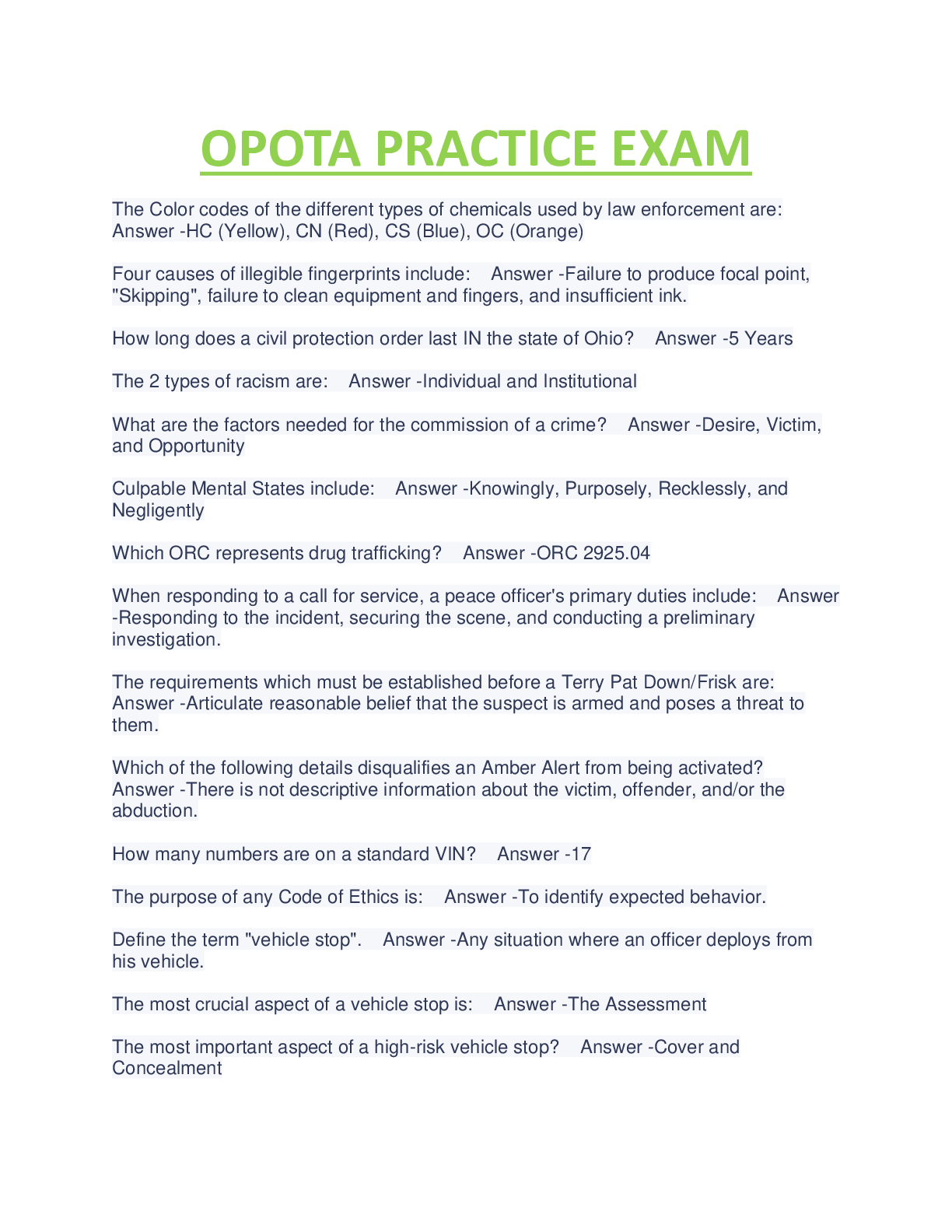
What requirements must be established before terry/Pat down frisk. ✔✔Officers are required to
articulate a reasonable belief that the suspect is armed and the suspect poses a threat to them.
When can an officer justify a warrant less, non consensual entry into a private dwelling in order
to make an arrest ✔✔Exigent circumstances must exist which demand an immediate response,
the crime is serious and it is likely the suspect is armed, it is likely the suspect will escape.
When can an arrest warrant be executed in the home of a third party? ✔✔There is also a warrant
to search the premises, for the reason to be arrested, the officer has consent to enter, there are
exigent circumstances.
Whats hot fresh pursuit? ✔✔The pursuit without unreasonable interruption of a person who is
trying to avoid arrest.
Name the types of searches ✔✔Full search-based on probable cause the requirements an officer
mush show to establish probable cause to search are the items involved are associated with
criminal activity as either evidence or criminal activity or contraband and is more likely than not
the items will be found in the place the officer wishes to search, full searched require a search
warrant or a recognized exception to the warrant requirement.
Limited weapon searches, frisks and protective sweeps, used to disarm a person to protect
officers, authority based on reasonable suspicion that a person lawfully detained is armed and
dangerous.
Inventory not necessary a search under the fourth amendment standards, used to catalogue
property that police have taken into custody, authority comes from the need to adhere to
department policy to protect the property and agency from claims of lost, stolen or damaged
property.
Case Law ✔✔The law found in the collection of reported cases that form all of part of the body
of law within a given jurisdiction.
Exclusionary Rule ✔✔Evidence improperly obtained by Police will be excluded from criminal
trial.
Crime ✔✔Omission done in violation of the law.
Venue ✔✔Particular county or geographical area in which a court with jurisdiction may hear or
determine a case and in the territory of which the offense or any element of the offense was
committed.
Statutory Law ✔✔An act of admission in violation of the law.
Plakas V. Drinski (1994) ✔✔No requirements for Officers to use all feasible alternatives to
avoid a situation where deadly force can justifiably be used.
[Show More]