. A client at an outpatient clinic submits a clean- catch midstream urine
specimen for a routine urinalysis. In later review of the client's medical
record, which data indicates to the nurse that the specimen collectio
...
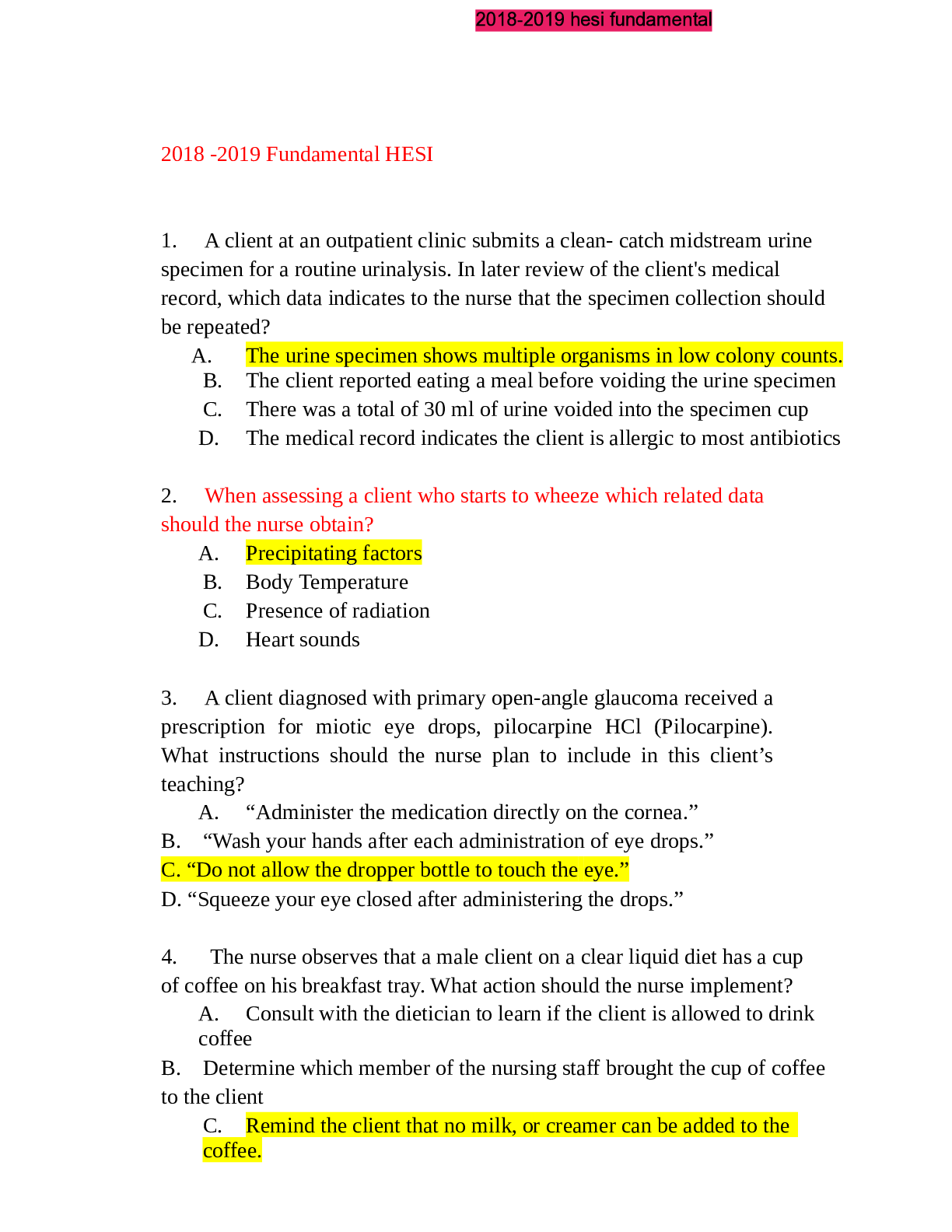
. A client at an outpatient clinic submits a clean- catch midstream urine
specimen for a routine urinalysis. In later review of the client's medical
record, which data indicates to the nurse that the specimen collection should
be repeated?
A. The urine specimen shows multiple organisms in low colony counts.
B. The client reported eating a meal before voiding the urine specimen
C. There was a total of 30 ml of urine voided into the specimen cup
D. The medical record indicates the client is allergic to most antibiotics
2. When assessing a client who starts to wheeze which related data
should the nurse obtain?
A. Precipitating factors
B. Body Temperature
C. Presence of radiation
D. Heart sounds
3. A client diagnosed with primary open-angle glaucoma received a
prescription for miotic eye drops, pilocarpine HCl (Pilocarpine).
What instructions should the nurse plan to include in this client’s
teaching?
A. “Administer the medication directly on the cornea.”
B. “Wash your hands after each administration of eye drops.”
C. “Do not allow the dropper bottle to touch the eye.”
D. “Squeeze your eye closed after administering the drops.”
4. The nurse observes that a male client on a clear liquid diet has a cup
of coffee on his breakfast tray. What action should the nurse implement?
A. Consult with the dietician to learn if the client is allowed to drink
coffee
B. Determine which member of the nursing staff brought the cup of coffee
to the client
C. Remind the client that no milk, or creamer can be added to the
coffee.
D. Remove the coffee from the tray, advising the client that it is not
included in the diet.
5. When evaluating the effectiveness of a client’s nursing care, the nurse
first reviews the expected outcomes identified in the plan of care. What
action should the nurse take next?
A. Determine if the expected outcomes were realistic
B. Modify the nursing interventions to achieve the client’s goals
C. Obtain current client data to compare with expected outcomes
D. Review related professional standards of care.
6. The nurse learns that members of the nursing staff are uncomfortable
with responding to client family members who are angry. In designing a
teaching session to help the staff respond more effectively in these situations,
which instructional strategy is best for the nurse to use?
A. Return demonstration
B. Journaling
C. Analogies
D. Role playing
7. The nurse observes the skin over a client's greater trochanter as seen in
the picture. What actions should the nurse implement? (select all that apply)
A. Remove the eschar before applying and securing a hydrocolliod
B. Prepare to implement a pressure redistribution mattress
C. Obtain a specimen of the site for culture and sensitivity
D. Instruct the Unlicensed assistive personnel to frequently offer oral
fluids
E. Explain to the client that the wound needs debridement
8. The nurse has removed the barbiturate capsule from the unit dose
wrapper to administer to a male client. The client decides he wants to watch a
television program and requests not to take the medication. Which action
should the nurse implement?
A. Credit the medication back and put in the client’s medication box
B. Keep the medication and see if the client will want to take it later.
C. Have another nurse watch disposal of the medication into
disposal container
D. Explain that since the medication is a controlled substance it must be
taken.
9. The home health nurse is reviewing the personal care needs of an
elderly client who lives alone. Which client assessment findings indicate the
need to assign an unlicensed assistive personal (UAP) to provide routine foot
care and file the client’s toenails? (Select all that apply).
A. Shuffling gait.
B.Diminished visual acuity.
C. Syncope when bending.
D. hands tremors.
E.Urinary incontinence
10. The charge nurse observes a new graduate's performance of wound care.
Which technique indicates that the employee is effectively cleansing the
wound?
A. Starts at the wound site and moves outward using circular motions.
B. Cleanses from the outer area of the wound toward the center
C. Uses a sterile swab to go over the wound site twice.
D. Scrubs wound vigorously for at least two minutes
11. The nurse is evaluating the fluid balance of the client who was admitted
yesterday with dehydration and who has been receiving iv fluids since
admission. An increase in which parameter indicates to the nurse that the
client is rehydrating.
A. Serum haematocrit.
B. Urine specific gravity.
C. Pulse Rate.
D. Urinary output.
12. In-home hospice care is arranged for a client with stage 4 lung cancer.
While the palliative nurse is arranging for discharge, the client verbalizes
concerns about pain. What action should the nurse implement?
a. Explain the respiratory problems that can occur with morphine use.
b. Teach family how to evaluate the effectiveness of analgesics.
c. Recommend asking the healthcare professional for a patient-controlled
analgesic (PCA) pump.
d. Provide client with a schedule of around-the-clock prescribed analgesic
use.
13. The nurse begins to suction a client’s oropharynx as seen in the picture.
What action should the nurse take next?
a. Position suction in the trachea.
b. Apply nasal cannula oxygen.
c. Insert a tongue blade.
d. Observe the suction secretion.
14. While interviewing a client, the nurse records the assessment in
the electronic health record. Which statement is most accurate
regarding electronic documentation during an interview?
a. The interview process is enhanced with electronic documentation and
allows the client to speak at a normal pace.
b. Completing the electronic record during an interview is a legal
obligation of the examining nurse.
c. The nurse has limited ability to observe non-verbal communication
while entering the assessment electronically.
d. The client’s comfort level is increased when the nurse breaks eye-contact
to type notes into the record.
15. The nurse measures the client’s blood pressure(BP) and notes that it is
significantly higher than the previous reading. What should the nurse do
next? (Select all that apply).
a. Determine the client’s activities and feelings prior to the BP measurement.
b. Retake the Client's blood pressure in the opposite arm
c. Assign the unlicensed assistive personnel to recheck the BP in an hour.
(not the answer because it should be rechecked sooner)
d. Ask another nurse to assist in assessing for an apical-radial pulse
deficit.
e. Immediately take two more readings on the same arm.
[Show More]