Ambulatory Care Test Questions
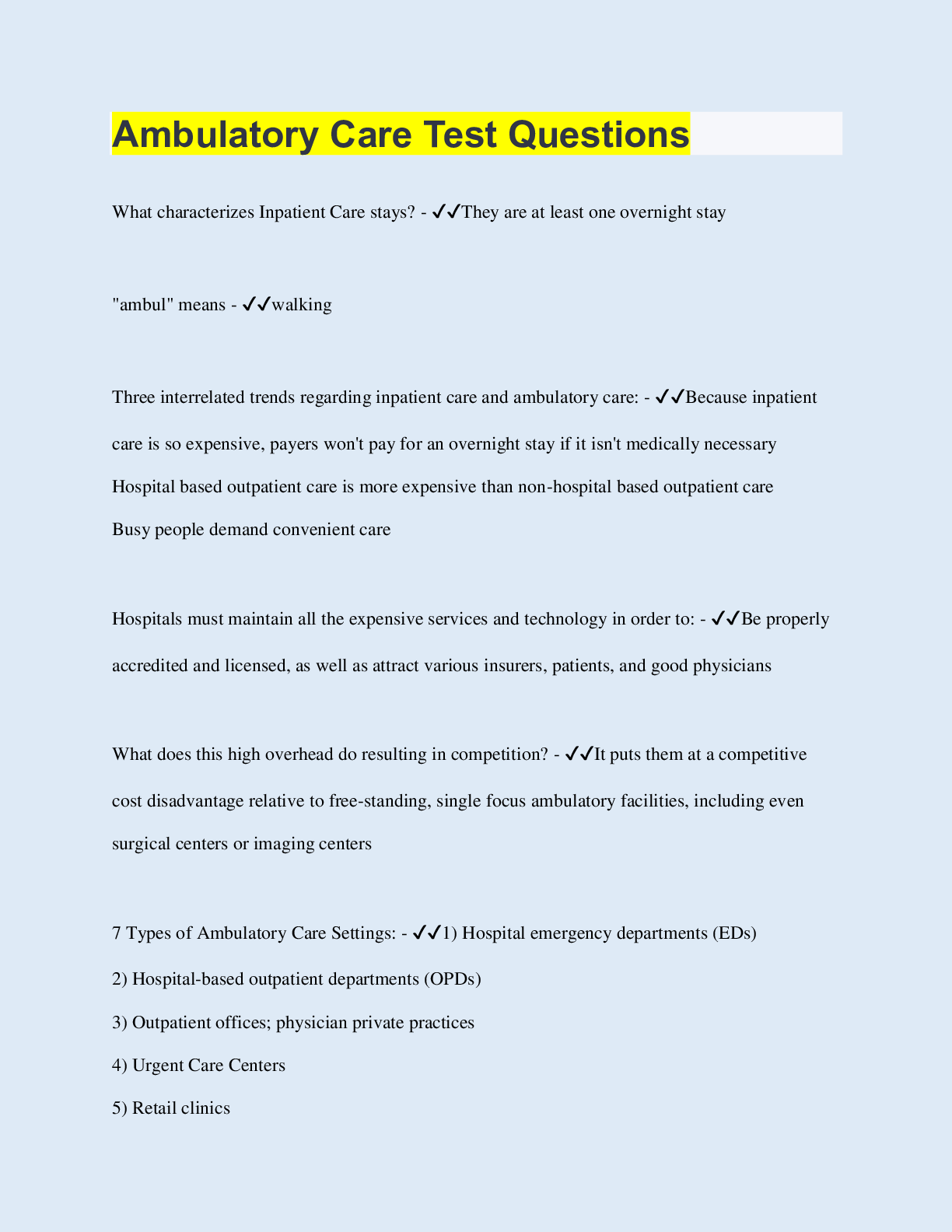
What characterizes Inpatient Care stays? - ✔✔They are at least one overnight stay
"ambul" means - ✔✔walking
Three interrelated trends regarding inpatient care and ambulatory care: - ✔✔Be
...
Ambulatory Care Test Questions
What characterizes Inpatient Care stays? - ✔✔They are at least one overnight stay
"ambul" means - ✔✔walking
Three interrelated trends regarding inpatient care and ambulatory care: - ✔✔Because inpatient
care is so expensive, payers won't pay for an overnight stay if it isn't medically necessary
Hospital based outpatient care is more expensive than non-hospital based outpatient care
Busy people demand convenient care
Hospitals must maintain all the expensive services and technology in order to: - ✔✔Be properly
accredited and licensed, as well as attract various insurers, patients, and good physicians
What does this high overhead do resulting in competition? - ✔✔It puts them at a competitive
cost disadvantage relative to free-standing, single focus ambulatory facilities, including even
surgical centers or imaging centers
7 Types of Ambulatory Care Settings: - ✔✔1) Hospital emergency departments (EDs)
2) Hospital-based outpatient departments (OPDs)
3) Outpatient offices; physician private practices
4) Urgent Care Centers
5) Retail clinics
6) Concierge medicine
7) Complimentary and Alternative Medicine
What is EMTALA (1986), and what does it require? - ✔✔Emergency Medical Treatment and
Labor Act. It requires hospitals and ambulances to provide care to anyone needing it regardless
of ability to pay, citizenship, and legal status. A functional safety net.
What was one issue with the act in terms of financing? - ✔✔It provided no money to accomplish
this; classic "unfunded mandate"
What did the act try to counteract? - ✔✔"dumping" of uninsured or unprofitable patients
From 1997-2007, the amount of emergency room visits ______ by ___%, however the annual
visit rate ______ by ___% - ✔✔Increased, 23% (116.8 million visits)
Increased, 11%
Visit rate for nursing home residents was ___x that of those living at home.
Visit rate for homeless was ___x that of those with homes.
Visit rate for blacks was ____x that of whites. - ✔✔4x
2x
2x
What percent of people are admitted to hospitals from emergency rooms? - ✔✔12%
What are the leading diagnoses for those admitted? - ✔✔Heart disease, chest pain, pneumonia,
and cerebrovascular disease (stroke)
What percent of visits are by uninsured patients? - ✔✔15.3%
Historically, general practitioners provided first contact care in US, however now, only ___% of
annual visits for acute care (treatment for newly arising health problems) are made to patients'
personal physicians. The rest are made to: - ✔✔42%
Emergency departments, specialists, or outpatient departments
In the US, the number of emergency departments is ________, the number of hospitals is
_______, and the number of emergency room visits is _______. - ✔✔Decreasing
Decreasing
Increasing
True/False: When visiting an emergency room for care, patients are granted a follow-up visit -
✔✔False
What percent of the time are urban hospitals at or over capacity? - ✔✔50%
Overcrowding in hospitals leads to: - ✔✔Long waits for inpatient beds, ambulance diversions,
errors, adverse outcomes
Other elements of ED crisis: - ✔✔Nursing shortages, physician shortages (surgeons and
specialty care physicians related to legal liability), uncompensated care
What are some reasons ED is used more often than primary care? - ✔✔Busy primary care
offices, Difficulty providing after hours and weekend care, Patient-Centered Medical Home and
other measures in the ACA may help improve access to office care, Discussion of Accountable
Care Organizations (ACOs) and retail clinics
Hospital Based Outpatient Departments (OPDs) - ✔✔Historically primarily serve inner
city/country hospitals. Important part of a safety net. Include many services, such as primary
care, cancer center, ambulatory surgery center, diagnostic services
How are outpatient clinics a source of profit for hospitals? - ✔✔They can compete with private
physicians for the privately insured, cross referral with hospital inpatient facilities, send non
urgent ED visitors to ambulatory care center, and better manage patients under managed care
Hospital Outpatient visits per 1,000 people are ______ from 1992-2012 - ✔✔Increasing
Urgent Care Centers: - ✔✔Treat patients who have illness/injury that requires immediate care
but not require ED.
(Should be treated within 24 hours)
How do urgent care centers fill in gaps and offer advantages compared with other options? -
✔✔Unscheduled, walk in basis, Extended hours (fills in the gap after private offices are closed),
More services than primary care practice (X-Ray, defibrillator, oxygen, lab), Can be freestanding or within hospitals
Compared to emergency rooms, urgent care centers are: - ✔✔Cheaper, often have shorter wait
times, and often have lower copay for insurance than ER
Urgent care centers are not really connected to PCPs, so they have: - ✔✔Fragmented, poorly
connected care
Retail Clinics are: - ✔✔Clinics located in retail stores (Grocery stores, drug stores). Convenient,
walk-in care for minor problems, usually staffed by non-physicians, night-time and weekend
hours often
From 2007 to 2009, retail clinics grew ____x - ✔✔4x
Retail clinic for low acuity conditions represents ______ utilization, and that retail clinic use was
associated with a modest ______ in spending; retail clinics do not ________ health care
spending - ✔✔Increased
Increase
Decrease
What is Concierge Medicine? - ✔✔Pay a retainers of $1k-5k and get a variety of additional
services including cell phone access to MD 24/7, same day visits, longer visits, and PCP
accompanies you to specialty visits
What are some of the pros of concierge medicine? - ✔✔Why not allow people pay more to get
more?
Physicians argue that it allows them to practice the kind of medicine that they think is right
What are some of the cons of concierge medicine? - ✔✔It's 2 tier medicine, better care for the
wealthy, takes physicians away from those who need them
Concierge medicine ______ have a huge impact yet - ✔✔Does not
What is Direct Primary Care? - ✔✔Concierge care for the rest of us. Pay a monthly retainer, but
way less money (~$50), and get all the office-based primary care you need. Couple with a high
deductible plan
What is the benefit of direct primary care from the MD perspective? - ✔✔Don't have the hassle
of reimbursement; focus on patient care
What is the benefit of direct primary care from the PT perspective? - ✔✔Better, easier access
A poorly functioning system creates niches for services such as concierge medicine and direct
primary care because: - ✔✔Patients are not getting what they need and physicians are
constrained in how they can meet these needs
What is Complementary and Alternative Medicine (CAM)? - ✔✔Group of diverse medical and
healthcare systems therapies and products that are not presently considered to be part of
conventional medicine
Top 10 CAM therapies used: - ✔✔Prayer specifically for one's own health,
Prayer for another person's health,
Natural products,
Deep breathing exercises,
Prayer group,
Meditation,
Chiropractic care,
Yoga,
Massage,
Diet based
Yoga is ________ as a CAM - ✔✔Increasing
CAM makes up about ____% of Out of Pocket Spending on all healthcare - ✔✔11%
For 20 years, care has been moving to the _________ setting - ✔✔Ambulatory
The inefficiencies and less than optimal service quality in office setting is creating: -
✔✔Opportunities for new markets and new care settings (urgent care centers and retail clinics)
The tradeoffs in these new settings, convenience vs detailed patient knowledge, leads to: -
✔✔Potentially poor communication with primary care providers
What are the leading diagnoses for those admitted? - ✔✔
[Show More]