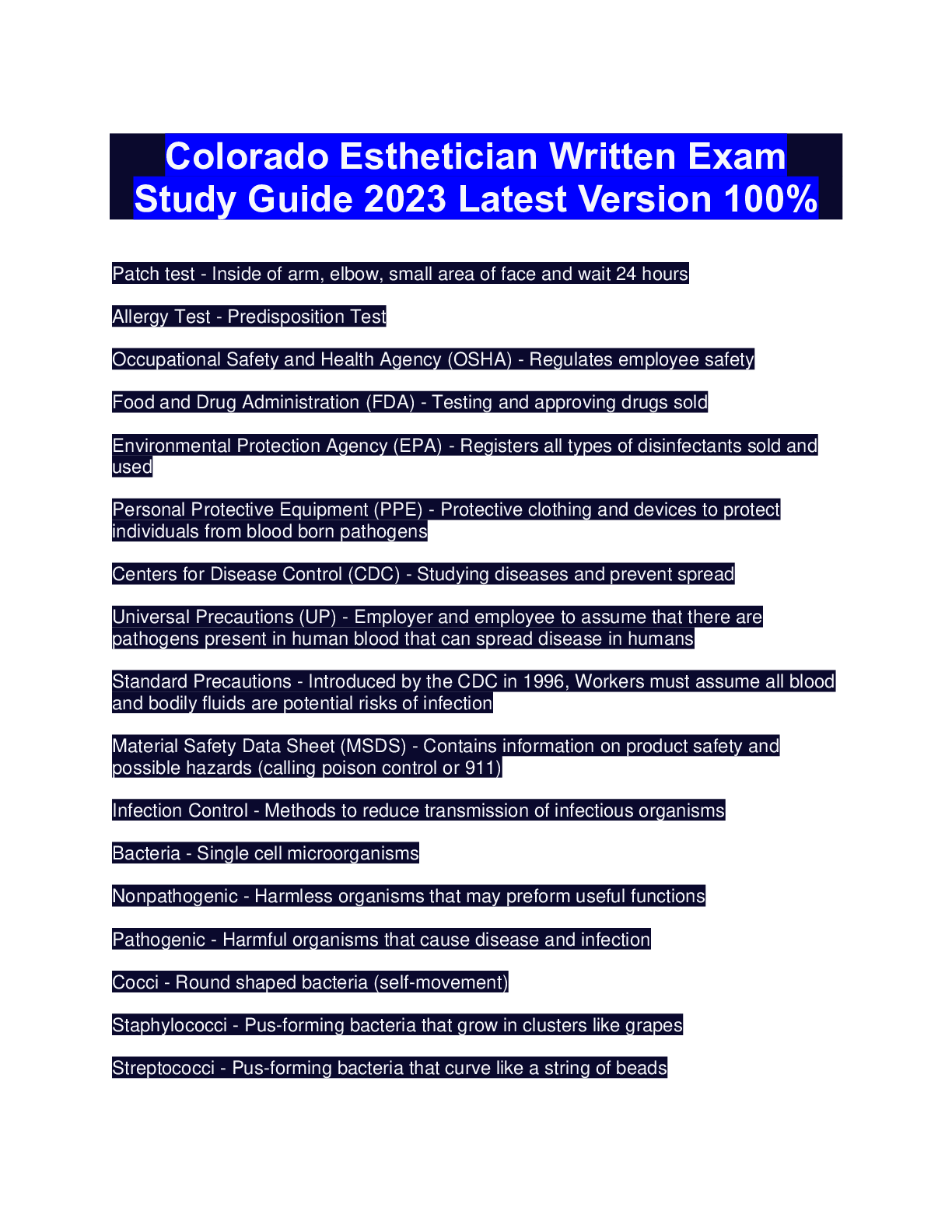
Patch test - Inside of arm, elbow, small area of face and wait 24 hours
Allergy Test - Predisposition Test
Occupational Safety and Health Agency (OSHA) - Regulates employee safety
Food and Drug Administration (F
...
Patch test - Inside of arm, elbow, small area of face and wait 24 hours
Allergy Test - Predisposition Test
Occupational Safety and Health Agency (OSHA) - Regulates employee safety
Food and Drug Administration (FDA) - Testing and approving drugs sold
Environmental Protection Agency (EPA) - Registers all types of disinfectants sold and used
Personal Protective Equipment (PPE) - Protective clothing and devices to protect individuals from blood born pathogens
Centers for Disease Control (CDC) - Studying diseases and prevent spread
Universal Precautions (UP) - Employer and employee to assume that there are pathogens present in human blood that can spread disease in humans
Standard Precautions - Introduced by the CDC in 1996, Workers must assume all blood and bodily fluids are potential risks of infection
Material Safety Data Sheet (MSDS) - Contains information on product safety and possible hazards (calling poison control or 911)
Infection Control - Methods to reduce transmission of infectious organisms
Bacteria - Single cell microorganisms
Nonpathogenic - Harmless organisms that may preform useful functions
Pathogenic - Harmful organisms that cause disease and infection
Cocci - Round shaped bacteria (self-movement)
Staphylococci - Pus-forming bacteria that grow in clusters like grapes
Streptococci - Pus-forming bacteria that curve like a string of beads
Diplococci - Spherical bacteria that grow in pairs (DI=2) causes pneumonia
Bacilli - Short rod-shaped bacteria
Spirilla - Spiral or corkscrew shaped bacteria
Flagella - Slender, hair like extensions used by parasites for locomotion (moving about) snake like motion
Cilia - Hair like extensions, but shorter and and move in a rowing-like motion
Methicillin-resistant staphylococcus aureus (MRSA) - infectious bacteria that is high resistant to conventional treatments such as antibiotics
Viruses - Parasitic submicroscopic particles that infects and resides in cells, Does not have a cell or nucleus, it is a protein. ex. Common colds, measles, mumps, chicken pox, smallpox, HIV/AIDS
Fungi - Microscopic plant parasites that include mold, mildew, and yeast
Dermatophytes - Fungi that causes skin, hair, and nail infections
Tinea Pedis - Ringworm fungus of the foot
Parasites - Organisms that grow, feed, and shelter on or in a host
Scabies - Contagious skin disease caused by itch mite
Pediculosis - Infestation of head lice
Cleaning - Washing with soap and water
Disinfection - Chemical disinfectant that destroys most but not all organisms (must be in for 10 minutes)
Bactericidal - Kills bacteria
Virucidal - Kills viruses
Fungicidal - Kills fungi
Sterilization - Destroys all pathogens and microbial life, ex. Autoclaves: using high pressure steam under dry heat
Single Use - Disposables items that cannot be used more than once
Multi-use - Reusable items that can be cleaned and disinfected even if exposed to blood or bodily fluids
Cross-contamination - Touching an object without cleaning hands and then touching another object
Aseptic Procedures - Process of properly handling sterilized and disinfected equipment and supplies
Skin Histology - Study of the structure and composition of the skin tissue
Skin Physiology - Study of the functions of living organisms
Second Degree - Affects the top two layers of the skin.
Asymptomatic - Showing no symptoms or signs of infection
Porous - Made or constructed of a material that has openings
Nonporus - Has no pores or openings and cannot absorb liquid
Mycrobacterium Fortuitum - Microscopic germ that normally exists in tap water
Skin Histology - Study of the structure and composition of the skin tissue
Skin Physiology - Study of the functions of living organisms
6 Skin Functions - Protection, Absorption, Secretion, Excretion, Temperature Regulation, Sensation
Protection - Acid mantle protective barrier made up of sebum, lipids, sweat, and water. Forms a hydrolipidic film to protect the skin from trying out from exposure to external factors.
Sensation - Responds to touch, pain, cold, heat and pressure
Thermoregulation - Average internal temp is 98.6° F through evaporation, perspiration, radiation, and insulation
Excretion - Sudoriferous glands; sweat glands detoxifies the body by excreting excess water, salt, and unwanted chemicals
Secretion - Sebum; oily substance that protects and lubricates the skin. Sebaceous glands; oil glands. Skin is 50 to 70% water and slows down the evaporation of water Transepidermal Water Loss (TEWL)
[Show More]