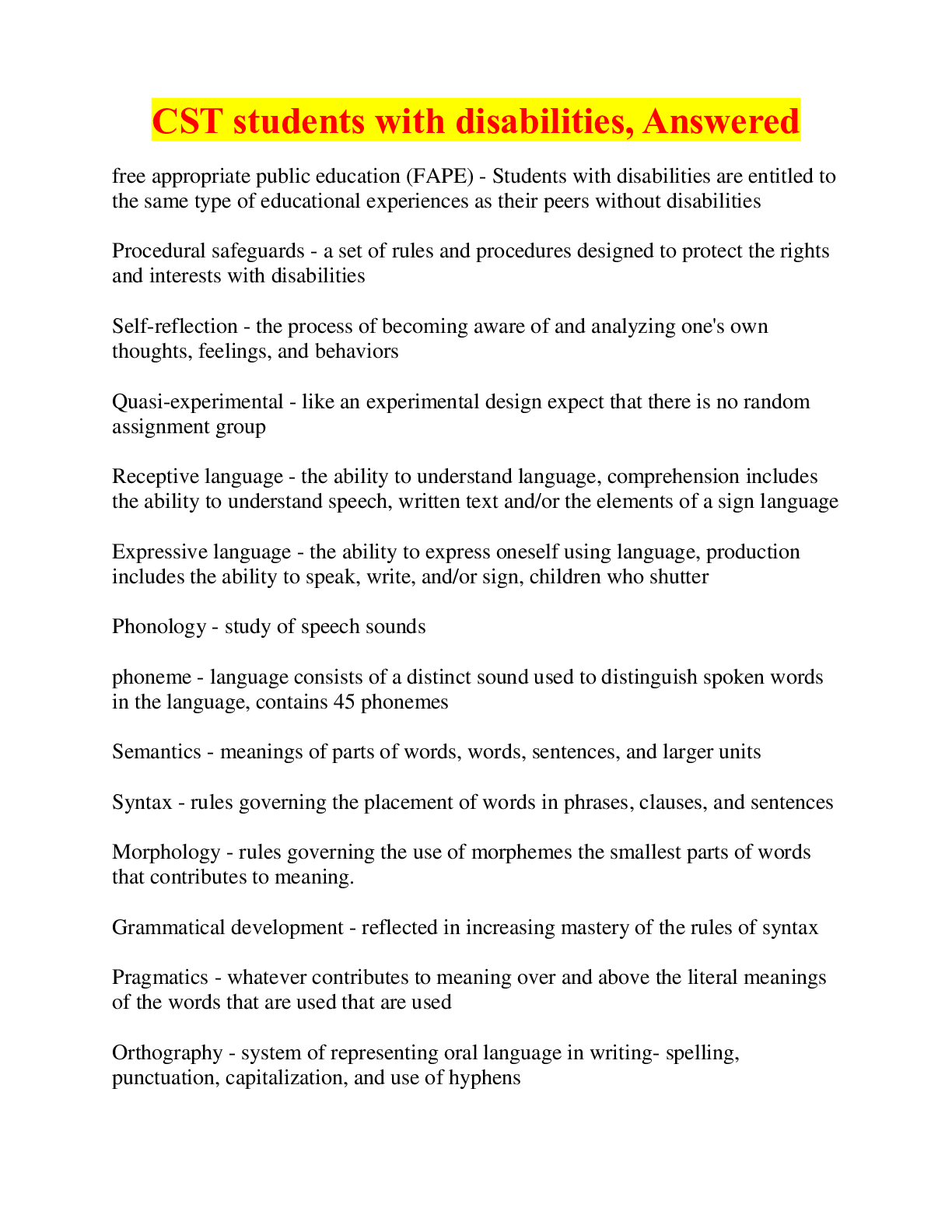
CST students with disabilities, Answered-free appropriate public education (FAPE) - Students with disabilities are entitled to the same type of educational experiences as their peers without disabilities
Procedural sa
...
CST students with disabilities, Answered-free appropriate public education (FAPE) - Students with disabilities are entitled to the same type of educational experiences as their peers without disabilities
Procedural safeguards - a set of rules and procedures designed to protect the rights and interests with disabilities
Self-reflection - the process of becoming aware of and analyzing one's own thoughts, feelings, and behaviors
Quasi-experimental - like an experimental design expect that there is no random assignment group
Receptive language - the ability to understand language, comprehension includes the ability to understand speech, written text and/or the elements of a sign language
Expressive language - the ability to express oneself using language, production includes the ability to speak, write, and/or sign, children who shutter
Phonology - study of speech sounds
phoneme - language consists of a distinct sound used to distinguish spoken words in the language, contains 45 phonemes
Semantics - meanings of parts of words, words, sentences, and larger units
Syntax - rules governing the placement of words in phrases, clauses, and sentences
Morphology - rules governing the use of morphemes the smallest parts of words that contributes to meaning.
Grammatical development - reflected in increasing mastery of the rules of syntax
Pragmatics - whatever contributes to meaning over and above the literal meanings of the words that are used that are used
Orthography - system of representing oral language in writing- spelling, punctuation, capitalization, and use of hyphens
Pre-reading - recognize marks are meaningful to others, printed markers are meaningful to others, acquire concepts of print
alphabet knowledge - the ability to name letters of the alphabet and recognize these letters in print
alphabetic principle - the understanding that letter represent sounds in systematic and predictable ways
phonological awareness - the ability to consciously recognize, discriminate among, and manipulate language sounds such as phonemes and syllables,
decoding - the sounding out of words
Transitional reading - decoding skills become more advanced, number of sight words that children automatically recognize continues to grow, improvements in reading comprehension, ability to infer meaning from context, make predictions about what will happen next in a story, and d
[Show More]